
Hello, and welcome to the first lesson in your writing course. We will begin with sentence foundations because clear, controlled sentences make every later skill—paragraph development, analysis, argument, professional writing, and creative voice—more manageable.
This module builds the grammatical control needed to write complete sentences deliberately. Today’s focus is one essential distinction: an independent clause can stand alone as a sentence, while a dependent clause cannot. Once you can see that difference, you will be better able to avoid fragments and build more varied sentences without losing clarity.
By the end of this lesson, you should be able to identify both kinds of clauses and combine them into complete sentences in formal academic writing.
The core idea: a clause has a subject and a verb
A clause is a group of words containing a subject and a verb.
- The subject tells who or what the clause is about.
- The verb tells what the subject does, thinks, feels, or is.
Consider:
The class discussed the novel.
- Subject: The class
- Verb: discussed
- Complete idea: yes
This is an independent clause because it has all three requirements:
- a subject
- a verb
- a complete thought
It can stand on its own:
The class discussed the novel.
A clause can be short:
She hesitated.
Or it can be much longer:
She hesitated outside the classroom after rereading the assignment instructions twice.
Both are independent clauses because each makes a complete statement.
The length of a group of words does not determine whether it is a complete sentence. What matters is whether it contains a subject and verb and completes an idea.
Dependent and independent clauses | Syntax | Khan Academy
Watch “Dependent and independent clauses | Syntax” from Khan Academy for a concise explanation of the two clause types and the effect of a subordinating conjunction.
Watch independent clauses to see how a subject and verb form a complete sentence. Then watch dependent clauses, focusing on why adding a word such as “because” changes a complete clause into an incomplete one.
The key question is not merely “Does this group of words have a subject and verb?” It is also:
Can this clause stand alone and still make complete sense?
Dependent clauses: grammatically complete, but unfinished
A dependent clause has a subject and a verb, but it does not express a complete thought. It depends on an independent clause to finish its meaning.
Compare these two versions:
I revised my essay.
Because I wanted clearer evidence.
The first sentence works independently. It makes a complete statement.
The second group of words has a subject (I) and verb (wanted), but it begins with because. That word creates an expectation: Because you wanted clearer evidence, what happened?
So this is a dependent clause:
Because I wanted clearer evidence
It needs an independent clause:
I revised my essay because I wanted clearer evidence.
Or:
Because I wanted clearer evidence, I revised my essay.
Both sentences are complete because each contains:
- one independent clause: I revised my essay
- one dependent clause: because I wanted clearer evidence
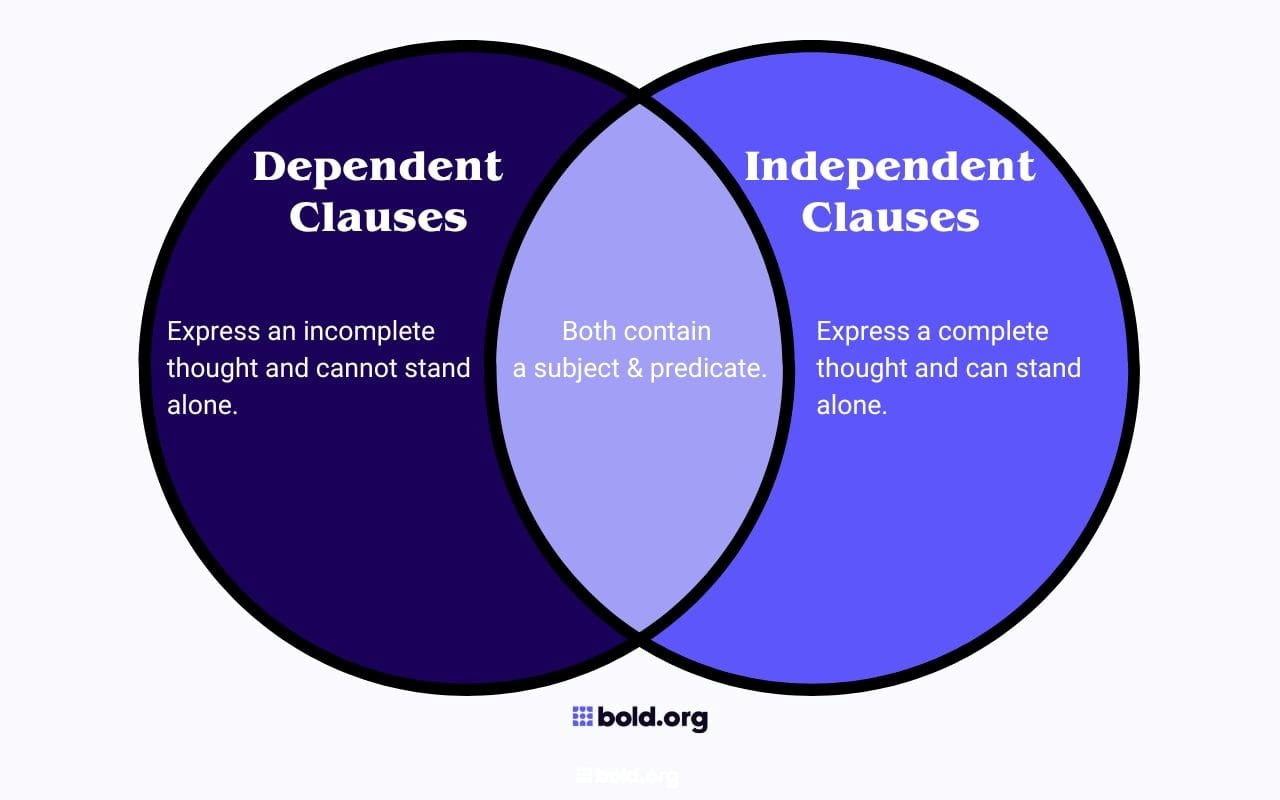
Notice the shared center of the diagram: both types are clauses because both have a subject and predicate. Their difference is not grammatical “size”; it is independence.
Identifying Independent and Dependent Clauses - Purdue OWL
Read Purdue OWL’s “Identifying Independent and Dependent Clauses.” It gives a reliable definition of each clause type and shows how a dependent-marker word can make an otherwise complete clause dependent.
In the opening definitions on the “Identifying Independent and Dependent Clauses” page, read from the two core definitions. Then continue through the example beginning with “When Jim studied”. Pay attention to the question Purdue asks after the dependent-clause example: it is a useful test for spotting an unfinished thought.
Words that often signal dependence
A dependent clause frequently begins with a subordinating conjunction, sometimes called a dependent-marker word. These words show a relationship—such as time, cause, contrast, or condition—between one idea and another.
Here are useful groups to recognize:
| Relationship | Common subordinating conjunctions | Example dependent clause |
|---|---|---|
| Time | after, before, when, while, until, whenever | After the bell rang |
| Cause | because, since | Because the source was unreliable |
| Contrast | although, though, even though, whereas | Although the argument sounded convincing |
| Condition | if, unless | If the team finishes the project |
Each example above has a subject and verb:
- the bell rang
- the source was
- the argument sounded
- the team finishes
Yet each leaves the reader waiting for the main point.
After the bell rang … what happened?
Because the source was unreliable … what did you do?
If the team finishes the project … then what?
That waiting feeling is meaningful grammatical evidence: the clause is dependent.
A powerful comparison
Take an independent clause:
The research team changed its conclusion.
Now add a subordinating conjunction:
Although the research team changed its conclusion
The subject and verb remain. But although turns the statement into background or contrast. The reader now expects another clause:
Although the research team changed its conclusion, the article still received criticism.
The first clause sets up the situation; the second clause delivers the main statement.
Do not confuse a phrase with a dependent clause
A phrase does not contain both a subject and a verb. It may be incomplete, but it is not a dependent clause.
| Group of words | Classification | Why |
|---|---|---|
| After lunch | Phrase | No subject and verb |
| After we ate lunch | Dependent clause | Subject: we; verb: ate; incomplete thought |
| We returned to class after lunch. | Independent clause | Subject: We; verb: returned; complete thought |
This distinction matters when editing. If a sentence begins with after lunch, you should not automatically label it a dependent clause. First, look for a subject and verb.
A practical method for classifying clauses
When a sentence feels confusing, do not rely on whether it “sounds right.” Use a repeatable process.
1. Find the verb
Look for the main action or state of being.
While the audience waited, the speaker organized her notes.
There are two verbs: waited and organized.
2. Find the subject for each verb
Ask who or what performs the action.
- the audience waited
- the speaker organized
Now you have located two clauses.
3. Test each clause for a complete thought
The speaker organized her notes.
This makes sense alone, so it is independent.
While the audience waited
This creates an expectation: while the audience waited, what happened? It is dependent.
4. Look for a dependence signal
Words such as because, although, if, when, and while are strong clues. They do not replace the complete-thought test, but they help you spot where to look.
In the example, while signals that the audience’s waiting provides time-related background for the speaker’s action.
5. Make sure every dependent clause has a home
In formal school writing, a dependent clause should be attached to an independent clause:
Fragment: Although the assignment was difficult.
Complete sentence: Although the assignment was difficult, the class completed it on time.
A dependent clause often appears first, but it can also come after the independent clause:
The class completed the assignment on time although it was difficult.
For now, remember one useful punctuation pattern: when the dependent clause comes before the independent clause, use a comma after it.
Although the assignment was difficult**,** the class completed it on time.
A later lesson will examine commas and sentence punctuation in much more detail. Today, the priority is recognizing the two clause types before deciding how to punctuate them.
Relative words can also create dependent clauses
Subordinating conjunctions are common signals, but they are not the only ones. A dependent clause can also begin with a relative pronoun, such as who, whom, whose, which, or that.
Consider:
The student submitted the draft that she revised over the weekend.
The independent clause is:
The student submitted the draft.
The words that she revised over the weekend form a dependent clause. They give information about the draft, but cannot stand alone:
That she revised over the weekend.
The word that connects the clause to the noun draft. Similarly:
The article that changed my perspective was published last year.
- Independent clause: The article was published last year.
- Dependent clause: that changed my perspective
This pattern is useful in academic writing because it allows you to add precise detail without creating a separate, choppy sentence.
Compare:
I found an article. The article changed my perspective.
With:
I found an article that changed my perspective.
The second version is more compact, but its clarity still depends on a complete independent clause.
Constructing complete sentences from clause “building blocks”
Once you can identify clauses, you can construct sentences more intentionally. Start with a clear independent clause—your main point—and then decide whether a dependent clause adds useful context.
Pattern 1: Main point first
The student chose a narrower topic because the original question was too broad.
The independent clause comes first:
The student chose a narrower topic.
The dependent clause explains why.
This pattern works well when the independent clause deserves immediate emphasis.
Pattern 2: Context first
After the student narrowed the topic, the research became more focused.
The dependent clause comes first and supplies time-related context. The independent clause supplies the main assertion:
the research became more focused
This pattern helps vary sentence openings, which can make a paragraph sound less repetitive.
Pattern 3: Contrast
Although the first draft was disorganized, its central idea was promising.
The dependent clause acknowledges a limitation. The independent clause states the main point. This is especially useful in literary analysis and argument writing, where you may need to make a qualified claim rather than an exaggerated one.
Pattern 4: Condition
If a claim lacks evidence, readers may not trust it.
The dependent clause gives a condition. The independent clause tells what follows under that condition.
The point is not to make every sentence longer. A clear short independent clause is often exactly right:
The evidence matters.
Use a dependent clause when it adds a relationship the reader needs: time, reason, contrast, or condition.
A note on formal writing and fragments
In everyday conversation, people often answer with dependent clauses:
Why are you revising the introduction?
Because my thesis is unclear.
Everyone understands the answer because the question supplies the missing context. In formal academic writing, however, this would generally be treated as a sentence fragment if it appeared alone on the page.
Write:
I am revising the introduction because my thesis is unclear.
Understanding clause types gives you control. You can recognize a fragment when it is accidental—and later, in creative writing, you can choose whether a fragment has a purposeful stylistic effect. First, build confidence with standard complete sentences.
Your editing checklist
When reviewing a draft, pause at every period and ask:
- Does this sentence contain a subject and a verb?
- Does it make a complete thought by itself?
- Does it begin with a word such as because, although, when, while, if, or after that leaves a question unanswered?
- If it is dependent, where is the independent clause that completes it?
For example:
When students only summarize a quotation.
- Subject: students
- Verb: summarize
- Complete thought: no
- Dependence signal: When
- Result: fragment
A complete revision could be:
When students only summarize a quotation, they miss the chance to explain how it supports their claim.
The revised sentence now has a dependent clause that provides the condition and an independent clause that expresses the main idea.
You have learned that a clause contains a subject and verb, but a clause becomes an independent clause only when it also expresses a complete thought. A dependent clause has a subject and verb but relies on another clause, often because a subordinating conjunction or relative word makes the reader expect more information.
Most importantly, begin with the question: Can this clause stand alone as a complete statement? If yes, it is independent. If not, locate the independent clause it needs.
In the next lesson, you will use this knowledge to repair sentence fragments by identifying what is missing: a subject, a verb, or an independent clause.
Can't find a good explanation? Sign up and we'll make it for you
Sign up