
Welcome to your next lesson in the "Advanced Distributed Concepts" module. In our last session, we delved into the heart of single-cluster resilience by exploring distributed consensus and the Raft algorithm. You learned how a group of servers within one data center can agree on a leader and reliably replicate state, ensuring the system stays available even when individual nodes fail.
Today, we're zooming out from a single data center to a global perspective. Your users aren't all in one place, so why should your application be? Serving a global audience from a single region leads to high latency for distant users and creates a single point of failure for your entire service. The learning outcome for this lesson is to explain the role of DNS load balancing and GeoDNS in multi-region deployments. We will explore how to direct users to the best possible server location, enhancing both performance and resilience on a worldwide scale.
The Problem: A Single Region is a World Away
Imagine your application is hosted in a data center in Virginia, USA. For your users in North America, this is great. But what about a user in Tokyo or London? Their requests have to travel thousands of miles across undersea cables, introducing significant latency. Every millisecond counts for user experience.
Furthermore, what happens if that entire Virginia data center goes offline due to a power outage, a network failure, or a natural disaster? Your application is down for everyone, everywhere.
To solve these problems, we deploy our application to multiple geographic regions. This is the goal state we're aiming for:
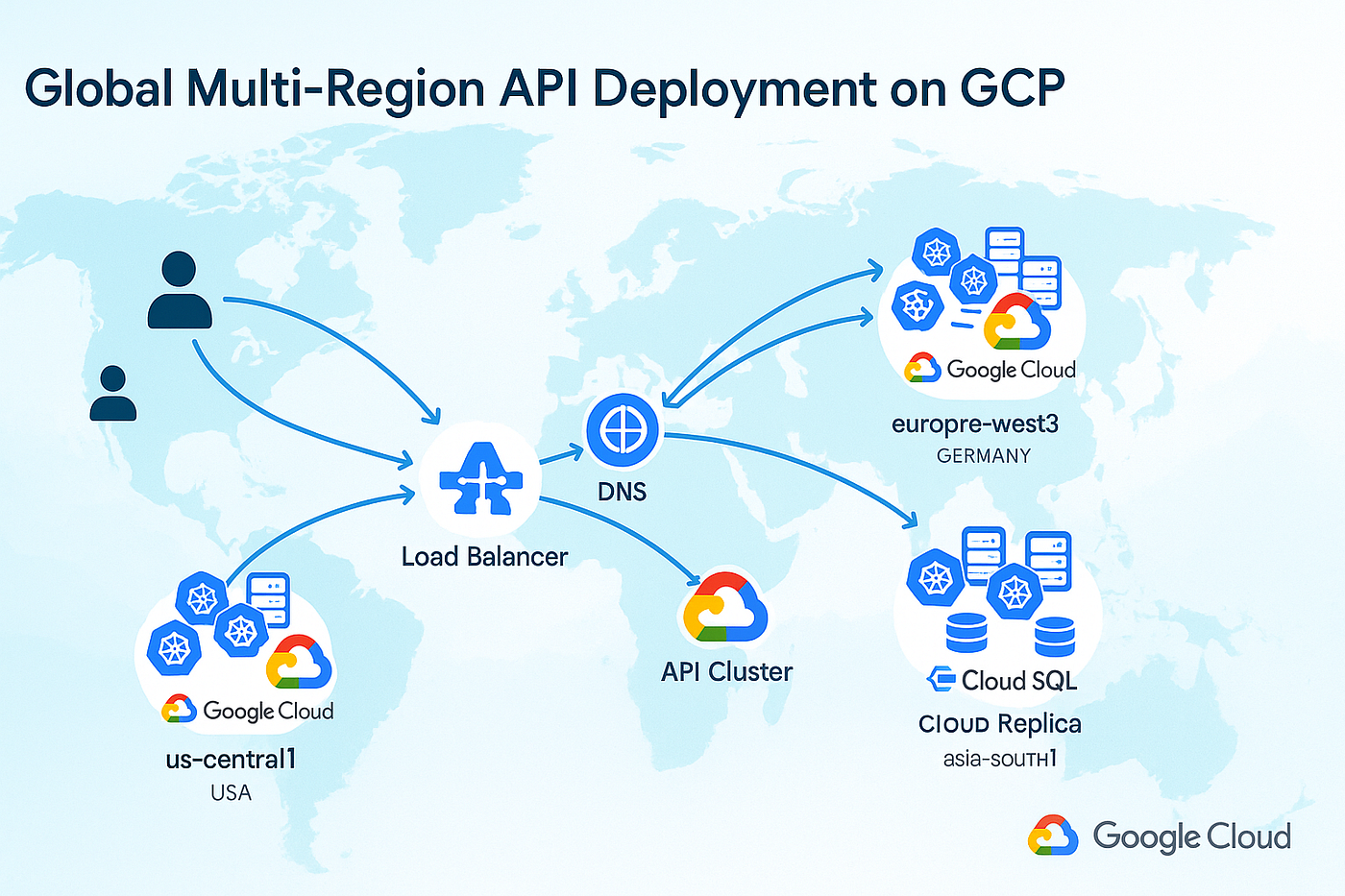
The central question then becomes: how do you get the user in Germany to the German deployment, and the user in the US to the American one, all while using a single domain name like api.yourapp.com? The answer starts with the Domain Name System (DNS).
From Simple DNS to Intelligent Routing
At its most basic, DNS maps a hostname (like www.google.com) to an IP address (like 142.250.187.196). But what if a hostname could map to multiple IP addresses? This is the foundation of DNS load balancing.
The simplest form is Round-Robin DNS. When a DNS server is configured for round-robin, it has a list of IP addresses for a single hostname. For each DNS query it receives, it returns the next IP address in the list, looping back to the beginning when it reaches the end.
While simple, round-robin DNS is quite "dumb." It has no awareness of:
- Server Health: It will happily send users to a server that has crashed.
- Geographic Proximity: It might send a user in London to a server in Sydney, even if there's a perfectly good server in Dublin.
- Server Load: It can't direct traffic away from an overloaded server.
To overcome these limitations, we need a more intelligent approach. This is where Global Server Load Balancing (GSLB) comes in.
What is a LOAD BALANCER really about?
This short clip from the ByteByteGo channel provides a concise and clear definition of Global Server Load Balancers (GSLB) and their purpose.
Please watch the section on Global Server Load Balancers. It explains how GSLB distributes traffic across geographic locations to reduce latency and increase resilience.
As the video explains, GSLB operates at a higher level, using techniques like DNS-based routing to direct users to the nearest and healthiest data center. Let's see how that works.
GeoDNS: Routing by Geography
The key technology behind GSLB's location-based routing is GeoDNS. Instead of returning a static or round-robin list of IPs, a GeoDNS service inspects the incoming DNS query to determine the user's approximate geographic location and then returns the IP address of the server designated for that region.
How to Build GeoDNS for Global Traffic Routing
This article from OneUptime provides a great introduction to GeoDNS and its mechanics.
Please read the introduction and the "How GeoDNS Works" section. This will explain the core principle and introduce the two main ways a GeoDNS server determines a client's location.
The article highlights that the GeoDNS server primarily uses the IP address of the user's DNS resolver to guess their location. Let's walk through an example.
The process is as follows:
- A user in France wants to access
openrainbow.com. Their device sends a query to their configured DNS resolver. - The DNS resolver sends a query to the authoritative DNS authority for
openrainbow.com. This is not a simple DNS server; it's a GeoDNS-capable service (like AWS Route 53, Cloudflare DNS, etc.). - The DNS Authority inspects the source IP of the request (which is the resolver's IP). Using a GeoIP database, it determines the geographic location associated with that IP.
- Based on pre-configured rules (e.g., "traffic from Europe goes to the Frankfurt data center," "traffic from North America goes to the Virginia data center"), it selects the appropriate IP address.
- It returns this geographically-specific IP address to the resolver, which passes it back to the client.
- The client's browser now connects directly to the nearest data center, resulting in lower latency.
Crucially, GSLB services combine this geographic routing with health checks. Before returning the IP for the "best" data center, the service first ensures that the data center is actually online and healthy. If the primary region is down, the GSLB service can automatically fail over and return the IP of the next-best region, maintaining availability for your users.
Practical Pitfalls and Advanced Concepts
As an experienced engineer, you know that the real world is messier than the diagrams suggest. A successful multi-region strategy requires understanding the nuances and potential pitfalls of GeoDNS.
How to Build GeoDNS for Global Traffic Routing
This part of the article discusses critical performance considerations and common issues you will face when implementing a GeoDNS strategy.
Please read the sections on Performance Considerations and Common Pitfalls. Pay close attention to the discussion of TTL, resolver location vs. user location, and EDNS Client Subnet (ECS).
Let's summarize these crucial points:
- DNS TTL (Time-To-Live): This value tells resolvers how long to cache a DNS record. There is a critical trade-off here. A low TTL (e.g., 60 seconds) allows for fast failover—if a region goes down, you can change the DNS record and have clients pick up the change quickly. However, it also increases the load on your DNS provider and can increase latency for the initial connection as fewer requests are served from cache. A high TTL reduces DNS load but means failover will be very slow.
- Resolver Location vs. User Location: This is a classic problem. The GeoDNS service sees the IP of the DNS resolver, not the end-user. If you use a public resolver like Google's
8.8.8.8or Cloudflare's1.1.1.1, their servers are distributed globally using Anycast. A user in Brazil might get routed to a Google DNS server in Miami. The GeoDNS service sees a request from Miami and routes you to the US East data center, even if a São Paulo data center would have been much closer for the user. - EDNS Client Subnet (ECS): This is the modern solution to the resolver location problem. With ECS, a compliant DNS resolver can include the first part of the user's IP address in its query to the authoritative server. This allows the GeoDNS service to perform geolocation based on the user's actual network, leading to much more accurate routing. Most major cloud DNS providers support this.
An Alternative: Anycast
It's worth briefly mentioning another technology used for global traffic routing: Anycast. While GeoDNS works at the application layer (DNS) by returning different IPs for different locations, Anycast works at the network layer (IP) by advertising the same IP address from multiple locations around the world. The internet's own routing protocol, BGP, then automatically sends a user's packets to the topologically "closest" location that is advertising that IP.
Anycast vs Global Server Load Balancing on the Brightboard
This "Brightboard" video from F5 provides an excellent visual comparison between GSLB (the DNS-based approach we've discussed) and Anycast.
Watch from the introduction of GSLB to the end. The video clearly explains how GSLB provides fine-grained control through DNS, and then contrasts this with the Anycast approach where routing decisions are left to the internet itself.
The key takeaway is the trade-off:
- GeoDNS/GSLB gives you fine-grained application-level control. You can create complex rules based on geography, latency, server load, or even business logic, but it relies on the client respecting DNS TTLs.
- Anycast is simpler from a DNS perspective (it's just one static IP address) and failover can be faster at the network layer. However, you give up control and are at the mercy of internet routing, which can sometimes be unpredictable.
Many large-scale services, like CDNs and major DNS providers themselves, use a combination of both techniques.
Conclusion
In this lesson, we have bridged the gap between a single resilient cluster and a truly global, high-performance, and high-availability application. You now understand how to use DNS as a powerful tool for intelligent traffic management across multiple regions.
Key Takeaways:
- Multi-Region Deployments are essential for serving a global user base with low latency and for providing disaster recovery.
- DNS Load Balancing is the practice of associating multiple IP addresses with a single hostname to distribute traffic.
- Global Server Load Balancing (GSLB) elevates this by using "smart" DNS servers that incorporate health checks and routing policies.
- GeoDNS is a key feature of GSLB that routes users based on their geographic location, drastically reducing latency.
- Health Checks are a critical component, enabling automatic failover to a secondary region if a primary region becomes unavailable.
- Practical Implementation requires careful management of DNS TTLs and an understanding of limitations like the resolver vs. user location problem, which can be solved with EDNS Client Subnet.
In our next lesson, we will dive into another challenge that arises when you have a distributed system spanning multiple regions: how to generate unique identifiers across all your servers without creating a central bottleneck. We will explore this by studying how to implement a distributed unique ID generator based on the Snowflake algorithm.