
Welcome. This closing lesson turns the course’s explanatory toolkit into an investment instrument: a contrarian thesis that can be tested, revised, or rejected rather than defended as an identity.
We have treated venture markets as social systems under radical uncertainty. Investors infer from one another, prestige concentrates attention, and financing can reshape the operating reality of the companies being funded. The practical implication is demanding: it is not enough to say that a category is neglected or overheated. You need to state what the market believes, why that belief may be causally wrong, how the error could become visible, and what evidence would prove your account wrong.
By the end, you should be able to write a concise thesis with those four elements, while keeping price, financing dependency, and survival through neglect in view.
A contrarian thesis is a test, not an identity
“Contrarian” only describes one’s position relative to prevailing belief. It does not establish that the belief is wrong, that a company will win, or that the entry price produces an attractive return.
A useful contrarian VC thesis has this form:
In a defined segment, the market currently expects because it believes . That conclusion rests on a flawed causal inference, . A specific set of observable developments should reveal the error within a defined period. If those developments do not occur, or if contrary evidence appears, we abandon the thesis.
This formulation prevents three common evasions:
- Difference mistaken for insight: “We like what others ignore” says nothing about why others are wrong.
- Narrative mistaken for a mechanism: “This category will become important” does not explain how importance will become investable value.
- Optimism protected from evidence: “It will take longer” can become a way to avoid admitting that the thesis failed.
The relevant comparison is not contrarian versus consensus; it is the relationship between entry conditions, probability-weighted outcomes, and the quality of the underlying causal claim. A consensus deal can be attractive when the probability of success justifies its price. A contrarian deal can be cheap because the consensus is correct.
Contrarian vs Consensus in VC | A Quant VC Framework | Vela Partners
Read this short Vela Partners essay as a corrective to the romantic version of contrarianism. Its useful contribution is to separate being non-consensus from being right, and to connect both to entry price and expected value.
Start with the opening section, “Contrarian thinking is the most romanticized idea in venture capital.” Read the opening argument. Then read the full sections “What contrarian investing actually looks like” and “What consensus investing actually looks like,” focusing on the trade offs between access, valuation, probability, and upside. Treat the author’s expected-value framing as a discipline, not as a claim that early-stage probabilities can be estimated precisely.
In pre-seed and Series A, the relevant “price” is broader than the post-money valuation. It includes the ownership available, the terms needed to close a round, the probability of a credible next financing, and how much time the company has to generate evidence before capital becomes necessary again. A thesis that is directionally correct but cannot survive a prolonged period of category neglect is not yet an investable thesis.
State the consensus as an observable causal claim
The consensus is not merely an average verbal opinion. In VC, it appears in behavior:
- who takes meetings and who declines them;
- which companies obtain lead investors, follow-on financing, and talent;
- what milestones are demanded before a round can close;
- the valuations and ownership terms that clear the market;
- which comparable companies are invoked, and which failures are repeatedly cited.
A vague formulation such as “investors are bearish on lab software” is too weak. It does not reveal what must be false for the opportunity to exist.
A stronger formulation looks like this:
| Component | Vague statement | Testable statement |
|---|---|---|
| Consensus | “The category is out of favor.” | “Seed investors treat software for small regulated laboratories as a low-ceiling services market and require proof of enterprise-scale revenue before leading a round.” |
| Implied causal belief | “It has bad sentiment.” | “The market infers that implementation effort will remain bespoke, preventing scalable gross margins and follow-on financing.” |
| Investment implication | “Valuations are low.” | “Companies with a narrow workflow product receive little competitive pressure despite evidence of repeatable customer demand.” |
This specificity matters because one can disagree with a consensus in several very different ways:
- The market may be right about the category but wrong about a specific wedge.
- It may be right about the near-term financing environment but wrong about the company’s ability to reach self-sustaining traction before it needs another round.
- It may have observed genuine negative data but drawn the wrong causal explanation.
- It may be responding mainly to others’ actions, rather than to independently assessed evidence.
The fourth case is where social learning becomes especially useful. A well-known fund’s investment, a celebrated founder’s entry, or a visible failure may be informative. But market participants often cannot observe the private diligence, access, incentives, or non-economic motives behind the action. They see the action and infer more than the action can reliably support.
[PDF] Informational cascades in financial markets: review and synthesis
This review provides the conceptual discipline for distinguishing genuine information from observed market behavior. Read it to sharpen the causal weakness in a contrarian thesis: the issue is not that other investors copy one another, but that their visible actions may cease to transmit their private information.
In Section 2, “Informational cascades,” on pp. 54–55, begin at the subsection’s opening definition of a cascade. Read through the discussion of information blockage, fragility, and reversal. Pay particular attention to information blockage and fragility: later actions may add little information, yet a modest public signal can change collective behavior quickly. Then, on p. 56, read the paragraph beginning “Social psychologists report” and focus on market celebrities. Translate “expert” into the VC setting: a prestigious lead may be informative, but its observed investment is not a transparent disclosure of its underlying evidence.
The contrarian’s task is therefore not to assert, “Brand-name investors are followers.” It is to make a more defensible claim:
The market is treating a public action as evidence of a category-level truth, although that action does not adequately reveal the private information needed to support the inference.
That is a potential causal weakness. It becomes investable only when you can name the missing information and obtain it more directly: customer interviews, implementation data, cohort retention, technical replication, procurement evidence, or founder-level access.
Identify the causal weakness, not merely the disagreement
A causal weakness is the point at which the consensus moves from evidence to an unjustified interpretation. It should answer:
What does the market believe causes the observed outcome, and what alternative cause better explains it?
Four recurring weaknesses are particularly relevant in venture categories.
| Causal weakness | Typical consensus interpretation | Contrarian alternative |
|---|---|---|
| Category error | A few failures show that the whole category lacks demand. | The failures shared a business-model, technical, or distribution flaw that the target segment avoids. |
| Signal error | A prestigious investment validates the whole category. | The investment may reflect exceptional founder quality, proprietary access, or strategic value, not broad category economics. |
| Reflexive error | Current financing scarcity proves poor fundamentals. | Scarcity may reduce hiring, experimentation, and customer acquisition, making a temporary financing condition look like a permanent demand condition. |
| Time-horizon error | Slow adoption means no venture-scale outcome. | Adoption may be slow because a verifiable switching trigger has not yet occurred; once it does, diffusion can be materially faster. |
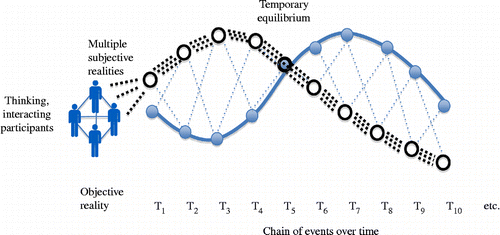
The reflexive case needs particular care. Financing conditions can change fundamentals. A richly financed category can hire scarce specialists, subsidize early adoption, create standards, and attract complementary infrastructure. A capital drought can have the opposite effects. In both cases, the market may later cite the resulting operating data as proof that its original belief was correct.
That is precisely why a thesis must distinguish:
- the underlying economic proposition — for example, whether customers gain enough value to adopt;
- the financing-mediated operating path — whether the company can reach proof before the market demands another financing event;
- the social interpretation — what investors infer from financing outcomes.
Expectations Investing Explained w/ Michael Mauboussin (TIP421)
Watch Michael Mauboussin’s explanation of expectations investing on The Intrinsic Value Podcast. It provides a disciplined way to begin with what the market appears to expect, then test the causal assumptions embedded in those expectations. His discussion of reflexivity also clarifies why prices and financing conditions can affect the underlying business rather than merely reflect it.
Watch expectations investing for the sequence of identifying embedded expectations, assessing them with scenarios, and comparing them with value. Then watch reflexivity, focusing on the distinction between a price that reflects fundamentals and a price that changes the conditions under which fundamentals develop. In VC, substitute valuation, financing access, recruiting power, and customer credibility for public-market price.
A good contrarian thesis often does not require that the whole market reverse its view. Consider a company whose consensus category is neglected because of a prior wave of failures. The thesis may be right if the company reaches repeatable customer adoption and becomes financeable on its own evidence, even if the broad category remains unpopular. Category re-rating is one recognition path, not the only one.
Specify the recognition mechanism
“Eventually, people will realize it” is not a recognition mechanism. It merely restates the desired outcome.
A recognition mechanism identifies the event or process that will convert hidden or discounted evidence into a decision-relevant public signal. It should have three properties:
- It is observable. An outside investor, customer, acquirer, or hire can see it.
- It is causally connected to the disputed belief. It directly tests the market’s reason for avoiding the opportunity.
- It can happen before the company’s financing runway expires. A contrarian company cannot depend on vindication after it has run out of cash or organizational momentum.
Common recognition mechanisms include:
| Mechanism | What becomes visible | What it can disprove |
|---|---|---|
| Repeatable paid deployments | Implementation time, customer conversion, retention, willingness to pay | “Every customer requires bespoke services.” |
| Technical replication | Performance under independent or commercial conditions | “The technical claim only works in a founder-controlled environment.” |
| A buyer-side trigger | Regulatory requirement, budget release, workflow change, or cost shock | “Customers have no urgency to adopt.” |
| Credible distribution proof | A channel partner repeatedly originates qualified demand | “Customer acquisition cannot scale economically.” |
| Financing-independent progress | Revenue, contracts, or strategic commitments achieved without a hot funding market | “The business needs category enthusiasm to survive.” |
| Selective category validation | A comparable outcome with similar economics, not merely similar branding | “There is no plausible path to a venture-scale company.” |
Notice the difference between evidence and social proof. A famous investor leading the next round may be useful social proof, but it is weak as the primary recognition mechanism. If your thesis is that the market overweights brand signals, it would be circular to rely on a new brand signal as the essential proof of value.
The strongest mechanisms make the market’s causal model visibly fail. If investors believe small labs will always require extensive customization, ten rapid deployments with limited implementation work are not just good operating news. They bear directly on the disputed causal claim.
Define falsification before commitment
Falsifiability does not mean demanding certainty. It means stating what evidence would make continued belief unreasonable.
A useful invalidation rule includes:
- a condition: what fact would be damaging;
- a threshold: how much of it is too much;
- a time horizon: by when evidence should emerge;
- a decision consequence: whether the category thesis, the company thesis, or both should be rejected.
There are three distinct kinds of invalidation.
| Type | Example of invalidating evidence | What it means |
|---|---|---|
| Foundational invalidation | Customers do not experience the claimed economic or regulatory pain. | The central value proposition is wrong. |
| Mechanism invalidation | Demand exists, but implementations remain labor-intensive after repeated attempts to standardize them. | The proposed scaling mechanism is wrong. |
| Survival invalidation | The recognition milestone cannot be reached before financing needs recur, and no non-speculative capital path exists. | The investment may be right in the abstract but not viable at this stage. |
This last category is essential in pre-seed through Series A. A company can be early rather than wrong, but “early” is only investable if the firm has a credible path through the intervening period. The relevant question is not whether the market will eventually recognize the opportunity. It is whether the company can produce decisive evidence before dependence on a favorable market cycle becomes fatal.
Avoid invalidation rules that are merely labels for disappointment:
- “We will revisit if traction is weak.”
- “We will reassess if the market changes.”
- “The thesis is wrong if the founders fail to execute.”
Instead, name the forecasted mechanism and its observable implications. The rule might be: “If fewer than half of the first twelve design partners convert to annual paid contracts within twelve months, despite meeting the agreed product requirements, the claim that this workflow has urgent, repeatable willingness to pay is rejected.” That is uncomfortable to write — which is why it is useful.
Worked example: a fictional neglected lab-software thesis
The following is deliberately fictional. Its purpose is not to recommend a sector, but to show how the four components fit together.
Scope: Pre-seed and seed companies building workflow and audit software for small regulated industrial laboratories.
1. Prevailing consensus
Workflow software for small laboratories is a low-ceiling services business. Laboratories have heterogeneous processes, implementation will remain bespoke, and the category cannot reliably attract follow-on capital after the visible failures of broader “AI for science” companies.
This statement identifies a belief, an implied cause, and a financing consequence. It is much more useful than “lab software is unpopular.”
2. Causal weakness
The consensus improperly treats prior failures of scientific-discovery platforms as evidence about an operational-compliance workflow. Those firms depended on uncertain scientific outcomes and broad integrations. The target product begins with one mandatory audit-trail workflow, has a bounded implementation surface, and can be adopted without changing the laboratory’s core scientific process.
This is not yet a claim that the consensus is false. It is a claim about why the comparison may be misleading.
3. Recognition mechanism
Recognition should occur through repeated evidence that the product can be deployed quickly, converted from design partnerships into annual contracts, and expanded within a laboratory without proportional implementation labor. A cluster of independently paid deployments would make the “bespoke services” explanation increasingly untenable to both customers and later-stage investors.
The key is that this mechanism tests the exact causal claim behind the consensus.
4. Invalidating evidence
The thesis is invalidated if, within twelve months of commercial release, most early customers require extensive custom integrations, fewer than half of qualified design partners convert to paid annual contracts, or customers use the product only when subsidized by project budgets. It is also invalidated if the company cannot reach these tests within its available financing horizon without assuming an uncommitted follow-on round.
The example can be compressed into an investment-memo paragraph:
Thesis: The market prices small-lab workflow software as non-venture-scale because it extrapolates from failures of scientifically risky, integration-heavy platforms. This conflates distinct business models. A focused compliance workflow can demonstrate repeatable deployment and paid conversion before the next financing need, making the market’s “services business” inference visibly weaker. We reject the thesis if rapid deployment, paid conversion, and low implementation intensity do not appear in the initial customer cohort within twelve months.
The thesis is contrarian in a meaningful sense because it identifies a concrete consensus, a mistaken causal extrapolation, and a route by which the disagreement can be resolved. It is not contrarian merely because it supports an unfashionable category.
A memo template for future category work
For each prospective contrarian category, write a one-page “claim ledger” before writing a conventional market map. Keep it narrow enough that its causal claims can be checked.
-
Scope and entry condition
Define the customer, product wedge, geography if relevant, stage, and current financing environment. State what is unusually available: price, ownership, access, or time with founders. -
Prevailing consensus
Write the market’s belief as a causal sentence: “Because , will not happen.” Cite behavioral evidence rather than relying on atmosphere. -
Causal weakness
State the alternative explanation. Specify the evidence the consensus overweights, ignores, or misclassifies. -
Recognition mechanism
Identify the event, metric, customer behavior, or financing-independent proof that would force a meaningful update by others. -
Invalidation rule
Name the threshold and deadline that would make the underlying proposition, not just the specific company, less credible. -
Survival condition
Ask whether the company can reach the recognition event without relying on the very market enthusiasm your thesis says is absent.
Before treating the thesis as investable, apply four final checks:
| Check | A credible answer sounds like |
|---|---|
| Is the consensus real? | “We observe it in round terms, follow-on behavior, comparable selection, and repeated customer objections.” |
| Is the disagreement causal? | “We disagree with the explanation for the data, not simply with the mood.” |
| Can recognition occur? | “This specific operating milestone makes the disputed claim publicly testable.” |
| Can we be wrong? | “By this date, these outcomes would lead us to reject the thesis.” |
A contrarian thesis should become more precise as one learns from founders and customers, not merely broader. Founder conversations are especially valuable when they reveal a repeated anomaly: something sophisticated operators know from direct experience but that market-level narratives have not yet incorporated. The task is then to determine whether the anomaly is genuinely generalizable, economically meaningful, and capable of becoming visible to others.
Key takeaways
A falsifiable contrarian VC thesis has four irreducible parts:
- Prevailing consensus: an observable market belief with a causal explanation and an investment implication.
- Causal weakness: a specific reason that the consensus may be misreading evidence, signals, comparisons, or feedback effects.
- Recognition mechanism: an event or operating proof that can make the error visible before financing dependency becomes decisive.
- Invalidating evidence: predetermined conditions, thresholds, and time horizons that would make continued belief unjustified.
The central discipline is to avoid confusing neglect with opportunity. A neglected asset may be cheap because the market is trapped in an information cascade; it may also be cheap because the underlying economics are poor. A serious contrarian thesis makes those alternatives distinguishable, then accepts in advance what evidence would decide between them.
This completes the course’s movement from belief formation and herding, through mimetic and reflexive cycles, to a practical framework for diagnosing categories and committing to a testable view.