
Hello, and welcome to the first step in understanding why eclipses recur in long, remarkably regular patterns.
The Saros cycle is not based on one “lunar month.” It works because three different lunar clocks nearly synchronize after many years. This lesson introduces those clocks: the synodic, draconic, and anomalistic months. By the end, you should be able to say not only how long each is, but—more importantly—what astronomical alignment it measures and why eclipse prediction needs all three.
One Moon, several legitimate “months”
A month is not inherently a calendar unit. Astronomically, it is the time required for a repeating relationship to recur. The important question is: a repeat of what relationship?
For eclipses, the Moon’s orbit has three distinct features that matter:
- Its phase relative to the Sun, such as new Moon or full Moon.
- Its position relative to the two places where its orbit crosses Earth’s orbital plane: the nodes.
- Its changing distance from Earth, because its orbit is slightly elliptical.
Each feature repeats on its own schedule. Those schedules are close to—but not equal to—one another.
Read Todd Timberlake’s Cambridge University Press overview to establish the three lunar periods in a visual, physical way. It also introduces a useful comparison—the sidereal month—that helps explain why the three eclipse-related months have different lengths.
Begin with the opening discussion of the phase cycle. Read the phase and sidereal-month passage, focusing on the fact that a phase is defined relative to the Sun, not the background stars. Then continue in the paragraph beginning “Ancient astronomers noticed” through the end of the discussion of nodes. Read the distance and node cycles. Keep a three-column note: recurring event, name of month, and approximate duration.
Before defining the three eclipse clocks directly, it helps to separate the sidereal month from them. A sidereal month is about days: the time for the Moon to complete one circuit relative to distant stars. It is a useful orbital reference period, but it does not repeat the Moon’s phase, node position, or distance.
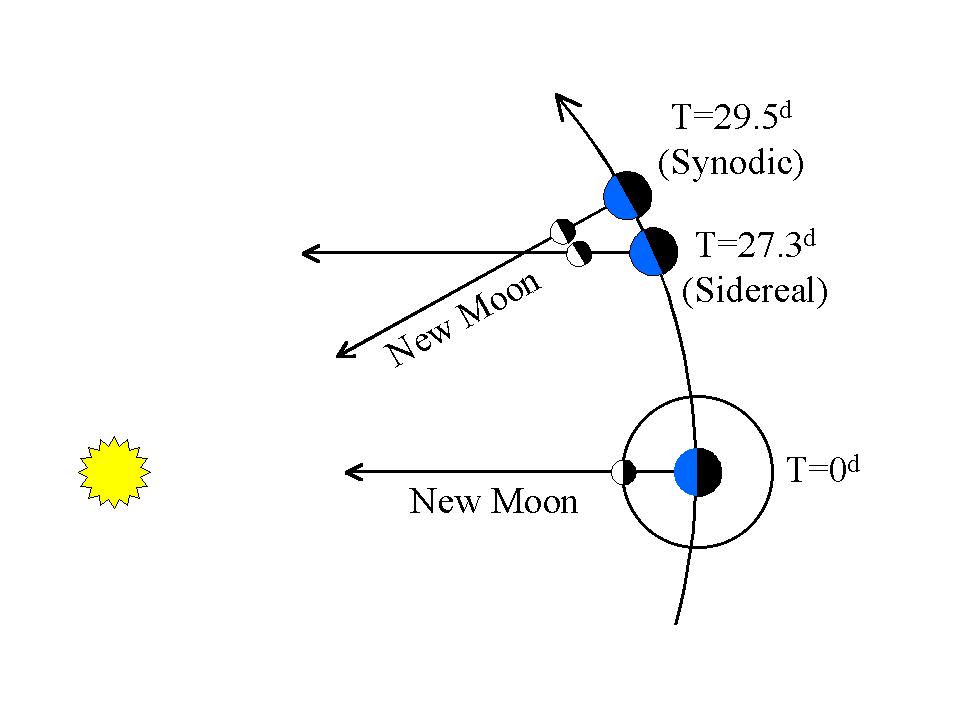
Because Earth moves along its orbit while the Moon is orbiting Earth, the Moon must travel a little farther than one orbit relative to the stars to line up with the Sun again. That extra travel makes the synodic month longer than the sidereal month.
The synodic month: the phase clock
The synodic month is the interval from one lunar phase to the same phase again. For eclipse work, the usual reference point is new Moon to new Moon:
At new Moon, the Moon lies generally in the Sun’s direction as seen from Earth. This is the required phase for a solar eclipse, because the Moon can only pass in front of the Sun when it is near new.
The word generally matters. A normal new Moon is not automatically an eclipse. The Moon may be above or below the Sun in the sky because its orbital plane is tilted relative to Earth’s orbital plane. The synodic month answers only this question:
Has the Moon returned to the correct phase alignment with the Sun?
It does not answer whether the Moon is positioned at the crossing point necessary for its shadow to strike Earth.
For a lunar eclipse, the relevant synodic phase is full Moon rather than new Moon. Yet the same synodic clock governs both: a solar eclipse needs a node near new Moon, and a lunar eclipse needs a node near full Moon.
The draconic month: the node clock
Earth’s orbit around the Sun defines a plane. From Earth, the Sun appears to follow the great circle called the ecliptic, which is the sky-projected version of that plane.
The Moon’s orbit is tilted by about to the ecliptic. Consequently, it crosses the ecliptic at only two points:
- the ascending node, where the Moon crosses from south to north of the ecliptic;
- the descending node, where it crosses from north to south.
The draconic month—also called the nodical month—is the interval from one passage through a particular node to the next passage through that same node:
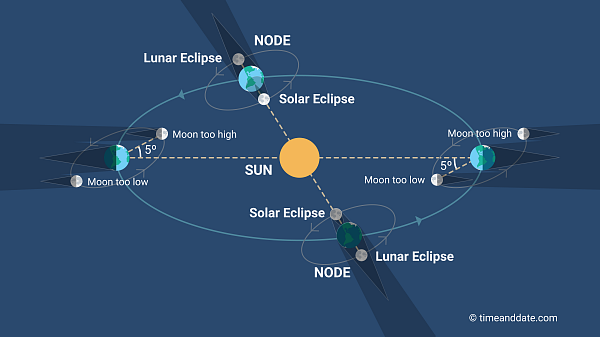
This is the clock that explains why eclipses do not happen every month. At most new Moons, the Moon passes north or south of the Sun rather than directly across it. Only when the new Moon occurs sufficiently near a node can the Moon’s shadow reach Earth.
So the draconic month answers a second, distinct question:
Has the Moon returned to the correct orbital crossing point for an eclipse?
It is slightly shorter than the sidereal month because the nodes themselves are not fixed against the stars. They drift gradually westward around the sky, a motion called nodal regression. The Moon therefore meets a given node before it has completed a full sidereal circuit.
A concise way to keep the distinction straight is:
| Lunar period | Repeating reference event | Approximate length | Eclipse relevance |
|---|---|---|---|
| Synodic month | New Moon to new Moon | days | Repeats the required phase |
| Draconic month | Same node to same node | days | Repeats the ecliptic-crossing geometry |
| Anomalistic month | Perigee to perigee | days | Repeats the Moon’s distance and apparent size |
The anomalistic month: the distance clock
The Moon does not orbit Earth in a perfect circle. Its orbit is an ellipse, so its distance changes over the course of each orbit.
- Perigee is the point at which the Moon is nearest Earth.
- Apogee is the point at which it is farthest from Earth.
The anomalistic month measures the interval from one perigee to the next:
This period tells us when the Moon returns to approximately the same part of its elliptical orbit, and hence to a similar Earth–Moon distance.
That distance affects the Moon’s apparent angular size in the sky. Near perigee, the Moon appears somewhat larger; near apogee, somewhat smaller. For solar eclipses, that difference can be decisive:
- A relatively large apparent Moon can cover the entire solar disk, allowing a total eclipse.
- A relatively small apparent Moon cannot fully cover the Sun, producing an annular eclipse, a bright ring around the Moon.
The anomalistic month therefore answers the third question:
Has the Moon returned to roughly the same distance from Earth?
Its length is slightly longer than the sidereal month because the line joining perigee and apogee slowly rotates eastward relative to the stars. This slow rotation is called apsidal precession. The Moon must travel a bit more than one sidereal orbit to catch up with the moving perigee.
A useful three-part memory framework is:
- Synodic: Sun and phase.
- Draconic: Dragon and nodes. The historical “dragon” image refers to the nodes, where eclipses were once imagined as a dragon consuming the Sun or Moon.
- Anomalistic: Anomaly in distance, from the changing distance caused by the elliptical orbit.
Why three clocks are needed for a similar eclipse
Suppose a solar eclipse occurs today. To obtain a truly similar eclipse later, a new Moon alone is insufficient. The later event should also occur near the same node, and preferably at a similar Moon–Earth distance.
In other words, the Moon must satisfy three conditions at nearly the same time:
| Needed return | Clock that measures it | What would be lost without it? |
|---|---|---|
| New Moon | Synodic month | The Moon would not be in front of the Sun. |
| Near the correct node | Draconic month | The Moon would pass above or below the Sun. |
| Similar distance from Earth | Anomalistic month | The Moon’s apparent size, eclipse duration, and possibly eclipse type could differ. |
NASA’s eclipse-periodicity material states this idea compactly: a repeating solar eclipse requires the Moon to return to new phase with the same longitude of the ascending node and the same longitude of perigee. Those are simply the phase, node, and distance conditions we have unpacked here.
The challenge is that the three clocks do not tick at the same rate:
After one month of any kind, the other two conditions will generally be out of step. After many lunar orbits, however, the accumulated cycles come extremely close to re-aligning. That near-agreement—not a perfect equality—is the mathematical foundation of the Saros cycle.
Key takeaways
The Moon has several meaningful “months” because different astronomical relationships repeat on different schedules:
- The synodic month is new Moon to new Moon, about days. It repeats the Moon’s phase relative to the Sun.
- The draconic month is node to the same node, about days. It repeats the Moon’s position relative to the ecliptic, the condition that determines whether an eclipse is geometrically possible.
- The anomalistic month is perigee to perigee, about days. It repeats the Moon’s changing distance from Earth and thus contributes to its apparent size during an eclipse.
A similar solar eclipse requires all three: new Moon, near a node, and at a similar distance. In the next lesson, we will use that framework to examine why those three requirements must recur together for one eclipse to resemble another.
Can't find a good explanation? Sign up and we'll make it for you
Sign up