
Architecture Trade-Off Matrix: Performance, Availability, Security, Operability, Cost, and Evolvability
Good to see you again. In the previous lesson, you turned the flash-sale checkout system’s uncertainties into an assumption log: database commit capacity, payment-provider quotas, queue retention, identity-provider behavior, and regional data handling all became explicit risks with validation work.
Now you need to decide what to do with that evidence. A candidate architecture is not “better” in the abstract. It is better only when its strengths fit the business priorities and its weaknesses are understood, acceptable, and actively managed.
This lesson develops a practical architecture trade-off matrix. You will use it to compare alternatives across performance, availability, security, operability, cost, and evolvability, while avoiding a common mistake: treating a spreadsheet of scores as a substitute for architectural judgment.
A trade-off matrix makes a decision discussable
Architecture decisions matter because they affect several qualities at once and are expensive to reverse. Adding replicas, splitting services, replicating data, or deploying to another region may improve one scenario while making another harder, slower, or more costly.
The Azure Well-Architected Framework provides a helpful high-level way to organize several of these concerns. Its five pillars are cost optimization, security, reliability, operational excellence, and performance efficiency.
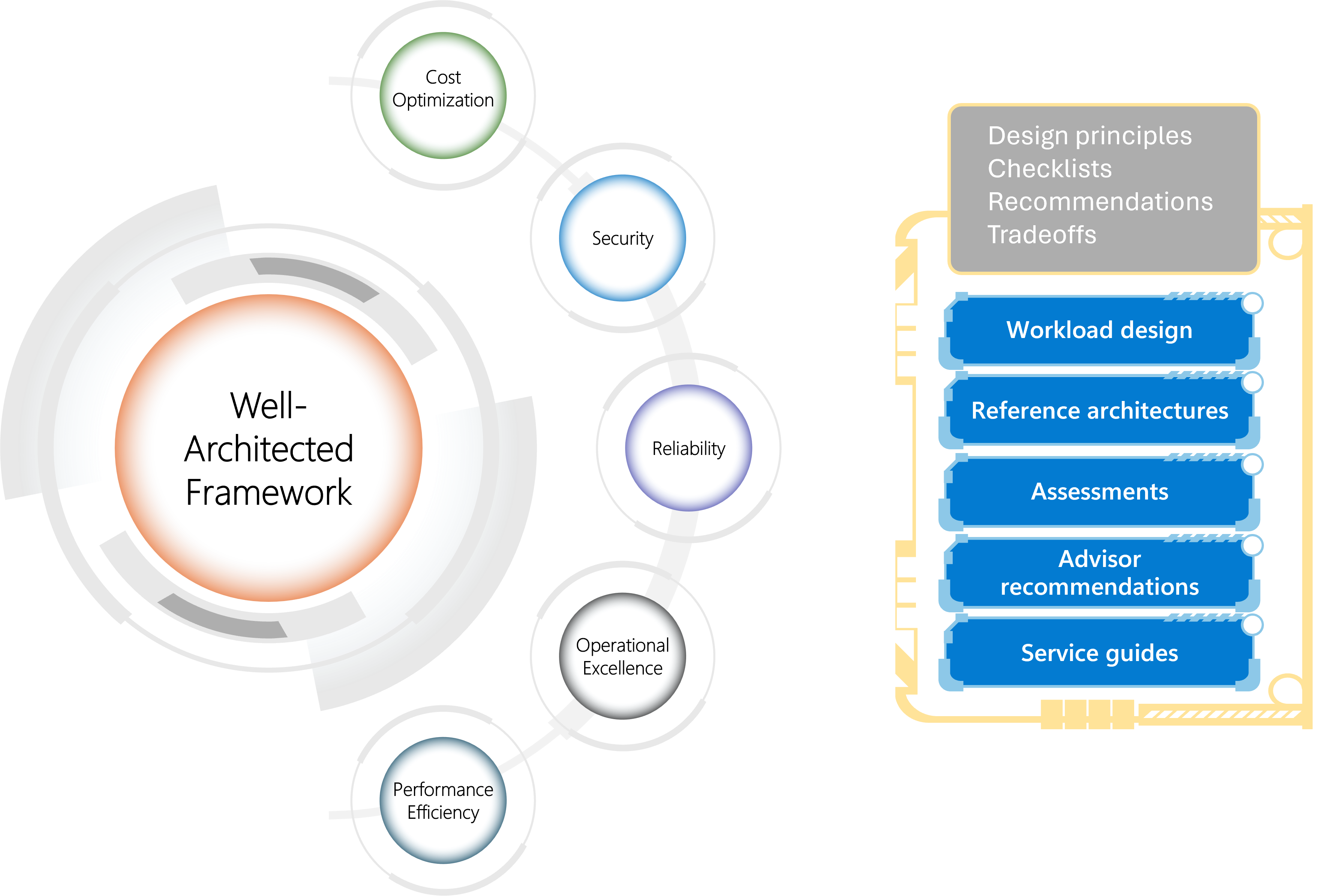
For this course, we will use six columns:
| Quality attribute | The architectural question |
|---|---|
| Performance | Can the system meet its latency, throughput, and capacity scenarios? |
| Availability | Can users complete the critical journey during component, zone, or regional failures? |
| Security | Can the system protect assets across its trust boundaries while preserving confidentiality, integrity, and appropriate access? |
| Operability | Can the team deploy, observe, diagnose, recover, and change the system predictably? |
| Cost | What is the full cost of building, running, supporting, and changing the option? |
| Evolvability | How safely and cheaply can the system accommodate plausible future changes? |
A matrix does not prove that one option is correct. It does three more realistic and valuable things:
- Makes the alternatives comparable.
- Makes reasoning and uncertainty visible.
- Forces a decision back to the business objective.
The last point is crucial. A system can receive high marks for performance and still be the wrong choice if the business can tolerate a few additional milliseconds but cannot afford a complex on-call model or a large recurring cloud bill.
Modern Trade-off Analysis for Software Architecture - Neal Ford - DDD Europe
Watch “Modern Trade-off Analysis for Software Architecture” by Neal Ford at Domain-Driven Design Europe. Ford frames objective trade-off analysis as the central work of architecture rather than a hunt for universal “best practices.”
Watch the opening for the core claim that every architecture choice has trade-offs. Focus on the distinction between a genuine architectural decision and a local implementation preference.
A matrix is therefore an argument map, not a beauty contest. Each cell should answer:
Given this particular scenario, what outcome do we expect from this candidate, why, and how confident are we?
Start with scenarios, constraints, and comparable candidates
A trade-off matrix becomes misleading when it compares vague labels such as “monolith” versus “microservices,” or “single region” versus “multi-region.” Those terms hide the details that actually determine quality outcomes.
For example, “single-region” could mean:
- one fragile application instance and a single database;
- multiple application instances, a load balancer, backups, and automated recovery;
- zone-redundant compute and storage within one region.
Those are materially different architectures. Before making a matrix, define alternatives at a similar level of detail.
The Architecture Tradeoff Analysis Method, or ATAM, formalizes this discipline: gather scenarios and constraints, describe the candidate architectures in quality-relevant views, evaluate each attribute separately, then identify the points where the qualities interact.
[PDF] The Architecture Tradeoff Analysis Method
Read this excerpt from the Carnegie Mellon Software Engineering Institute’s ATAM report to see the intellectual basis for a trade-off matrix: analyze each quality attribute against scenarios first, then look for the design elements that affect several qualities at once.
In Section 3, “The ATAM” (pp. 4–8 of the PDF), begin with the explanation of the method’s main areas. Read the method overview, paying particular attention to why scenarios, constraints, and architectural views must precede scoring. Then continue to the discussion of attribute-specific results, beginning analysis results. Finally, in Section 13, “Sensitivities and Tradeoffs,” read the trade-off example. Notice that the number of servers affects several qualities, rather than being inherently good or bad.
Define the decision context
Return to the flash-sale checkout system. Its earlier quality scenario was:
During a flash sale, the system must accept eligible orders at 200 requests per second, handle a 300 requests-per-second opening burst, and durably acknowledge accepted orders within 2 seconds at p99.
Suppose the business context also establishes these priorities:
- Checkout is revenue-critical during a limited sale window.
- Losing an accepted order is unacceptable.
- Briefly delaying payment confirmation is acceptable if the order is durably recorded and the customer is clearly informed.
- The organization has a small operations team.
- Initial operating cost matters, but not more than protecting the sale.
- The business expects more sales events and possibly expansion into another geography within two years.
These statements should be converted into matrix inputs, not left as background prose.
| Input type | Flash-sale checkout example |
|---|---|
| Hard constraint | Payment data must not be stored in the checkout system. |
| Threshold | Acknowledgement latency must remain below 2 seconds at p99 at the expected burst. |
| Business priority | Avoid revenue loss and unrecoverable accepted orders during a sale. |
| Risk acceptance | Payment confirmation may be delayed during a provider outage. |
| Future change hypothesis | The sale may expand to another geography within two years. |
A hard constraint is not a weighted preference. If an option violates it, it is removed or redesigned. Likewise, a performance target may be a threshold: an architecture that cannot meet it does not become acceptable because it scores well on cost.
Define candidates at the same scope
For a deployment-oriented comparison, consider three candidates. Each includes the same logical checkout design: a Checkout API, durable Orders Database, payment-work queue, and asynchronous Payment Worker. The comparison concerns the deployment and resilience strategy.
| Candidate | Concise description |
|---|---|
| A. Single-region baseline | Managed application and data services in one region, with backups in a secondary region. Recovery from a full regional outage requires a planned restoration procedure. |
| B. Zone-redundant primary region | Application, queue, and data services are distributed across availability zones in one primary region, with backups in a secondary region. Zone recovery is automatic where supported. |
| C. Multi-region active-passive | Zone-redundant deployments exist in a primary and secondary region. Data replicates asynchronously, and traffic fails over when the primary region is unavailable. |
Candidate C is not simply “Candidate B plus more reliability.” It introduces new questions about replication lag, regional failover, data residency, monitoring, deployment coordination, and cost. Those are trade-offs, not implementation footnotes.
Populate the matrix with evidence, not adjectives
A useful matrix has three layers:
- A qualitative assessment of each candidate against each quality attribute.
- The rationale and evidence supporting that assessment.
- Open risks and validation work where evidence is incomplete.
A five-level scale is often sufficient:
| Rating | Meaning |
|---|---|
| 5 | Strong fit for the stated scenario; evidence is strong. |
| 4 | Good fit; manageable drawbacks or a small evidence gap. |
| 3 | Acceptable only with explicit mitigations or validation. |
| 2 | Poor fit for a priority scenario. |
| 1 | Fails a key scenario or creates an unacceptable risk. |
These are ordinal judgments, not precise measurements. The difference between 4 and 5 is not necessarily the same magnitude as the difference between 2 and 3. Use the numbers to structure comparison, but preserve the explanation in every cell.
Evaluate each column through a scenario
The six attributes become useful only when phrased as concrete tests.
| Attribute | Example scenario to assess | Typical evidence |
|---|---|---|
| Performance | Can checkout acknowledge 200 sustained requests per second and the 300-request burst within the p99 target? | Load test, queueing estimate, provider quota, storage benchmark |
| Availability | Can checkout still accept orders if an availability zone fails? What happens during a regional outage? | Failure-mode analysis, recovery test, documented RTO and RPO |
| Security | Does the design preserve least privilege, isolate credentials, and protect data across region and provider boundaries? | Threat model, identity design, data-flow review, penetration-test findings |
| Operability | Can the team detect a growing payment backlog, deploy safely, and recover during an outage? | Runbook rehearsal, observability design, deployment automation, staffing model |
| Cost | What are the steady-state, burst, data-transfer, backup, and support costs? | Cost model with usage assumptions and operational effort estimate |
| Evolvability | Can a new payment method, geography, or sale model be added without high-risk rework? | Dependency analysis, interface boundaries, migration plan, change scenarios |
Two cautions follow.
First, security is not a reward for simplicity. A smaller deployment can have fewer exposed components, but still fail security requirements through excessive privileges, insecure secrets handling, weak tenant isolation, or poor auditability. Conversely, a multi-region architecture creates more control points, but can be secure if its identities, replication paths, and administration boundaries are intentionally designed.
Second, availability and operability are related but distinct. Automation may improve both, but an architecture can theoretically fail over automatically while remaining difficult for the team to understand, investigate, or recover after a partial failure. Operability asks whether the system can be run responsibly, not merely whether an availability feature exists.
Worked comparison: flash-sale checkout
The following matrix is an initial architecture-review artifact. Its ratings are deliberately provisional because the previous assumption log identified evidence that has not yet been obtained.
| Attribute | A. Single-region baseline | B. Zone-redundant primary region | C. Multi-region active-passive |
|---|---|---|---|
| Performance | 4 — local request path; no cross-region synchronous work. Must validate database capacity. | 4 — normally similar to A, but zone-aware storage may add small write latency. Validate p99 under burst. | 4 — local traffic can remain in the active region; asynchronous replication avoids adding cross-region latency to each acknowledgement. |
| Availability | 2 — a regional outage requires recovery or restoration. | 4 — can tolerate a zone outage when all critical services support zone redundancy. A regional outage still requires restoration. | 5 — can continue after a regional outage once failover completes, subject to replication and routing design. |
| Security | 4 — smaller operational surface, but backup access and recovery privileges need control. | 4 — similar controls, with more infrastructure identities and configuration to govern. | 3 — more replication, routing, administrative, and data-residency boundaries need strong controls and review. |
| Operability | 5 — fewest resources and simplest deployment model, though regional recovery must be rehearsed. | 4 — automatic zone failover can reduce incident effort; platform features and service support need verification. | 2 — requires regional health checks, failover decisions, replication monitoring, reconciliation, and regular failover exercises. |
| Cost | 5 — lowest ongoing infrastructure and data-transfer cost. | 3 — redundant capacity and higher service tiers increase cost. | 1 — duplicated regional resources, replication, networking, and operational overhead. |
| Evolvability | 3 — adequate for current sales, but geographic expansion may require significant later redesign. | 4 — provides a resilient foundation while keeping the regional model relatively contained. | 3 — supports geographic expansion, but its complexity can slow ordinary changes and testing. |
The matrix should be read horizontally, not only vertically.
For Candidate B, zone redundancy improves availability relative to Candidate A. But it may increase storage cost, require service-specific configuration, and slightly affect the write path. For Candidate C, regional resilience improves, but the team now owns a larger operational system with more failure modes.
This is a trade-off point: the scope and mode of replication affect several qualities simultaneously.
Examine the most important trade-off points
For this decision, at least four design elements deserve special scrutiny.
| Trade-off point | Potential benefit | Potential cost or risk |
|---|---|---|
| Redundant capacity across zones | Better tolerance of a datacenter or zone outage | Higher cost and more configuration |
| Cross-region replication | Better regional recovery and geographic reach | Replication lag, transfer cost, residency constraints, more operational complexity |
| Synchronous replication | Stronger data durability at the replicated boundary | Added write latency and reduced performance headroom |
| Automatic failover | Faster recovery and less manual intervention | More complex health checks, routing logic, and validation requirements |
The principle is not “avoid complexity.” It is “purchase complexity only when it protects a priority scenario.”
Microsoft’s comparison of locality, zone redundancy, and multi-region deployment is a concrete example of this reasoning. Its tables show that increased reliability commonly changes cost, performance, and operational responsibility at the same time.
Using Availability Zones and Regions - Microsoft Azure Well-Architected Framework | Microsoft Learn
Read the opening comparison in Microsoft Learn’s Azure Well-Architected Framework guidance. It is a compact real-world trade-off matrix: four deployment approaches are compared across reliability, cost optimization, performance efficiency, and operational excellence.
At the start of the article, before “Deployment approach 1: Locally redundant deployments,” read the two comparison tables. Compare the deployment approaches column by column. Notice that the tables do not claim a universal winner; their value is that they make the consequences of each approach explicit.
Weighting is useful only after thresholds are enforced
Stakeholders rarely value all qualities equally. For the flash-sale checkout system, a plausible weighting discussion might produce:
| Attribute | Relative priority | Reason |
|---|---|---|
| Performance | High | Slow acknowledgement during the sale directly loses orders. |
| Availability | High | A sale window is short; prolonged checkout loss has immediate revenue impact. |
| Security | High | Payment-adjacent workflows, customer data, and privileged integrations demand strong controls. |
| Operability | Medium | A small team must run the system during a high-pressure event. |
| Cost | Medium | The business accepts some spend to protect sale revenue. |
| Evolvability | Medium-high | New sales, payment methods, and geographies are plausible. |
You may assign numerical weights to support discussion, but do not let weighted totals override constraints. A disciplined sequence is:
- Eliminate options that violate hard constraints.
- Eliminate options that fail non-negotiable quality thresholds.
- Compare surviving options using relative priorities.
- Review the rationale, assumptions, and open risks behind the apparent result.
- Record what would cause the decision to be revisited.
Suppose the organization determines that it cannot operate a multi-region failover design responsibly this year. Candidate C may be unsuitable even if regional availability is strategically attractive. That is not a failure of the matrix. It is a clear statement of a real organizational constraint.
Conversely, if the sale is legally required to remain operational through a full regional outage with very little data loss, Candidate A and perhaps Candidate B are disqualified regardless of their attractive cost and simplicity.
Convert the matrix into a decision recommendation
A good matrix ends with a recommendation in prose, not just a highlighted row.
For the current flash-sale context, a defensible provisional recommendation might be:
Prefer Candidate B, the zone-redundant primary-region design with backups in a secondary region. It offers substantially better tolerance of zone failures than the single-region baseline while preserving a simpler operating model and lower cost than active-passive multi-region deployment. It is suitable only if load testing confirms that acknowledgement latency remains below the 2-second p99 target and if the selected application, database, and messaging services support the required zone-redundant behavior.
That statement does four things:
- makes a choice;
- names the business-relevant advantage;
- acknowledges the main sacrifice;
- links the choice to conditions that remain uncertain.
The assumption log from the preceding lesson supplies the evidence plan. The matrix should reference those entries rather than duplicate them.
| Matrix claim | Supporting assumption or evidence needed |
|---|---|
| Candidate B meets the performance scenario. | Validate ASM-01: database and Checkout API meet sustained and burst acknowledgement targets. |
| Payments can recover after provider disruption. | Validate ASM-02 and ASM-03: provider quota, queue retention, and backlog drain rate. |
| Zone redundancy genuinely improves availability. | Verify service-specific availability-zone support, failover behavior, and recovery semantics. |
| The design is operationally manageable. | Rehearse alerts, runbooks, deployment rollback, and a zone-failure response. |
| Candidate C can be deferred safely. | Record the trigger: geographic expansion, a tighter regional-outage objective, or changed data-residency needs. |
This is the connection between analysis and action. A matrix with unvalidated optimistic ratings is just formatted opinion. A matrix tied to scenarios, evidence, risks, and reconsideration conditions becomes a decision-quality artifact.
Common failure modes
Counting check marks
A candidate that is “best” in four columns is not automatically preferable. Security and availability may be non-negotiable, while cost and performance may have different business weights. The relevant question is not, “Which option wins the most cells?” It is, “Which option best satisfies the outcomes we have agreed matter most?”
Treating every quality as independent
Attributes often interact. More replicas can improve capacity and availability while increasing cost, attack surface, deployment work, and configuration drift risk. A matrix should identify these shared levers explicitly.
Equating a platform feature with an outcome
“Zone redundant” is an implementation property, not a demonstrated business outcome. You still need to ask: Which dependencies are zone-redundant? What happens to in-flight requests? Does the data layer preserve the required consistency? Can the team detect and respond to degraded behavior?
Hiding uncertainty in a score
Use qualifiers such as validated, estimated, assumption-dependent, or unknown. An option with a provisional 4 supported by one shallow vendor claim should not be treated like a 4 supported by a representative failure test.
Confusing future flexibility with present value
Evolvability matters when a change is plausible and costly to retrofit later. Building active-active multi-region conflict handling today for a product with one regional customer base may be premature. Ignoring a likely geographic expansion when data partitioning will be difficult to change later may be equally shortsighted.
Key takeaways
A trade-off matrix compares candidate architectures against measurable scenarios, not abstract labels or fashionable patterns. Its six lenses in this course are performance, availability, security, operability, cost, and evolvability.
Use hard constraints and minimum thresholds before applying weights. Then make each matrix cell explain the expected outcome, rationale, evidence, and uncertainty. Scores are aids to discussion, not mathematical proof.
The most valuable result is often the discovery of a trade-off point: a design choice, such as replication scope or redundancy level, that affects several qualities at once. Connect those points to the assumption log, validation work, and explicit conditions for reconsidering the decision.
Next, you will capture a selected choice in an architecture decision record, including the decision, alternatives considered, consequences, and the triggers that should reopen the decision.
Can't find a good explanation? Sign up and we'll make it for you
Sign up