
Hello! Welcome back to our course on growth flywheels.
In our last lesson, we deconstructed Waze's real-time data flywheel, a model built on the collective and instantaneous value created from passive user data. We saw how one driver's current speed immediately benefits everyone else's route.
Today, we shift our focus from collective utility to deep individualization. Our learning outcome is to evaluate the personalization flywheels of Netflix and Spotify, where consumption data informs both recommendation algorithms and future content investment decisions. We will explore how your personal viewing and listening history powers a virtuous cycle that not only refines your own experience but also shapes the future of the entire content library.
1. The Netflix Personalization Flywheel
Netflix's success is fundamentally tied to its ability to keep users engaged in a vast sea of content. The core mechanism is a data flywheel that transforms user engagement into a powerful competitive advantage.

This flywheel has two primary, interconnected loops that we will evaluate:
- The Recommendation Loop: Your viewing data is used to personalize the service, making it better for you.
- The Content Investment Loop: Aggregated viewing data is used to make smarter decisions about which content to license or produce.
The Recommendation Loop: From Data to "Member Joy"
Netflix states that over 80% of content watched is discovered through its recommendations. This isn't just about suggesting titles; it's about personalizing the entire user interface to maximize what they term "long-term member joy," which is a proxy for retention.
To understand the business context, let's start with a brief reading.
How Netflix Uses Data to Drive Hyper-Personalized Customer Experience (CX)
This article from Renascence provides a concise overview of Netflix's data strategy. It highlights the scale of personalization and its business impact.
Please read the first two sections, 'The Foundation of Netflix’s Data-Driven Customer Experience (CX) Strategy' and 'Leveraging Machine Learning to Enhance Customer Experience (CX)'. Focus on the statistics cited for the impact of recommendations and A/B testing.
The article establishes the "what" and "why." Now, let's delve into the "how." Given your background in statistical science, the technical evolution of these recommendation systems is particularly relevant. The following video provides an expert overview of the machine learning trends at Netflix.
Trends in Recommendation & Personalization at Netflix
This talk by Justin Basilico, a former Director of Engineering at Netflix, goes deep into the machine learning that powers personalization. It's an excellent resource for understanding the technical underpinnings of the flywheel.
First, watch the segment 'Why Personalization Matters at Netflix' (01:05 - 03:37) to frame the problem. Then, watch 'Deep Learning for Recommendations' (07:06 - 15:24). As you watch the second part, note the transition from classic matrix factorization to deep learning models and why the latter are more powerful.
As the video explains, the journey of recommendation algorithms at Netflix has been one of increasing sophistication:
-
Collaborative Filtering (Matrix Factorization): The classic approach, popularized by the Netflix Prize, involves decomposing the massive, sparse user-item interaction matrix () into two lower-dimensional matrices representing latent user features () and item features (), such that . Your familiarity with linear algebra makes the intuition here straightforward. The goal is to "fill in the blanks" in the interaction matrix to predict ratings for unseen items.
-
Deep Learning Models: While matrix factorization is powerful, it's fundamentally a linear model that struggles to incorporate rich, contextual information. Deep learning models overcome this by allowing for non-linear transformations and the integration of diverse data types. As Basilico points out, the real gains come not from simply replacing the dot product with a feed-forward network, but from building models that can process sequential and contextual data:
- User Context: Time of day, device, country.
- Item Data: Metadata, tags, and even raw video/audio/text analysis.
- Sequence Data: A user's recent viewing history, treated as a sequence, to predict the next likely action. This is where models like RNNs or Transformers become highly effective.
A Critical Challenge: Correlation vs. Causation
A key problem in recommendation systems is the feedback loop: the system recommends popular items, users watch them, making them appear even more popular, which causes the system to recommend them more. This creates a self-fulfilling prophecy that can stifle diversity and discovery.
Your econometrics background, particularly with concepts like endogeneity and confounding variables, provides the perfect lens for this issue. The system's recommendations act as a confounder, making it difficult to know if a user watched a show because they genuinely liked it, or simply because it was heavily promoted to them.
To address this, Netflix employs causal inference techniques. The next resource provides one of the clearest explanations of this problem and its solution in a real-world context.
Artwork Personalization at Netflix | Netflix
In this video, another Netflix expert explains the importance of moving from correlational to causal machine learning. The examples used are exceptionally clear.
Please watch the sections 'Causal Machine Learning and its Importance' (07:56 - 16:49) and 'Artwork Personalization with Contextual Bandits' (16:34 - 28:00). Focus on: The airline ticket analogy for understanding hidden confounders. How randomization (instrumental variables) helps disentangle correlation from causation. How they frame artwork selection as a contextual bandit problem to balance exploration (learning) and exploitation (optimizing).
This use of contextual bandits is a direct practical application of the exploration-exploitation trade-off you would have encountered in your reinforcement learning studies. Instead of just showing the "best" artwork based on historical data (exploitation), the system strategically shows different variations to different users (exploration) to continuously learn which images are most effective for different user segments, thereby optimizing for engagement (the "reward").
The Content Investment Loop: From Data to Originals
The second, and arguably more powerful, part of the flywheel is using aggregated data to guide content strategy. The billions of data points on what's being watched, by whom, for how long, and in what combinations provide an unparalleled asset for de-risking content investment.
How Netflix Uses Data to Drive Hyper-Personalized Customer Experience (CX)
Let's return to the Renascence article, which directly addresses how data informs content acquisition and creation.
Please read section 8, 'The Role of Data Science Teams...', and section 11, 'Future Directions...'. Focus on the concepts of 'Predictive Analytics for Content Acquisition' and 'Integrating Advanced Analytics with Content Creation'.
This loop works as follows:
- Data Analysis: Netflix analyzes viewing patterns at a massive scale. They can identify clusters of users, popular genre combinations (e.g., viewers who like sci-fi also like political thrillers), and talent that drives high completion rates.
- Predictive Analytics: This data feeds predictive models that estimate the potential audience size and engagement for a new show or movie, creating a "projected ROI" for content acquisition. The decision to spend $100 million on The Gray Man, starring Ryan Gosling and Chris Evans, was not a blind bet; it was a calculated investment based on data showing the global appeal of both actors and the action-thriller genre.
- Closing the Loop: When Netflix launches a successful original like Stranger Things, it not only retains existing subscribers but also attracts new ones. This new engagement generates more data, which further refines the content investment models, making the next bet even smarter.
2. The Spotify Personalization Flywheel
Spotify operates a similar flywheel, but it's adapted to the unique characteristics of audio consumption: shorter content units, higher consumption frequency, and strong contextual dependence.
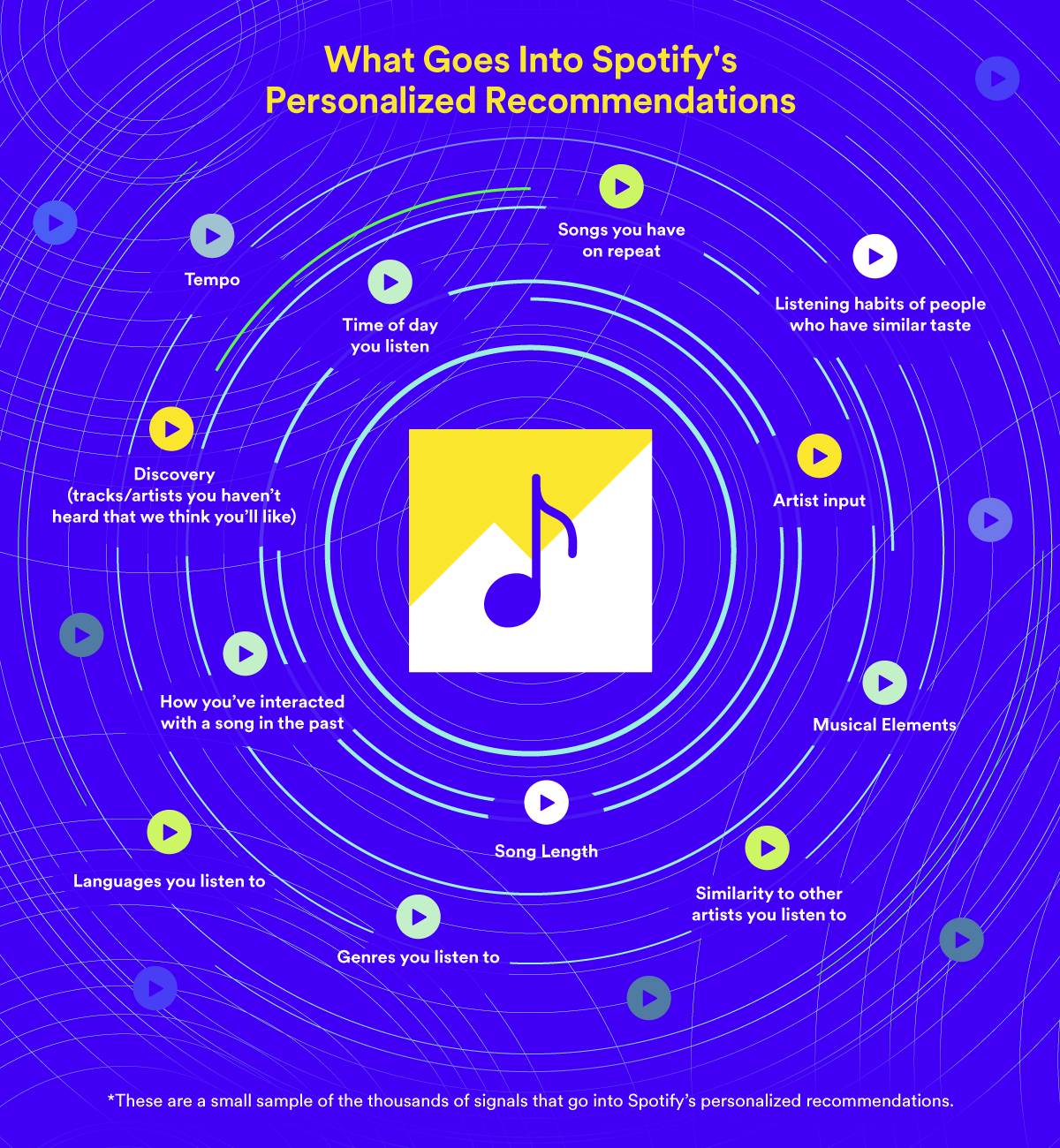
The Recommendation Loop: Curating the Soundtrack of Your Life
Like Netflix, Spotify's core product is personalization. Its iconic features like Discover Weekly and Release Radar are direct outputs of its data flywheel.
How Spotify Uses AI to Turn Music Data Into $13 Billion Revenue
This article provides a great overview of Spotify's AI-centric strategy, which is the foundation of its flywheel.
Please read the sections 'The Strategic Vision...', 'AI-Powered Recommendation Systems...', and 'Context-Aware AI...'. Note the 'hybrid approach' to recommendations and the importance of context.
Spotify's recommendation engine has three key pillars:
- Collaborative Filtering: The same principle as Netflix. It analyzes your listening habits and compares them to millions of other users to find people with similar tastes. If you and User X both love Bands A, B, and C, and User X just discovered Band D, Spotify will likely recommend Band D to you.
- Content-Based Filtering (NLP): Spotify analyzes the raw audio files and associated text (lyrics, web articles, blog posts) to understand the music itself. It uses Natural Language Processing to categorize songs by mood, genre, and other attributes, creating a rich feature set for each track.
- Context-Awareness: This is a key differentiator from Netflix. Spotify knows that your music taste isn't static; it depends on the context—time of day, location, and activity. It learns that you prefer high-tempo electronic music for your morning workout but calm acoustic tracks for studying in the evening. This allows for dynamic, context-sensitive recommendations that feel incredibly personal.
The Content Investment Loop: From Playlists to Podcasts
Spotify's content strategy is also data-driven, but in a way that is distinctly different from Netflix's big-budget productions.
How Spotify Uses AI to Turn Music Data Into $13 Billion Revenue
The same article details two fascinating ways Spotify uses data to inform its content strategy, one focused on cost reduction and the other on market expansion.
Please read the sections 'AI-Generated Content Strategy That Reduces Royalty Costs' and 'Podcast and Audio Content AI That Expands Platform Value'.
Spotify's data-informed content strategy has two notable prongs:
- AI-Generated Content for Playlists: Spotify's data shows immense popularity for mood-based playlists like "Focus" or "Chill." Instead of paying royalties for every track on these playlists, Spotify has reportedly commissioned or created its own AI-generated or "stock" music that fits the required audio profile. This is a direct, data-driven strategy to fill a content need while dramatically reducing royalty costs, thereby improving profit margins.
- Exclusive Podcast Acquisitions: By analyzing listening data, Spotify can identify which podcasts are gaining traction and which topics are most engaging to its user base. This data directly informed its multi-hundred-million-dollar investments in exclusive rights for popular shows like The Joe Rogan Experience and its acquisition of podcasting companies like Gimlet Media. The goal is to transform from a music service into an all-encompassing audio platform, with data guiding the expansion.
3. Comparative Evaluation
Both Netflix and Spotify leverage a personalization flywheel, but the mechanics differ based on their respective domains.
| Feature | Netflix | Spotify |
|---|---|---|
| Primary Data Input | Viewing history, completion rates, searches, time of day, ratings. | Listening history, skips, repeats, playlist adds, time of day, location. |
| Content Unit | Long-form, high-commitment (e.g., 2-hour movie, 10-hour series). | Short-form, low-commitment (e.g., 3-minute song). |
| Key Algorithmic Challenge | Predicting the next best single title to commit to. | Predicting the next best sequence of tracks for a given context. |
| Role of Context | Moderate (e.g., time of day might influence genre preference). | Critical (e.g., workout, commute, focus, party). |
| Content Investment Strategy | De-risking large-budget bets on original movies and series. | Acquiring high-engagement podcasts; filling playlist gaps with low-cost music. |
| Flywheel Feedback Speed | Slower feedback on content ROI (takes months/years to assess a show's impact). | Faster feedback on playlist/track performance (can be measured in hours/days). |
Conclusion
Today we evaluated the powerful, two-pronged personalization flywheels of Netflix and Spotify. Unlike the collective, real-time utility of Waze, these are built on historical, individualized data.
Key Takeaways:
- Two-Pronged Flywheel: In both cases, consumption data powers two loops. The recommendation loop improves user engagement and retention by personalizing the experience. The content investment loop uses aggregated data to make smarter, de-risked decisions on content acquisition and creation.
- Technical Sophistication: These flywheels rely on advanced machine learning, evolving from classic matrix factorization to deep learning, causal inference, and reinforcement learning techniques to deliver increasingly accurate and relevant personalization.
- Content-Driven Differences: The specific mechanics of each flywheel are adapted to the content type. Netflix focuses on predicting high-commitment "hits," while Spotify excels at context-aware sequencing and has developed novel strategies like using AI-generated content to optimize its library.
Preview of the Next Lesson:
We've seen how data can refine search results (Google), power conversational AI (Perplexity), optimize real-time routes (Waze), and personalize content (Netflix/Spotify). In our next lesson, we will analyze how Grammarly's product improvement flywheel is powered by aggregating implicit user correction data at scale. We'll shift from personalizing content to seeing how user interactions directly and continuously improve the core functionality of the product itself.
Can't find a good explanation? Sign up and we'll make it for you
Sign up