
Hello! Welcome to your next lesson on growth flywheels.
In our last session, we deconstructed Grammarly's product improvement flywheel. We saw how it leverages implicit user correction data—the act of accepting or ignoring suggestions—to refine its core AI algorithms, making the product fundamentally smarter over time.
Today, we continue our exploration of data network effects by examining Duolingo. Our learning outcome is to isolate and analyze Duolingo's data flywheel based on implicit user interaction data, distinguishing it from its explicit user-contribution loop.
While both Grammarly and Duolingo use implicit data, their goals differ. Grammarly's flywheel improves the accuracy of its core algorithm. Duolingo's flywheel, as we'll see, is primarily focused on optimizing user engagement and retention. We will explore how Duolingo turns user interactions into a powerful engine for habit formation and then contrast this with the more direct ways it solicits contributions from its community.
1. The Engagement Engine: Gamification and the "Hooked" Model
The primary challenge for any educational product is sustained user engagement. Learning is inherently difficult and requires consistent effort. Duolingo's core strategy to overcome this is a masterful application of gamification and data-driven product design.
A useful framework for understanding this is Nir Eyal's "Hooked" model, which describes a four-step process that successful products use to form user habits: Trigger, Action, Variable Reward, and Investment. Duolingo has meticulously engineered each stage of this loop, using data to optimize every step.
Let's watch a video that provides an excellent overview of how Duolingo applies this model.
Guide to make your product addictive : Duolingo Business Case Study
This video from Think School provides a clear breakdown of Duolingo's strategy using the 'Hooked' model. It will serve as our framework for analyzing the implicit data flywheel.
Please watch the sections explaining the four parts of the Hooked model as applied to Duolingo: Trigger (07:28 - 09:46), Action & Variable Reward (09:50 - 12:37), and Investment (12:37 - 15:40). The final summary (15:40 - 16:06) ties it all together.
Now, let's deconstruct this loop and identify the implicit user data that powers each stage.
2. The Implicit Data Flywheel in Action
The "Hooked" loop is not a static design; it's a dynamic system that continuously learns from user behavior. This is Duolingo's implicit data flywheel.
Step 1: Trigger (Getting the User Back)
- Mechanism: Personalized push notifications.
- Implicit Data Used:
last_session_timestamp: To send a notification exactly 24 hours later, when the user is likely to be free.notification_open_rate: To determine which notification copy, tone, or timing is most effective for different user segments.user_inactivity_duration: To trigger specific notifications, like the famous "These reminders don't seem to be working" message.
- Optimization Engine: As the video you're about to watch explains, Duolingo doesn't just A/B test these notifications; it uses more sophisticated methods like bandit algorithms. Given your background in stochastic systems and MARL, you can think of this as a multi-armed bandit problem: each notification type is an "arm," and the algorithm must balance exploring new notifications with exploiting the ones that have historically yielded the highest "payout" (i.e., getting the user to return).
How Duolingo Turned a Free Language App Into a $7.7B Business | WSJ The Economics Of
This clip from The Wall Street Journal details the data science behind Duolingo's notifications, specifically mentioning the use of bandit algorithms.
Please watch from 02:55 to 04:48. Focus on how they use AI and bandit algorithms to personalize notifications and optimize for user return.
Step 2: Action (Completing a Lesson)
- Mechanism: Short, easy-to-complete lessons.
- Implicit Data Used:
lesson_completion_rate,time_per_lesson,error_rates_per_question.
- Optimization: This data feeds back into the design of the lessons themselves. If data shows users frequently drop off during long lessons or get stuck on certain question types, the AI can adjust the difficulty or length to maximize the probability of completion. This ensures the user feels a sense of accomplishment, which is crucial for the next stage.
Step 3 & 4: Variable Reward & Investment (Creating the Habit)
- Mechanism: Streaks, Experience Points (XP), and Leagues. These features represent the "investment" a user makes in the app.
- Implicit Data Used:
daily_active_status: This binary data point (active/inactive) is the fuel for the streak feature.XP_earned_per_session: This data determines a user's position on the leaderboard.
- The Flywheel Effect: This is where the loop becomes self-reinforcing. A user's investment (a 10-day streak) becomes a powerful internal trigger to maintain it. The fear of loss (loss aversion) motivates the user to take the action (complete a lesson) every day. This daily action generates more data, which further personalizes the triggers and reinforces the habit. The longer the streak, the stronger the motivation, and the more valuable the user becomes within Duolingo's retention model.
3. The Strategic Layer: Identifying the North Star
Optimizing individual features is one thing; guiding the entire company's growth efforts is another. Duolingo's leadership took a highly analytical approach to identify the single most important metric to move.
They built a sophisticated model that segmented their entire user base into buckets (New, Current, Reactivated, etc.) and measured the flow of users between them. This allowed them to run simulations to see which lever had the biggest impact on Daily Active Users (DAU).
How Duolingo reignited user growth
This article from Lenny's Newsletter, written by Duolingo's former CPO, is a masterclass in data-driven strategy. It explains how they moved from ad-hoc feature ideas to a focused, model-based approach.
Please read the sections 'Phase 3: Using data and models' and 'The streak vector'. Focus on: (1) How they defined user buckets and retention rates like CURR, NURR, etc. (2) Why the sensitivity analysis pointed to Current User Retention Rate (CURR) as the North Star metric. (3) How this strategic insight led them to double down on optimizing the 'streak' feature.
The analysis revealed that improving the Current User Retention Rate (CURR)—the probability that an already engaged user returns—had a disproportionately massive impact on DAU growth. This insight was transformative. It shifted the company's focus from acquiring new users to obsessively retaining their current ones. The features we just discussed, especially Streaks and Leagues, became the primary vectors for driving CURR.
This is the complete implicit data flywheel:
More Engagement -> More Implicit Data -> Better Personalization (Triggers) & Stronger Investment Mechanics (Streaks) -> Higher CURR -> More Engaged Users -> More Implicit Data
.png)
4. Distinguishing: Implicit Data vs. Explicit Contribution
Now, let's address the second part of our learning outcome. The flywheel we've analyzed is powered by implicit data—it's a byproduct of normal product usage. However, Duolingo also has a powerful explicit user-contribution loop, where users consciously and actively provide value back to the platform.
The distinction is crucial:
- Implicit Loop: The user's primary intent is to learn. The data they generate for the flywheel is a secondary consequence.
- Explicit Loop: The user's primary intent is to contribute.
Here are the main forms of explicit contribution at Duolingo:
- Course Creation (The Duolingo Incubator): For many years, Duolingo relied on a community of bilingual volunteers to build new language courses for its platform. This was a direct, massive contribution of expert labor.
- Community Support (Forums): Duolingo hosted forums where learners could explicitly ask and answer questions about grammar, vocabulary, and culture, providing peer-to-peer support.
- Direct Product Feedback: Duolingo sometimes explicitly asks users for feedback on new features, a process often called "dogfooding."
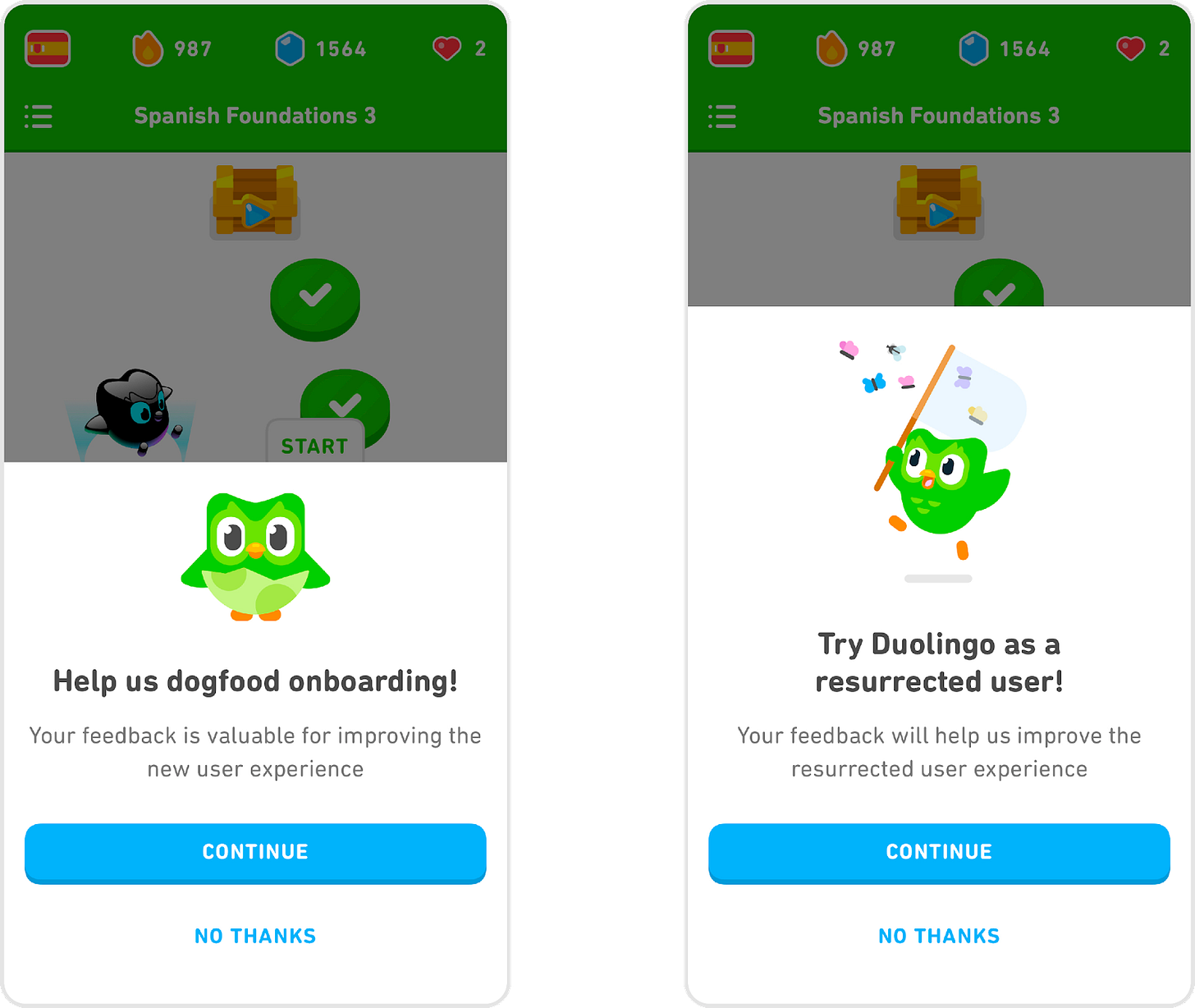
The following article neatly summarizes and contrasts these different growth levers.
Duolingo's Journey: From Gamification Misfires to 350 ... - Offline
This article from Offline.club provides a concise summary of Duolingo's growth strategy and clearly distinguishes its product-led tactics from its community-driven ones.
Please read the section titled 'Community-Driven Growth and TikTok Success'. Notice how it describes the Incubator, forums, and user reports as distinct from the product-led strategies like streaks and notifications.
To make the distinction perfectly clear:
| Feature | Loop Type | User Intent | Data/Contribution Type |
|---|---|---|---|
| Notifications | Implicit | Learn a language | Behavioral data (response rate, timing) |
| Streaks & Leagues | Implicit | Learn a language | Behavioral data (daily usage, XP earned) |
| Lesson Personalization | Implicit | Learn a language | Performance data (error rates, time) |
| Incubator | Explicit | Build a new course | Expert-created content (translations, exercises) |
| Forums | Explicit | Help another user | User-generated content (questions, answers) |
| "Dogfooding" | Explicit | Provide feedback | Qualitative user feedback |
Both loops are valuable, but they operate on different principles. The implicit data flywheel is an automated, scalable engine for optimizing engagement, while the explicit contribution loop leverages community goodwill to add content and quality control.
Conclusion
Today we dissected Duolingo's growth model, isolating its powerful implicit data flywheel and distinguishing it from its explicit contribution loops.
Key Takeaways:
- Implicit Data Drives Engagement: Duolingo's primary data flywheel uses implicit user interactions (login times, lesson performance, notification responses) to power a gamified system designed to maximize user retention.
- The "Hooked" Model as a Flywheel: The Trigger -> Action -> Reward -> Investment loop, when powered by real-time data and personalization, becomes a self-reinforcing flywheel for habit formation.
- Strategy Guided by Data: Duolingo's success wasn't just about clever features. It was about using a sophisticated data model to identify a North Star metric (CURR) that focused the entire company's efforts on retaining existing users.
- Implicit vs. Explicit Loops: The implicit data flywheel runs automatically as a byproduct of usage. The explicit contribution loop relies on users consciously deciding to create content, provide support, or give direct feedback.
Preview of the Next Lesson:
We have now concluded our module on Data Network Effect Flywheels. We've seen how data can be used to improve search (Google), optimize logistics (Waze), personalize content (Netflix), enhance an algorithm (Grammarly), and now, drive engagement (Duolingo).
In our next lesson, we will begin a new module: Viral & Network-Driven Flywheels. We will start by analyzing the payment network flywheel of Cash App and Venmo, where the core transaction utility requires and drives adoption by both sender and receiver. We will shift from flywheels where data improves the system for everyone (data network effects) to flywheels where the product's value is a direct function of how many other people use it (direct network effects).
Can't find a good explanation? Sign up and we'll make it for you
Sign up