
Hello again. In the previous lesson, you separated rule-based automation, predictive machine learning, and generative AI by the business output required: a defined action, a forecast or score, or newly generated content.
This lesson goes one level deeper into machine learning. “Predictive ML” is not a single capability: supervised learning, unsupervised learning, and reinforcement learning learn in different ways and therefore support different kinds of business decisions. The practical objective is to recognize which learning setup a prospect is implicitly asking for—and when their data and workflow do not support it.
Three ways a system can learn
The core distinction is not the industry, software vendor, or type of data. It is the feedback available during learning.
- Supervised learning learns from past examples where the correct outcome is already known.
- Unsupervised learning examines data with no predefined correct outcome and finds meaningful structure within it.
- Reinforcement learning learns a decision strategy through actions, feedback, and accumulated rewards over time.
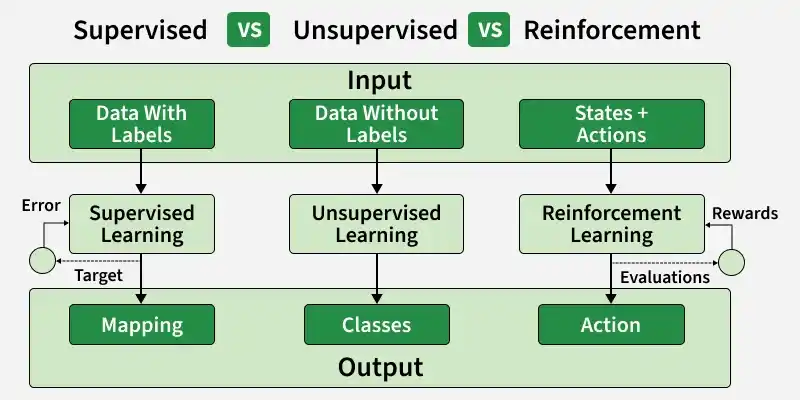
The visual provides a useful first orientation, but interpret it carefully. In supervised learning, the “target” is the known historical outcome. In unsupervised learning, the resulting groups are not automatically meaningful business segments; people must interpret them. In reinforcement learning, reward is feedback on a sequence of actions, not a correct answer attached to each individual record.
Before continuing, watch IBM Technology’s concise explanation of the supervised and unsupervised distinction. It uses operational examples rather than mathematical notation, which is the right level for initial enterprise discovery conversations.
Machine Learning Basics: Supervised v Unsupervised
Watch "Machine Learning Basics: Supervised v Unsupervised" from IBM Technology to connect labeled data, prediction, and pattern discovery to familiar business use cases.
Watch the framing for the distinction based on labels. Then watch supervised learning, focusing on why known maintenance outcomes let the system predict a new case. Continue with unsupervised learning, especially the customer-persona and anomaly examples. Finish with the selection summary, which ties the approach to the business need.
Supervised learning: learn from outcomes the business already knows
A supervised model starts with historical records that contain both:
- Inputs, often called features: information available before a decision or event.
- A label, or target: the outcome that later became known.
For example, a business might have years of account data:
| Available before renewal | Known later |
|---|---|
| Contract value, product usage, support tickets, tenure, payment history | Renewed or churned |
| Lead source, firm size, buyer role, activities, sales-cycle stage | Converted or did not convert |
| Transaction amount, merchant, device, location, account behavior | Fraudulent or legitimate |
| Machine temperature, vibration, operating hours | Failed or did not fail |
The model looks for relationships between the inputs and the known outcome. Once trained, it receives a new record without a known outcome and estimates what is likely to happen.
A label is not merely a field someone has typed into a spreadsheet. It needs to represent a reliable business outcome. “Customer churned within 90 days” can be a useful label if the organization agrees on its definition and records it consistently. “High-value customer,” by contrast, may be too vague unless it is defined through a stable rule or measure.
The business capabilities supervised learning produces
Supervised learning usually produces one of two broad kinds of output.
Classification assigns a case to a category or estimates the probability of a category. Typical capabilities include:
- Flagging a payment as likely fraudulent.
- Prioritizing leads by likelihood of conversion.
- Classifying a support request by likely issue type.
- Identifying machinery likely to require service.
- Estimating whether an invoice is likely to be paid late.
A classification can be binary, such as “fraudulent” or “not fraudulent,” or include several categories, such as “billing,” “technical issue,” “access request,” or “cancellation.”
Regression estimates a numeric value. Typical capabilities include:
- Forecasting demand next week.
- Estimating expected revenue for an opportunity.
- Predicting how many days late a payment may be.
- Estimating energy usage or delivery time.
- Forecasting the likely cost of a claim or service visit.
From a business-development perspective, the important translation is:
Supervised learning turns historical outcomes into a repeatable capability to score, classify, forecast, or prioritize new cases.
It does not determine whether acting on that score is worthwhile. A model may estimate that an account has a high churn risk; the business must still decide whether to assign a retention manager, offer a concession, or simply monitor the account. Rules, financial thresholds, and human judgment remain part of the operating workflow.
Discovery signals for supervised learning
A supervised-learning opportunity is plausible when a prospect can describe:
- A decision that repeats at meaningful volume.
- A future outcome they want to anticipate or a category they want to assign.
- Historical cases where that outcome is known.
- Data available before the outcome occurs.
- A practical action the business can take from the prediction.
Consider a sales leader who says, “Our representatives waste time on low-quality inbound leads.” This is not yet a complete AI use case. A stronger hypothesis would be:
“Given historical leads and their conversion outcomes, a supervised model may rank new leads by estimated conversion likelihood, helping representatives prioritize follow-up.”
That hypothesis now contains a target outcome, usable inputs, a decision, and an intended operational benefit.
A frequent qualification issue is label quality. If CRM stages are incomplete, if closed-lost reasons are unreliable, or if only the best-performing representatives record activities consistently, the historical data may teach the model the organization’s data-entry habits rather than genuine conversion patterns. Later modules will address data readiness in depth; for now, treat the availability of a trustworthy label as an early gate.
Unsupervised learning: reveal structure before the business has named it
Unsupervised learning has no known correct answer for each historical record. Instead, it searches the data for similarities, differences, associations, and unusual cases.
Its central business value is discovery. The organization may know it has a large customer base, thousands of support tickets, or years of transactions, but not know the useful patterns contained in that information.
The most common technique is clustering: grouping records that are similar according to the data available. A retailer might cluster customers using purchase frequency, average order value, product categories, discount use, and return behavior. The model might reveal several clusters, such as frequent high-value buyers, seasonal shoppers, discount-led customers, and new low-engagement customers.
Notice what has not happened: the model has not discovered an objectively true customer identity. It has grouped records with similar observed characteristics. Business and domain teams must examine the groups, name them sensibly, validate whether they are useful, and decide how to serve them differently.
Unsupervised learning can also support:
- Anomaly detection: finding activity that is unusual compared with normal patterns, such as atypical transactions, unexpected equipment behavior, or unusual user access.
- Association discovery: identifying patterns that tend to occur together, such as products commonly bought in the same order.
- Dimensionality reduction: simplifying a highly complex dataset while retaining key patterns, often to make analysis or later modeling more manageable.
The business capabilities unsupervised learning produces
Unlike supervised learning, unsupervised learning does not usually answer “Will this customer churn?” It produces capabilities such as:
| Business need | Unsupervised capability | Possible business use |
|---|---|---|
| Understand a heterogeneous customer base | Segment customers by observed behavior | Design differentiated campaigns or service models |
| Find emerging themes in unstructured feedback | Group similar topics or tickets | Identify product issues and recurring service problems |
| Detect unusual behavior | Flag records unlike established patterns | Triage potential fraud, access risk, or equipment issues |
| Simplify overwhelming operational data | Reduce complexity while preserving useful variation | Support analysis, visualization, or downstream models |
This distinction matters when a prospect asks for “customer segmentation.” Do not assume they need a model that predicts who will buy. If they have no established target outcome and want to understand customer types, unsupervised clustering may be the relevant approach. If they want to predict response to a specific campaign and possess reliable historical campaign outcomes, supervised learning may be more appropriate.
A caveat: a cluster is not automatically a customer strategy
A visually neat cluster can still be commercially useless. It may merely reflect an irrelevant data field, a temporary operational anomaly, or an overly technical choice in how similarity was calculated.
A credible proposal includes a validation step:
- Review whether each group is stable and understandable.
- Check whether groups differ on measures the business cares about, such as retention, margin, service cost, or engagement.
- Design a different treatment for at least one group.
- Measure whether that treatment improves an outcome.
Without this connection to an action and outcome, segmentation can become an interesting dashboard rather than a valuable AI initiative.
Reinforcement learning: optimize a sequence of decisions
Reinforcement learning, commonly abbreviated as RL, fits a different kind of problem. Instead of learning from static examples with correct answers, an agent takes actions in an environment and receives feedback in the form of rewards or penalties.
Its goal is to learn a policy: a strategy for choosing an action in a given situation that maximizes total reward over time.
A simplified business example is a system that decides which offer to display to a customer across repeated interactions. At each interaction, it observes the customer context, chooses an offer, and later receives feedback such as engagement, purchase, margin, or unsubscribing. It must balance:
- choosing an option that has worked well before; and
- occasionally testing alternatives that may work better in the long run.
This is more than predicting a single result. The model’s action changes what happens next. The customer may see a different offer, the inventory situation may shift, and the system receives new feedback. That sequential aspect is why RL is conceptually distinct from a supervised conversion model.
Watch the reinforcement-learning segment from IBM Technology’s Machine Learning Explained. The autonomous-driving illustration is not an enterprise implementation template, but it clearly shows the relationship among state, action, feedback, and long-term reward.
Machine Learning Explained: A Guide to ML, AI, & Deep Learning
Watch the reinforcement-learning section of IBM Technology's "Machine Learning Explained: A Guide to ML, AI, & Deep Learning" to see why RL is designed for sequential decisions rather than one-off predictions.
Watch the RL loop. Focus on the agent's current situation, the action it selects, the reward or penalty received, and why the system optimizes accumulated reward rather than an immediate result alone.
Where reinforcement learning can create business capability
RL is potentially useful where conditions change, actions have delayed consequences, and the organization can define meaningful feedback. Examples include:
- Marketing and recommendations: selecting a sequence of product suggestions or messages based on interaction feedback, while optimizing longer-term engagement or sales.
- Cloud or computing operations: adjusting resource configurations to balance availability, utilization, and cost.
- Energy management: selecting charging, storage, or consumption decisions as demand and price conditions change.
- Routing and scheduling: choosing operational actions where each choice affects later capacity, time, and cost.
- Robotics and industrial control: learning actions that improve performance in a physical process, usually with extensive simulation and safety controls.
The defining business capability is not “prediction.” It is adaptive optimization of decisions over time.
Read the comparison in AWS’s What is Reinforcement Learning? after the video. The final practical section is especially important for commercial conversations: learning by trial and error can be expensive or unsafe in a live environment.
What is Reinforcement Learning? - Reinforcement Learning Explained - AWS
Read AWS's explanation to sharpen the boundary between reinforcement, supervised, and unsupervised learning, then consider why RL can be difficult to deploy in real operating environments.
In the section “What is the difference between reinforced, supervised, and unsupervised machine learning?”, read the comparison. Focus on the difference between known input-output pairs, unlabeled pattern discovery, and a sequence of reward-guided decisions. Then continue to the “What are the challenges with reinforcement learning?” section and read the practicality caveat, noting why simulation, controlled rollout, and safeguards matter when real-world experimentation carries a cost.
Why RL is often over-proposed
“Optimize pricing,” “maximize engagement,” or “make the system learn continuously” can sound compelling in a sales conversation. But RL demands much more than a high-level objective.
A realistic RL opportunity needs:
- A decision the system is actually permitted to make.
- Clear observations about the current state of the environment.
- A limited, safe set of actions.
- A reward that represents real business value without encouraging harmful shortcuts.
- Sufficient interactions or a credible simulation environment.
- Guardrails, monitoring, and often human override.
The reward-design issue is crucial. If a support system is rewarded only for minimizing average handling time, it may learn behavior that rushes customers or avoids difficult cases. A sound reward design might need to balance handling time, resolution quality, repeat-contact rate, customer satisfaction, and compliance. In practice, that complexity often means a business should begin with analytics, rules, or supervised prediction rather than live RL.
Choosing the learning paradigm in enterprise discovery
The following comparison is a practical guide, not a rigid taxonomy. A single workflow can use more than one approach.
| Dimension | Supervised learning | Unsupervised learning | Reinforcement learning |
|---|---|---|---|
| Starting data | Historical inputs paired with known outcomes | Historical data without predefined outcome labels | Observations of situations, available actions, and feedback |
| Central question | “What is likely to happen?” or “Which category fits?” | “What patterns or groups exist?” | “What should we do now to improve long-term results?” |
| Typical output | Probability, score, category, forecast, ranking | Segments, themes, associations, anomalies | A policy for selecting actions |
| Business capability | Predict, prioritize, classify, forecast | Discover, segment, explore, flag unusual cases | Adaptively optimize repeated decisions |
| Main validation | Is the prediction accurate and decision-useful? | Are the discovered patterns stable, interpretable, and actionable? | Does the policy improve total outcomes safely over time? |
| Common risk | Biased, incomplete, or poorly defined labels | Meaningless or non-actionable clusters | Unsafe experimentation or a poorly designed reward |
A customer-support organization could combine all three:
- A supervised model predicts whether a newly opened ticket is likely to escalate.
- An unsupervised model identifies newly emerging themes across thousands of ticket descriptions.
- An RL approach might, in a mature and tightly controlled setting, optimize the order in which non-sensitive self-service options are presented based on longer-term resolution outcomes.
These are distinct claims and should be sold, measured, and governed differently.
A business developer’s language: precise, not performative
In an early conversation, avoid trying to name the algorithm immediately. First clarify the decision and the evidence available.
Useful phrasing includes:
- “Do you already have historical examples of the outcome you want to predict?”
- “Is the aim to discover meaningful groups, rather than forecast a known outcome?”
- “Will the system make repeated choices where one choice affects later conditions?”
- “What feedback would tell us that a decision was beneficial?”
- “Can the business safely test alternative actions, or would experimentation create customer, financial, or compliance risk?”
- “What action will a team take when the system produces this score, segment, or recommendation?”
These questions prevent common category errors:
| Customer statement | Likely interpretation |
|---|---|
| “We want to identify suppliers who may deliver late.” | Supervised learning, if historic delivery outcomes exist |
| “We have years of purchasing data but do not understand our buyer types.” | Unsupervised learning, likely segmentation |
| “We want a system to continually choose inventory actions that reduce long-term stockout and holding costs.” | Potential RL problem, subject to safety and data constraints |
| “We want to send an approval reminder whenever a request sits for two days.” | Rule-based automation, not machine learning |
| “We want agents to summarize long customer histories.” | Generative AI, not one of the three classic learning setups |
The final two rows preserve the lesson from earlier: not every valuable business request needs machine learning, and not every AI request needs generative AI.
Key takeaways
Supervised learning uses historical records with known outcomes to create forecasting, classification, scoring, and prioritization capabilities. Its commercial viability depends heavily on the quality and relevance of the historical labels.
Unsupervised learning works with unlabeled data to discover segments, relationships, themes, and anomalies. Its output needs human interpretation and a clear path to action before it becomes business value.
Reinforcement learning learns a policy through actions and reward feedback. It is suited to sequential decisions with delayed consequences, but live experimentation, reward design, and safe deployment make it substantially harder to implement responsibly.
In discovery, identify whether the prospect needs a prediction, a newly revealed pattern, or an adaptive decision strategy. Then test whether their data, workflow, and risk tolerance support that capability.
Next, the course turns to large language models: how they generate outputs from tokens, context, and inference.
Can't find a good explanation? Sign up and we'll make it for you
Sign up