
Hello! Welcome to the first lesson in our new module on Thermodynamics.
In our last lesson, we concluded our study of fluid mechanics by applying the Steady Flow Energy Equation (SFEE) to analyze pumps and turbines. We saw that the SFEE is a form of the First Law of Thermodynamics, and we were introduced to a crucial property called enthalpy.
Today, we will take a step back and build the formal foundation for our study of thermodynamics. The concepts you encountered briefly in the last lesson—heat, work, and energy transformations—are the central themes of this new topic. Understanding them rigorously is absolutely essential for your goal of studying aerospace engineering, as they govern the operation of all propulsion systems and power cycles.
Our learning outcome for this lesson is to: Define thermodynamic systems, states, processes, and properties (e.g., enthalpy). We will establish the core vocabulary that we will use for the rest of this course.
1. What is Thermodynamics?
At its heart, thermodynamics is the science of energy and its transformations. It deals with the relationships between heat, work, and the properties of substances. To get a quick overview of what this field encompasses, let's start with a short animated video.
Basic Concepts of Thermodynamics (Animation)
This video provides a concise definition of thermodynamics and introduces some of the basic terms we'll be exploring in this lesson.
Please watch from 0:12 to 0:52 to get a formal definition of thermodynamics.
As the video states, thermodynamics is the study of the flow of heat and other forms of energy into or out of a system as it undergoes a transformation. To analyze these transformations, we first need to precisely define what we are studying.
2. The Thermodynamic System
In thermodynamics, we must be very clear about the object of our analysis. We do this by defining a system, its surroundings, and the boundary that separates them.
- System: The specific quantity of matter or region in space that we are interested in.
- Surroundings: Everything outside the system.
- Boundary: The real or imaginary surface that separates the system from its surroundings. The nature of the boundary determines how the system interacts with its surroundings.
Systems are classified based on whether mass and energy (in the form of heat or work) can cross the boundary. There are three main types:
- Open System (Control Volume): Both mass and energy can cross the boundary. A jet engine is a perfect example: air and fuel (mass) enter, and exhaust gases (mass) leave, while heat is lost to the surroundings and work is produced by the turbine (energy).
- Closed System (Control Mass): Energy can cross the boundary, but mass cannot. A sealed tank of gas that is being heated or cooled is a closed system. The amount of gas is fixed.
- Isolated System: Neither mass nor energy can cross the boundary. This is an idealization, but a well-insulated, sealed container like a high-quality thermos flask is a close approximation.
The following image provides a clear visual distinction between these three types.

To solidify these concepts, let's return to the animated video, which provides excellent examples and further defines the types of boundaries.
Basic Concepts of Thermodynamics (Animation)
This next segment of the video explains the different types of systems with helpful animations and also discusses the nature of the boundary itself.
Watch from 0:52 to 4:03. Pay close attention to the examples given for open, closed, and isolated systems. Notice also the brief mention of homogeneous and heterogeneous systems, which relate to the phases (solid, liquid, gas) within the system.
3. Thermodynamic State and Properties
Once we have defined our system, we need a way to describe its condition. The state of a system is its condition at a particular moment, which is fully described by its properties. Properties are the measurable characteristics of the system.
Properties are classified into two categories:
- Intensive Properties: These are independent of the mass or size of the system. Examples include temperature (T), pressure (P), and density (). If you were to divide a system in half, the temperature of each half would be the same as the original.
- Extensive Properties: These depend on the mass or size of the system. Examples include mass (m), volume (V), and total energy (E). If you divide the system in half, each half would have half the original mass and volume.
To make extensive properties easier to work with, we often convert them into specific properties by dividing by the mass. A specific property is an intensive property. For example:
- Specific volume:
- Specific internal energy:
Basic Concepts of Thermodynamics
These definitions are fundamental. Please read this short section for a clear written explanation of system properties.
Read page 6, starting from the heading 'Properties of a System' and ending just before 'State and Equilibrium'. The diagram on this page is a great illustration of the difference between intensive and extensive properties.
Test your understanding!
A container holds 10 kg of air at a temperature of 300 K and a pressure of 100 kPa. The total volume of the container is 8.61 m³. Classify the following properties as intensive or extensive:
- Temperature (300 K)
- Mass (10 kg)
- Pressure (100 kPa)
- Volume (8.61 m³)
- Specific volume ( m³/kg)
Show answer
- Temperature: Intensive (does not depend on the amount of air).
- Mass: Extensive (depends on the amount of air).
- Pressure: Intensive (does not depend on the amount of air).
- Volume: Extensive (depends on the amount of air).
- Specific volume: Intensive (it's an extensive property, volume, divided by another extensive property, mass, resulting in a property that is independent of the system's size).
The collection of all properties at a given time defines the system's state. If even one property changes, the system has moved to a new state. An important rule in thermodynamics, known as the State Postulate, says that for a simple compressible system (like a gas in a cylinder), its state is completely defined by any two independent, intensive properties. For example, if you know the temperature and pressure of the air in a room, you can determine all its other properties, like density, specific volume, etc.
4. Key Thermodynamic Properties
Let's formally define some of the most important properties we'll be using.
This resource provides clear, formula-based definitions for pressure, temperature, and other key properties.
Please read the sections '2.2.1 Pressure', '2.2.2 Temperature', and '2.2.3 Density and specific volume'. Pay special attention to: The difference between absolute and gauge pressure. The importance of absolute temperature scales (Kelvin). The relationship between density and specific volume (v = 1/\rho).
Internal Energy and Enthalpy
Now we come to two properties that are central to the study of energy transformations: internal energy (U) and enthalpy (H).
- Internal Energy (U): This is an extensive property representing the sum of all microscopic energies within a substance. It includes the kinetic energy of molecules (translation, rotation, vibration) and the energy stored in chemical bonds. For a given substance, internal energy is primarily a function of its temperature.
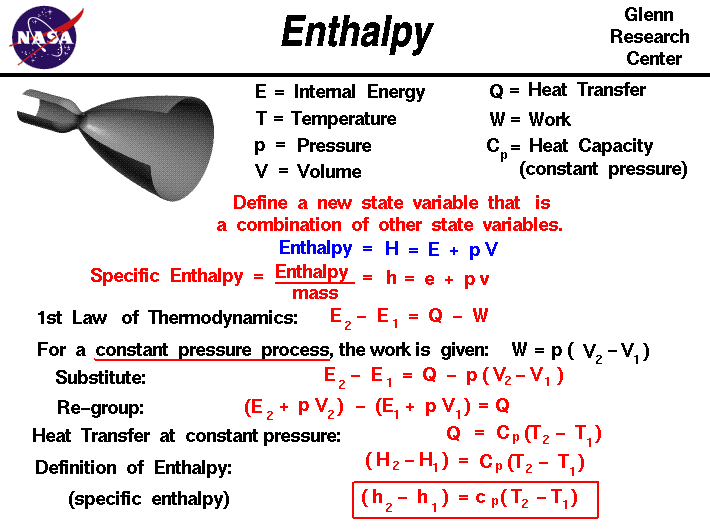
- Enthalpy (H): You were introduced to this in the last lesson. It is formally defined as:
where U is internal energy, P is pressure, and V is volume. In specific, intensive terms:
Enthalpy is a property created for convenience. It combines the internal energy () with the "flow work" () associated with pushing a fluid into or out of a control volume (an open system). This makes it extremely useful in the analysis of devices like turbines, compressors, and nozzles.
The following video gives an excellent intuitive explanation for why we need both internal energy and enthalpy, relating them to constant volume and constant pressure processes, respectively.
ENTHALPY and INTERNAL ENERGY in 12 Minutes!
This video clarifies the distinction between internal energy and enthalpy by linking them to different types of processes. This is a very helpful way to understand their physical significance.
Watch the video from the beginning to 5:52. Focus on: How heating a rigid tank (a constant volume process) relates to a change in internal energy. How heating a piston-cylinder device (a constant pressure process) relates to a change in enthalpy.
To summarize this important concept, here is a concise derivation from NASA.
5. Thermodynamic Processes and Cycles
When a system changes from one state to another, it undergoes a process. The series of states the system passes through is called the path of the process.
It is crucial to distinguish between properties that depend on the state and those that depend on the path taken.
- State Functions (or Point Functions): Their values depend only on the current state of the system, not on how the system got there. All thermodynamic properties we've discussed so far (P, V, T, U, H) are state functions.
- Path Functions: Their values depend on the specific path followed during a process. The two most important path functions are work (W) and heat (Q).
Basic Concepts of Thermodynamics (Animation)
The distinction between state and path functions is fundamental. This final video segment uses excellent analogies to explain the difference.
Watch from 6:11 to 10:45. The mountain climber analogy for state functions (altitude) and the car travel analogy for path functions (fuel consumed) are very effective.
We often analyze specific types of idealized processes where one property is held constant:
- Isothermal process: Temperature is constant ().
- Isobaric process: Pressure is constant ().
- Isochoric (or Isometric) process: Volume is constant ().
- Adiabatic process: There is no heat transfer ().
Finally, when a system undergoes a series of processes and returns to its initial state, it has completed a cycle. Thermodynamic cycles are the foundation of engines, power plants, and refrigerators. The Brayton cycle, which models the operation of a jet engine, is a key cycle we will study later in this course.
Conclusion
This lesson has established the fundamental vocabulary of thermodynamics. Mastering these definitions is the first and most important step to analyzing energy systems.
Key Takeaways:
- A thermodynamic system is the object of study, classified as open, closed, or isolated based on mass and energy transfer across its boundary.
- A system's state is defined by its properties (e.g., P, V, T). Properties can be intensive (independent of size) or extensive (dependent on size).
- Internal energy (U) is the sum of a system's microscopic energies. It's the key energy term for closed systems.
- Enthalpy (H = U + PV) combines internal energy and flow work. It's the key energy term for open systems (control volumes).
- A process describes a change in state. We often study idealized processes where a property is held constant (isothermal, isobaric, isochoric).
- Properties are state functions (path-independent), while heat and work are path functions.
Preview of the Next Lesson:
Now that we have our vocabulary set, we can start to analyze the behavior of substances. In the next lesson, we will focus on a particularly important class of substance in engineering: the ideal gas. We will introduce the Ideal Gas Law, an equation of state that relates pressure, volume, and temperature, allowing us to put these new concepts into practice.
Can't find a good explanation? Sign up and we'll make it for you
Sign up