
Hello! Welcome back.
In our last lesson, we established the fundamental principle of a DC motor: a current-carrying coil in a magnetic field experiences a torque, causing it to rotate. We saw that this torque is dynamic, changing with the coil's orientation, and we derived the core equation that governs it.
Today, we will focus on applying that knowledge. The goal for this lesson is to master the following outcome: Calculate the torque on a motor's coil from current, magnetic field strength, and geometry. We will move from the conceptual to the concrete, using the torque equation to solve practical problems and build a quantitative intuition for what makes a motor powerful.
The Torque Equation Revisited
Let's start with a quick recap of the formula we derived in the last lesson. The magnitude of the torque () on a flat coil with turns in a uniform magnetic field is given by:
Each term in this equation represents a specific physical parameter you can control or measure:
- : Torque, the rotational force, measured in Newton-meters (N·m).
- : The number of turns or loops in the coil (dimensionless). More turns act like more wires, multiplying the force.
- : The current flowing through the coil, in Amperes (A).
- : The area of the loop, in square meters (m²). This is the primary geometric factor.
- : The strength of the external magnetic field, in Tesla (T).
- : The angle between the magnetic field vector and the normal vector (a vector perpendicular to the plane of the coil).
It is crucial to remember the definition of . When the coil's face is parallel to the field lines, its normal vector is perpendicular to them (), resulting in maximum torque. When the coil's face is perpendicular to the field, its normal vector is parallel (), and the torque is zero.
A More Elegant Formulation: The Magnetic Dipole Moment
Given your background in linear algebra and vector calculus, you'll likely appreciate a more compact and powerful way to represent this relationship. We can combine the properties of the coil (, , and ) into a single vector quantity called the magnetic dipole moment, .
Its magnitude is , and its direction is defined by the normal to the coil's area, , determined using the right-hand rule: curl the fingers of your right hand in the direction of the current, and your thumb points in the direction of .
With this definition, the torque equation becomes a simple cross product:
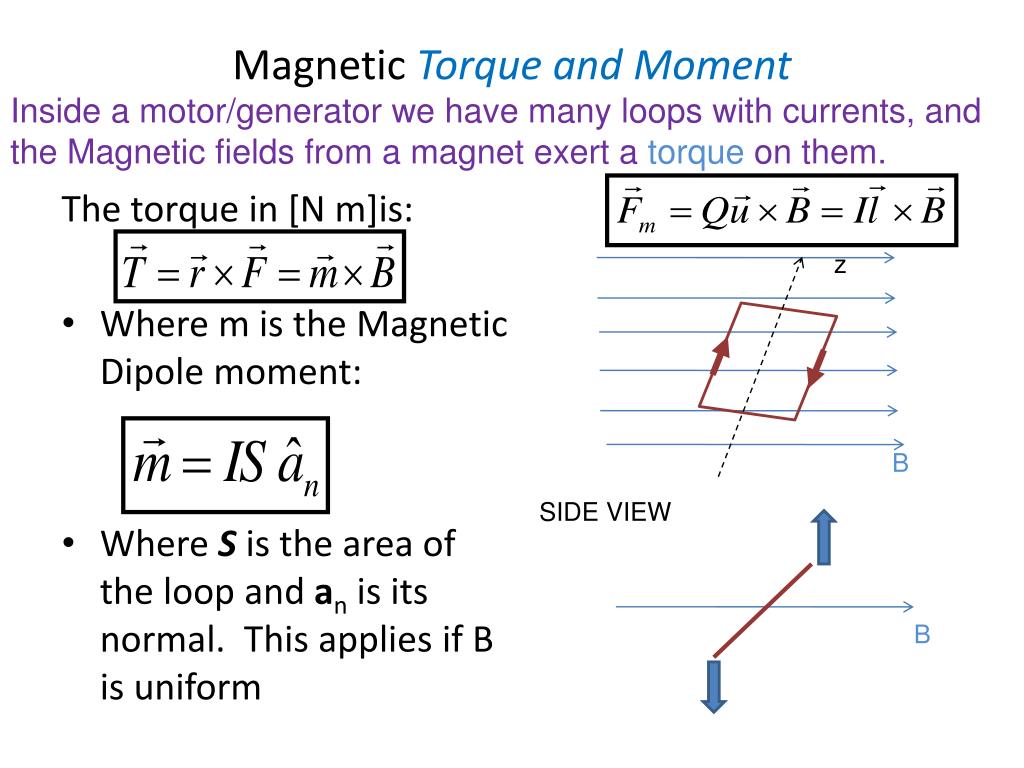
This is directly analogous to the torque on an electric dipole in an electric field , which is given by . This reveals a deep symmetry in electromagnetism.
A Worked Example in Action
Before you tackle some problems yourself, let's watch a clear, step-by-step example of a torque calculation.
Torque on a Current Loop In a Magnetic Field & Magnetic Dipole Moment - Physics
The following video from The Organic Chemistry Tutor demonstrates how to solve a typical torque problem. It starts by identifying the forces, deriving the formula, and then applies it to a specific scenario.
Please watch from 02:27 to 08:23. Pay attention to how the formula \tau = NIAB \sin\theta is applied and how the units are handled, especially the conversion of area from cm² to m².
Applying the Formula: Calculation Practice
Now it's time to put the theory into practice. The best way to get comfortable with this calculation is to work through a few examples with different parameters and geometries.
Torque on Current Loop, Magnetic Dipole
The following resource from CK-12 provides a concise summary and, most importantly, four excellent worked examples. Please study them carefully.
Please navigate to the section titled 'Examples of Torque on Current Loop, Magnetic Dipole'. Work through all four examples. Notice how they handle: A standard rectangular coil (Example 1). A different geometry (a triangular coil, Example 2). Calculating maximum torque (Example 3). A common trap: when the angle is given relative to the plane of the coil instead of the normal vector (Example 4).
After reviewing those examples, you should have a solid grasp of how to approach these calculations.
Test your understanding!
You are designing a small DC motor. The coil is a rectangle with 150 turns, sides of 5 cm and 3 cm, and it will operate in a 0.8 T magnetic field.
- What is the magnitude of the magnetic dipole moment, , when a current of 2.0 A flows through the coil?
- What is the maximum torque the motor can produce?
- If you need to double the maximum torque, but you cannot change the magnetic field or the current, what single change could you make to the coil's geometry?
Show answer
1. Calculate the magnetic dipole moment ():
First, calculate the area of the coil in square meters:
Now, calculate the magnetic moment using :
2. Calculate the maximum torque ():
Maximum torque occurs when , so .
3. Double the torque by changing geometry:
The torque is proportional to the number of turns () and the area (). To double the torque, you could either:
- Double the number of turns to .
- Double the area of the coil to (e.g., by making the sides 5 cm and 6 cm).
Conclusion
In this lesson, you've translated the physics of a DC motor into a concrete calculational skill. We've seen that the torque, the very output of the motor, is a direct and predictable function of its design parameters.
Key Takeaways:
- The torque on a motor's coil can be calculated using the formula .
- Each variable—number of turns (), current (), area (), and magnetic field strength ()—provides a lever to engineer the motor's performance.
- The concept of the magnetic dipole moment () simplifies the torque equation to , a compact vector form that is powerful for analysis.
- Care must be taken with the angle , which is always defined between the magnetic field and the normal to the coil's area.
Preview of the Next Lesson:
We now understand what makes a motor spin. But what happens as it spins faster and faster? Does it draw the same amount of current regardless of its speed? The answer is no, and the reason is a fascinating phenomenon called back-EMF. In our next lesson, we will explore this concept and its crucial role in the self-regulation of a motor's speed and current draw.
Can't find a good explanation? Sign up and we'll make it for you
Sign up