
Hello! Let's continue our exploration of electric motors.
In the last lesson, we uncovered the crucial role of back-EMF. We saw how it self-regulates a motor's speed and current, and we established a fundamental power balance equation: the electrical power you put in gets split between heat loss () and the mechanical power that actually turns the shaft (). This naturally leads to a critical question: how good is a motor at this conversion?
This lesson directly answers that question. Our objective is to: Analyze motor efficiency by relating mechanical power output to electrical power input. We'll start with the foundational DC case and then, drawing on your interest in a more rigorous approach, extend the analysis to AC motors, where concepts like power factor become essential.
Defining Motor Efficiency
At its core, efficiency () is a simple ratio: what you get out versus what you put in. For a motor, this means the ratio of useful mechanical power output to the total electrical power input.
This value, usually expressed as a percentage, tells us how effectively the motor converts electrical energy into mechanical work. An efficiency of 85% means that for every 100 watts of electrical power supplied, 85 watts become useful mechanical power, while the remaining 15 watts are lost, primarily as heat.
Calculating Efficiency: The DC Motor Case
Let's ground this in the concepts from our previous lessons. For a simple DC motor:
- Electrical Power Input (): This is the power drawn from the source, given by , where is the supply voltage and is the current.
- Mechanical Power Output (): This is the power delivered by the rotating shaft. For rotational motion, power is the product of torque () and angular velocity (). So, .
Combining these, the fundamental formula for motor efficiency is:
To make this tangible, let's walk through the process of calculating these values. The following resource explains the necessary formulas and provides a worked example.
The document 'Motor Calculations' provides a clear, step-by-step guide to determining a motor's performance characteristics, including its efficiency. It will show you how to calculate both the mechanical power output and the electrical power input to find the final efficiency value.
First, read the section 'Calculating Mechanical Power Requirements' to understand the formula for mechanical power and the necessary unit conversions. Then, study the 'Sample Calculation' at the end of the document. This example ties everything together by calculating speed, current, mechanical power output, electrical power input, and finally, efficiency. Follow the logic from the given parameters to the final 65% efficiency result.
Where Does the Energy Go? A Closer Look at Losses
The reason efficiency is always less than 100% is due to energy losses. In our simple model, we only considered the heat loss in the armature winding. A more complete picture includes several types of loss, which can be broken down into two main categories.
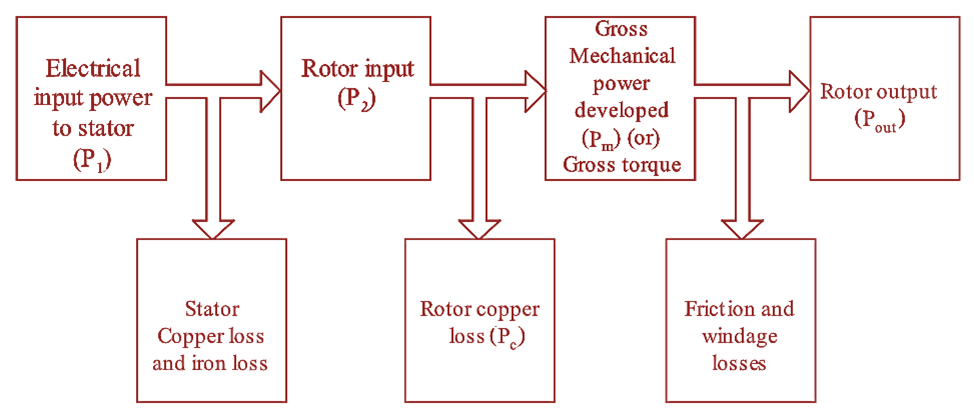
As seen in the diagram, losses are subtracted at each stage of energy conversion. The resource below categorizes these losses.
Determining Motor Load & Efficiency from Measured Data
The document 'Determining Motor Load & Efficiency from Measured Data' provides a good breakdown of the different types of losses in a motor.
Please read the section titled 'MOTOR LOSSES'. This section classifies losses into 'Fixed losses' (magnetic and mechanical) and 'Variable losses' (copper losses), which depend on the motor's load.
These losses mean that a motor's efficiency is not a constant value; it changes with the load. Typically, a motor is most efficient when operating near 75-80% of its rated load. Operating a motor at a very light load is inefficient.
Efficiency in AC Motors: Power Factor vs. Efficiency
The DC model provides a solid foundation, but most industrial motors are AC motors. This introduces an important complication you wanted to explore: the phase difference between voltage and current.
Since motors are inductive loads, the current typically lags the voltage. This gives rise to three distinct types of power:
- Real Power (P): The power that does actual work (turning the shaft, generating heat). Measured in watts (W).
- Reactive Power (Q): The power required to create and sustain the motor's magnetic fields. It doesn't do mechanical work but "sloshes" back and forth between the source and the load. Measured in volt-amperes reactive (VAR).
- Apparent Power (S): The vector sum of real and reactive power. It's the total power that the electrical grid must be able to supply. Measured in volt-amperes (VA).
The ratio between real power and apparent power is the Power Factor (PF).
It is absolutely crucial to distinguish between power factor and efficiency. Your analytical background will appreciate this nuance. Think of them as two sequential filters.
Power Factor and Efficiency in AC Circuits (Full Lecture)
The video 'Power Factor and Efficiency in AC Circuits' by Jim Pytel offers an excellent conceptual framework for distinguishing between these two concepts. It explains how they work together to determine the final useful power output.
Please watch from 03:58 to 05:36 to understand how efficiency is defined in terms of real power. Then, watch from 08:04 to 11:09, which presents a powerful analogy of 'hoops' that apparent power must jump through. This section perfectly clarifies the relationship between power factor and efficiency and includes a quantitative example.
To summarize the "hoops" analogy from the video:
- You start with Apparent Power (), the total power supplied by the utility ().
- It first jumps through the Power Factor hoop. This filters out the non-working reactive power, leaving you with Real Electrical Power (). This is the power actually consumed by the motor. .
- This real electrical power then jumps through the Efficiency hoop. This filters out the internal losses (heat, friction), leaving you with usable Mechanical Power Output (). .
So, power factor describes the efficiency of delivering electrical power to the load, while motor efficiency describes the efficiency of converting that electrical power into mechanical power.
Test your understanding!
An AC motor has a power factor of 0.8 and an efficiency of 90%. If it draws an apparent power of 10 kVA from the grid, what is its useful mechanical power output in kW?
Show answer
-
First Hoop (Power Factor): Calculate the real electrical power input.
-
Second Hoop (Efficiency): Calculate the mechanical power output from the real power input.
The motor delivers 7.2 kW of mechanical power.
Practical Measurement
So how are these values measured in a real-world setting? Engineers use a setup that simultaneously measures the electrical inputs and the mechanical outputs.
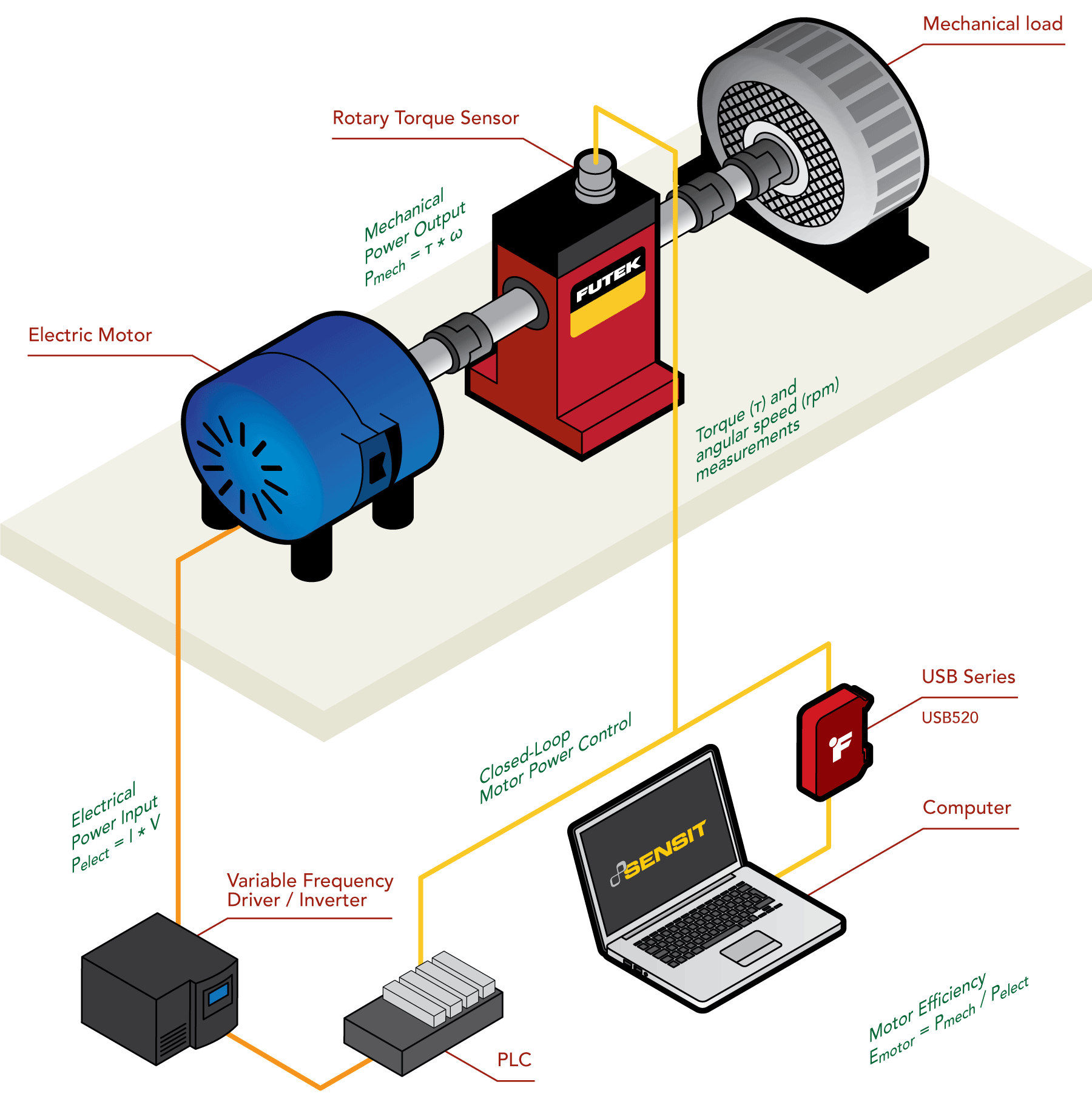
Conclusion
Today, we've quantified the performance of a motor, moving from the simple DC case to the more complete AC analysis.
Key Takeaways:
- Motor efficiency () is the ratio of mechanical power output to electrical power input: .
- Mechanical power output is the product of torque and angular velocity ().
- Inefficiencies arise from losses, which include fixed components (magnetic core, friction) and variable components (load-dependent copper losses).
- In AC motors, it's vital to distinguish power factor from efficiency.
- Power Factor relates real power to apparent power, indicating how effectively current delivers useful electrical power.
- Efficiency relates mechanical output power to the real electrical input power.
- The total conversion from grid power to shaft power involves both of these "filters": .
Preview of the Next Lesson:
We have now built a comprehensive understanding of how individual loads like motors work, how they are rated, and how they consume power. In the next lesson, we will zoom out from the single device to the system that powers it. We will begin our final module, "Applied Power Systems," by exploring the structure that delivers electricity to our homes and industries, aiming to: Describe the basic structure of single-phase and three-phase mains power distribution systems.
Can't find a good explanation? Sign up and we'll make it for you
Sign up