
Hello again! Last time, you learned that a point on a grid has an address, such as , and that the grid has four quadrants. Those addresses will later help us keep track of every corner as a shape moves.
Now we are ready for a big idea: some ways of moving a shape keep it exactly the same, while other changes make it bigger, smaller, stretched, or squished. Today you will learn to tell the difference.
A shape can move without changing
Imagine drawing a triangle on a clear plastic sheet. You can slide the sheet across a table, turn it, or flip it over. The triangle may end up in a different place or face a different way, but it is still the same triangle.
In geometry, a transformation is a rule that changes a figure’s position, direction, size, or shape.
- The shape before the change is the original figure, also called the pre-image.
- The shape after the change is the image.
A corner called on the original figure is often called , read “A prime,” on the image. The prime mark means “the new place of that same corner.”
The most important question for this lesson is:
Did the shape stay the same size and same shape?
If the answer is yes, the move is a rigid transformation. Think of “rigid” as meaning not stretchy. A rigid transformation keeps every side length and every angle the same.
The three rigid moves: slide, flip, and turn
There are three main rigid transformations. The friendly picture below shows all three, plus one important non-rigid change.
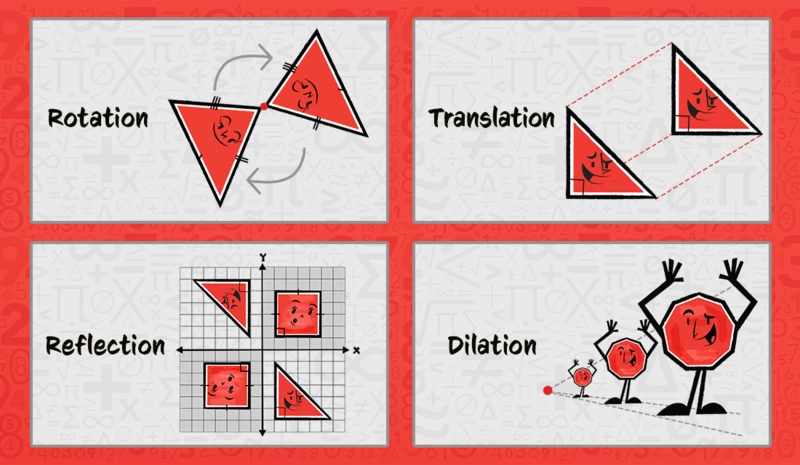
1. Translation: a slide
A translation slides a shape from one spot to another.
Picture pushing a book straight across a table without spinning it. The book changes location, but it does not turn, flip, grow, or shrink.
For a translation:
- Every point moves the same distance.
- Every point moves in the same direction.
- The figure keeps the same size and shape.
- The figure still faces the same way.
For example, if a triangle slides 4 squares right and 2 squares up, every one of its vertices makes that same trip: 4 right and 2 up. You cannot move one corner 4 squares right and another corner 2 squares right—that would stretch or warp the triangle.
2. Reflection: a flip
A reflection flips a shape across a line, called the line of reflection. It works like looking in a mirror.
If you hold up your right hand to a mirror, your reflection appears to lift its left hand. The reflection is not a different-sized version of you. It is a flipped version, equally far from the mirror line.
For a reflection:
- The figure is flipped over a line.
- Each point and its matching image point are equally far from the flip line.
- The figure keeps the same size and shape.
- It may look as if it is facing the opposite way.
A flip is still rigid even though the figure may look “backward.” Nothing has been stretched or cut.
3. Rotation: a turn
A rotation turns a shape around one fixed point, called the center of rotation.
Think about a pin pushed through the center of a paper shape. The paper can spin around the pin. Or picture a turntable: the object turns, but it does not change its size.
To describe a rotation clearly, we need to know:
- Where the center of rotation is
- How far the figure turns, such as
- Which way it turns: clockwise or counterclockwise
For a rotation:
- The figure turns around a fixed point.
- Every point stays the same distance from that center.
- The figure keeps the same size and shape.
Later, you will rotate points on a coordinate grid. For now, focus on recognizing the visual idea: a turn pivots around a point.
Transformations: Translations, Reflections, and Rotations
Watch “Transformations: Translations, Reflections, and Rotations” from Math Defined for a quick visual tour of the three rigid moves. Notice that each example changes a figure’s position or direction without changing its dimensions.
Watch the introduction for the meaning of a rigid movement. Then watch the slide, the flip, and the turn. In each example, look for what stays unchanged: the side lengths, angles, and overall size of the figure.
The “same-shape test”
A rigid transformation may make a figure look different at first glance because it has moved or turned. But you could pick it up and place it exactly on top of its image. Every corner and side would match.
Use this test:
If I could move the original shape by only sliding, flipping, or turning it until it lies exactly on the new shape, the transformation is rigid.
Here is what remains unchanged in every rigid transformation:
| What we check | After a slide, flip, or turn |
|---|---|
| Side lengths | Stay the same |
| Angle sizes | Stay the same |
| Overall shape | Stays the same |
| Overall size | Stays the same |
| Location on the grid | May change |
| Direction it faces | May change |
Notice the last two rows. A rigid move is allowed to change where the shape is and which way it faces. It is not allowed to change its measurements.
A shape and its rigidly moved image are called congruent. That word means they have the same size and shape. We will study congruence much more carefully later in the course.
Not every transformation is rigid
Now for the opposite idea. Some transformations change a figure’s size or shape. These are non-rigid transformations.
Dilation: resizing
A dilation makes a figure larger or smaller from a center point. It is a resizing transformation.
In the bottom-right panel of the image, the red character becomes larger and larger. It still has a similar outline, but its side lengths have changed. That means it is not a rigid transformation.
A dilation can:
- Enlarge a shape
- Shrink a shape
- Keep the same general shape
But it does not keep the same size. So a dilation is not rigid.
For example, a square with sides 2 units long might become a square with sides 4 units long. Both are squares, but the second one is larger. You could not place one exactly on top of the other without resizing one of them.
Distortion: stretching, squishing, or warping
A figure can also be changed by distortion. This means the shape itself is altered.
Imagine pulling one side of a square outward. It may become a long rectangle. Or imagine squishing a circle until it becomes an oval. These changes are not rigid because at least some lengths or angles have changed.
| Change | Rigid or non-rigid? | Why? |
|---|---|---|
| Slide a triangle 3 squares right | Rigid | Same shape and size |
| Flip a letter across a mirror line | Rigid | Same shape and size |
| Turn a rectangle around a point | Rigid | Same shape and size |
| Make a triangle twice as large | Non-rigid | Size changed |
| Stretch a square into a rectangle | Non-rigid | Shape changed |
| Squish a circle into an oval | Non-rigid | Shape changed |
A careful comparison
Sometimes a change can be tricky to identify. Here are clues that help.
“It moved somewhere else.”
That alone does not tell you which transformation happened. A slide, flip, or turn all move a shape somehow. Look for the special action:
- It travels straight without turning: translation
- It looks mirrored across a line: reflection
- It pivots around a point: rotation
“It looks different because it is sideways.”
That can still be rigid. A sideways book is still the same book. A rotated rectangle may look tall instead of wide, but its side lengths have not changed.
“It is bigger, so it must be a slide.”
No. Slides never make a shape bigger or smaller. If size changes, it is not a rigid transformation.
“It is flipped, so it must be stretched.”
No. A reflection reverses the figure’s direction, but it keeps all its measurements exactly the same. A mirror image is a flip, not a stretch.
A simple sorting routine
When you see an original figure and an image, follow this routine:
- Check the size. Is one clearly bigger or smaller?
- Check the shape. Has it been stretched, squished, bent, or otherwise changed?
- If size and shape are both unchanged, identify the movement:
- straight move: translation
- mirror move: reflection
- pivoting move: rotation
- If size or shape changed, say it is non-rigid.
You do not have to know coordinate rules yet to make this decision. Your eyes can often spot the difference first. In the next module, the coordinate grid will give you a precise way to perform slides and flips.
Key takeaways
A transformation changes a figure in some way. The original figure is the pre-image, and the new one is the image.
The three main rigid transformations are:
- Translation: slide
- Reflection: flip across a line
- Rotation: turn around a point
All rigid transformations preserve a figure’s side lengths, angles, size, and shape. They may change its location or the direction it faces.
A dilation resizes a figure, and a distortion stretches or squishes it. Because these changes alter size or shape, they are non-rigid.
Next, you will begin working with translations on the coordinate grid: using a rule to slide every corner of a polygon by the same amount.
Can't find a good explanation? Sign up and we'll make it for you
Sign up