
Hello. In the previous lesson, you prioritized the authorization-aware cited evidence assistant as the strongest initial use case for the enterprise intelligence platform. It earned that position because it supports a concrete Strategic Operations task, can be bounded as decision support rather than automated funding judgment, and creates reusable foundations for retrieval, citations, permissions, and evaluation.
A sound use case still fails if the people who control funding, source data, operational adoption, or risk approval are treated as afterthoughts. This lesson turns the selected MVP into a stakeholder map: a practical view of who can enable, constrain, approve, adopt, or stop the initiative, what each party needs, and how you will engage them.
By the end, you will have a first stakeholder register and a clear assignment of decision rights for funding, data access, adoption, and AI governance.
Stakeholder mapping: trace the controls, not just the org chart
A stakeholder is anyone who can affect the initiative, is affected by it, or can influence those who are. For an AI platform, that definition is wider than the delivery team and executive sponsor.
The most useful starting question is not “Who should be kept informed?” Instead, ask:
Who controls a resource, decision, policy, or behavior that the MVP requires?
For the enterprise intelligence platform, trace four control surfaces.
| Control surface | The decision to map | Typical stakeholders |
|---|---|---|
| Funding | Who approves discovery, MVP, scale-up, and ongoing operating spend? | Executive sponsor, portfolio leader, finance or FinOps partner, procurement |
| Data access | Who can authorize use of each source, define permitted users, and resolve quality issues? | Data owner, data steward, records manager, IAM or data-platform team |
| Adoption | Who owns the affected workflow, accepts the product, and shapes whether users actually change behavior? | Business product owner, Strategic Operations leaders, analysts, change lead, user representatives |
| Governance | Who sets and approves controls for privacy, security, legal compliance, model risk, and responsible AI? | Security, privacy, legal, risk, AI-governance group, internal audit, compliance |
A person or role can influence more than one surface. For example, an executive sponsor may release funding and chair governance discussions. A data owner can authorize a source while also insisting on retention, classification, and audit requirements. Mapping these overlaps early prevents a common failure mode: a team has sponsor support and a working prototype, but cannot legally or operationally connect the data that makes the prototype useful.
The map should identify named people behind roles once your organizational context is known. “IT,” “Legal,” or “the business” is too vague to act on. A department may contain a decision-maker, a subject-matter expert, an implementer, and an opponent, all with different needs.
Prioritize attention with power and interest
The classic power–interest grid gives the team a disciplined way to decide where its limited engagement effort belongs.
- Power is a stakeholder’s authority or practical ability to accelerate, constrain, redirect, or stop work.
- Interest is the extent to which the initiative affects their objectives, performance measures, workload, risk exposure, or professional concerns.
The grid is not a moral ranking. Low power does not mean low importance. Analysts with low formal authority may determine whether the platform becomes part of the actual decision workflow; data stewards may uncover the provenance issue that prevents a source from being used safely.
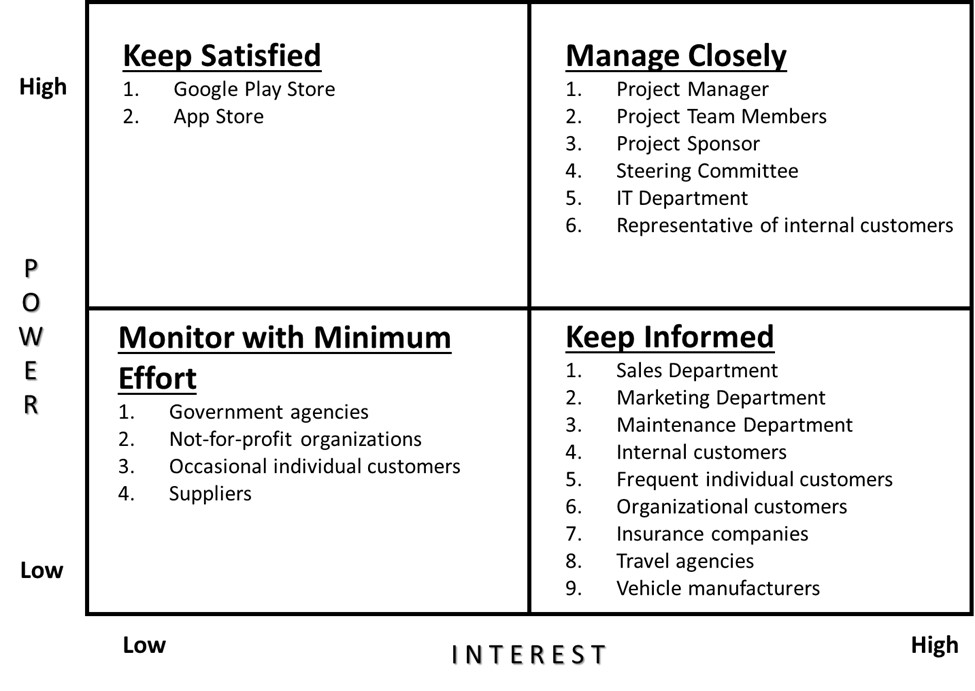
The four engagement defaults are useful, but they are only defaults:
| Power and interest | Engagement posture | What it means for the capstone |
|---|---|---|
| High power, high interest | Manage closely | Involve them in real decisions, not merely status reporting. Seek agreement on scope, controls, milestones, and escalation. |
| High power, low interest | Keep satisfied | Provide concise, decision-relevant evidence. Do not create avoidable concern through surprises or unnecessary operational detail. |
| Low power, high interest | Keep informed | Create structured ways to surface workflow friction, data-quality concerns, and adoption barriers. |
| Low power, low interest | Monitor | Maintain awareness, but avoid using communication volume as a substitute for meaningful engagement. |
A high-interest stakeholder may be supportive, neutral, or strongly opposed. Interest is not support. An operations manager might be highly interested precisely because they believe the platform will add review burden or threaten professional judgment. Your register must capture both their current posture and the support level required for success.
5.2 Stakeholder Analysis – Project Management
Read the relevant parts of Stakeholder Analysis from the Pressbooks project-management text. It supplies the core power–interest method, then extends it with a living stakeholder register and a RACI responsibility model.
In Chapter 5, Section 5.2, begin with the grid overview. Focus on how the text distinguishes authority from concern and on the engagement strategy for each quadrant. Then find the subsection titled “Stakeholder Register” and read the register discussion, including its example columns. Finally, in the subsection “Responsibility Assignment Matrix (RACI Chart)”, read the RACI explanation. Notice the principle that each decision or activity should have one accountable role.
For this MVP, do not assume the grid position from a job title alone. Validate it with evidence:
- What can this role approve, reject, or delay?
- What budget, data, people, policy interpretation, or technical control does it command?
- How will success or failure affect this person’s objectives?
- Has this group supported or resisted similar change before?
- Who influences this stakeholder’s view?
A finance leader may have high power over the next funding gate but little desire to attend product design meetings. Conversely, the business product owner has high interest and often high power over acceptance, even when they do not control the infrastructure budget.
Build the platform’s first stakeholder register
Start with roles, then replace them with real names and contact paths. The table below is a provisional map for the cited evidence assistant, not a claim about any particular organization.
Use these symbols:
- F — funding
- D — data access and quality
- A — workflow adoption
- G — governance and risk
| Stakeholder role | Primary control or decision | Levers | Likely position | Engagement commitment |
|---|---|---|---|---|
| Executive sponsor | Approves MVP investment, removes cross-functional barriers, decides continuation after pilot | F, G | High power, high interest | Monthly decision review; concise evidence on value, risks, dependencies, and requested decisions |
| Business product owner, Strategic Operations | Defines workflow scope, prioritizes requirements, accepts the pilot experience | A | High power, high interest | Weekly product review; approves pilot workflow and adoption criteria |
| Portfolio or operations leader | Releases representative users and determines whether the workflow can change | F, A | High power, high interest | Early alignment on time commitments, decision rights, and pilot success measures |
| Finance or cloud-financial-management partner | Validates budget assumptions, cost tracking, and scale economics | F | High power, variable interest | Engage at funding gates; provide spend forecast, cost tags, and cost-per-use assumptions |
| Data owner for each source | Authorizes permissible use, users, retention conditions, and source-level access | D, G | High power, high interest | Source-onboarding agreement; approve access rules, classification, and use boundary before ingestion |
| Data steward or source subject-matter expert | Clarifies source meaning, quality, freshness, metadata, and exceptions | D | Moderate power, high interest | Working sessions during source onboarding; create source definitions and quality checks |
| Data platform, IAM, or security architecture lead | Implements identity, access enforcement, logging, and secure data flows | D, G | High power, high interest | Technical design review; test authorization behavior before user pilot |
| Privacy, legal, records, and compliance partners | Interpret privacy, retention, intellectual-property, regulatory, and records obligations | G, D | High power, variable interest | Provide an early use-case and data-flow brief; seek written conditions rather than late-stage approval |
| AI governance or model-risk lead | Defines acceptable use, evaluation evidence, monitoring, and escalation thresholds | G | High power, high interest | Review intended use, residual risks, model/provider choices, and pilot exit criteria |
| Representative analysts and directors | Determine practical usefulness, citation usability, trust, and workflow fit | A | Low formal power, high interest | Interviews, prototype tests, pilot feedback, and a clear channel to report failures |
| Change or enablement lead | Coordinates communications, training, support materials, and feedback loops | A | Moderate power, high interest | Co-design rollout, training, and adoption measurement before pilot launch |
| Procurement and vendor management | Negotiate model-provider terms, data-processing commitments, and exit provisions | F, G | Moderate to high power, variable interest | Engage before commitments; provide anticipated model usage, data categories, and vendor dependencies |
| Internal audit | Assesses evidence that controls operate as claimed | G | High power, low to moderate interest | Keep satisfied through auditable records: approvals, access logs, evaluation results, and decision history |
This is deliberately more specific than a generic “stakeholder list.” Each row identifies a control, not merely an audience.
Notice two crucial distinctions:
-
The data owner is not necessarily the data steward.
The owner is usually senior enough to be accountable for the meaning, quality, and appropriate management of a data domain. The steward provides the day-to-day domain expertise: defining terms, maintaining metadata, investigating quality issues, and identifying exceptions. -
The technical custodian is not necessarily authorized to grant data use.
An engineering or platform team may be able to configure a connection, but should not invent the policy that makes restricted material permissible for an AI system. Technical implementation must follow an explicit owner-approved access decision.
What is the difference between Data Owners and Data Stewards?
Watch What is the difference between Data Owners and Data Stewards? from The Data Governance Coach for a concise distinction between executive accountability and day-to-day data stewardship.
Watch data owners for the accountability, authority, and resourcing expectations of the owner role. Continue with data stewards to see the operational responsibilities of a steward, then watch both roles for why senior accountability and domain expertise should work together.
Turn the map into decision rights
A stakeholder map identifies influence; it does not by itself resolve who decides. The next step is to map the few decisions that could otherwise create delay or ambiguity.
Use RACI carefully:
- Responsible performs the work.
- Accountable makes the final decision and answers for the result.
- Consulted gives input before the decision.
- Informed receives the decision and relevant progress.
For each decision, assign one and only one Accountable role. Multiple parties may need to agree under a formal policy, but the delivery team still needs a clear route for assembling the decision, documenting it, and escalating disagreement.
Here is a lean decision-rights view for the initial MVP.
| Decision | Accountable | Responsible | Consulted | Informed |
|---|---|---|---|---|
| Approve MVP funding and pilot boundary | Executive sponsor | Product owner and delivery lead | Finance partner, governance lead, portfolio leader | Delivery team and user representatives |
| Approve a source for ingestion and retrieval | Data owner for that source | Data steward and data engineering lead | Privacy, legal, security, records management, product owner | AI-governance lead and affected users |
| Configure and verify permission-aware retrieval | Security or platform architecture lead | Engineering team | Data owner, IAM team, privacy partner | Product owner and governance lead |
| Approve workflow readiness and user-pilot entry | Business product owner | Change lead and delivery lead | Representative analysts, operations leader, support team | Executive sponsor |
| Approve responsible-AI controls and pilot exit criteria | AI-governance or model-risk lead | Delivery lead | Security, legal, privacy, data owners, product owner | Executive sponsor and internal audit |
| Decide whether to scale, revise, or stop after the pilot | Executive sponsor | Product owner | Finance, governance, data owners, user representatives | Wider stakeholder community |
The final row protects against “pilot inertia.” A pilot should not become a production service merely because it is technically functional. The sponsor’s scale decision should use the outcomes already established: reduced evidence-preparation time, improved traceability, actual use by the intended audience, and no breach of defined safety or access-control guardrails.
For each high-stakes decision, create a short decision packet:
- Decision requested — stated in one sentence.
- Decision owner — the accountable role and escalation path.
- Evidence — metrics, user research, source inventory, test results, cost estimate, or risk assessment.
- Options and trade-offs — including the option to defer or stop.
- Conditions — controls or dependencies required for approval.
- Recorded outcome — decision, rationale, date, and review trigger.
This makes governance an operating discipline rather than a late-stage approval ritual.
Governance is cross-functional operating design
AI governance cannot be delegated solely to legal, security, or the technical team. The platform combines organizational policy, enterprise data, user behavior, model-provider capabilities, and potentially consequential portfolio decisions. Governance must therefore bring together the functions that hold those perspectives.
AWS’s AI governance guidance frames stakeholder identification as the first step in establishing a cross-business-unit practice. Its emphasis is especially relevant here: scalable governance covers responsible use, risk, data curation, cost management, monitoring, and policy revision—not just an initial review of a model.
Governance perspective: Managing an AI-driven ...
Read the selected sections of AWS’s Governance perspective: Managing an AI-driven organization. They connect AI governance to cross-functional ownership, data stewardship, and ongoing responsible-use controls.
At the beginning of the page, read the governance foundation. Focus on the stated responsibilities of the multi-business-unit team: goals, policies, monitoring, and policy revision. Next, in “Data curation,” read from the data-governance discussion. Relate the recommendation for direct dataset owners and stewards to each source planned for the evidence assistant. Finally, locate “Risk management” and read the governance-board guidance. Identify which of the listed functions are required in your context and which can be consulted only for the initial MVP.
The goal is proportionality. A narrowly scoped, internal decision-support pilot does not need a large committee to approve every prompt revision. It does need clear answers to questions such as:
- Which users can retrieve which sources?
- What kinds of content are prohibited from ingestion or model-provider transmission?
- What evidence demonstrates that citations support generated claims?
- Who can accept residual risks for the pilot?
- Which signals require pause, rollback, or escalation?
- Who owns cost and provider-risk decisions as usage scales?
For the cited evidence assistant, the governance boundary should remain explicit:
The platform may retrieve approved sources, synthesize evidence, and show verifiable citations for authorized users. It does not independently determine portfolio funding decisions, override source permissions, or take consequential actions.
That boundary lets stakeholders assess the proposal they are actually being asked to support.
Produce a usable first version this week
Your initial stakeholder map should fit on one or two pages. It is a living operating artifact, not a one-time slide.
Use this sequence:
-
List the four control surfaces.
Write the exact upcoming decisions for funding, each planned data source, pilot adoption, and governance approval. -
Identify roles and then name the people.
For every decision, identify the accountable owner, the people who do the work, and the most important consulted parties. Do not leave “Legal,” “IT,” or “Data” as undifferentiated labels. -
Place stakeholders provisionally on the power–interest grid.
Record the evidence behind each placement. Revise it after interviews; a stakeholder’s actual influence is often different from the org chart. -
Record current and required support.
Use a simple scale such as actively supportive, supportive, neutral, opposed, or actively opposed. Treat uncertainty as a reason for a conversation, not as support. -
Define a concrete engagement commitment.
Replace “communicate regularly” with an artifact and cadence: a weekly source-onboarding session, monthly sponsor decision review, prototype test, risk review, or written approval. -
Create the minimum RACI table.
Include at least MVP funding, data-source approval, access-control verification, pilot entry, responsible-AI approval, and pilot scale decision. -
Set a review rhythm.
Revisit the register at least monthly during discovery and at major gates such as source onboarding, pilot launch, and pilot review. New data sources, a change in model provider, or an expanded user group can change both the stakeholder set and its risk profile.
A useful definition of done is:
Every required funding, data-access, adoption, and governance decision has one accountable owner; affected users and subject-matter experts have a defined input channel; key stakeholders have an engagement commitment; and unresolved ownership conflicts have an escalation path.
Key takeaways
A stakeholder map for an AI initiative is more than a communications plan. It reveals the people who control the resources and decisions required to make the platform viable.
For the enterprise intelligence platform:
- map stakeholders through funding, data access, adoption, and governance;
- use the power–interest grid to prioritize engagement, while separately tracking each stakeholder’s current and desired support;
- distinguish data owners who authorize and are accountable for data use from data stewards who supply day-to-day domain knowledge and quality oversight;
- translate influence into executable decision rights with a RACI, assigning one accountable owner for every material decision;
- treat the register as a living artifact, updating it as scope, data, risks, and organizational support change.
Next, you will estimate a baseline value hypothesis for the prioritized cited evidence assistant: turning the proposed reduction in evidence-preparation effort and improvement in traceability into an initial, testable investment case.
Can't find a good explanation? Sign up and we'll make it for you
Sign up