
Hello. This course is designed to turn the broad work you already do—implementation, client relationships, risk management, process design, executive communication, and operational planning—into a clear professional profile that travels well across onboarding, implementation, customer success, and program-management roles.
This first module focuses on role positioning. Today’s goal is to distinguish four titles that often overlap in job postings: Head of Onboarding, Implementation Manager, Senior Customer Success Manager, and Customer Success Program Manager. The key is not memorizing titles. It is learning to identify each role’s center of accountability and the evidence an employer expects from a candidate.
Titles overlap; accountability differentiates them
A title is a weak signal on its own. At a smaller company, an “Onboarding Success Manager” may own implementations, renewal risk, process design, capacity planning, and executive reporting. At a larger SaaS company, those responsibilities might be split among an Implementation Manager, CSM, Customer Success Operations team, and onboarding leader.
To read roles accurately, look for four things:
- Primary outcome: What business result does this person own?
- Scope: Do they own individual clients, a portfolio, a process, a team, or a whole function?
- Time horizon: Is their work concentrated around launch, the ongoing customer lifecycle, or long-term operational scale?
- Authority: Are they coordinating work, setting standards, managing people, or making functional trade-offs?
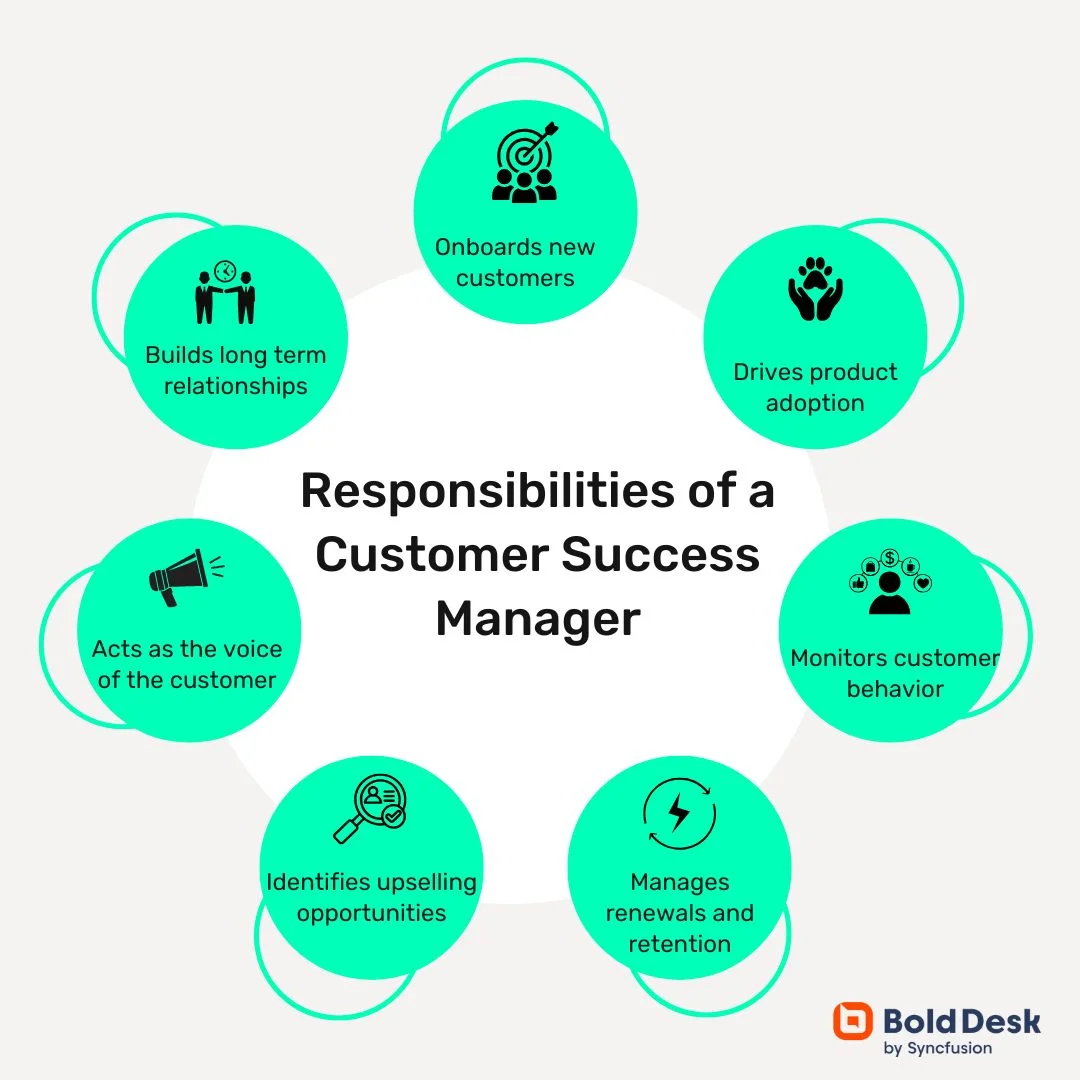
The responsibilities graphic below is a useful reminder that customer-facing roles often touch the same activities. It should not be read as a job-title definition: onboarding, adoption, retention, relationship building, feedback, and expansion can sit in different roles depending on the company.
A practical distinction is this:
- Implementation asks: Can this client be deployed successfully, on time, and within an agreed scope?
- Customer Success asks: Is this client realizing value and likely to retain or grow?
- Customer Success Program Management asks: Can the organization run these customer-success motions consistently and at scale?
- Head of Onboarding asks: Is the entire onboarding function producing business outcomes, and is it built to scale?
The four roles at a glance
| Role | Center of accountability | Typical scope | Common success measures | What the employer is really hiring for |
|---|---|---|---|---|
| Implementation Manager | A successful client deployment | Multiple concurrent projects, often from discovery through go-live | Time to launch, milestone completion, scope control, implementation CSAT, budget or utilization where relevant | A client-facing project leader who can convert needs into a workable delivery plan |
| Senior Customer Success Manager | Sustained customer value and commercial health | A portfolio of accounts after launch, sometimes including strategic onboarding involvement | Adoption, customer health, retention, renewal rate, expansion, CSAT or NPS | A strategic advisor who can influence stakeholders and prevent value or renewal risk |
| Customer Success Program Manager | A repeatable, measurable customer-success operating system | Cross-functional programs, processes, tooling, data, and enablement | Program adoption, process efficiency, data quality, coverage, team productivity, improvement in success metrics | An operator who can design systems, lead change without formal authority, and make work scalable |
| Head of Onboarding | The performance and evolution of the onboarding function | End-to-end onboarding journey, delivery model, team, capacity, systems, and strategy | Activation, time-to-value, early retention, onboarding CSAT, capacity, cost to serve, engagement | A functional leader who can build a team and operating model that improves business outcomes |
The same person may perform pieces of all four roles in a lean organization. The distinction lies in what they are formally accountable for, what decisions they are trusted to make, and the evidence they can show.
Implementation Manager: delivering a defined change
An Implementation Manager is typically responsible for moving a customer from a signed agreement to a functioning solution. This is a delivery role with a defined beginning and end. It involves project planning, requirements discovery, solution design, configuration, testing, training, launch readiness, and a clean transition to ongoing support or success.
PeopleGrove’s Implementation Manager posting captures this well: it emphasizes managing several client projects, planning timelines and deliverables, surfacing risks and dependencies, facilitating requirements discussions, guiding solution decisions, and coordinating readiness before launch.
Implementation Manager - PeopleGrove
Read the PeopleGrove job description to see how an employer combines project delivery, client leadership, solution design, and cross-functional coordination in an Implementation Manager role.
In the “Key Responsibilities” section, begin with the paragraph that starts “Manage multiple concurrent client projects” and read the implementation-management responsibilities. Then continue through “Client & Stakeholder Management,” “Solution Design & Documentation,” and “Cross-Functional Collaboration.” In “Requirements & Qualifications” and “Technical and Professional Skills,” identify the proof points an applicant would need: complex project ownership, project planning, risk management, communication, solution design, and cross-functional influence.
What makes this role distinct
An Implementation Manager is not merely an administrator of a project plan. The stronger version of the role interprets client needs, surfaces trade-offs, and makes sure the solution can actually be delivered.
For example, consider a client that wants to launch a new regulated advertising workflow quickly but has incomplete creative approvals and unclear platform requirements. An implementation-oriented leader would:
- clarify the contracted scope and launch criteria;
- identify dependencies such as client approvals, asset access, configuration, and internal specialist availability;
- make schedule risk visible early;
- facilitate decisions about what must be ready for launch versus what can follow later; and
- maintain an accurate project plan and status narrative.
That is close to much of your existing work: redesigning onboarding processes, managing implementation plans, coordinating stakeholders, escalating risks, and reporting to executives. Your experience with regulated marketing also creates valuable evidence of operating under constraints rather than simply following a generic workflow.
Hiring signals for an Implementation Manager
Employers commonly look for evidence that you can:
- manage several projects with competing deadlines;
- translate customer goals into requirements, milestones, and decisions;
- run client-facing meetings and maintain expectations;
- manage risks, issues, scope changes, and dependencies;
- coordinate Sales, Product, technical teams, delivery teams, and client stakeholders;
- use a project-management platform such as Asana, Monday.com, Jira, or a comparable system;
- document decisions, requirements, and implementation processes; and
- finish a project with a usable handoff rather than treating go-live as the end of accountability.
A good résumé or interview signal is specific: “Owned a portfolio of X concurrent implementations” is stronger than “managed onboarding.” Stronger still is a statement that names a delivery result, such as an improvement in time to launch, fewer avoidable delays, or clearer accountability at handoff.
Senior Customer Success Manager: sustaining value after launch
A Senior Customer Success Manager has a different center of gravity. Rather than being primarily accountable for implementation execution, the Senior CSM is accountable for whether customers achieve their desired outcomes over time.
They may participate in onboarding, especially for strategic accounts. But their work continues well beyond launch: defining success plans, interpreting usage or performance data, building executive relationships, identifying adoption barriers, managing risk, preparing for renewals, and sometimes partnering on expansion opportunities.
Customer Success Manager career path, skills, and responsibilities
Watch “Customer Success Manager career path, skills, and responsibilities” from Build+ for a concise view of the CSM’s outcome-focused and proactive role. Treat the video’s emphasis on “vendor lock-in” critically: the professional objective is ethical, demonstrable customer value that supports retention—not making departure artificially difficult.
Watch the core role for the connection between customer outcomes, implementation guidance, and ongoing value. Then watch the metrics to distinguish retention, satisfaction, renewal, and expansion measures from implementation delivery measures. Finish with the skills, focusing on proactive risk detection, metric interpretation, listening, coaching, and clear communication.
What “senior” usually adds
The word senior usually means more than a larger account list. It often signals greater ambiguity and influence. A Senior CSM may be expected to:
- own strategic or complex accounts;
- communicate credibly with executive stakeholders;
- diagnose why adoption or outcomes are lagging;
- coordinate internal action without directly managing the people involved;
- handle escalations and renewal risk;
- lead business reviews or value reviews;
- mentor less-experienced CSMs; and
- improve how the broader team works.
The role can include commercial responsibilities, but the degree varies. Some companies expect CSMs to contribute directly to renewals and expansion; others have an Account Management or Sales team that owns the commercial transaction. Therefore, never assume that “Senior CSM” means either quota-carrying salesperson or purely noncommercial relationship manager. Read the metrics and ownership language in the posting.
Hiring signals for a Senior CSM
Look for evidence of:
- managing a portfolio of accounts, especially complex or strategic ones;
- creating measurable success plans tied to customer goals;
- improving adoption, engagement, retention, or renewal outcomes;
- interpreting customer data and turning it into a recommendation;
- conducting executive business reviews;
- influencing Product, Support, Sales, and delivery teams for the customer’s benefit;
- recognizing risk before it becomes an escalation; and
- communicating a difficult truth without losing trust.
Your early-retention tracking and executive stakeholder work are useful bridges toward this role. To position yourself as a Senior CSM, you would frame onboarding not only as “getting clients launched,” but also as “creating the conditions for early value realization and retention.”
Customer Success Program Manager: building the system behind the work
A Customer Success Program Manager is frequently misunderstood because the title can sound like “CSM with project-management duties.” In most companies, it is different: the role owns programs that enable many CSMs or onboarding specialists to work more effectively and consistently.
This person may not own a conventional book of business. Instead, they might design a customer-health program, standardize onboarding milestones, implement a risk-review cadence, launch a new success-plan template, improve CRM data quality, create enablement materials, or manage a cross-functional initiative to improve activation.
Think of the role as owning the operating system, not necessarily every individual customer interaction.
A concrete contrast
Suppose leadership wants to reduce delayed launches and improve early retention.
- An Implementation Manager may rescue delayed projects, update plans, coordinate dependencies, and launch clients successfully.
- A Senior CSM may work with affected customers after launch to restore confidence, adoption, and value.
- A Customer Success Program Manager may analyze delay patterns across the customer base, redesign handoff fields and milestone definitions, implement standardized risk flags, train teams on the new process, and measure whether the change worked.
- A Head of Onboarding decides whether this problem deserves investment, sets the target, allocates team capacity, establishes accountability across functions, and owns the business result.
Hiring signals for a Customer Success Program Manager
Employers commonly seek a person who can work across teams without relying on direct reporting authority. Signals include:
- building repeatable processes, playbooks, and operating cadences;
- defining success measures before launching a program;
- analyzing operational data and translating it into a recommendation;
- improving CRM, project-management, customer-success, or reporting workflows;
- planning and driving cross-functional change;
- creating enablement that people actually adopt;
- managing several linked initiatives with clear owners and deadlines; and
- documenting decisions, workflows, and outcomes.
This role is particularly portable because it combines program management, customer operations, process improvement, and data-informed decision-making. It aligns with your current ownership of onboarding playbooks, capacity planning, KPIs, cross-functional coordination, and strategic decisions. Building stronger Google Sheets analysis skills will make this profile more credible, which is why the course later focuses on lookups, pivots, dashboards, and operational metrics.
Head of Onboarding: owning the function, not just the projects
A Head of Onboarding is accountable for the performance of onboarding as a business function. At larger firms, the equivalent title may be Director of Customer Onboarding, Director of Implementation, or VP of Professional Services. At a smaller company, the title may be “Head of Onboarding” even when the person remains hands-on with customers.
The crucial shift is from asking, “Did I deliver this implementation?” to asking, “Is our onboarding model capable of producing reliable activation, early value, and retention as demand grows?”
Jobber’s Director, Customer Onboarding posting makes the leadership scope explicit: the role owns the journey from implementation to early success, scales different delivery models, sets performance targets, develops dashboards, improves tooling, and leads a growing team.
Director, Customer Onboarding @ Jobber
Read Jobber’s Director, Customer Onboarding posting as a practical proxy for a Head of Onboarding role. It shows how responsibility expands from individual project delivery to team leadership, operating-model design, measurement, and functional strategy.
Start in “The role” and “Team Leadership & Development” to identify the leadership scope. In “Customer Experience & Operational Strategy,” read the operating-model expectations. Then read all of “Performance, Tooling, and Measurement,” noting which metrics and systems are owned at this level. Finish with “To be successful, you should have,” especially the qualification signals.
The Head-level accountability shift
A Head of Onboarding usually owns five connected areas:
- Customer outcomes: activation, time-to-value, engagement, early retention, and onboarding experience.
- Delivery model: deciding what should be one-to-one, one-to-many, self-guided, or technology-assisted; and defining which clients receive which level of support.
- Operational performance: capacity, quality standards, process consistency, tooling, dashboards, and cost to serve.
- People and capability: hiring where applicable, coaching, role design, performance expectations, enablement, and succession coverage.
- Cross-functional alignment: making Sales commitments, product limitations, support handoffs, and customer feedback visible and actionable.
A Head of Onboarding may still step into a high-risk implementation, but that is not the core reason they are hired. They are hired to ensure the system does not depend on repeated heroics.
Hiring signals for a Head of Onboarding
The strongest signals are evidence that you have led at the level of a function:
- improved onboarding outcomes across a group of customers, not just one account;
- designed and scaled a repeatable onboarding process or tiered delivery model;
- established KPIs, dashboard reporting, and performance targets;
- forecasted capacity or made staffing and prioritization recommendations;
- led people directly, coached peers, or created a performance framework;
- influenced executives and peers across Sales, Product, RevOps, Enablement, and Support;
- made strategic trade-offs between quality, speed, client complexity, and cost; and
- connected onboarding performance to retention or revenue outcomes.
You have some credible evidence already: process redesign, KPI ownership, capacity planning, executive reporting, strategic decision-making, and prior supervision of four people. The most likely evidence gap is not whether you can run complex onboarding work; it is whether you can document function-level impact with data and whether you can show a repeatable leadership model despite currently working as a solo owner.
A hiring manager’s practical scorecard
A hiring manager will often translate a résumé into a simple question: What have you already been trusted to own? Use this scorecard when evaluating roles and describing your work.
| If the posting emphasizes… | It is probably closest to… | Evidence to foreground |
|---|---|---|
| Project plans, requirements, configuration, go-live, scope, dependencies, client workshops | Implementation Manager | Concurrent implementation ownership, launch planning, risk management, stakeholder coordination, delivery results |
| Adoption, customer outcomes, health, renewals, executive relationships, retention, expansion | Senior Customer Success Manager | Success planning, strategic stakeholder management, risk prevention, adoption or retention impact |
| Playbooks, operating cadence, workflows, systems, change management, enablement, reporting | Customer Success Program Manager | Process redesign, cross-functional programs, standardization, KPI definition, dashboard or workflow improvements |
| Team design, performance targets, capacity, scalable delivery models, functional strategy, executive influence | Head of Onboarding | Leadership, scaled process design, functional metrics, capacity planning, organizational decision-making |
The most useful language is the language of scope and outcome. Compare these statements:
- “Managed onboarding for new clients.”
- “Owned end-to-end onboarding plans for complex clients, coordinating internal and client executives to surface delivery risks and protect launch timelines.”
- “Redesigned onboarding operating practices, including playbooks, risk visibility, and capacity planning, to improve consistency across a changing client portfolio.”
The first describes activity. The second signals implementation leadership. The third signals program and functional leadership.
Positioning your current work without overstating it
Your current role appears to span several categories. That is an advantage if you describe it accurately.
You can reasonably position your work as:
- Implementation leadership when discussing project plans, implementation strategy, launch readiness, risk management, milestones, and client delivery.
- Senior CSM-level capability when discussing executive relationships, client outcomes, early retention, escalations, and strategic client communication.
- Customer Success Program Management when discussing playbooks, KPI design, capacity planning, process redesign, and cross-functional operating improvements.
- Emerging Head of Onboarding capability when discussing ownership of the end-to-end function, strategic decisions, executive reporting, and your previous people-management experience.
Avoid claiming a Head of Onboarding role solely because you perform many tasks alone. A Head-level claim becomes persuasive when you can show that you set a direction, built a repeatable model, measured performance, influenced resource decisions, and improved outcomes beyond individual accounts.
A concise professional positioning statement could be:
Onboarding and implementation leader with experience owning end-to-end client launches, operational process design, risk management, capacity planning, and executive stakeholder communication in a regulated digital-marketing environment. Builds scalable client-delivery systems that improve launch readiness and support early client value.
This is industry-neutral, emphasizes transferable capabilities, and does not depend on a specific title.
Key takeaways
The four roles overlap, but they make different promises to an employer:
- An Implementation Manager delivers a successful deployment.
- A Senior Customer Success Manager protects and grows customer value over time.
- A Customer Success Program Manager creates the systems, processes, and programs that make success work scalable.
- A Head of Onboarding owns the outcomes, operating model, people, and strategic evolution of the onboarding function.
When interpreting a job description, focus on the primary outcome, scope, time horizon, authority, metrics, and evidence requested—not the title alone. Your current experience gives you meaningful overlap with implementation, customer-success programs, and emerging onboarding leadership. The next step is to validate that positioning against the actual U.S. remote job market.
In the next lesson, you will extract recurring competencies, tools, and performance expectations from a set of job descriptions, turning vague title comparisons into a targeted view of what employers repeatedly demand.
Can't find a good explanation? Sign up and we'll make it for you
Sign up