
Hello and welcome to the final lesson in our module on launch strategies.
In our previous lesson, we dissected the high-impact, single-event launch on Hacker News. We focused on crafting the perfect technical story to capture the attention of a developer-centric audience in a short burst. Today, we shift from a sprint to a marathon. We'll explore a strategy based on consistency, transparency, and long-term community building.
This lesson directly addresses the learning outcome: Use Indie Hackers to share build-in-public updates and engage with the founder community.
Unlike the intense, one-day focus of a Hacker News launch, Indie Hackers is a platform where you can document your entire entrepreneurial journey. The "build in public" movement is about showing the process—the wins, the struggles, the pivots, and the learnings. For your goal of building ten SaaS companies, mastering this approach is a powerful way to build an audience and a personal brand that can follow you from one project to the next.
Part 1: The "Build in Public" Philosophy
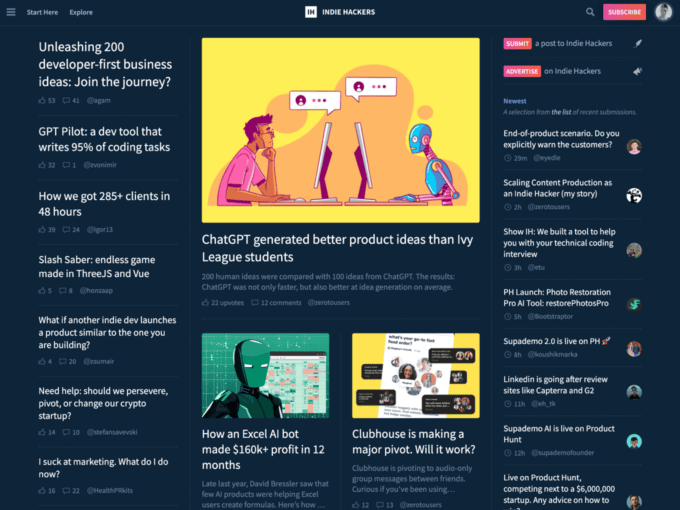
Before we dive into tactics, it's crucial to understand the mindset behind building in public and the community at Indie Hackers. Indie Hackers is a hub for founders, developers, and marketers who are building and growing their own online businesses. The conversations are less about niche technical debates (like on Hacker News) and more about the holistic journey of a founder: finding an idea, marketing, getting first customers, and scaling revenue.
The core of engaging on Indie Hackers is the concept of "building in public." This isn't just a marketing tactic; it's a growth flywheel.
Making $$$ with MicroSaaS (I might delete this)
Let's watch a short clip from investor Greg Isenberg that powerfully illustrates the 'growth flywheel' of building in public and how it can lead to rapid success.
Watch from 05:23 to 06:46 to understand the growth flywheel. Then, watch from 12:01 to 14:17 to see a real-world example of a founder who built a product in 12 hours, shared it publicly, and got his first paying customer within an hour. Pay close attention to the phrase 'people are rooting for you'.
As the video shows, building in public turns your startup journey into a story that people want to follow. This creates a community around you and your product before you even have a large user base. It builds trust, generates invaluable feedback, and attracts your first, most loyal customers.
Part 2: The Playbook for Effective "Build in Public" Updates
Many founders try to build in public but fail to get traction because their updates are generic or self-promotional. The key is to provide value and be authentic.
We're going to use a fantastic playbook from a founder who mastered this process. It provides concrete frameworks and templates you can use immediately.
Building in public playbook: How to turn daily updates into ...
This Reddit post is a tactical goldmine for building in public. It breaks down exactly what to do and what not to do. We will use it as the foundation for the rest of this lesson.
First, read the two sections: 'The problem with most building in public' and 'The framework that actually converts'. Focus on understanding the shift from feature-focused updates to problem-focused storytelling.
The Mindset Shift
The most important takeaway is to change your mindset from "How do I promote my product?" to "How do I share my journey in a way that helps other founders?"
Common Mistakes to Avoid
Based on the resource, here are the most common pitfalls:
- Generic Updates: "Fixed some bugs today" or "Working on a new feature!" These tell the audience nothing of value.
- Posting Only Wins: People connect with struggles and vulnerability far more than a constant stream of success.
- Being Too Salesy: Building in public is about building trust first. The sales come later as a natural byproduct.
- Inconsistent Posting: Momentum is key. Sporadic updates make it hard for people to follow your story.
- Not Engaging: It's a community, not a broadcast channel. If you don't engage with others, they won't engage with you.
Effective Content Frameworks
Instead of generic updates, use structured storytelling to make your posts compelling:
-
The Problem-First Structure: Don't just announce a new feature. Frame it around the customer problem you solved.
- Bad: "Added 4K video export."
- Good: "My users complained that video exports looked terrible on mobile. After digging in, I realized mobile browsers handle video compression differently. Here’s the technical fix I implemented to solve it."
-
The Vulnerability Formula: People root for those who are open about their struggles.
- Template:
[Struggle] + [What I tried] + [What I learned] + [How this helps users] - Example: "I completely botched my pricing at first. I charged $10 and people thought it was a cheap toy. I raised it to $50 and no one bought. I finally landed on $30 and conversions stabilized. The lesson: price signals value."
- Template:
-
The Behind-the-Scenes Teaching Moment: Turn a mundane task into a valuable lesson for others. Your CS background is a huge asset here.
- Instead of: "Optimized the database today."
- Try: "My app's dashboard was taking 10 seconds to load. I spent the morning profiling the queries and discovered a missing index on a critical table. Here’s the
EXPLAINplan before and after, and a quick tip for anyone using PostgreSQL with large JSONB columns."
-
The Community Question Hook: End your posts with a specific question to spark conversation.
- Example: "I just finished my first 5 user interviews and realized 80% of what I thought was important, users don't care about. They just want a better mobile experience. How do you all balance your product vision with direct user feedback?"
Part 3: Actionable Templates for Your Updates
Your goal is to build a habit of consistent, valuable posting. Here are some copy-paste templates, adapted from the playbook, that you can use on Indie Hackers to get started.
Building in public playbook: How to turn daily updates into ...
Let's look at more specific templates from the 'Building in public playbook' that you can apply immediately.
Read the section 'Specific post templates that get engagement'. Notice how each one is structured to be transparent and engaging.
Here are the key templates to add to your arsenal:
-
The "Honest Numbers" Post:
Day 45 building [Product Name]:
- Revenue: $550 MRR (+$50 from last week)
- Users: 85 active users (12 new signups)
- Today's reality: Had a tough conversation with a user who churned. Their feedback was painful but 100% right.
- Tomorrow's focus: Refactoring the user onboarding flow based on that feedback.
- Question for you: How do you handle feedback that stings but you know you need to hear?
-
The "Pivot Moment" Post:
I just scrapped two weeks of code.
I was building a complex analytics dashboard until a user told me, "I don't need more charts, I just need to know if my campaigns are working or not."
It was a gut punch, but he's right. I was solving a fun technical problem, not his core business problem.
So, I'm pivoting to build a simple, daily email digest instead. Sometimes the best progress is admitting you were running in the wrong direction.
Test your understanding!
Imagine your SaaS is an AI tool that helps people create video scripts (tying into our future modules!). You just spent a day struggling to get the AI to produce consistently good hooks.
Using The Vulnerability Formula, draft a short "build in public" post for Indie Hackers.
Show answer
Here's one possible answer:
"Spent 6 hours today wanting to throw my laptop out the window. My AI scriptwriting tool was generating the most generic, boring video hooks imaginable. [Struggle]
I tried everything: tweaking the prompt, changing the temperature settings, giving it more examples. Nothing worked. [What I tried]
Finally, I realized I was prompting it to be 'creative' instead of prompting it to follow proven copywriting formulas like AIDA or PAS. As soon as I re-engineered the prompt to explicitly use the 'Problem-Agitate-Solution' framework, the quality shot up 10x. [What I learned]
It's a huge lesson: AI needs constraints and structure, not just vague instructions. This change should mean every user gets a compelling video hook on their first try, not their fiftieth. [How this helps users]"
Part 4: Building Your Conversion Bridge
Okay, so you're posting great content and people are following you. How does this turn into customers for your SaaS? This process is what the playbook calls "The Conversion Bridge."
Building in public playbook: How to turn daily updates into ...
Finally, let's read about how this strategy connects to actual customer acquisition and what metrics you should really be tracking.
Read the sections 'The conversion bridge (follower → customer)' and 'Metrics that actually matter'. This is key to understanding the ROI of this activity.
Building in public works by moving people through these stages:
- Value-First Content: You share helpful lessons and frameworks, establishing yourself as a knowledgeable builder.
- Consistent Updates: People get into the habit of following your story and seeing your progress.
- Authentic Struggles: Your vulnerability makes you relatable and human, building genuine trust.
- Problem-Solving in Public: As you solve problems for your product, your audience sees your product as the solution.
- Soft CTAs: You don't need a hard sell. A simple "I just shipped the feature I talked about last week, you can try it here" is incredibly effective because the trust is already there.
Forget vanity metrics like likes and follower counts. The metrics that truly matter are:
- Number of genuine comments and conversations.
- DMs from people asking about your product.
- Email signups from your Indie Hackers profile link.
- Direct customer conversions you can trace back to the community.
Conclusion
If Hacker News is for a high-impact launch, Indie Hackers is for building a long-term strategic asset: a community. By documenting your journey with honesty and a focus on providing value, you build a loyal following that will support you, give you feedback, and become your first customers.
Key Takeaways:
- Embrace Transparency: "Build in public" means sharing the entire journey—successes, failures, and lessons learned.
- Tell Stories, Don't List Features: Use frameworks like the "Problem-First Structure" and "Vulnerability Formula" to make your updates compelling.
- Give More Than You Take: Your primary goal should be to help other founders. The customers will follow.
- Consistency is Your Greatest Weapon: A daily or weekly habit of sharing your progress builds momentum and a loyal following.
- Track Real Engagement: Focus on conversations and conversions, not likes.
Preview of the Next Lesson:
The principles of building an audience through authentic content are not limited to Indie Hackers. In our next module, we'll take these concepts and apply them to much larger platforms. We will start by learning how to design a foundational growth strategy for Twitter/X, defining your niche, voice, and content pillars. You'll see how the "build in public" ethos can be adapted to build a powerful personal brand and distribution channel on social media.