
Hello. This lesson begins the module Play Through Traps and Turning Points. You will practice the central move behind everyday strategic thinking: temporarily setting aside your own preferred outcome and constructing a plausible account of what another person is likely to do next.
The goal is not to read minds or label someone’s personality. It is to make a forecast that is useful, testable, and honest about its uncertainty: Given what this person wants, fears, knows, and can actually do, what is their most likely next move? What am I assuming in making that prediction? This is a practical skill for workplace coordination, difficult conversations, and negotiation.
Perspective taking is not the same as empathy
Empathy asks, “What might this feel like for them?” Perspective taking asks, “How do they see the situation, and what choice makes sense from that position?”
Both matter. If a colleague is frustrated, noticing that emotion can help you communicate with care. But when you need to anticipate whether they will accept a request, delay it, escalate it, or propose an alternative, emotions alone are not enough. You also need to examine their incentives, constraints, authority, information, and likely interpretation of your move.
Read this short article from Harvard Law School’s Program on Negotiation to distinguish strategic perspective taking from empathy. Its central message is useful for this course: understanding another person’s reasoning can improve forecasts, while attending to emotions is especially valuable for alliances and heated disputes.
Start with the section “The Basics of Perspective Taking.” Read the definition and habit; focus on the shift from assuming bad intent to examining interests, motives, and needs. Then read “Different Tasks, Different Skills,” especially the simulated arms-race experiment. Notice that strategic prediction differed from emotional attunement in that setting. Finish with “Choosing Which Skill to Highlight.” Read the practical distinction. Do not treat this as a rigid rule; in real interactions, you often need both skills.
A useful discipline is to keep three categories separate:
| Category | What it contains | Example |
|---|---|---|
| Observation | Things you can point to: words, actions, deadlines, policies | “They said they need an answer today.” |
| Interpretation | Your explanation of what an observation means | “They are under pressure from leadership.” |
| Assumption | Something that may be true but is not yet verified | “They can approve this without asking their manager.” |
Forecasts fail most often when interpretations and assumptions are silently treated as facts.
Build a forecast from the other person’s position
Consider a familiar work scenario.
A product manager, Maya, asks an analyst, Anton, to validate a new metric before Friday’s launch. Anton answers: “I’ll try, but I have several urgent requests.” Maya wants a yes or no today so she can plan the launch.
Maya may immediately think: “Anton will delay this; I need to push harder.” That is a prediction, but it does not yet explain why Anton would choose delay rather than refuse, negotiate scope, or work late.
Instead, step into Anton’s role. Do not ask what you would do. Ask what he is likely to see.
1. Identify the role and its immediate objective
Anton may want to protect the reliability of his work and avoid being blamed for a flawed metric after launch. He may also want to be seen as cooperative. Those goals can conflict: a quick “yes” demonstrates helpfulness, but it may create quality risk.
2. List constraints and available moves
His constraints could include existing commitments, unclear requirements, limited authority to reprioritize, or missing data access. His available moves are more varied than “help” or “refuse”:
- accept the request as stated;
- ask Maya to narrow the validation scope;
- ask his manager to reprioritize work;
- offer a later delivery date;
- defer without making a clear commitment;
- decline and explain why.
A good forecast identifies a specific action, not merely an attitude such as “he will be defensive.”
3. Ask what information he has
Anton may not know how costly a launch delay would be. He may think the request is optional, while Maya sees it as a release blocker. Conversely, Maya may not know that Anton has a deadline from a senior leader.
Different information can produce different behavior even when both people are reasonable.
4. Construct the most likely next move
A careful forecast might be:
Forecast: Anton will probably ask Maya to reduce the validation scope or explicitly reprioritize his other work before committing to Friday.
Reasoning: This protects quality and his existing commitments while allowing him to remain cooperative.
Assumptions: His current requests are genuinely urgent; he has some flexibility if priorities are clarified; and he believes Maya can make or escalate that prioritization decision.
This is strategically useful because it suggests a response. Rather than pressure Anton for an unconditional yes, Maya can say: “The launch depends on validating the core metric. Which of your current tasks would need to move for you to check that by Friday?” That response tests the assumptions and invites information that could change the forecast.
Notice the difference between certainty and calibration:
- Weak: “Anton is going to stall.”
- Better: “If Anton lacks authority to drop existing tasks, he is likely to request a priority decision rather than commit by Friday.”
- Best practical version: “My leading forecast is that he will request narrower scope or reprioritization. I am least certain about whether he has authority to make that decision himself.”
The last version leaves room for evidence.
Use an empathy map without inventing facts
An empathy map can organize your perspective switch. It has four fields: Said, Did, Thought, and Felt.
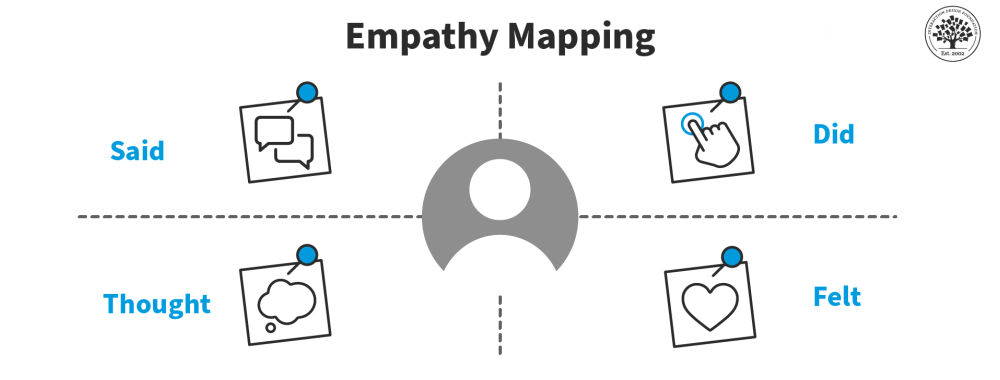
For forecasting, fill it in with asymmetric confidence:
- Said: capture exact words where possible.
- Did: record observable actions, including delays, choices, and commitments.
- Thought: infer relevant beliefs: “This will create extra work,” “My manager will not support this,” or “The deadline is negotiable.”
- Felt: infer relevant emotions only when they plausibly affect the choice: anxiety about risk, resentment about workload, pride in quality.
The “Thought” and “Felt” quadrants are not privileged access to someone’s inner life. They are provisional models. Mark them with phrases such as “may believe,” “might be concerned,” or “possibly expects.” This prevents a common strategic error: becoming attached to a vivid story about someone else and then treating that story as evidence.
How many layers of thinking are useful?
Strategic situations can tempt us into an exhausting chain of speculation:
- “I think Anton will ask for scope reduction.”
- “But perhaps he expects Maya to reject that.”
- “Then perhaps he will go directly to his manager.”
- “But perhaps Maya anticipates that…”
Game theory studies this sort of recursive reasoning. In life, however, the aim is not to continue indefinitely. The aim is to use just enough perspective switching to make a better forecast than you would make from your own viewpoint alone.
Game theory challenge: Can you predict human behavior? - Lucas Husted
Watch “Game theory challenge: Can you predict human behavior?” from TED-Ed. The number puzzle makes recursive thinking visible, then connects it to situations where each participant anticipates the other’s response.
Watch real behavior to see why people often reason only one or two levels beyond their own immediate choice. Then watch practical examples, which applies this insight to investing and a football penalty kick. Focus on the practical lesson: forecast actual people’s likely reasoning habits, not an ideal of perfect rationality.
For everyday use, two layers are normally sufficient:
- First layer: “What action does this person prefer, given their own goals and constraints?”
- Second layer: “How might their view change because they anticipate my response?”
Return to Maya and Anton. The first-layer forecast is that Anton asks for prioritization. A second-layer refinement is that he may avoid a direct refusal because he expects Maya to interpret it as lack of support for the launch. He may therefore use vague language, such as “I’ll try,” while waiting to see whether she clarifies urgency or offers a trade-off.
That is not manipulation; it is a hypothesis about incentives and anticipated reactions. The ethical use of the hypothesis is to communicate more clearly, not to corner Anton.
A role-reversal routine for better forecasts
The most reliable way to notice your blind spots is to argue the other person’s case in the first person. This is not merely a thought experiment. It forces your forecast to rest on concrete reasons that could plausibly drive their action.
[PDF] Role reversal activity | Metro North Health
Read Metro North Health’s concise role-reversal activity for a practical structure you can use with a colleague, friend, or study partner. We will adapt its workplace exercise from empathy-building to strategic forecasting.
In “How to run the activity,” read Step 2, beginning with choosing a scenario. Use a low-stakes real situation, or fictionalize it enough to protect privacy. Then read Step 3, “Role reversal,” from the role switch. The instruction to commit fully to the opposing role matters: you are trying to make the other person’s next move intelligible, not to produce a caricature of them. Review Step 4’s debrief prompts afterward, particularly the prompts about what shifted in your thinking and which assumptions surfaced.
A 12-minute version
Choose one interaction that is recurring, meaningful, but low stakes. Suitable examples include dividing a shared task, deciding who speaks in a meeting, choosing a family plan for the weekend, or agreeing on a deadline with a collaborator. Avoid situations involving serious power imbalance, sensitive personal information, or active conflict.
First, state your own initial view in two minutes. Write what you want the other person to do next and your unfiltered prediction of what they will actually do.
Next, switch roles for four minutes. Use “I” statements as if you were that person:
“I need…”
“I am worried that…”
“I can and cannot decide…”
“I believe the other person expects…”
“My realistic options are…”
If working with a partner, each person argues the role they did not initially hold. If working alone, write a brief internal memo from the other participant’s point of view. The constraint is important: make their position strong enough that a reasonable person could hold it.
Then write a forecast in three minutes. Use this format:
Given their goal of [goal] and constraint of [constraint], they will most likely [specific next action].
I expect this because they believe [belief about the situation or about my response].
This forecast assumes [two or three uncertain conditions].
Evidence that would change my mind: [what you could observe or ask].
Finally, identify one low-pressure information-gathering move. This may be a clarifying question, a summary of what you heard, or an offer to compare priorities. The purpose is to distinguish assumptions from facts before acting on your forecast.
Forecasts improve through questions, not just cleverness
Perspective switching produces a hypothesis. Conversation supplies the data.
The following questions are especially useful because they reveal constraints, priorities, and authority without demanding that someone defend themselves:
- “What would make this difficult to agree to?”
- “Which part of this creates the most risk for your side?”
- “What would need to change for this to be workable?”
- “Is this something you can decide, or does someone else need to be involved?”
- “If we cannot do the full version, what is the smallest version that would still help?”
3 steps to getting what you want in a negotiation | The Way We Work, a TED series
Watch the perspective-taking portion of TED’s “3 steps to getting what you want in a negotiation.” It translates the forecasting habit into concrete preparation for a conversation.
Watch the other side. Pay particular attention to the prompts about the counterpart’s requirements, obstacles, risks, and authority. These are precisely the assumptions that should appear explicitly in your forecast, and the video closes by emphasizing active listening and “why” or “why not” questions to test them.
There is an important ethical boundary here. Forecasting another person’s move is not a license to exploit a vulnerability. It is a way to reduce preventable misunderstanding and design responses that acknowledge real constraints. Often, the most strategically effective response is also the clearest and most respectful one.
Key takeaways
A strategic forecast is not “I know what they are like.” It is a conditional explanation of a likely action:
- Start with observable statements and actions.
- Switch roles and reconstruct the other person’s incentives, constraints, information, and available choices.
- Forecast a specific next move.
- State the assumptions that make the forecast plausible.
- Name the evidence or question that could prove you wrong.
Perspective taking and empathy support different tasks. Empathy helps you recognize emotional experience and build connection; perspective taking helps you model how another person may reason and act. In difficult real interactions, use both, but do not confuse a feeling-based story with a tested forecast.
Next, you will use these forecasts to identify stable outcomes: situations in which no one benefits by changing their own move alone. That will reveal why an outcome can be stable yet still leave everyone dissatisfied.
Can't find a good explanation? Sign up and we'll make it for you
Sign up