
Hello. In the previous lesson, you designed consumers that tolerate duplicate delivery by atomically recording a processed message and applying local state changes. That prevents a redelivery from producing a second local business effect. It does not, however, mean that every service sees the result at the same moment.
This lesson moves from an individual consumer’s reliability to the architectural decision around the whole flow. You will learn to evaluate an event-driven design through four linked concerns:
- Consistency: when different services may legitimately disagree temporarily.
- Latency: both how quickly a request is accepted and how long until its business outcome is visible.
- Availability: which failures prevent progress, and which can be absorbed as backlog.
- Operability: how the team detects, traces, recovers, and explains asynchronous failures.
The aim is not “make everything asynchronous.” It is to select the right consistency model and failure behavior for each business step, then be able to defend that choice in a technical-lead interview.
A four-way decision, not a slogan
An event-driven design typically replaces an immediate dependency with a durable handoff. A service records a business fact, publishes an event, and downstream consumers act later at their own pace. This provides valuable decoupling, but it moves costs into freshness, recovery, and operations.
A useful starting point is to separate four questions that are often incorrectly combined.
| Dimension | The design question | Typical symptom when it is wrong |
|---|---|---|
| Consistency | May downstream state be stale, and for how long? | A customer or service makes a decision from an outdated view. |
| Latency | How long may acceptance and end-to-end completion take? | The UI looks frozen, a workflow times out, or a queue grows. |
| Availability | Which component failures may delay work without rejecting it? | An unrelated downstream outage blocks a core user action. |
| Operability | Can the team observe and repair delayed or failed work? | Events silently disappear, remain stuck, or cannot be reconciled. |
These dimensions are coupled, but they are not identical.
For example, making Order Service publish OrderPlaced and return immediately can improve the availability and response time of order acceptance: a temporarily unavailable Email Service does not need to stop a customer placing an order. But if the customer immediately opens a “My Orders” page served from a downstream projection, that page may not yet show the order. The design has traded immediate cross-service consistency for decoupling.
The key technical-lead question is therefore:
What does the system guarantee at the moment it tells the user or calling service that the operation succeeded?
For a synchronous REST endpoint, a 200 OK often implies that the requested operation is complete according to the endpoint’s contract. For an asynchronous workflow, 202 Accepted should instead mean something precise such as:
“The order was durably accepted as pending fulfilment; shipment creation and notification will occur asynchronously.”
Do not return a response implying that fulfilment, payment, inventory, and notification are all complete if only the initial Order Service transaction has committed.
The following short comparison frames the central trade-off between request-response and event-driven communication.
Event-Driven Architecture (EDA) vs Request/Response (RR)
Watch Event-Driven Architecture (EDA) vs Request/Response (RR) from Confluent, an IBM Company. It distinguishes the temporal decoupling gained through an event topic from the immediate consistency and shared availability dependency of direct calls.
Watch coupling tradeoffs to see why a producer and consumer no longer need to be online at the same time. Then watch consistency lag, focusing on the distinction between an accepted source-of-truth update and a consumer's later local view.
A direct call is not inherently bad architecture. If a business decision requires a current answer now, forcing it through an asynchronous pipeline can make the system less correct from the user’s perspective. Conversely, requiring every downstream service to respond before accepting a non-critical operation creates avoidable availability and latency coupling.
Consistency: decide what may be stale
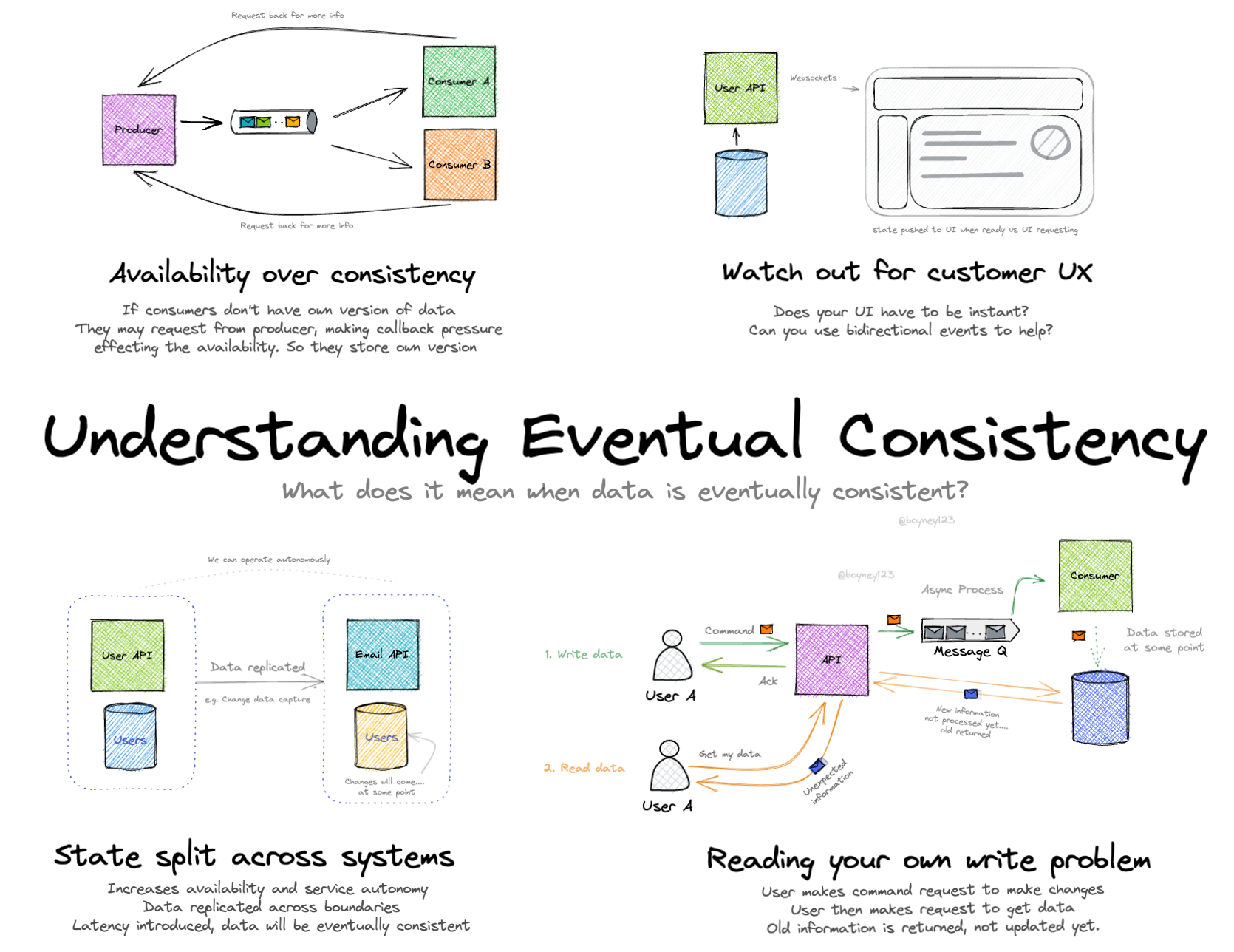
In an event-driven system, each service commonly owns its own database and processes events independently. After Order Service commits an order, the Fulfilment, Notification, Analytics, and Search services can each be at a different point in processing that order’s event stream.
That temporary divergence is eventual consistency. It is acceptable only when the business can tolerate it and the system has a credible path to convergence.
Not all inconsistency has the same risk
Consider an order workflow.
| State or decision | Can it be eventually consistent? | Why |
|---|---|---|
| Order acceptance recorded in Order Service | Usually no | The service must durably know whether it accepted the order. |
| Inventory reservation before promising an item is available | Often no | Overselling a scarce item may violate a business invariant. |
| Shipment tracking card appearing in the UI | Often yes | A short “Preparing shipment” period is usually understandable. |
| Confirmation email | Usually yes | It can arrive seconds or minutes after acceptance. |
| Analytics dashboard count | Usually yes | Reports can tolerate a measured freshness delay. |
| Fraud or regulatory hold | Depends on policy | A delayed hold may be unacceptable for regulated or high-risk actions. |
A strong consistency requirement should be expressed as an invariant, not as a preference for synchronous APIs. For example:
- “A seat may not be sold to two customers.”
- “Funds must be authorized before an order is marked confirmed.”
- “A revoked user must lose access before the next authorization decision.”
These statements identify the point where a stale view would cause an invalid decision. That point might require a synchronous call to the authoritative service, a local transactional constraint, or a deliberately coordinated workflow. The cost is higher latency and an increased dependency on the availability of the authoritative service.
By contrast, “the sales dashboard may be up to five minutes behind” is a freshness objective. It is well suited to event-driven replication, provided the lag is observed and acted on.
Eventual does not mean “eventually, somehow”
Eventual consistency is not achieved merely by using Kafka, RabbitMQ, or a message broker. Convergence depends on several design conditions:
- The source service must durably record the authoritative change.
- The change must be handed off reliably for publication.
- Consumers must retry transient failures and safely handle duplicates.
- Poison messages must be isolated and investigated rather than blocking a flow indefinitely.
- Consumers must be able to recover after downtime and process the remaining backlog.
- The team must detect when convergence is taking too long or has stopped.
You addressed one of these conditions already: idempotent consumers make retry and redelivery safe for local state. Later lessons will implement reliable publication, retry topologies, dead-letter handling, and replay in RabbitMQ, Kafka, and CDC pipelines.
The read-your-own-write problem
A common user-experience failure occurs when a command succeeds, but the next read uses a stale projection.
For example:
- A customer submits an address change.
- Customer Service commits the new address and emits
CustomerAddressChanged. - The web application immediately queries a Search or Profile projection.
- The projection has not processed the event yet, so it returns the old address.
Technically, the system may be working exactly as designed. To the customer, it looks like the update was lost.
Common responses include:
- Read from the authoritative service immediately after the write. This gives strong read-after-write behavior, but may add a synchronous dependency.
- Return the accepted state in the command response. The UI renders the submitted address while the projection catches up.
- Represent the state honestly. For example, show
Address update pendingrather than falsely implying every downstream view is current. - Use a version or operation identifier. A client can distinguish an older projection state from the version it has just submitted.
- Notify the client when processing completes. This can suit longer workflows, but it requires a clear completion contract.
The correct option depends on the business interaction. A customer waiting a few seconds for a shipment status update is different from a security-sensitive authorization check. The important point is to design the user experience for the consistency window, rather than treating it as an invisible infrastructure detail.
Latency and availability: asynchronous acceptance is not instant completion
Asynchronous systems have at least two latency measurements:
- Acceptance latency: time from request arrival until the source service durably accepts or rejects the command.
- Completion latency: time until the required downstream effect is complete and observable.
Event-driven architecture can reduce acceptance latency because the source service need not wait for every subscriber. It does not automatically reduce completion latency. Every stage contributes time:
- time waiting for a message to be consumed;
- consumer processing time;
- database or remote-call latency;
- retry delay after transient failure;
- backlog accumulated during downstream outages.
A system can return 202 Accepted in 100 milliseconds while taking two minutes to create a shipment during peak load. That may be excellent or unacceptable depending on the service objective.
A queue is a buffer, not a solution to overload
Messaging improves resilience when a consumer is briefly slower or unavailable: the broker retains work and the producer can continue, within capacity limits. This is an availability benefit.
But sustained imbalance becomes queue growth. If producers create events faster than consumers complete them, the backlog increases and completion latency rises. Eventually the broker’s storage, retention policy, or downstream capacity becomes the limiting factor.
For each important event flow, define an end-to-end objective in business language. For example:
| Flow | Example completion objective | What to monitor |
|---|---|---|
| Order accepted to fulfilment task created | 99 percent within 30 seconds | Age of oldest unprocessed order event; consumer lag |
| Password reset requested to email sent | 99 percent within 60 seconds | Retry count; email-provider failures; delayed-message age |
| Customer change to analytics dashboard | Within 15 minutes | Projection freshness; consumer throughput |
| Inventory reservation for checkout confirmation | Before confirming checkout | Synchronous dependency latency and failure rate |
The objective determines whether a queue delay is normal, degraded, or an incident.
Decoupling changes the failure boundary
With direct request-response, the caller often needs the callee to be reachable now. If Payment Service is unavailable and checkout requires a payment decision, checkout cannot complete that decision.
With durable asynchronous messaging, Order Service may accept an order while Notification Service is down. Notification work accumulates and is processed after recovery. This isolates the critical acceptance path from a non-critical dependency.
However, messaging does not eliminate dependencies:
- The producer still depends on its own database and on reliable handoff to the broker.
- The broker is itself an operational dependency.
- Storage limits and backlog retention determine how long an outage can be absorbed.
- A workflow may be accepted but remain incomplete when a necessary downstream service is unavailable.
- If a stale downstream view is used for a critical decision, apparent availability can become incorrectness.
A good design explicitly states which outcome applies during a dependency outage:
| Downstream capability | Possible policy during outage |
|---|---|
| Non-critical notification | Accept core business action; queue notification for later delivery. |
| Search indexing | Accept write; display a bounded “indexing” delay if necessary. |
| Inventory reservation for scarce stock | Reject, wait for authoritative confirmation, or accept only as an explicitly unconfirmed request. |
| Payment authorization | Do not claim payment success without an authoritative result; offer a pending state only if the business permits it. |
This is why “favor availability over consistency” is too vague for an interview answer. Availability for what business promise? Consistency of which invariant? A meaningful answer names the authoritative owner, the stale-data window, the customer-facing state, and the recovery behavior.
Operability is part of correctness
A synchronous request often leaves a relatively clear trace: one inbound request, a call stack, a response, and logs around a small set of services. Event-driven workflows run across independent producers, topics or exchanges, queues, consumer groups, databases, retries, and dead-letter paths. The original request may finish long before a later consumer fails.
This is the operational price of decoupling.
The Azure Architecture Center’s discussion of event-driven architecture is particularly useful here because it treats eventual consistency and observability as architectural challenges rather than broker configuration details.
Event-Driven Architecture Style - Azure Architecture Center
Read the “Challenges” material in Microsoft’s Azure Architecture Center guide. Focus on the practical consequences of independently processed events: temporary stale state, ordering and duplicate-processing concerns, and the need to trace work across decoupled services.
In the “Challenges” section, read the subsection “Eventual consistency,” beginning with the explanation of delayed state. Identify the assumptions that allow consumers to tolerate stale or partially updated data. Then read “Observability across decoupled components,” starting the observability discussion. Focus on why a correlation ID needs to be present from the initial event, rather than retrofitted after an incident.
What an operable event flow needs
At a minimum, every event should carry the metadata you began defining earlier:
- Event ID for identity, deduplication, and tracing a specific fact.
- Correlation ID for following one user request or business workflow across many events.
- Causation ID for identifying which prior command or event triggered this event.
- Event type, source, subject, and occurrence time for interpretation and diagnosis.
Each consumer should log these IDs with its processing outcome. A trace should be able to answer:
- Was the event published successfully?
- Which consumer received it?
- Was it retried, dead-lettered, or skipped as a duplicate?
- Which local state changed?
- Did the downstream business outcome complete?
- If not, who owns the next operational action?
Measure convergence, not only infrastructure
Broker health alone is insufficient. A topic can be healthy while a business workflow is failing.
Useful operational signals include:
| Signal | What it reveals |
|---|---|
| Publish failure or unroutable-message count | The producer may not be handing work to the intended destination. |
| Consumer lag or oldest-message age | Downstream state is becoming stale. |
| Processing duration and error rate | A consumer or dependency may be slowing the flow. |
| Retry volume and dead-letter count | Failures may be transient, persistent, or caused by malformed events. |
| Duplicate-skip rate | Redelivery or producer retry behavior may be rising. |
| Business completion age | The time from OrderPlaced to ShipmentCreated, not merely broker throughput. |
| Reconciliation mismatch count | Authoritative state and downstream projection may have failed to converge. |
A crucial operational distinction is between retriable and non-retriable failure:
- A database connection timeout may be retried with a bounded policy.
- A malformed event that no consumer version can parse should be quarantined for investigation.
- A business rule failure, such as “order already cancelled,” may require an explicit state transition rather than endless retry.
An infinite retry loop can preserve availability at the broker level while making the business flow unavailable and obscuring the original error. It also consumes capacity, increases lag for unrelated messages, and may repeatedly invoke external side effects. Bounded retries, dead-letter handling, alerting, and a documented replay process are therefore core operability requirements.
Worked design review: order placement
Suppose an e-commerce platform needs to process an order with the following downstream actions:
- reserve inventory;
- authorize payment;
- create fulfilment work;
- send a confirmation email;
- update search and analytics views.
A weak answer would be: “Use Kafka so all services are decoupled.”
A stronger design review begins by assigning guarantees per action.
| Step | Consistency choice | Latency and availability consequence | Operability requirement |
|---|---|---|---|
| Record the new order | Strong local consistency in Order Service’s database | Order acceptance depends on Order Service and its database | Audit the command result and reliable publication intent |
| Reserve scarce inventory | Current authoritative decision before promising availability | Can increase checkout latency and depend on Inventory Service availability | Timeouts, idempotent reservation ID, reconciliation of uncertain outcomes |
| Create fulfilment task | Eventual consistency is often acceptable | Order can be accepted while Fulfilment is temporarily down | Track order-to-task completion age and retry failures |
| Send confirmation email | Eventual consistency is usually acceptable | Email-provider outage should not block order acceptance | Durable retry, idempotency, and alerting for delayed emails |
| Update analytics and search | Eventual consistency normally acceptable | Reads may be stale for a defined window | Monitor projection freshness and support rebuild or replay |
This table does not prescribe one universal implementation. It makes trade-offs explicit.
For example, if the business requires “do not confirm an order until inventory is reserved,” then the UI cannot truthfully display a fully confirmed order until Inventory’s authoritative decision has been received. The system may choose to keep the customer in a PENDING_CONFIRMATION state while an asynchronous reservation occurs, or it may synchronously request the reservation before responding. The first choice can protect availability and responsiveness but delays confirmed completion; the second improves immediate certainty but adds dependency latency and failure coupling.
Either can be correct. What matters is that the API response, UI state, monitoring, and recovery procedure all match the chosen guarantee.
A compact interview answer
For an interview prompt, a concise way to reason aloud is:
“I would first identify the authoritative owner and the invariants that cannot tolerate stale data. Order acceptance is strongly consistent within Order Service. Fulfilment, notification, analytics, and search can consume durable events asynchronously because a bounded delay is acceptable. I would not claim that an order is fully confirmed until any required inventory and payment decisions are known. The API and UI would represent pending states explicitly to avoid a read-your-own-write problem. This reduces coupling to non-critical downstream services, but it creates eventual-consistency windows and operational responsibilities. I would define end-to-end freshness objectives, propagate event and correlation IDs, monitor consumer lag and business completion age, use idempotent consumers and bounded retries, and provide reconciliation for workflows that fail to converge.”
That answer ties technology choices to business semantics rather than treating Kafka or RabbitMQ as an automatic solution.
A practical decision checklist
Before making a service interaction asynchronous, work through these questions:
-
What business fact is authoritative, and which service owns it?
Avoid treating a replicated projection as the decision-maker when it can be stale. -
What is the exact success promise at request time?
Distinguish accepted, pending, confirmed, completed, and failed states. -
What is the maximum tolerable freshness delay?
Turn “eventual” into an observable objective, such as a completion-age threshold. -
What happens when a consumer or its dependency is unavailable?
Decide whether work queues safely, the user sees pending status, the command is rejected, or an alternative path is used. -
How will the user experience the consistency window?
Avoid immediate reads from stale projections without a read-after-write strategy. -
How will the team detect and repair non-convergence?
Define trace identifiers, lag and age metrics, retry limits, dead-letter ownership, and reconciliation procedures. -
What new operational dependency has been introduced?
A broker, schema contract, replay process, consumer fleet, and observability pipeline all need ownership and operational readiness.
Key takeaways
- Event-driven architecture trades immediate cross-service consistency for decoupling, independent scaling, and resilience to some downstream outages.
- A fast asynchronous acknowledgement is not the same as a completed business outcome. Make the API contract and UI state honest about that distinction.
- Define consistency requirements through concrete business invariants and freshness objectives, not vague statements about preferring synchronous or asynchronous design.
- Eventual consistency requires reliable publication, safe consumer retry, idempotency, recovery, and monitoring. It is not guaranteed simply because a broker exists.
- Availability improves when non-critical downstream outages become buffered work, but brokers, storage capacity, stale reads, and required authoritative decisions remain real dependencies.
- Operability is a first-class cost: propagate event and correlation identifiers, monitor backlog and business completion age, isolate poison messages, and plan reconciliation.
- A strong design distinguishes the critical path that needs current authoritative data from downstream effects that can converge asynchronously.
Next, you will move from architecture decisions to hands-on RabbitMQ fundamentals: running RabbitMQ locally and tracing a message through a producer, exchange, binding, queue, and consumer.
Can't find a good explanation? Sign up and we'll make it for you
Sign up