
Welcome back. In the previous lesson, you turned a broad insurance-conference audience into a practical design brief: a provisional audience profile, three questions the room is likely to bring, and a promise to distinguish present realities from future claims.
That promise depends on using automation language precisely. “Autonomous,” “self-driving,” “hands-free,” and “assisted” are often used interchangeably in public discussion, but they imply very different answers to the questions insurers care about: Who is performing the driving task? Who must monitor the road? What happens when the system reaches its limit?
In this lesson, you will build a reliable way to distinguish driver assistance, automated driving, and autonomous mobility. The two concepts that make the distinction meaningful are the operational design domain, or ODD, and fallback.
Start with the driving task, not the marketing label
The central technical term is the dynamic driving task (DDT). It includes the real-time work of operating a vehicle in traffic:
- controlling lateral movement: steering and lane position;
- controlling longitudinal movement: acceleration and braking;
- detecting objects and events;
- responding appropriately to what the road environment presents.
A vehicle can help with one or more of those activities without taking responsibility for the full driving task. That is the first distinction to hold onto:
Assistance helps a driver perform the driving task. Automation performs the driving task within defined conditions.
In UK policy material, this is also a distinction of responsibility, not merely technical sophistication. Technology that supports a driver remains driver assistance; the driver is responsible at all times. A system capable of driving without human input for part of a journey is treated differently because the legal responsibilities associated with its use can change.
Automated Vehicles Bill: policy scoping notes - GOV.UK
Read these GOV.UK policy scoping notes to establish the UK distinction between driver assistance and self-driving features, then connect the dynamic driving task to an operational design domain.
Begin with the opening policy discussion, at the paragraph beginning “The government’s response,” and read the legal distinction. Then find the subsection “Principles relating to self-driving vehicles ability to drive without monitoring.” Read the paragraph that defines the dynamic driving task and ODD, focusing on DDT and ODD. Notice that driving is more than steering and braking: monitoring and responding are part of the task.
The following taxonomy is a helpful visual orientation. It depicts increasing automation in terms of who performs object and event detection, the dynamic driving task, and fallback. Treat it as a communication aid rather than a legal classification: an automation “level” alone does not establish whether a feature is legally self-driving in the UK.
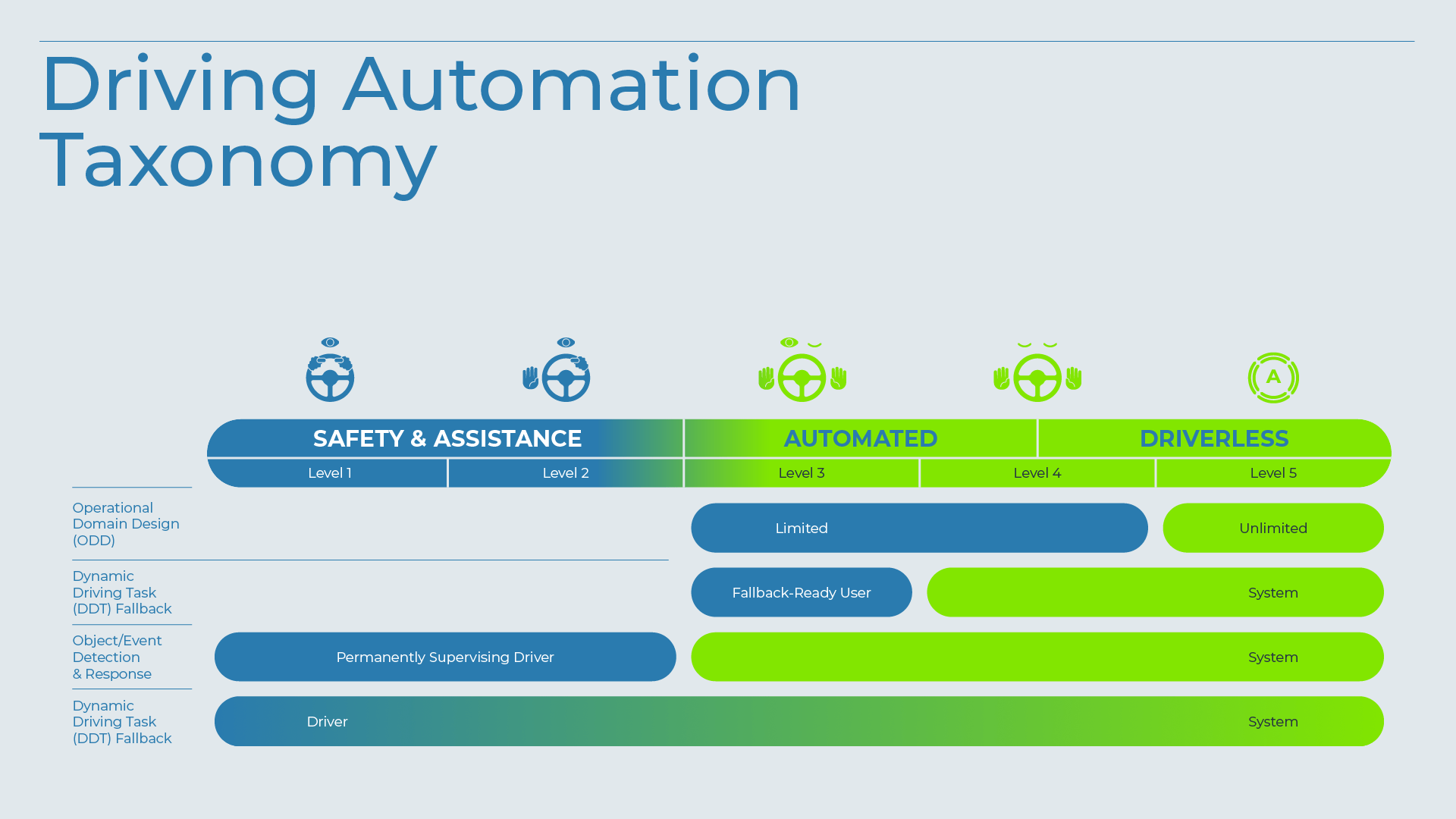
A particularly useful rule for a conference audience is:
Do not ask, “What level is the car?” before asking, “What is the system permitted and designed to do in this situation?”
A vehicle may have advanced driver-assistance features and still require its driver to supervise the road continuously. Conversely, a genuinely automated feature may operate without road monitoring, but only within a tightly bounded setting.
The familiar levels: a useful shorthand with important limits
The SAE automation scale, from Level 0 to Level 5, is widely used as shorthand. It can help explain the technical progression, provided you do not use it as a substitute for the UK regulatory question of whether a particular feature is authorised as self-driving.
What are the Six Levels of Vehicle Autonomy?
Kelley Blue Book’s “What are the Six Levels of Vehicle Autonomy?” gives a quick visual overview of the commonly used Level 0 to Level 5 taxonomy. Use it to orient yourself to the vocabulary, while relying on UK sources for responsibility and regulatory interpretation.
Watch the overview for the purpose of the scale. Then watch Levels 0 to 2, concentrating on the continuing need for driver supervision. Finish with Levels 3 to 5 to see why the distinction changes once the system monitors the environment and handles its own limits. The examples are illustrative; do not carry the video’s market or legal assumptions into a UK claim without checking them.
Here is the practical interpretation you need.
| Category | Typical SAE shorthand | Who performs the DDT while engaged? | Who monitors the road? | Core message for your keynote |
|---|---|---|---|---|
| Driver assistance | Levels 0–2 | The driver remains responsible, even if the system steers, brakes, or accelerates | Driver | Helpful technology is not necessarily self-driving |
| Automated driving feature | Often Levels 3–4 | The automated driving system performs the full DDT within its ODD | Depends on the authorised feature and mode | The system’s defined operating conditions and fallback matter more than the label |
| Autonomous mobility service | Commonly associated with Level 4-type operation | The system performs the DDT in a defined service area or use case | No in-vehicle driver may be needed | Driverless does not mean unrestricted; it means the system and operator must manage the limits |
Driver assistance: Level 0 to Level 2
At Level 0, the car may warn or briefly intervene, but the driver controls the vehicle. Basic cruise control is a familiar example.
At Level 1, a system can provide sustained assistance with either speed control or steering. Adaptive cruise control can adjust speed to maintain a gap; lane-centering assistance can help maintain lane position.
At Level 2, the system can provide sustained steering and speed control together in certain conditions. This can look impressive. It may be described as “hands-free” in some settings. But it remains driver assistance if the driver is expected to supervise the road and intervene whenever necessary.
That last point is worth stating without qualification in a keynote:
Hands-free is not the same as mind-free, and neither is automatically self-driving.
A driver-assistance system can reduce workload, warn of hazards, brake in an emergency, or hold a lane. Yet the human driver remains the fallback: they must monitor the environment and be ready to take control immediately.
This does not mean a manufacturer has no potential responsibility when a driver-assistance system malfunctions or is misleadingly designed. It means the driver’s responsibility for the driving task has not transferred merely because assistance was active. The separate questions of product safety, software quality, marketing, insurance cover, and legal liability will matter later in the course.
Automated driving: the system takes the complete task, but not everywhere
The key technical threshold is crossed when the system, rather than the person, performs the full dynamic driving task and monitors the road environment while it is engaged.
A Level 3-style system is often described as conditional automation. Within its defined conditions, it can drive and monitor the environment. However, it may issue a request for a person in the vehicle to take control. That person must be capable of doing so after a safe transition process.
A Level 4-style system can perform the driving task and deal with fallback within a defined ODD. It may operate without any need for a human driver to recover control in that setting. The essential limitation is not human capability but domain: the system is designed for particular roads, locations, weather conditions, speeds, or times of day.
Level 5 is the hypothetical general case: a vehicle that can drive wherever a competent human driver can drive, in all relevant conditions. It has no meaningful ODD restriction. For your conference presentation, do not allow discussion of Level 5 to distract from the commercially and policy-relevant question: what can a system safely do, in what domain, today?
The ODD: the boundary that makes an automation claim intelligible
An operational design domain is the set of conditions in which an automated driving system is designed to operate without intervention by an individual. It is not a footnote. It is part of the system’s safety claim.
An ODD can specify conditions such as:
| ODD dimension | Illustrative question |
|---|---|
| Geography | Is the feature limited to a mapped city zone, a particular motorway network, or a car park? |
| Road type and layout | Does it operate on motorways only? Can it handle roundabouts, level crossings, roadworks, or complex junctions? |
| Speed and traffic | Is it designed for low-speed traffic, motorway speeds, or both? |
| Weather and visibility | Does heavy rain, fog, snow, glare, or darkness limit operation? |
| Infrastructure and connectivity | Does it depend on road markings, high-quality maps, mobile connectivity, or specific roadside infrastructure? |
| Road users and events | Can it manage the pedestrians, cyclists, emergency vehicles, and unusual events reasonably expected in that setting? |
The ODD has two jobs. First, it tells users and operators where the system may be used. Second, it tells regulators, insurers, and safety assessors what the system must be shown to handle.
Consider two apparently similar claims:
- “This vehicle can drive itself.”
- “This system can operate without human road monitoring on specified motorway sections, in defined weather and traffic conditions, and will safely manage the boundary of those conditions.”
The second statement is longer, but it is meaningful. It identifies the claim’s scope and makes it possible to test, insure, regulate, and challenge.
Responsible Innovation in Self-Driving Vehicles - GOV.UK
This GOV.UK report explains why a vehicle cannot be assessed in isolation from where and how it will actually be deployed. Read it to connect the ODD to safety assurance and real-world mobility services.
In “Elements of a safety framework,” locate the subsection “Operational Design Domain (ODD) and deployment domains.” Read from the explanation of ODD through ODD and deployment. Focus on the distinction between an ODD, which defines what the vehicle was designed to handle, and a deployment domain, which describes where an operator actually intends to use it.
ODD versus deployment domain
This distinction is especially useful for an insurance audience.
- The ODD is the system’s technical and safety boundary.
- The deployment domain is the actual service environment: where, when, and for what purpose vehicles are used.
Suppose a driverless shuttle is designed for a low-speed, mapped business park with clear lane markings and no railway crossings. That is its ODD. If an operator wants to expand the service to a nearby area containing complex junctions, regular roadworks, and a level crossing, the new deployment domain may exceed the ODD. The service should not simply expand because the route is nearby.
For insurers, the lesson is direct: exposure is defined not just by the vehicle model or software version, but by the interaction of capability, operating domain, and actual use.
Fallback: what must happen when the system reaches its limit?
An ODD answers, “Where is the system intended to operate?” Fallback answers, “What happens when it cannot continue safely?”
A system can reach its operational limit for several reasons:
- it approaches the end of an authorised road segment;
- weather deteriorates beyond its specified conditions;
- a sensor or computing component has a fault;
- roadworks or an unusual incident create conditions outside its intended domain;
- a planned journey ends;
- the system detects that its perception or localisation confidence is inadequate.
The important question is not merely whether the system can issue a warning. It is whether there is a safe, credible path to control or to a minimal-risk state.
Fallback in driver assistance
In driver assistance, the answer is simple in principle: the driver is the fallback. The system may disengage, warn, or reduce support, but the driver must already be monitoring the road and able to control the vehicle.
This is why a Level 2 system can combine steering and speed control but still be categorically different from self-driving operation. Its support may be sophisticated; its fallback remains human.
Fallback with a user in charge
Some automated-driving concepts include a user-in-charge. This is a qualified person in the vehicle who is in a position to operate the controls while the automated feature is engaged. They are not responsible for the dynamic driving task while the authorised feature is operating, but they may need to respond to a transition demand.
A transition demand is not simply an alarm. It is a structured handover. The system should:
- make the demand perceptible, including to users with relevant disabilities;
- provide enough time for the person to regain situational awareness;
- continue driving safely and legally during the transition period;
- make clear when the transition period ends;
- handle non-response safely.
The last point is critical. Safe fallback cannot mean “the human did not react, so the system ceased to have a safety obligation.”
Automated Vehicles Bill: policy scoping notes - GOV.UK
Return to the GOV.UK policy scoping notes for a concrete UK account of transition demands and minimum-risk fallback. This is policy-scoping material, so use it to understand the design and accountability logic rather than to make claims about a particular vehicle’s approval.
Find the subsection “Transition demands: outline of the policy intent.” Read the handover requirements. Then continue to the paragraph beginning “The final requirement,” through minimum risk fallback. Notice how the appropriate manoeuvre depends on the deployment context.
If the user does not take over, the vehicle may need to execute a minimum risk manoeuvre to reach a minimum risk condition. In some contexts, that could mean a controlled in-lane stop with hazard lights. In others, particularly on a motorway, it may require a more complex manoeuvre, such as progressing safely to an emergency refuge area.
The key lesson is that “takeover” and “fallback” are not synonyms. A takeover is one possible route. Fallback is the wider safety obligation to manage an inability to continue normal automated operation.
Fallback in autonomous mobility
Autonomous mobility is best understood as a mobility service or operational model, not as a separate SAE level. It usually refers to driverless transport services such as automated shuttles, delivery vehicles, or ride-hailing vehicles operating within a defined domain.
In a no-user-in-charge model, there may be no capable person seated at the controls. The system therefore cannot rely on an occupant to become the fallback driver. It must manage its limits itself, potentially with operational oversight and recovery support.
That does not necessarily mean a remote operator is continuously driving the vehicle. Oversight, assistance, recovery, and responsibility must be defined for the service, but the automated vehicle must still have a safe response to events that occur before external support can intervene.
This is why “driverless” should never be translated as “unlimited”:
A driverless service can be highly constrained by route, weather, speed, time, and operating procedures. Its autonomy lies in performing the driving task without an in-vehicle driver within those constraints.
A UK-ready explanation for your keynote
For a large mixed audience, avoid beginning with a dense Level 0–5 diagram. Begin with responsibility, then introduce the terms.
Here is a concise, defensible explanation you can adapt:
“The useful distinction is not between a clever car and a less clever one. It is between assistance, where the driver still monitors and remains responsible for the driving task, and automated driving, where the system performs that task within defined conditions. Those conditions are its operational design domain. The next question is fallback: when the system reaches a limit, does a person safely take over, or can the system itself reach a minimal-risk condition? That is what separates advanced assistance from credible automated and driverless mobility.”
For your insurance audience, add one further sentence:
“So the relevant risk question is not simply what badge the vehicle carries, but who was responsible for the driving task, in which operating domain, and how the system was designed to manage its limits.”
This wording does three useful things:
- it corrects the tendency to treat all automation as one category;
- it avoids promising that any particular system is safe, authorised, or ready for scale;
- it sets up the regulatory, liability, data, and insurance questions that follow later in the course.
A language discipline for slides and spoken claims
Use the following vocabulary carefully.
| Prefer | Avoid, unless precisely justified |
|---|---|
| “driver-assistance feature” | “self-driving car” for a supervised Level 2 system |
| “automated-driving feature within a defined ODD” | “works everywhere” |
| “driverless service in a specified deployment domain” | “fully autonomous” when you mean limited-area operation |
| “the system performs the DDT while engaged” | “the car takes over” without saying what it monitors and when |
| “fallback to a user or minimum-risk condition” | “the driver can always take over” |
| “the feature’s UK authorisation status” | “it is Level 3, therefore it is legally self-driving” |
Before using an automation claim in your talk, run a quick four-part check:
- Task: Who performs steering, speed control, monitoring, and response?
- Domain: Under what specific conditions is that true?
- Fallback: What happens at the boundary or after a fault?
- Status: Is this a technical description, a demonstration, an operational service, or an authorised UK feature?
That framework is much more revealing than the word “autonomous” by itself.
Key takeaways
Driver assistance supports a human driver; even sophisticated Level 2 systems leave the driver responsible for monitoring the road and performing the dynamic driving task. Automated driving begins when the system performs the complete dynamic driving task, including object and event detection and response, while it is engaged within its defined domain.
The ODD is the specific set of roads, conditions, and environmental limits for which a system is designed. The deployment domain is where the vehicle is actually used; the two must be compatible. Fallback is the safe response when the system reaches a limit, which may involve a user-in-charge taking control or the vehicle achieving a minimum-risk condition.
For your keynote, avoid treating SAE levels, marketing labels, and UK legal status as interchangeable. The most useful question for insurers is: who was performing the driving task, within what domain, and what was the fallback when conditions changed?
Next, you will look beneath these categories and contrast two ways automated-driving systems can turn sensor input into driving actions: modular architectures and learned end-to-end architectures.
Can't find a good explanation? Sign up and we'll make it for you
Sign up