
Hello! Welcome to the first lesson of our second module. In the previous module, we developed a practical toolkit for analyzing DC circuits using Ohm's and Kirchhoff's laws. As promised, we're now going to pivot from the behavior of circuits to the fundamental physics that governs them.
Your goal is to understand electromagnetism from the ground up, and that journey begins here. Today, we'll explore the foundational concepts of electrostatic fields and potential. We will answer the question: how does a single charged particle influence the space around it? This is the microscopic origin of the forces and voltages we worked with at the macroscopic circuit level.
By the end of this lesson, you will be able to calculate the electric field and electric potential generated by individual point charges and, crucially, by systems of multiple charges using the principle of superposition.
1. The Concept of the Electric Field
In physics, a field is a powerful idea: it's a physical quantity that has a value for each point in space and time. Instead of thinking about two distant charges exerting a force on each other through empty space ("action at a distance"), we can think of it as a two-step process:
- One charge creates an electric field that permeates the space around it.
- A second charge, placed in this field, experiences a force from the field at its location.
The electric field, denoted by the vector , is defined as the electric force experienced by a tiny, positive "test charge" , divided by the magnitude of that charge itself.
The units of the electric field are newtons per coulomb (N/C). Because force is a vector, the electric field is also a vector field; it has both a magnitude and a direction at every point in space.
The following short video introduces this definition and illustrates a key convention:
- The electric field vector points in the direction of the force a positive charge would feel.
- A negative charge placed in the same field will feel a force in the opposite direction to the field vector.
Electric Field Due To Point Charges - Physics Problems
This clip from The Organic Chemistry Tutor defines the electric field and explains the directional conventions for positive and negative charges.
Watch the first part of the video (00:00 - 02:50). Focus on the definition of the electric field (E = F/q) and the behavior of positive versus negative charges within an external field.
2. The Electric Field of a Point Charge
To find the electric field created by a source charge, we start with Coulomb's Law. As you may recall from your A-Level physics, this law describes the force between two point charges, (the source) and (the test charge), separated by a distance .
The magnitude of the force is given by:
where is the Coulomb constant. This is an inverse-square law, analogous in form to Newton's law of universal gravitation.
By substituting this into our definition of the electric field, , we can find the magnitude of the electric field created by the single source charge :
This fundamental equation tells us the strength of the electric field at any distance from a single point charge .
The direction is determined by the sign of :
- If is positive, the field lines point radially outward.
- If is negative, the field lines point radially inward.
The following resource provides a clear, formal explanation of these concepts.
This OpenStax Physics chapter provides a concise textual reference for the electric field.
Read from the beginning of the page down to the end of the section with Figure 18.18. Pay attention to the derivation of Equation 18.16 (the formula for the E-field of a point charge) and the diagrams showing field lines for positive and negative charges.
3. The Superposition Principle: Fields from Multiple Charges
The real power of the field concept comes when dealing with more than one charge. The principle of superposition states that the net electric field at any point due to a system of charges is the vector sum of the electric fields created by each individual charge.
Since you have a strong background in linear algebra and vector calculus, the process for applying this principle will be familiar:
- Choose a point in space where you want to calculate the net field.
- For each source charge, calculate the electric field vector () it produces at that point. This involves finding both its magnitude () and its direction.
- Resolve each vector into its components (e.g., x and y components).
- Sum the components to find the components of the net field vector: and .
- If needed, calculate the magnitude and direction of the net field vector from its components.
The image below illustrates this process for two charges.
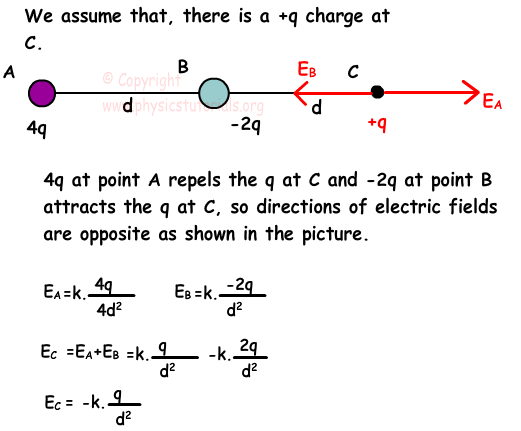
The following video provides an excellent worked example, demonstrating exactly how to execute this vector addition for a system of two charges.
Electric Field Due To Point Charges - Physics Problems
This segment of the video from The Organic Chemistry Tutor provides a detailed, step-by-step calculation of the net electric field at two different points near a pair of charges.
Watch the segment from 33:24 to 44:26. Observe carefully how the field from each charge is treated independently and then combined vectorially to find the net result.
Test your understanding!
Consider two point charges on the y-axis: is at the origin (), and is at . Find the net electric field (magnitude and direction) at point P on the x-axis, located at .
Hint: Sketch the problem. You'll have two E-field vectors at point P. You'll need to find the components of each before you can add them.
Show answer
-
Sketch: Draw the y-axis with at (0,0) and at (0,6). Point P is at (8,0).
-
Field from :
- Distance from to P is simply 8 m.
- Magnitude: .
- Direction: Since is positive, points away from it, along the positive x-axis. So, .
-
Field from :
- Distance from at (0,6) to P at (8,0) is found using Pythagoras: .
- Magnitude: .
- Direction: Since is negative, points toward it. The vector from P(8,0) to (0,6) is . The angle this vector makes with the negative x-axis is .
- Components:
- .
- .
- So, .
-
Net Field (Superposition):
- .
-
Magnitude and Direction of Net Field:
- Magnitude: .
- Direction: The angle above the positive x-axis is .
The net electric field at point P has a magnitude of approximately 174.4 N/C at an angle of 38.2° above the horizontal.
4. Electric Potential
Just as the electric field is force per unit charge, the electric potential (), often just called potential, is the electric potential energy per unit charge.
The unit of potential is the volt (V), which is a joule per coulomb (J/C). This is the very same "volt" we used in our DC circuit analysis. Voltage is simply a difference in electric potential between two points.
For a single point charge , the potential at a distance is given by:
Notice two critical differences from the electric field equation:
- Potential is a scalar, not a vector. It has magnitude but no direction.
- It depends on , not .
- The sign of is used in the calculation, making the potential itself positive or negative.
Because potential is a scalar, the superposition principle is much simpler to apply. The total potential at a point due to multiple charges is the simple algebraic sum of the potentials from each charge.
No vectors, no components. You just calculate for each charge and add the numbers.
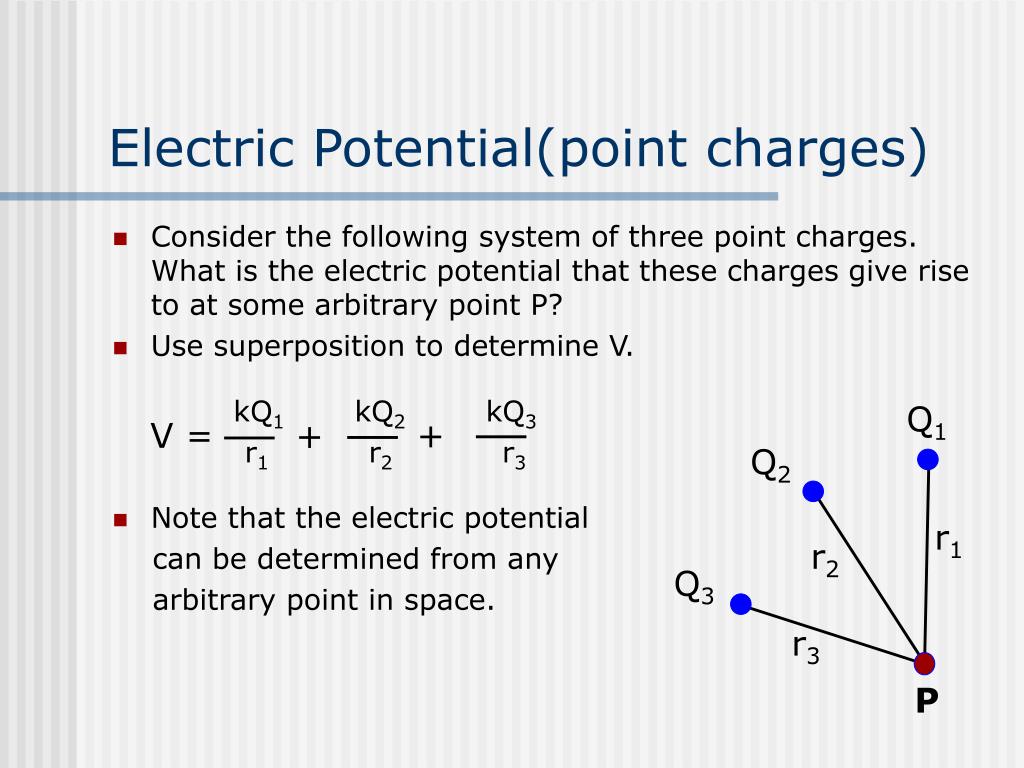
The following video demonstrates this simple but powerful concept.
Physics - E&M: Ch 38.1 Voltage Potential Understood (9 of 24) Potential Due to Multiple Charges%%%
In this short video, Michel van Biezen calculates the total potential at a point due to three charges, highlighting how simple the scalar addition is compared to vector field calculations.
Watch the entire video (00:00 - 04:01). The key takeaway is the direct, algebraic summation of potentials, which he explicitly contrasts with the vector sum needed for fields.
Conclusion
In this lesson, we have taken our first steps into the fundamental theory of electromagnetism. We've defined the core concepts of the electric field and electric potential and learned how to calculate them for the simplest case: one or more point charges.
Key Takeaways:
- An electric charge creates an electric field (a vector) and an electric potential (a scalar) in the space around it.
- For a single point charge , the field strength is and the potential is .
- The Principle of Superposition allows us to find the net effect of multiple charges by summing their individual contributions.
- Calculating the net field requires vector addition (), which often involves breaking vectors into components.
- Calculating the net potential is a simpler scalar addition ().
Preview of the Next Lesson:
We've defined potential as energy per charge, but what does that mean practically? Your goal includes understanding electricity in terms of "work done." In the next lesson, we will directly connect the concept of electric potential difference (voltage) to the work required to move a charge within an electric field, solidifying the link between these fundamental ideas and the world of energy and mechanics.
Can't find a good explanation? Sign up and we'll make it for you
Sign up