
Hello! In our previous lessons, we explored the world of electrostatics, focusing on the fields and potentials created by stationary charges. We finished by establishing a clear link between electric potential and the work required to move a charge within an electric field.
Today, we pivot from static charges to moving charges, which is where magnetism enters the picture. We will investigate how an electric current—a flow of charge—generates a magnetic field around it. Our main tool will be Ampère's Law, a cornerstone of electromagnetism and one of the four famous Maxwell's equations. By the end of this lesson, you will be able to use Ampère's Law to describe and calculate the magnetic field produced by a current-carrying wire.
1. From Currents to Magnetic Fields: Ampère's Law
Just as Coulomb's law gives us the electric field from a point charge, we need a law to find the magnetic field () from a current. While the more general Biot-Savart law exists (which is computationally intensive), Ampère's Law provides a powerful and elegant method for calculating magnetic fields in situations with high symmetry.
Ampère's Law relates the magnetic field integrated around a closed imaginary path, called an Amperian loop, to the net electric current that passes through the surface enclosed by that loop. Mathematically, it is expressed as a line integral:
Let's break this down:
- : This is a line integral of the magnetic field around a closed loop. It represents the "circulation" of the magnetic field. Conceptually, you are walking along a closed path and, at every infinitesimal step , you measure the component of the magnetic field that points along your direction of travel and sum it all up. Your background with line integrals from calculating work should make this formalism familiar.
- : This is a fundamental constant called the permeability of free space, . It quantifies the ability of a vacuum to support a magnetic field.
- : This is the net current that pierces the surface bounded by your Amperian loop.
The following video provides an excellent conceptual introduction to the law, explaining each part in detail, including the crucial role of the right-hand rule in determining the sign of the enclosed current.
Ampere's circuital law (with examples) | Moving charges & magnetism | Physics | Khan Academy
To understand the physical meaning of Ampère's Law, let's watch this video from Khan Academy. It clearly explains the line integral, the concept of an Amperian loop, and how to determine the enclosed current.
Watch the video from the beginning until 11:44. Focus on understanding the two sides of the equation: what the line integral represents and how to correctly identify the enclosed current using the right-hand rule.
As the video explains, there's a sign convention. Once you choose a direction to travel around your loop, you use the right-hand rule: curl the fingers of your right hand in the direction of integration, and your thumb points in the direction of positive current. Any current flowing in that direction is positive; any current flowing opposite to it is negative.
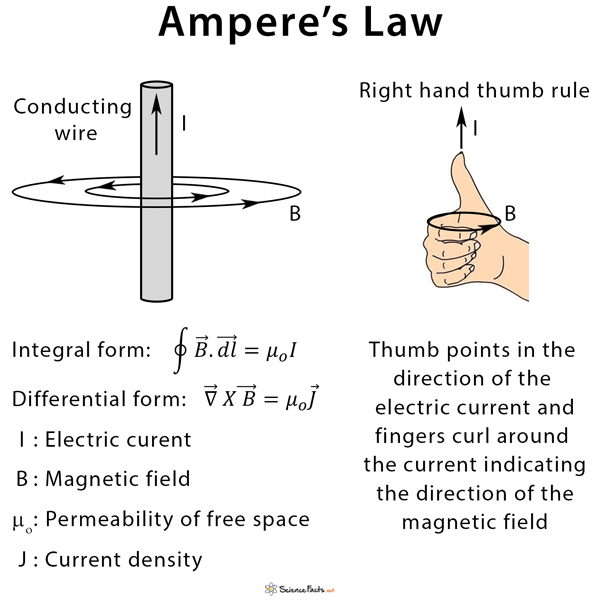
2. Application: Magnetic Field of a Long, Straight Wire
Now, let's use Ampère's law to achieve our main goal: finding the magnetic field around a long, straight wire carrying a current . This is a classic application that demonstrates the law's power.
The key is to choose an Amperian loop that exploits the problem's symmetry.
- Symmetry: For a long, straight wire, the magnetic field must be the same magnitude at any point at the same distance from the wire. Furthermore, the field lines must be circular, centered on the wire.
- Choice of Loop: This symmetry points to an obvious choice for our Amperian loop: a circle of radius concentric with the wire.
This choice is strategic for two reasons:
- The magnetic field vector is everywhere tangent to the circular loop, meaning it is perfectly parallel to our path element vector . The dot product simplifies: .
- The magnitude of the magnetic field, , is constant everywhere on our chosen loop due to symmetry. This means we can pull outside the integral.
The following video masterfully walks through this exact derivation.
Field due to straight wire carrying current (Outside) | Moving charges & magnetism | Khan Academy
This Khan Academy video applies Ampère's law to the case of a long, straight wire. Pay close attention to how the choice of a circular Amperian loop simplifies the line integral, making the calculation straightforward.
Watch the entire video. It sets up the problem, explains the strategic choice of the Amperian loop, and carries out the mathematical steps to arrive at the final formula.
Let's summarize the derivation you just saw:
- Start with Ampère's Law:
- Evaluate the left-hand side (LHS): With our circular loop, is parallel to and is constant.
The integral is simply the sum of all the infinitesimal length elements around the loop, which is the circumference of the circle, .
- Evaluate the right-hand side (RHS): The current enclosed by our loop is simply the total current flowing through the wire.
- Equate and solve for :
This is the magnitude of the magnetic field at a distance from a long, straight wire carrying current . The field strength is directly proportional to the current and inversely proportional to the distance from the wire.

3. Direction and Calculation
We have the magnitude of the field, but what about its direction? We use a convention often called the Right-Hand Rule 2 (RHR-2).
- Point the thumb of your right hand in the direction of the current ().
- Your fingers will curl in the direction of the circular magnetic field lines ().
Now let's apply this with a calculation.
Example 1: Calculating Current that Produces a Magnetic Field
This brief example from the online textbook 'Introductory General Physics' demonstrates a practical calculation using the formula we just derived.
Read through 'Example 1' to see how the formula B = μ₀I / 2πr is rearranged to solve for the current required to produce a given magnetic field.
Test your understanding!
A standard household wire carries a DC current of 10 A. What is the strength of the magnetic field at a distance of 1 cm (0.01 m) from the wire? Compare this to the Earth's magnetic field, which is approximately .
(Recall that )
Show answer
We use the formula we derived:
Plugging in the values:
The magnetic field from the wire is . This is four times stronger than the Earth's magnetic field of , which explains why power lines can interfere with compass readings, as mentioned in the reading.
Conclusion
In this lesson, we made the transition from electrostatics to magnetostatics. We introduced Ampère's Law as a fundamental principle linking electric currents to the magnetic fields they create. By applying this law to a situation with simple symmetry, we derived a practical and important result for the magnetic field around a wire.
Key Takeaways:
- Moving charges (currents) are the source of magnetic fields.
- Ampère's Law, , relates the circulation of the magnetic field around a closed loop to the net current flowing through it.
- For a long, straight wire carrying current , the magnetic field lines are concentric circles, and their strength at a distance is given by .
- The direction of the magnetic field around a wire is determined by the right-hand rule (point thumb with current, fingers curl with the field).
Preview of the Next Lesson:
We've now seen how currents create magnetic fields. The natural next question is: how do magnetic fields affect charges? In the next lesson, we will investigate the magnetic force exerted on moving charges and current-carrying wires. This concept, known as the Lorentz force, is the foundation for understanding how electric motors and many other electromagnetic devices work.
Can't find a good explanation? Sign up and we'll make it for you
Sign up