
Hello. This course connects DeFi yield-market mechanics and institutional diligence to the communication tasks expected in an institutional capital-markets role. In this module, the focus is not merely on understanding a product, but on communicating an opportunity without smoothing away the conditions, uncertainties, and operational work that determine whether it is actually suitable.
This lesson develops a capital-markets newsletter update around Exponent’s ONyc risk-tranching opportunity. By the end, you should be able to turn a product launch into a concise, balanced note that states: what is new, how the economics work, which risks matter, who may fit, who likely does not, and what evidence a prospective allocator should request before acting.
A capital-markets newsletter is a compact underwriting note
An institutional newsletter should not read like a launch announcement. A launch announcement answers, “What has the protocol released?” A capital-markets note answers a more demanding question:
“Why might this matter for a particular portfolio, what is the return for bearing risk, and what would invalidate the opportunity?”
That distinction is especially important for products described with phrases such as principal protection, senior, or target APY. These terms are useful shorthand, but each can create an overly familiar fixed-income impression if left unqualified.
For this type of note, separate every statement into one of three categories:
| Category | What it means | Appropriate newsletter language |
|---|---|---|
| Verified product fact | A documented mechanism or currently observable market parameter | “The program uses a Senior and Junior loss waterfall.” |
| Investment interpretation | Your reasoned view of what that mechanism may enable | “This may suit an allocator seeking yield exposure with a defined first-loss layer.” |
| Open diligence item | A fact that must be checked at the time of allocation | “Current effective coverage, withdrawal conditions, and NAV-source arrangements should be confirmed before deployment.” |
The discipline is simple: do not present an interpretation as a fact, and do not present an advertised yield as a contractual result.
For a newsletter, the objective is not to complete all diligence. It is to give the reader enough information to decide whether a diligence conversation is warranted.
The opportunity: risk-tranched exposure to ONyc
Exponent’s risk-tranching design divides exposure to one underlying yield-bearing asset between two participant groups:
- Senior LPs give up part of the underlying asset’s upside in exchange for Junior capital beneath them in the loss waterfall.
- Junior LPs hold first-loss exposure and receive both the underlying’s residual economics and a risk premium transferred from Senior.
The most useful institutional translation is not “senior debt versus equity.” Instead, describe it as a programmable loss-allocation arrangement around a yield-bearing underlying asset. Senior has priority over Junior in the loss waterfall, but neither tranche eliminates the underlying asset, smart-contract, operational, custody, or legal risks.
Risk-Tranching - Exponent Docs
Read Exponent’s documentation first to establish the economic meaning of the two tranches and the coverage metric before writing about either expected returns or protection.
In the section “What Senior and Junior Economically Represent,” read the tranche economics. Focus on the fact that LP shares represent claims on each tranche’s effective NAV, not a fixed coupon claim. Then move to “Coverage and Utilization.” Read the coverage discussion. Note the central communication point: lower utilization indicates more Junior protection relative to the program’s required level, while utilization above 100 percent indicates under-coverage.
The promotional summary below illustrates the intended positioning of the ONyc tranches. It displays a Senior tranche, srONyc, with a 6.4% APY at target utilization and a 20% minimum protection figure, alongside a Junior tranche, jrONyc, with a 27.5% APY at target utilization. It also labels the Senior side as protected principal and the Junior side as amplified yield with first-loss risk.
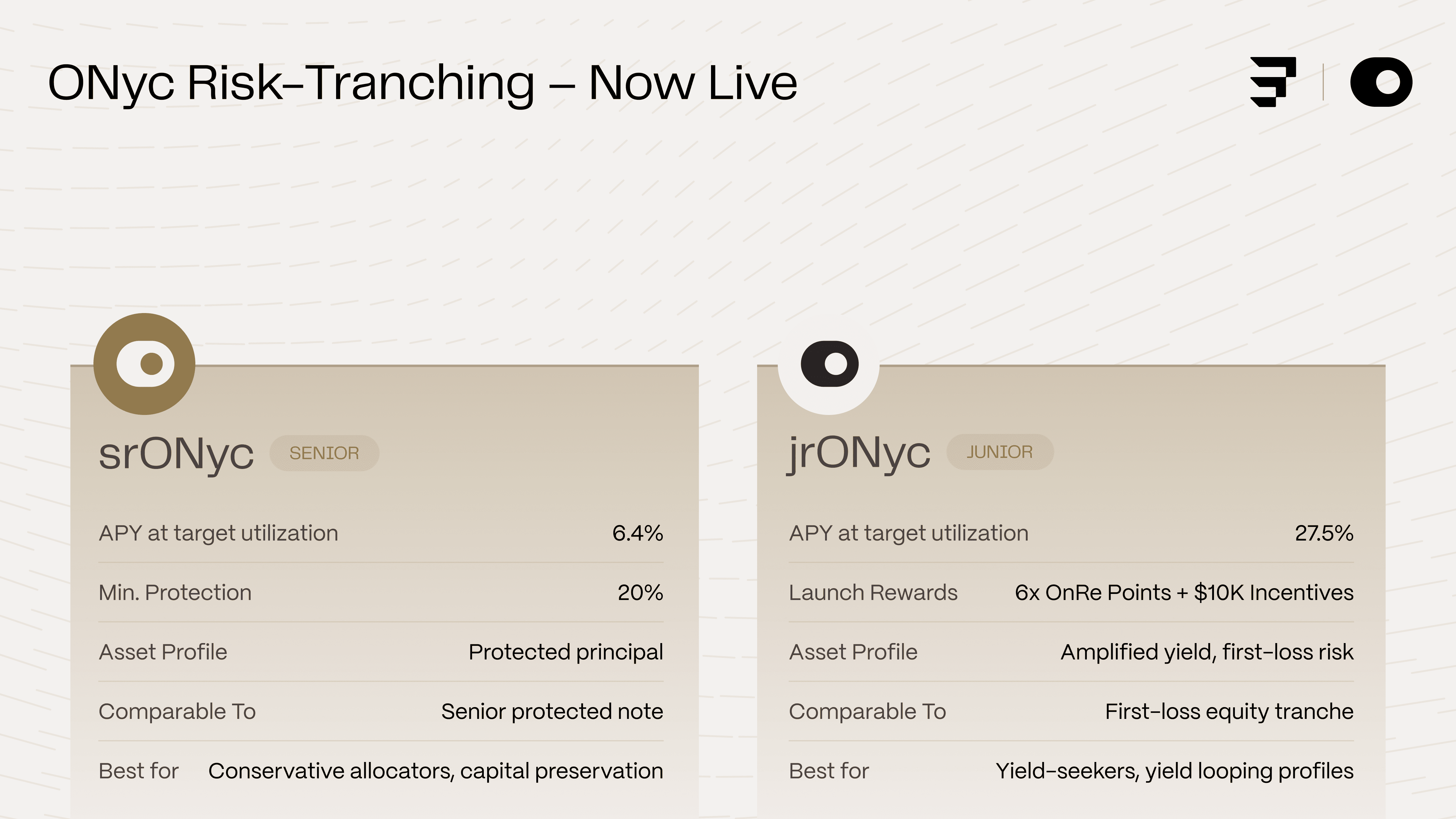
Treat this as marketing and product-positioning data, not an allocation recommendation. In particular:
- “At target utilization” means the stated APY depends on the market’s capital structure and return curve.
- “Minimum protection” is a configured structural parameter, not a blanket guarantee against every loss or a statement of current, real-time coverage.
- The Junior panel includes launch rewards separately from APY. Incentives, points, and promotional rewards should never be blended into recurring organic yield without explicit labeling.
- Any newsletter must state the “as of” date and verify whether a product is in alpha, public launch, or a different deployment phase. Product-launch blog language can become stale.
Exponent v2 is Live - Built For Those Who Outperform - Exponent Blog
Use Exponent’s launch post to understand how the firm frames risk tranching within the broader v2 platform, and how it describes its security work. Read it as a primary source, while still distinguishing launch claims from independently verified facts.
In “Risk-Tranching Swaps – Principal Protection on Rate Assets,” begin at the sentence “The inability to protect invested principal keeps” and read the launch rationale. Notice that the post describes an Alpha Phase and a later public rollout; this is why publication-date verification is essential. Then read the security discussion beginning “Security has been our number one priority” through the stated security process. Record the claims precisely: the post says that close to $1M was allocated across security work and that v2 programs underwent 12 audits. Do not convert audit activity into a claim of zero risk.
Explain the risk premium without overselling the yield
The fundamental transaction is a transfer of risk.
Senior receives a lower share of the underlying asset’s yield because it is purchasing a first-loss buffer from Junior. Junior receives a higher expected return because it supplies that buffer and absorbs losses first. The premium is dynamic rather than permanently fixed: when Junior protection becomes scarce, Junior capital is more valuable and its share of yield can increase; when Junior capital is abundant, its premium can decline.
A careful newsletter can say:
“Senior holders exchange part of the underlying yield for priority in the loss waterfall. Junior holders receive a variable risk premium for providing first-loss capital.”
It should not say:
“Senior earns a safe fixed return,” or “Junior’s higher APY is free yield enhancement.”
The first statement confuses a variable, risk-dependent allocation with a fixed coupon. The second hides the economic reason Junior is compensated.
A useful internal test is to ask what must happen for each tranche to disappoint:
| Position | Why the return may be attractive | Principal sources of disappointment |
|---|---|---|
| Senior / srONyc | Receives yield while Junior capital absorbs losses before Senior | Underlying NAV loss larger than available Junior protection; reduced or paused yield during recovery; smart-contract, pricing-source, custody, and liquidity risks |
| Junior / jrONyc | Receives risk premium plus residual underlying economics, potentially amplifying return | First-loss exposure; lower realized yield than implied; constrained exits if coverage would become too thin; loss of capital following a sufficiently adverse underlying NAV event |
The word first-loss should appear early in any Junior discussion. It is the reason the return can be higher, and it helps prevent an allocator from treating the Junior APY as merely a boosted lending rate.
The risk paragraph must describe the waterfall and the exit conditions
The most decision-relevant risk is not simply “market volatility.” It is how a negative NAV event is allocated and how that allocation affects exits.
If Junior effective coverage is 22% and the underlying asset suffers a 15% NAV loss, Junior absorbs the loss first and Senior remains whole, though the protective buffer falls to 7%. If the loss is 25%, Junior absorbs the first 22% and Senior bears the remaining 3%.
That is meaningful protection, but it is conditional protection. It depends on the size of the loss, the actual Junior effective NAV at the event, the market’s configured parameters, and the treatment of the underlying asset’s NAV.
Risk-Tranching - Exponent Docs
Read these sections to write risk language that is specific enough for an investment committee, rather than relying on the vague statement that “capital is protected.”
In “Loss Waterfall,” read the waterfall and example. Focus on the difference between a loss that Junior can fully absorb and one that reaches Senior. Then read “Recovery Period,” “Settlement Threshold,” and “Senior and Junior Exit Constraints.” Read the recovery and withdrawal rules. The crucial newsletter implication is that Senior withdrawals can be paused during a Recovery Period, while Junior withdrawals may be restricted in normal conditions if an exit would impair required protection.
A complete risk paragraph should cover five layers, in descending order of relevance:
-
Underlying-asset risk: ONyc’s NAV and cash-flow performance drive the economic base of both tranches. The newsletter should identify the underlying asset but avoid asserting its credit quality without underlying-specific diligence.
-
Structural protection risk: Junior is only as protective as its effective NAV at the relevant time. Minimum coverage, target coverage, utilization, and settlement thresholds must be checked in the live market.
-
Liquidity and recovery risk: The protection mechanism may alter withdrawal availability. A Senior investor may remain economically whole during recovery but be unable to withdraw immediately.
-
Protocol and pricing risk: The system depends on smart contracts and an approved NAV or pricing source. NAV changes are recognized when the market is synced through designated on-chain actions, rather than necessarily updating continuously.
-
Operational and legal risk: A prospective investor still needs to assess Solana wallet controls, custody, signing policy, permitted-investment status, tax and accounting treatment, and reporting requirements.
Security evidence belongs here, but proportionately. A good formulation is:
“Exponent’s v2 launch materials describe 12 independent audits and a broader security program. Those controls are relevant diligence evidence, but they do not eliminate smart-contract, integration, or operational risk.”
This is materially stronger than simply writing “audited.”
Match the product to a mandate, not to a generic risk label
A newsletter earns trust when it is explicit about unsuitable mandates. That reduces unproductive sales conversations and makes the suitable profiles more credible.
Potentially suitable client profiles
Senior tranche: yield allocators seeking conditional downside prioritization
Possible profiles include a crypto-native asset manager, family office, or treasury with a defined allocation to on-chain yield, a tolerance for protocol and underlying-asset risk, and a willingness to monitor coverage and withdrawal conditions. The attraction is not a risk-free return. It is the ability to exchange some upside for a transparent, Junior-funded first-loss layer.
Relevant suitability conditions:
- The mandate permits Solana-based DeFi exposure.
- The client understands that the protection is limited by live Junior effective NAV.
- The liquidity horizon can accommodate a Recovery Period or temporary withdrawal pause.
- The client can independently underwrite ONyc, Exponent, and the relevant operational stack.
Junior tranche: specialist capital seeking compensation for first-loss risk
Potential users include crypto hedge funds, specialist yield desks, sophisticated family offices, and proprietary or market-making capital with an explicit appetite for underwriting the underlying risk. The Junior side may be relevant where the investor believes the risk premium more than compensates for the expected loss, liquidity constraints, and active monitoring burden.
Relevant suitability conditions:
- The investor can take capital loss and understands that it occurs before Senior is impaired.
- The investment process can monitor utilization, NAV developments, incentives, and exit constraints.
- The return target is high enough to justify a variable and potentially impaired outcome.
- Any launch incentives are treated as temporary and separately valued.
Generally unsuitable profiles
The product is likely unsuitable for:
- Cash-management mandates that require capital certainty and daily unconditional liquidity.
- Investors unable to hold or operate Solana-native positions through approved custody and governance processes.
- Allocators seeking exposure only to traditional, legally defined senior secured instruments.
- Junior investors who cannot tolerate a loss of principal or cannot monitor the market’s protection health.
This suitability framing is commercially useful. It tells a Senior prospect that the product is not a deposit substitute, and tells a Junior prospect that the compensation exists because they are assuming a real risk-transfer role.
A repeatable structure for the newsletter
Aim for roughly 250 to 400 words. The reader should be able to scan it in two minutes, then know exactly what to request next.
Use this sequence:
- Headline and timestamp: Name the market and state the publication date.
- Why now: State the new market or program and the portfolio problem it addresses.
- Economics: Explain the Senior–Junior exchange in plain fixed-income language.
- Current terms: Include only date-stamped, verifiable figures; label target APY, incentives, and protection separately.
- Risk and liquidity: Name the loss waterfall, coverage dependency, and withdrawal constraints.
- Suitable profiles: Specify mandate characteristics, not just investor labels.
- Diligence call to action: Identify the documents and live metrics required for an allocation decision.
Before publication, apply this editorial control:
| Check | What to verify |
|---|---|
| Status | Whether the market is live, capacity-limited, in alpha, or publicly available |
| Terms | Current target APY, minimum coverage, target coverage, fees, incentives, and program parameters |
| Live protection | Current Junior effective NAV, coverage utilization, and any withdrawal restrictions |
| Underlying diligence | ONyc NAV methodology, risk factors, liquidity, legal structure, and relevant counterparties |
| Protocol diligence | Contract addresses, audit reports, upgrade or pause powers, pricing source, and incident process |
| Operational fit | Custody, wallet policy, approvals, accounting, reporting, and permitted-investment status |
Model newsletter update
The following is intentionally written with bracketed fields. In a live capital-markets workflow, replace only those fields after checking the current app, documentation, and internal diligence materials.
Subject: New Solana Yield Opportunity: ONyc Risk Tranching With a Junior-Funded Protection Layer
As of [publication date], Exponent is offering risk-tranched exposure to the ONyc yield asset through Senior and Junior LP positions. The structure is designed for allocators who want to separate yield exposure from the amount of first-loss risk they are willing to retain.
The Senior tranche, srONyc, gives up part of ONyc’s upside in exchange for Junior capital absorbing losses first. The Junior tranche, jrONyc, receives the residual underlying economics plus a variable risk premium for providing that protection. Exponent’s current product materials display a Senior target-utilization APY of [verify current figure] and a minimum protection setting of [verify current figure]; these are not equivalent to a fixed coupon or guaranteed loss limit. The Junior target-utilization APY and any launch incentives should be assessed separately from recurring yield.
The core risk is the adequacy of live Junior effective NAV. A loss first reduces Junior capital; Senior is affected only if losses exceed available Junior protection. Coverage utilization, NAV-source methodology, and the program’s settlement parameters therefore matter more than the headline APY. Investors should also note that Senior withdrawals may be paused during a Recovery Period, while Junior exits can be restricted where withdrawal would reduce protection below required levels.
Potential fit: Senior may suit crypto-native yield allocators with a defined Solana mandate and tolerance for conditional liquidity. Junior may suit specialist capital able to underwrite first-loss exposure and monitor coverage actively. The structure is not a substitute for cash management, insured deposits, or conventional senior secured credit.
Before allocation, request the current coverage dashboard, tranche parameters, fees, underlying ONyc diligence materials, NAV and sync methodology, contract and audit materials, and the operational requirements for custody and reporting.
The draft works because every attractive feature has a paired condition:
- Yield is paired with the source of that yield and its variability.
- Protection is paired with Junior effective NAV and the loss waterfall.
- Senior status is paired with recovery-period liquidity risk.
- Junior return is paired with first-loss exposure.
- Security evidence is paired with the limits of audits and controls.
- Product fit is paired with clear disqualifiers.
Key takeaways
A strong institutional newsletter is a decision aid, not a promotional asset. For Exponent’s ONyc risk-tranching opportunity, the essential message is that Senior and Junior investors are exchanging yield for risk in different ways: Senior sacrifices upside for a Junior-funded first-loss buffer, while Junior receives a variable premium for bearing that first-loss exposure.
Use date-stamped facts, distinguish target APY from realized return, explain coverage and the waterfall, and state the Recovery Period and exit constraints plainly. Most importantly, match the product to mandates that can genuinely absorb its operational, liquidity, protocol, and underlying-asset risks.
Next, the course moves from written communication to live delivery: presenting Exponent’s products in a ten-minute institutional product presentation and answering technical and risk questions concisely.
Can't find a good explanation? Sign up and we'll make it for you
Sign up