Hello! Welcome to your first lesson in our "Radioelectronics: fundamentals, then advanced math" course. I'm excited to embark on this journey with you.
Given your background in Radiophysics and your extensive career in software engineering, we'll aim for a solid refresher on the core principles, connecting them to the underlying mathematics and physics that you're familiar with, while also bridging concepts to the world of technology where relevant.
Introduction
Today's Goal: This lesson introduces the fundamental building block of all alternating current (AC) signals: the sinusoid. By the end of this lesson, you will be able to define and explain the key characteristics of a sinusoidal waveform, including its amplitude, frequency, period, and phase.
This is the first step in Module 2, "AC Circuit Analysis". While the course syllabus also includes DC circuit fundamentals, your background suggests you're likely ready to jump straight into AC analysis, which is the heart of radioelectronics. We'll be dealing with signals that change over time, and understanding their properties is essential before we can analyze how circuits affect them.
Time to complete: Approximately 45-50 minutes.
1. The Anatomy of a Sinusoidal Signal
In electronics, we often represent an AC voltage or current as a sinusoidal function of time. The general mathematical expression for a sinusoidal voltage is:
Let's break down what each part of this equation represents. We'll start with the most intuitive property: its height.
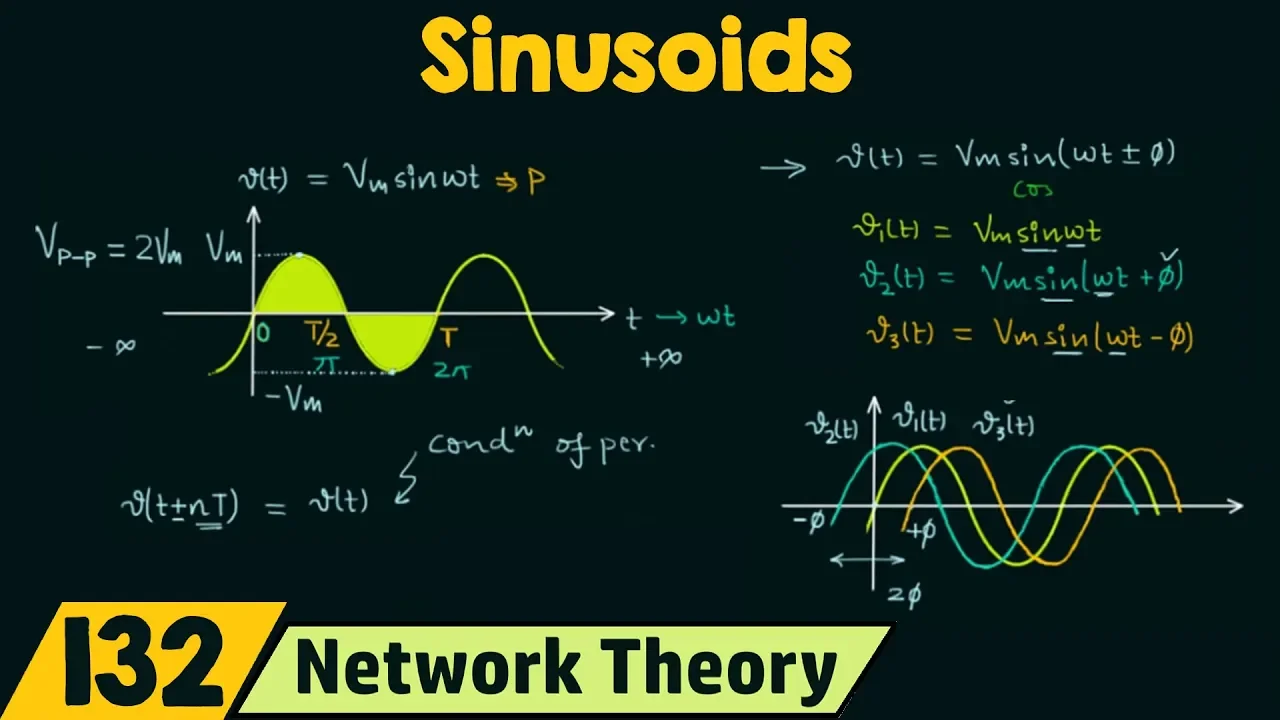
To begin, please watch the first part of this video from Neso Academy. It provides a clear visual introduction to the basic waveform and its amplitude.
- Resource: by Neso Academy
- Section: Introduction to Sinusoidal Waveform Parameters
- Watch: 00:17 to 01:46
As the video explains, the Amplitude () is the maximum or peak value that the signal reaches from its center point (usually zero). On an oscilloscope, this is the distance from the horizontal centerline to the highest point of the wave.
- Amplitude (): The peak value of the waveform. Its unit is Volts (V) for voltage or Amperes (A) for current.
- Peak-to-Peak Amplitude (): The full vertical extent of the wave, from the most negative peak to the most positive peak. As the video mentions, .
The expression represents the instantaneous value of the voltage at any specific time . While the amplitude is a single number describing the peak, the instantaneous value is what the signal is at any moment.
How do we calculate this value at a specific point in the cycle? The next video provides a great hands-on explanation.
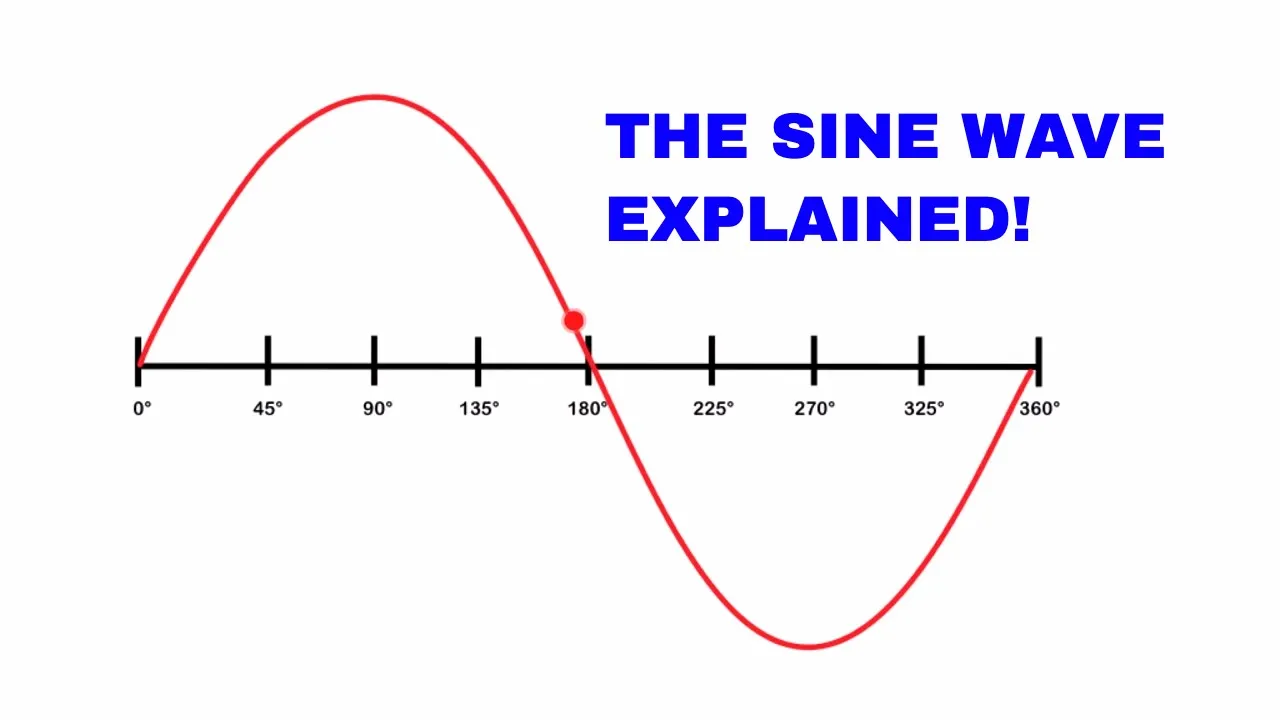
Please watch the following segment. Focus on how the instantaneous value is calculated using the peak value and the angle of the waveform at that point.
- Resource: by The Electric Academy
- Section: Instantaneous Value Calculation
- Watch: 03:09 to 06:10
The key formula from the video is:
Where is the angle in degrees or radians. This connects our time-based formula to the rotational generation of a sine wave. The angle and time are linked by the angular frequency (which we'll define next) through the simple relation . So, our original formula is precisely for calculating the instantaneous voltage.
2. Period and Frequency: The Rhythm of the Wave
Sinusoids are periodic, meaning they repeat the same pattern over and over. This repetitive nature is described by two intertwined concepts: period and frequency.
Let's return to the Neso Academy video to see how these are defined and related.
Please watch these two consecutive parts. They cover the definition of a periodic signal and the crucial mathematical relationships between period and the different types of frequency.
- Resource: by Neso Academy
- Sections:
- Periodicity and Time Period (01:46 - 04:00)
- Relationship between Angular Frequency, Frequency, and Time Period (04:00 - 06:21)
Here's a summary of those key definitions:
- Period (): The time required to complete one full cycle. The unit is seconds (s).
- Frequency (): The number of cycles completed in one second. The unit is Hertz (Hz), where . Frequency and period have a simple inverse relationship:
- Angular Frequency (): This is a concept you'll know well from physics. It describes the rate of change of the phase angle, measured in radians per second (rad/s). It's related to the frequency by: Since is the argument of our sine function, essentially scales the time axis. A higher means the wave oscillates more rapidly.
Example: The standard AC power in your home in the UK has a frequency of Hz. Let's find its period and angular frequency.
- Period: or 20 milliseconds.
- Angular Frequency: .
3. Phase: The Wave's Position in Time
Finally, let's look at the last term in our general equation, .
The phase angle () determines the horizontal position of the sine wave relative to a reference. Think of it as the starting angle of the waveform at time .
The final segment from the Neso Academy video explains this concept of phase shift and the important ideas of "leading" and "lagging."
- Resource: by Neso Academy
- Section: Phase Shift in Sinusoids
- Watch: 06:21 to 09:43
Let's recap the main points:
- Phase Shift (): The angle (or time) difference between two sinusoids of the same frequency.
- Leading Phase: A signal is "leading" if it reaches its peak (or any other point in its cycle) earlier in time than a reference signal. This corresponds to a positive phase angle (). For example, leads by .
- Lagging Phase: A signal is "lagging" if it reaches its peak later in time. This corresponds to a negative phase angle (). For example, lags by .
From your software background, you can think of phase shift like a CSS animation-delay or an offset in a timeline. A positive phase shift makes the wave "start" sooner.
As the video emphasizes, for a meaningful phase comparison between two signals, three conditions must be met:
- They must have the same frequency.
- They must be expressed in the same form (e.g., both as sine functions or both as cosine functions).
- Their amplitudes must have the same sign (e.g., both positive).
Remembering the relationship is very useful here. A cosine wave is just a sine wave that is leading by . This identity will be critical in our next lesson.
A Quick Preview: Other Important Values
While peak amplitude is easy to see on a scope, it's not always the most useful value for power calculations. The second video you watched introduced two other important concepts: Average and Effective (RMS) value. We'll touch on them briefly as a preview.
If you'd like a quick refresher, feel free to re-watch these sections:
- Average Value of a Sine Wave (01:42 - 02:40)
- Effective (RMS) Value Explained (07:05 - 09:43)
Here's the takeaway:
- Average Value: For a full sinusoidal cycle, the average value is zero, because the positive and negative halves cancel perfectly. This is why we often discuss the average of a half-cycle, which is relevant for rectifiers (a topic for Module 4).
- RMS (Root Mean Square) Value: This is the most important value for AC power calculations. The RMS value of an AC signal is the equivalent DC value that would deliver the same amount of power to a resistor. It's often called the "effective" value. For a sinusoid, the relationship is: The 230V rating for UK mains power is an RMS value. The peak voltage () is actually !
Conclusion
Great work! We've successfully covered the fundamental properties that define any sinusoidal signal.
Key Takeaways:
- A sinusoidal signal is described by .
- Amplitude (): The peak value of the waveform.
- Period (): The time for one full cycle.
- Frequency (): The number of cycles per second ().
- Angular Frequency (): The rate of change in phase angle in rad/s ().
- Phase (): The initial angle of the signal, determining if it leads or lags a reference.
What's Next?
In our next lesson, "Representing Sinusoids with Phasors and Complex Exponentials," we will move from drawing waves and writing functions to a much more powerful and elegant mathematical toolkit. Phasors allow us to represent these oscillating signals as static vectors, which dramatically simplifies the analysis of AC circuits. It's where the real power of complex numbers comes into play in electronics.
If you have any questions, please feel free to ask