Hello! Welcome back to our module on building powerful partner channels.
In the last lesson, we focused on the crucial first steps of a partnership: how to conduct outreach to micro-influencers and define the terms of your collaboration. You now have the templates and frameworks to initiate professional, clear, and effective partnerships.
Today, we'll address the next logical question: "How do I know if the partnership is actually working?" This lesson focuses on a fundamental skill for measuring the success of your influencer marketing: creating unique discount codes to track sales from specific influencer campaigns. By the end of our 60 minutes, you will be able to set up trackable codes on major platforms to measure the direct return on investment (ROI) from each influencer you work with.
1. The 'Why': Tracking as the Foundation of Profitable Partnerships
Before we dive into the "how," let's solidify the "why." In your experience with local marketing, you know the importance of seeing what works. In the global e-commerce space, where you might be working with dozens of influencers simultaneously, this becomes even more critical. You need a reliable way to attribute sales to the correct source.
The most straightforward and reliable method for this is the unique discount code.
TikTok Influencer Campaign Guide: Proven ROI Tips
To understand why unique codes are so vital, let's look at some insights from the 'TikTok Influencer Campaign Guide' by Amplify Influencer. This article breaks down the essential elements of a successful campaign.
First, read the bullet points in the introductory section titled 'Every successful TikTok influencer campaign includes five essential elements...'. Note where tracking systems fall. Then, read the subsection 'Primary attribution methods ranked by reliability' under 'Setting Up Tracking and Attribution'. Pay close attention to why unique discount codes are ranked as the highest priority.
As you just read, unique discount codes are the highest priority and most reliable tracking method. They provide clear, unambiguous attribution. When a customer uses the code INFLUENCER_A_15, you know with certainty that the sale came from Influencer A's promotion.
Best Practices for Creating Codes:
- Make them unique: Never reuse codes between influencers or campaigns.
- Keep them simple and memorable: A common format is
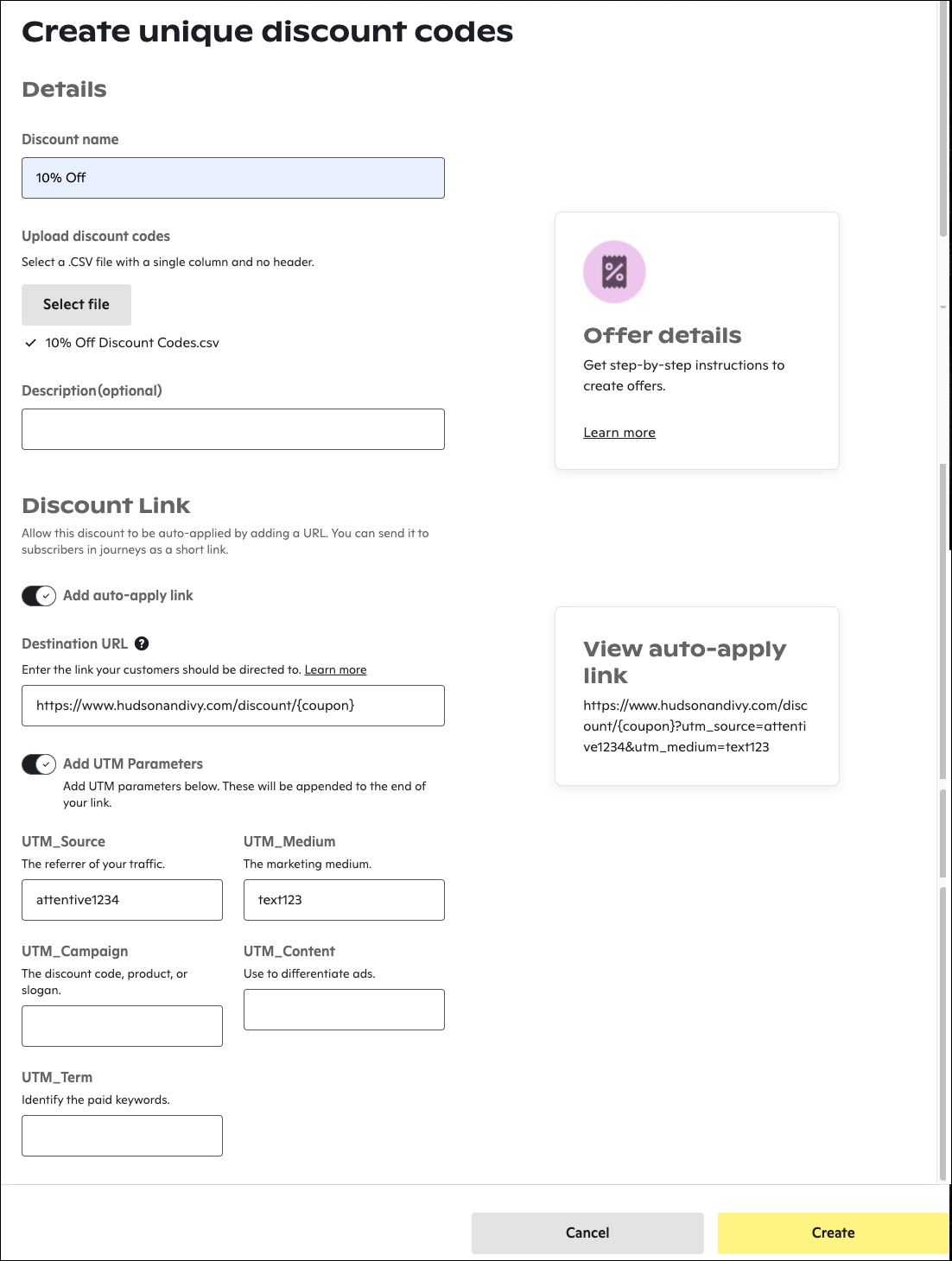
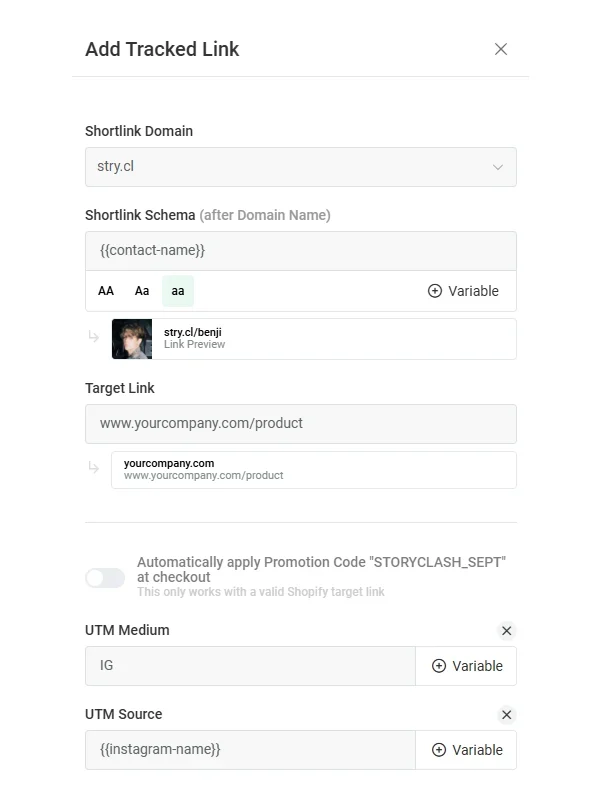
CREATORNAME15(Creator's Name + Discount Percentage). This is easy for the audience to remember and type. - Combine with trackable links: For even more data, a unique discount code can be embedded in a trackable link using UTM parameters. This allows you to track not just sales, but also clicks and traffic from that specific influencer.
Look at the following images. They show how a modern e-commerce or marketing platform allows you to create a unique link that not only tracks the source via UTM parameters but can also auto-apply the specific discount code at checkout. This combination is the gold standard for attribution.
Now, let's get practical and see how to implement this on the platforms you'll be using.
2. How to Create Tracking Codes on Your Key Platforms
Each marketplace has its own system for creating promotions. We'll cover TikTok Shop, which has a purpose-built feature for this, and Amazon, where we need a slight workaround. We'll also look at Shopify as an example of a general e-commerce platform with robust controls.
A. TikTok Shop: Using "Promo Codes" for Influencers
TikTok Shop is designed with influencer and affiliate marketing in mind. Its "Promo Code" feature is perfect for our goal.
TikTok Shop provides official documentation on how to create various seller coupons. We will focus specifically on their 'Promo Code' feature, which is designed for this exact purpose.
In the 'Seller coupons' article from TikTok Shop, first review the table under 'Available coupons & primary use cases' to understand what a 'Promo Code' is. Then, carefully read the section titled 'Promo Code' including its subsections 'How it Works' and 'Sharing the Promo Code' to learn the step-by-step creation process.
To summarize the key steps for creating an influencer-specific code on TikTok Shop:
- Navigate to Promotions > Promo Code in your Seller Center.
- Promotion Name: Give it an internal name for your own tracking, e.g., "TechLeo Campaign - May 2024".
- Claim Code: This is the crucial part. Create the unique code you will give to the influencer, e.g.,
TECHLEO15. Note the platform adds a 4-character prefix based on your shop name that you cannot change. - Active Dates: Set the start and end date to match the duration of the influencer's campaign. This is critical for isolating the campaign's performance.
- Discount: Choose a percentage or a fixed amount.
- Usage Quantity: You can cap the total number of times the coupon can be used to control your budget.
- Number of claims per customer: Typically, you would limit this to 1 to prevent abuse.
Once created, you simply copy this code and provide it to your influencer to share with their audience. The TikTok Seller Center will then show you how many times that specific code has been used.
B. Amazon: Adapting "Coupons" for Influencer Tracking
Amazon's coupon system is less flexible than TikTok's and is primarily designed for public-facing promotions. It doesn't have a simple "create a unique code" feature for one person. However, we can adapt the existing tool for basic tracking.
Let's watch the official Amazon Seller University video on how to create a coupon. While watching, think about how you could use these settings to isolate a campaign for a specific influencer, even if the code itself is technically public.
Watch the entire video (00:00 - 03:38). Pay close attention to the options for Coupon Title, Budget, and Scheduling the duration. These are the tools we will use to manage influencer campaigns.
As you saw, you can't create a simple, unique text code like TECHLEO15. Customers "clip" a digital coupon. So, how do we track an influencer?
Here's the workaround strategy:
- Create a New Coupon: Follow the steps in the video to create a new coupon for the specific product(s) in the campaign.
- Use a Descriptive Title: In the "Coupon Title" field, create a title that references the influencer. For example: "Special 15% Off for TechLeo's Followers". While other shoppers might see it, this helps you identify the campaign in your dashboard.
- Set a Strict Duration: Schedule the coupon to run only during the influencer's campaign period (e.g., from the day their video goes live for two weeks). This isolates the sales data to that timeframe.
- Set a Budget: Use the budget feature to limit your exposure. The budget is the total value of discounts you're willing to give. For example, a budget of $500 on a $10 discount would allow for 50 redemptions.
While this method isn't perfect attribution, running one such targeted coupon at a time for a specific campaign allows you to see the direct sales lift and redemptions during that period, giving you a strong directional sense of the influencer's impact. For more advanced tracking, you would use the Amazon Associates (affiliate) program or Amazon Attribution, which create unique trackable URLs.
C. The E-commerce Standard (Shopify Example)
Many sellers use a standalone e-commerce site (often built on Shopify) alongside marketplaces. Shopify's discount feature is a great example of a flexible system that gives you maximum control for influencer campaigns. The principles you see here apply to many other e-commerce platforms.
How To Setup and Create Discount Codes in Shopify - Beginner Tutorial
This tutorial shows how to create discount codes in Shopify. Even if you aren't using Shopify today, it's a valuable example of the features you should look for. It demonstrates the level of control that makes influencer tracking easy and precise.
Watch the sections from 00:18 to 01:51 and 05:45 to 08:27. Focus on how you can specify the exact discount code, set usage limits (both total and per customer), and define active dates.
The key features demonstrated in the video that are ideal for influencer tracking include:
- Custom Discount Code: You can create any code you want (e.g.,
TECHLEO15). - Maximum Discount Uses: You can limit the total number of times the code can be used, protecting your budget.
- Limit to One Use Per Customer: This is standard for promotional offers.
- Active Dates: Set a start and end date for the campaign.
- Performance Tracking: The platform provides built-in analytics to show how many times each specific code was used.
This level of control is what makes calculating the ROI for an individual influencer simple and accurate.
Test your understanding!
You are launching a new portable power bank. You've partnered with a TikTok influencer named 'GadgetGirl' for a one-week campaign starting next Monday. You've agreed to offer her followers a 20% discount.
Based on what you've learned from the TikTok Shop resource, describe the key settings you would configure to create a Promo Code for this campaign in the TikTok Seller Center. What would you suggest as the "Claim Code"?
Show answer
Here are the key settings for the TikTok Shop Promo Code:
- Promotion Name (Internal): "GadgetGirl Power Bank Campaign - Week of [Date]"
- Claim Code (Public): A good option would be
GADGETGIRL20. It's unique, memorable, and clearly communicates the offer. - Active Dates: Set the start date to next Monday and the end date to the following Sunday to cover the one-week campaign period.
- Discount: Set it to "Percentage-off" and enter "20%".
- Applies to: Select "Specific products" and choose the new portable power bank.
- Usage Quantity: Set a reasonable cap based on your budget and inventory (e.g., 500 total uses).
- Number of claims per customer: Limit to "1 claim per customer".
Conclusion
You are now equipped with the knowledge and practical steps to track the performance of your influencer partnerships accurately. This moves you from simply spending money on marketing to strategically investing it where it generates the best returns.
Key Takeaways:
- Tracking is Non-Negotiable: Unique discount codes are the most reliable way to measure the direct sales ROI of an influencer campaign.
- Platform Capabilities Vary:
- TikTok Shop offers a purpose-built "Promo Code" feature that is ideal for influencer tracking.
- Amazon requires a workaround using its standard coupon tool by carefully managing the coupon title, duration, and budget.
- General e-commerce platforms like Shopify often provide the most granular control over code creation, usage limits, and tracking.
- Structure is Key: Always create a unique code for each influencer and campaign, and set clear start/end dates to isolate performance data.
Next Up:
In our next module, we will begin exploring lead generation. We'll see how discount codes can be used not just to drive immediate sales, but also as a lead magnet to capture customer email addresses, building an asset you can market to for free in the future. This will be our first step in building long-term customer relationships beyond the initial marketplace transaction.