
Welcome to the third lesson in our module on building resilient microservices. In our previous session, we compared REST, GraphQL, and gRPC, concluding that gRPC is the superior choice for high-performance, internal service-to-service communication due to its efficiency and type-safe, contract-first approach.
Today, we transition from theory to practice. Your goal is to build a fully functional gRPC service and client in Go, one of your primary languages. This hands-on experience is critical for internalizing how microservices communicate in a modern, scalable system. By the end of this lesson, you will have implemented the foundational pattern for most internal network calls in the architectures you aim to build.
The gRPC Development Workflow
Building a gRPC application follows a clear, three-step workflow. You first define your service contract, then compile it into language-specific code, and finally, you implement the business logic for your server and client.
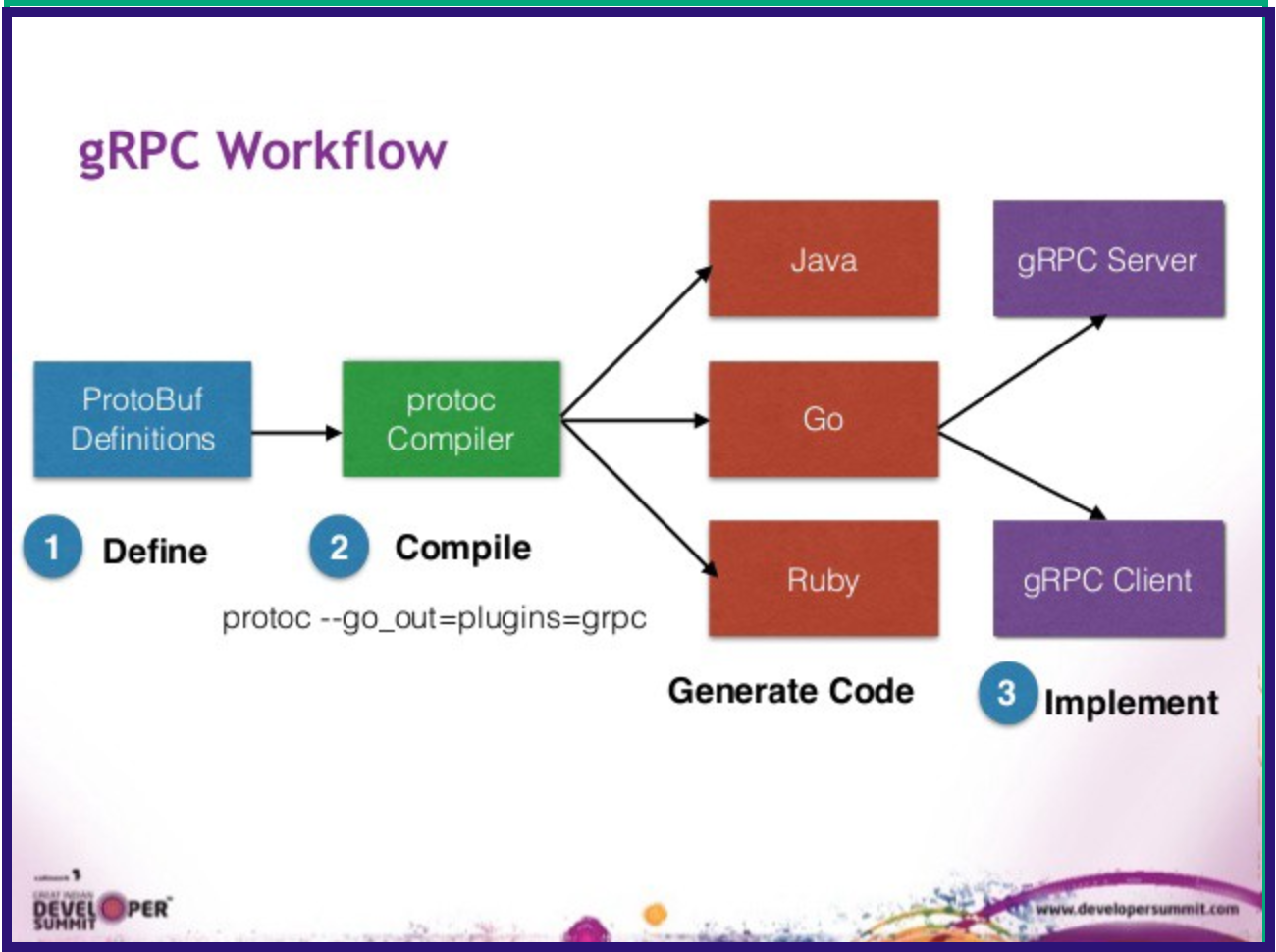
We will follow these three steps to build a simple "Coffee Shop" service.
Step 1: Defining the Service with Protocol Buffers
Before writing any Go code, we must define the "contract" for our service. In gRPC, this is done using Protocol Buffers (Protobuf). A .proto file is a language-agnostic file where you define:
- Messages: The data structures for your requests and responses. Think of these as the payload schemas.
- Services: A collection of remote methods (RPCs) that a service exposes.
- RPCs: The specific functions that clients can call, including their input (request message) and output (response message) types.
Protobuf offers a strongly-typed, binary format that is more compact and efficient to serialize/deserialize than text-based formats like JSON, which is a key reason for gRPC's performance advantage.
The video "2024 gRPC Golang Tutorial" by Code With Cypert provides an excellent walkthrough of creating a .proto file for our coffee shop example. It covers defining services, messages, RPCs (including a streaming RPC), and the significance of field numbers for backward compatibility.
2024 gRPC Golang Tutorial - The tutorial I wish I had when I was learning
Watch this segment to understand how a gRPC service contract is defined from scratch. The narrator does a great job explaining the syntax and concepts.
Please watch the section from protocol buffers. Pay close attention to the definitions of the CoffeeShop service, the RPC methods like GetMenu and PlaceOrder, and the corresponding message types. Note the use of the stream keyword for the GetMenu response, which we'll implement later.
Step 2: Generating Go Code
With the coffee_shop.proto file defined, we now use the Protobuf compiler, protoc, to generate the Go code that provides the necessary data structures and network stubs. This is a major advantage of gRPC's contract-first approach: it automates the creation of a significant amount of boilerplate code.
To do this, you need two Go-specific plugins for protoc:
protoc-gen-go: Generates the Go structs for your messages.protoc-gen-go-grpc: Generates the client and server interfaces for your service.
The official gRPC documentation provides the canonical explanation for this step.
This official tutorial explains the code generation process in detail.
Read the section Generating client and server code. Focus on understanding the protoc command and its flags (--go_out, --go-grpc_out). The text also clearly describes the two output files (.pb.go and _grpc.pb.go) and what each one contains.
The video from Code With Cypert also demonstrates this process live, including how to organize the generated files and create a Makefile to simplify the command—a common practice in real-world projects.
2024 gRPC Golang Tutorial - The tutorial I wish I had when I was learning
Watching this process in action can help solidify your understanding. The author also runs into and fixes common syntax errors in the .proto file, which is a valuable learning experience.
Watch the segment from generating go code, which covers running protoc, organizing the output, and creating a Makefile.
Step 3: Implementing the Server and Client
Now we have all the building blocks to write our application. This process involves two main parts:
- The Server: Listens for incoming requests, executes the business logic for the called RPC method, and sends back a response.
- The Client: Establishes a connection to the server, invokes the remote RPC methods as if they were local functions, and processes the server's response.
Given your experience in Go, you'll find the structure familiar. The generated code provides interfaces that your server must implement and a client stub that makes remote calls feel like local ones.
Server Implementation
The following segment from the video walks you through creating server.go. Key concepts to watch for are:
- Creating a
serverstruct that embeds the generatedUnimplementedCoffeeShopServer. This is a clever Go pattern that ensures forward compatibility if new RPCs are added to the service. - Implementing the methods for our service (
GetMenu,PlaceOrder,GetOrderStatus). - Handling a server-side streaming RPC (
GetMenu) by sending multiple messages on a stream. - Starting the gRPC server, registering your service implementation, and listening for TCP connections.
2024 gRPC Golang Tutorial - The tutorial I wish I had when I was learning
This is the core of the lesson. Follow along to build and run the gRPC server.
First, watch the detailed implementation of the server logic from server implementation. Then, watch how the main function is created to start the server and listen for traffic from main function.
Client Implementation
Next, you will build the client that communicates with your server. This part of the video demonstrates:
- Connecting to the gRPC server using
grpc.NewClient. - Creating a
CoffeeShopClientstub from the connection. - Using
context.Contextto manage timeouts and cancellations for RPC calls. - Calling a simple unary RPC (
PlaceOrder). - Receiving and processing a stream of messages from the server-side streaming RPC (
GetMenu). This is a crucial pattern for handling large datasets or real-time updates.
2024 gRPC Golang Tutorial - The tutorial I wish I had when I was learning
Now, build the client to interact with the service you just created.
Follow the client implementation from client implementation. Pay special attention to the goroutine and channel used to handle the incoming message stream from GetMenu.
Putting It All Together
With both the server and client code written, it's time to see them communicate. You'll run the server in one terminal and the client in another.
2024 gRPC Golang Tutorial - The tutorial I wish I had when I was learning
Watch the final result of your work.
Observe the full communication flow from running the client and server. You will see the client receive the streamed menu, place an order, and get its status.
Finally, the video concludes with important considerations for production code, such as robust error handling, security, and schema evolution. These are excellent points to keep in mind as you move from this example to real-world systems.
Conclusion
Congratulations, you have successfully built and tested a gRPC service and client in Go. You now have practical experience with the entire development workflow, from defining a contract with Protocol Buffers to implementing both unary and streaming RPCs. This skill is a cornerstone of modern microservice development.
Key Takeaways:
- Contract-First: The
.protofile is the single source of truth for your API. It enables strong typing and code generation. - Code Generation:
protocand its plugins save you from writing boilerplate networking and serialization code, letting you focus on business logic. - Server Implementation: You implement a generated interface. Embedding the
Unimplemented...Serverstruct is a best practice for forward compatibility. - Client Implementation: The generated client stub makes remote procedure calls look and feel like local function calls.
- Streaming is a First-Class Citizen: gRPC natively supports streaming, which is powerful for handling large data sets or real-time communication, a common requirement in scalable systems.
In this lesson, we built an internal service. But how do external clients, like web browsers or mobile apps, talk to it? They typically don't speak gRPC directly. The solution is an API Gateway, which acts as a single entry point into your system.

In our next lesson, we will explore the role of API Gateways and learn how to configure one for request routing, authentication, and rate limiting, bridging the gap between the outside world and the internal gRPC services you now know how to build.