Hello! Welcome to our next lesson on the foundations of language modeling.
In our last lesson, we dove into BERT's Masked Language Modeling (MLM), a "fill-in-the-blanks" objective that enables a model to develop a deep, bidirectional understanding of language. This is fantastic for tasks requiring rich contextual representations, like classification or question answering.
However, BERT's training objective isn't naturally suited for generating new text from scratch. For that, we need a different approach. This brings us to the core of modern generative AI.
Today's learning outcome is to explain the causal (autoregressive) language modeling objective used by GPT. This is the fundamental training principle that powers models like GPT, LLaMA, and Claude, enabling them to generate coherent and creative text.
By the end of this lesson, you will understand:
- The core concept of causal, or autoregressive, language modeling.
- The mathematical foundation of this objective based on the chain rule of probability.
- How this objective is implemented in the Transformer architecture using causal masking.
- The step-by-step process of autoregressive text generation at inference time.
1. The Core Idea: Predicting the Future, One Token at a Time
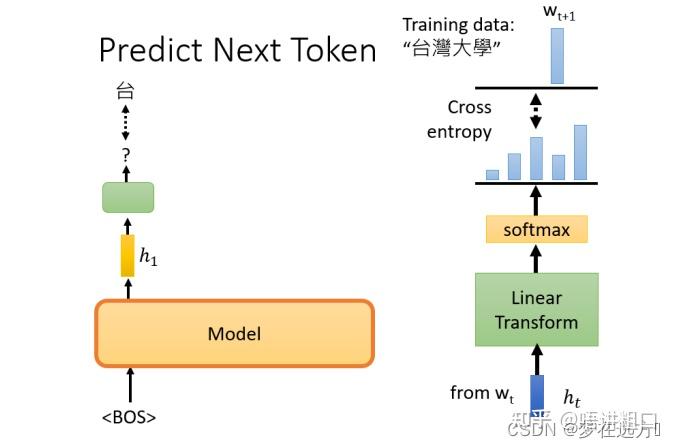
While BERT learns by looking at a whole sentence and filling in the blanks, models like GPT learn in a way that more closely mimics how a human might write: one word at a time, based on what has already been written. This is called causal or autoregressive modeling.
The training objective is simple yet powerful: predict the next token in a sequence, given all the preceding tokens.
Imagine the sentence: "The cat sat on the mat." The model is trained to perform a series of predictions:
- Given
[START], predictThe. - Given
[START] The, predictcat. - Given
[START] The cat, predictsat. - And so on...
This process is "causal" because the prediction at each step is caused only by the past; it cannot see the future. It's "autoregressive" because the model's output at one step becomes part of the input for the next step, essentially regressing on its own past outputs.
Understanding the Core Concepts of Large Language Models
To start, let's get a high-level overview of this concept. The following resource explains the decoder-only architecture of GPT-like models and introduces the next-token prediction objective.
Read the sections 'f. Decoder-Only Architecture', 'a. Pre-training' (specifically the 'Objective' part), and 'a. Autoregressive Generation'. These sections will introduce the key concepts of masked self-attention for generation, the next-token prediction objective, and the step-by-step generation process.
This simple objective, when applied at a massive scale with trillions of tokens of text, forces the model to learn grammar, facts, reasoning abilities, and stylistic patterns.
2. The Mathematical Foundation: The Autoregressive Factorization
This "predict-the-next-word" idea has a rigorous mathematical foundation in probability theory. The goal of a language model is to assign a probability to any given sequence of tokens, , where .
Calculating this joint probability directly is computationally impossible. For a vocabulary of 50,000 tokens and a sequence of just 100 tokens, the number of possible sequences is , an astronomically large number.
The solution is to use the chain rule of probability to decompose the joint probability into a product of conditional probabilities:
This can be written more compactly as:
where denotes all tokens before position .
This is the autoregressive factorization. It transforms an intractable problem into a series of tractable ones. The model doesn't need to learn the probability of every possible sentence; it just needs to learn a function that can compute the conditional probability of the next token, .
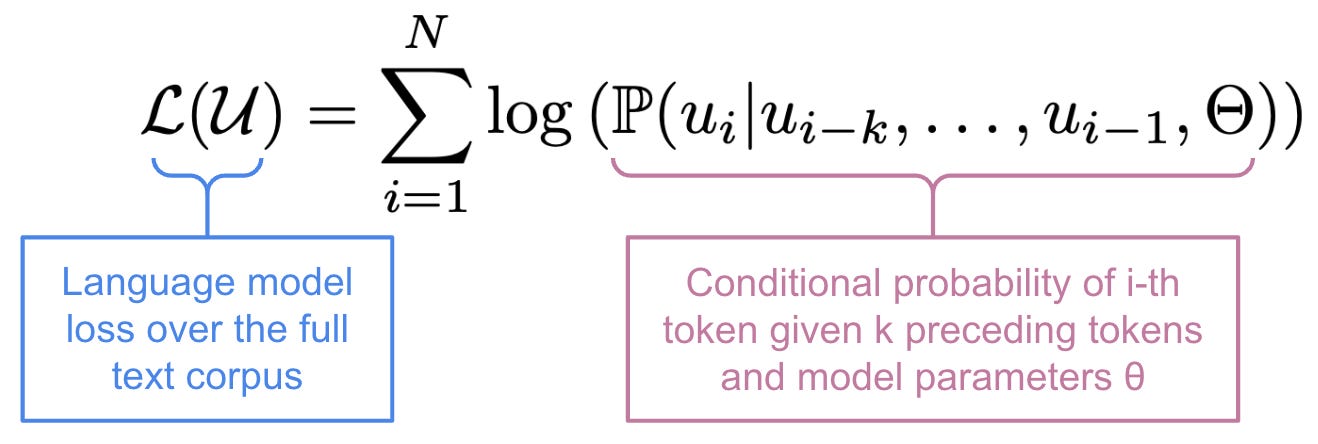
The training objective, therefore, is to find the model parameters that maximize the probability (or likelihood) of the training data. For numerical stability, we maximize the log-likelihood, which is equivalent to minimizing the negative log-likelihood. This loss function is also known as cross-entropy loss.
Causal Language Modeling: The Foundation of Generative AI
The article 'Causal Language Modeling: The Foundation of Generative AI' provides an excellent, in-depth explanation of this mathematical formulation.
Read the sections 'The Autoregressive Factorization' and 'The CLM Objective'. Focus on how the chain rule is used and how maximizing likelihood leads to the cross-entropy loss function. The plot of the negative log-likelihood curve is particularly insightful.
3. Implementation in Transformers: Causal Masking
Now, how do we implement this causal constraint in a Transformer, an architecture that processes all input tokens in parallel? In the last lesson, we saw that BERT's encoder allows every token to attend to every other token. If a GPT-style decoder did that, it would "cheat" by looking at future tokens to make its predictions.
The solution is causal masking. Inside the decoder's self-attention mechanism, a mask is applied to the attention scores before the softmax step. This mask prevents each token from attending to any subsequent tokens.
- When predicting the token at position 3, the model can only use information from tokens at positions 1 and 2.
- When predicting the token at position 4, it can use information from tokens at positions 1, 2, and 3.
This is highly efficient. During training, we can feed the entire sequence to the model at once. By using a clever "shifting trick" where the input is tokens[0...T-1] and the target is tokens[1...T], the model can calculate the loss for all prediction steps in a single parallel forward pass.
How Attention Mechanism Works in Transformer Architecture
This video provides a fantastic animated explanation of causal self-attention and how the mask works to enforce the autoregressive property.
Watch the segment on 'Causal Self-Attention' from 10:43 to 14:19. Pay close attention to the visualization of the mask being added to the attention scores and how this forces each token to only attend to itself and previous tokens.
Test your understanding!
In the previous lesson, we saw that BERT's MLM objective ignores the model's predictions for 85% of the tokens and only calculates loss on the 15% that were masked.
How is this different from the loss calculation in causal language modeling? For a sequence of length 100, how many loss terms are computed in CLM?
Show answer
In causal language modeling, a loss term is computed for every single token in the sequence (except the very first one, which has no prior context to predict from). For a sequence of length 100, the model makes 99 predictions, and a loss is calculated for each one.
This is a key difference: CLM is much more sample-efficient, as every token in the training data (after the first) serves as a label for a prediction. The model learns from (input_tokens[0:t-1], target_token[t]) for all t from 1 to T-1 in parallel.
4. The Generation Loop: From Training to Inference
The beauty of the causal language modeling objective is that it directly provides a mechanism for generating text. The process, known as autoregressive generation, is an iterative loop:
- Initialize: Start with an initial sequence of tokens (the "prompt"). This could be a special
[BOS](Beginning of Sequence) token or a user's query like "The capital of France is". - Forward Pass: Feed the current sequence into the model.
- Predict: The model outputs a probability distribution over the entire vocabulary for the single next token.
- Sample: Choose one token from this distribution. You could be "greedy" and always pick the most probable token, or use more sophisticated sampling methods (like temperature sampling, top-k, or nucleus sampling) to introduce variability.
- Append: Add the newly sampled token to the end of your sequence.
- Repeat: Go back to step 2, using the newly extended sequence as the input. Continue this loop until the model generates a special
[EOS](End of Sequence) token or a predefined maximum length is reached.
This step-by-step process, where the model's output is fed back as its own input, is the essence of how models like ChatGPT generate responses.
Decoder-Only Transformers, ChatGPTs specific Transformer, Clearly Explained!!!
StatQuest provides an exceptionally clear, step-by-step walkthrough of this entire generation process. This is a must-watch to solidify your understanding of how a decoder-only Transformer works at inference time.
Watch the section starting at 22:30 titled 'Let's start generating a response'. Follow along as the model generates the first word 'awesome', and then see how that word is fed back into the model to generate the next token, which is the EOS token. This is a perfect illustration of the autoregressive loop in action.
Conclusion
Today, we've explored the engine behind the generative AI revolution. By training models on the simple, scalable objective of predicting the next token, we unlock the remarkable ability to generate complex, coherent, and creative text.
Key Takeaways:
- Causal Language Modeling (CLM) is an autoregressive objective where the model learns to predict the next token based only on past tokens.
- This is mathematically grounded in the chain rule of probability, which decomposes a sequence's probability into a product of conditional probabilities.
- The training loss is the negative log-likelihood (or cross-entropy) of the true next tokens.
- In the Transformer architecture, this objective is enforced by causal masking in the decoder's self-attention layers.
- At inference time, models use an autoregressive generation loop: predict, sample, and append, one token at a time.
Preview of the Next Lesson:
We now have a solid understanding of the two primary pre-training strategies: Masked Language Modeling (BERT) for understanding and Causal Language Modeling (GPT) for generation. These pre-trained models are powerful but general-purpose. In our next lesson, we will explore how to fine-tune a pre-trained language model for a downstream text classification task, adapting its vast knowledge to solve a specific problem.