Hello! Welcome to the final lesson of this module.
In our last lesson, we took a very practical dive into how to adapt a large, pre-trained language model for a specific task. You learned the mechanics of fine-tuning, both with the high-level Hugging Face Trainer and by writing a custom PyTorch loop.
Today, we'll take a step back to understand the theory behind why that process is so effective. Our learning outcome is to understand the principles and benefits of transfer learning in NLP. We will explore the paradigm shift it represents, its core concepts, and its profound impact on the field. This lesson will provide the conceptual framework for the practical skills you just acquired.
1. What is Transfer learning? A Paradigm Shift
Humans have an innate ability to transfer knowledge. The skills you learn playing a classical piano piece can be transferred to learning jazz piano; you don't start from scratch. Traditional machine learning, however, often starts from scratch for every new task, building isolated models that have no knowledge of the world beyond their specific training data.
Transfer learning aims to change this.
Thomas Wolf "Transfer learning in NLP"
To start, let's watch a segment from a talk by Thomas Wolf, a key creator of the Hugging Face Transformers library. He provides a clear contrast between the traditional ML approach and the transfer learning paradigm, explaining why it's so powerful for NLP.
Watch from 02:33 to 06:54. Focus on the distinction between training models from scratch versus leveraging knowledge, and the three key reasons transfer learning works well in NLP: shared common knowledge, the high cost of annotated data, and the availability of vast unlabeled data.
As the video explains, transfer learning leverages knowledge from a source task to improve performance on a target task. This is especially useful in NLP because:
- Language is shared: The fundamental rules of grammar, syntax, and semantics are common across many different text-based tasks.
- Labeled data is expensive: Creating high-quality, task-specific datasets is a major bottleneck.
- Unlabeled data is abundant: The internet provides a massive corpus of text that can be used to learn general language properties without human annotation.
A Formal View
Given your technical background, we can formalize this. A learning problem can be defined by a Domain () and a Task ().
- A Domain consists of a feature space and a marginal probability distribution over that feature space. For example, the domain could be English-language movie reviews.
- A Task consists of a label space and an objective predictive function , which is learned from the training data. For example, the task could be to classify reviews with sentiment labels {positive, negative}.
Transfer learning applies when we have a source domain/task () and a target domain/task (), where or . The goal is to improve the learning of the target predictive function by using knowledge from and .
The fine-tuning you did in the last lesson is a form of Sequential Transfer Learning, which is the dominant paradigm in modern NLP.
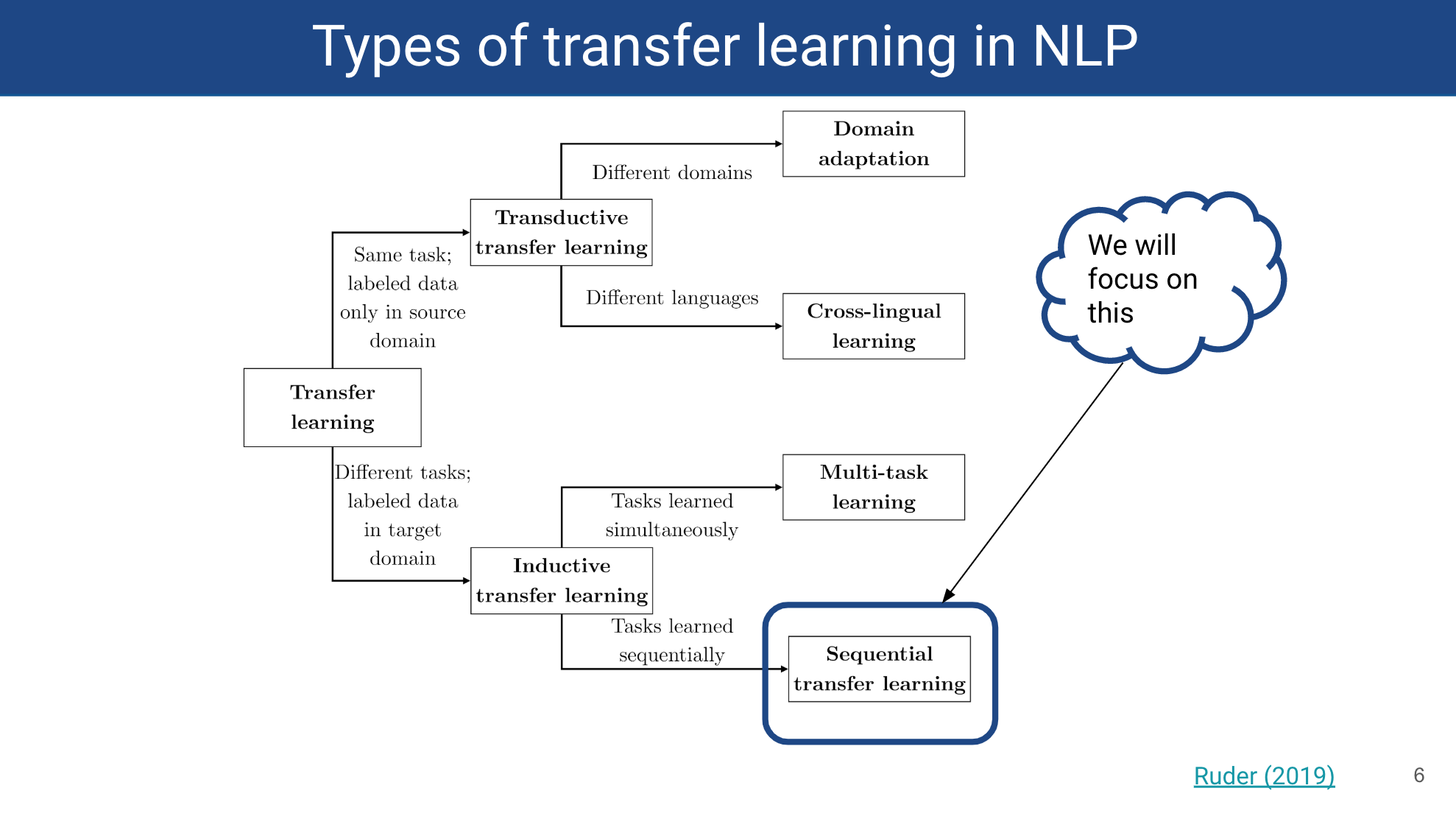
2. The Core Principle: Pre-training and Fine-tuning
The success of modern NLP is built on a two-step process that perfectly embodies transfer learning.

Step 1: Pre-training (The Source Task)
In this phase, a model (like BERT or GPT) is trained on a massive, unlabeled text corpus (e.g., a large portion of the internet and books). The "task" is self-supervised, meaning the labels are generated from the data itself. As we've seen, this is typically:
- Masked Language Modeling (MLM): Predicting masked words in a sentence.
- Causal Language Modeling (CLM): Predicting the next word in a sequence.
The key insight is that to become proficient at these objectives, the model is forced to learn rich, hierarchical representations of language, including syntax, semantics, and a vast amount of "common sense" or world knowledge. This is the foundational knowledge that will be transferred.
Thomas Wolf "Transfer learning in NLP"
Let's return to Thomas Wolf's talk. He explains why language modeling is such an effective pre-training objective for creating powerful, general-purpose models.
Watch from 09:17 to 13:17. Pay attention to how the goal of predicting text forces the model to learn about syntax and semantics (common sense knowledge), effectively compressing world knowledge into its parameters.
Step 2: Fine-tuning / Adaptation (The Target Task)
This is the step you performed in the last lesson. We take the pre-trained model, which is a powerful generalist, and adapt it to become a specialist for our target task.
This involves:
- Replacing the Head: The final layer(s) of the pre-trained model (the "head"), which were used for the pre-training objective (e.g., predicting vocabulary words), are removed.
- Adding a New Head: A new, randomly initialized head suitable for the target task is attached. For text classification, this is often just a single linear layer that outputs logits for each class.
- Training on Task-Specific Data: The model is then trained for a few epochs on the smaller, labeled dataset for the target task. During this process, the weights of the new head are trained from scratch, and the weights of the pre-trained body are "fine-tuned" or slightly adjusted.
3. The Overwhelming Benefits of Transfer Learning
This pre-train/fine-tune paradigm has revolutionized NLP for several key reasons.
Transfer Learning in Natural Language Processing (NLP)
This article, 'Transfer Learning in Natural Language Processing (NLP)', clearly outlines the main advantages. We will use it to structure our discussion of the benefits.
Read the section titled 'Benefits of Transfer Learning in NLP'. It covers Reduced Training Time, Improved Performance, Data Efficiency, and Domain Adaptation. Use this as a framework for the following points.
Let's break down these benefits:
- Improved Performance: Pre-trained models provide a far superior initialization point compared to random weights. They have already learned to recognize linguistic patterns, allowing them to achieve a higher performance ceiling on the target task.
- Data Efficiency: Because the model already possesses a general understanding of language, it can achieve high performance on a new task with significantly less labeled data than a model trained from scratch. This makes it feasible to tackle problems where collecting thousands of labeled examples is impractical.
- Reduced Training Time & Cost: Training a large language model from scratch can take weeks or months and cost millions of dollars. Fine-tuning, in contrast, often takes just minutes or hours on a single GPU. You leverage the massive upfront investment made by others.
- Domain Adaptation: Transfer learning is exceptionally effective for adapting a model pre-trained on a general corpus (like Wikipedia) to a specialized domain, such as legal contracts, medical records, or financial reports.
4. Strategies for Knowledge Transfer
When you use a pre-trained model, you have a crucial choice: how much of the original model should you update? This leads to two main strategies.
A Comprehensive Hands-on Guide to Transfer Learning...
The article 'A Comprehensive Hands-on Guide to Transfer Learning' provides an excellent breakdown of the two primary strategies for deep transfer learning.
Read the section 'Deep Transfer Learning Strategies'. Focus on the two main subsections: 'Off-the-shelf Pre-trained Models as Feature Extractors' and 'Fine Tuning Off-the-shelf Pre-trained Models'.
Strategy 1: Feature Extraction
In this approach, you "freeze" the weights of the pre-trained model. You use it as a fixed feature extractor. Only the weights of the new, task-specific head that you added are trained.
- When to use it: This is a good choice when your target dataset is very small, as fine-tuning the entire model could lead to overfitting. It's also computationally cheaper.
- Analogy: This is like using a function from a third-party library without modifying its source code. You simply use its output for your own purposes.
Strategy 2: Fine-Tuning
In this approach, you unfreeze some or all of the pre-trained model's layers and train them along with the new head. The pre-trained weights provide a starting point, but they are updated during training to become more specialized for the target task. This is the method you implemented in the previous lesson.
- When to use it: This is the most common approach and generally yields the best performance, especially if you have a reasonable amount of training data. You can choose to fine-tune all layers or just the top few layers as a compromise between performance and training cost.
- Analogy: This is like taking that library function, copying its source code into your project, and then modifying it to better suit your specific needs.
Test your understanding!
Imagine you need to build a sentiment classifier for Japanese anime reviews, but you only have a dataset of 500 labeled reviews. You have access to a large BERT model pre-trained on a massive general Japanese text corpus. Would you lean towards using the model as a feature extractor or fine-tuning the entire model? Why?
Show answer
Leaning towards feature extraction (freezing the BERT layers) would be a safer and more robust initial strategy.
Reasoning: With only 500 examples, the dataset is very small. Fine-tuning the entire model (which has hundreds of millions of parameters) would pose a high risk of overfitting. The model could start to memorize the specific examples in your small dataset instead of learning the general task of sentiment classification. By freezing the base model, you leverage its powerful, general language understanding as a fixed feature generator and only train the small classification head, which is much less prone to overfitting on a small dataset.
5. Limitations and the Road Ahead
While powerful, transfer learning is not a magic bullet. It's important to be aware of its limitations.
- Negative Transfer: If the source task is too dissimilar from the target task, the transferred knowledge can actually hinder performance.
- Inherited Bias: Models like BERT learn from a snapshot of the internet, and they internalize the biases (social, demographic, etc.) present in that data. These biases are transferred to the fine-tuned model.
- Common Sense Failures: As Thomas Wolf mentioned in his talk, models can fail on common-sense tasks due to "reporting bias." Since people rarely write down obvious facts (e.g., "sheep are usually white"), models trained on text can learn incorrect associations (e.g., associating "sheep" with "black" because the phrase "black sheep" is more distinctive and common in text than "white sheep").
The field is actively working to address these issues through techniques like multimodal learning (grounding language in images and video) and more sophisticated methods for bias detection and mitigation.
Conclusion
You now have a solid theoretical understanding to complement your practical fine-tuning skills. Transfer learning is the engine that makes the application of large language models both possible and practical, democratizing access to state-of-the-art AI capabilities.
Key Takeaways:
- Transfer learning is a paradigm where knowledge from a source task is used to improve a target task, avoiding the need to train models from scratch.
- The dominant approach in NLP is pre-training and fine-tuning: a model first learns general language understanding from massive unlabeled text, then is specialized on a small labeled dataset.
- The primary benefits are improved performance, data efficiency, and drastically reduced training time and cost.
- The two main strategies for transfer are using the pre-trained model as a fixed feature extractor or fine-tuning its weights on the new task.
Preview of the Next Lesson:
With this foundational understanding of pre-training objectives and transfer learning, we are now prepared to explore the models themselves. In the next module, "Modern Language Model Architectures," we will begin by analyzing the architecture of BERT, the model that popularized this paradigm, and its many variants.