
Welcome back. In the last lesson, you used atomic number and mass number to calculate protons, neutrons, and electrons in a neutral atom. The key idea to carry forward is that the number of protons identifies the element.
This lesson uses that fact to answer a frequent exam question: Are these two atoms isotopes of the same element? You will learn one precise definition, then apply a quick comparison method to particle-count tables and atomic notation.
The defining pattern of isotopes
Isotopes are atoms of the same element that have different numbers of neutrons.
Because the element is determined by its proton count, isotopes must have:
- the same number of protons
- different numbers of neutrons
This also means they have:
- the same atomic number
- different mass numbers
Remember:
If the proton number stays fixed but the neutron number changes, the total mass number must change too.
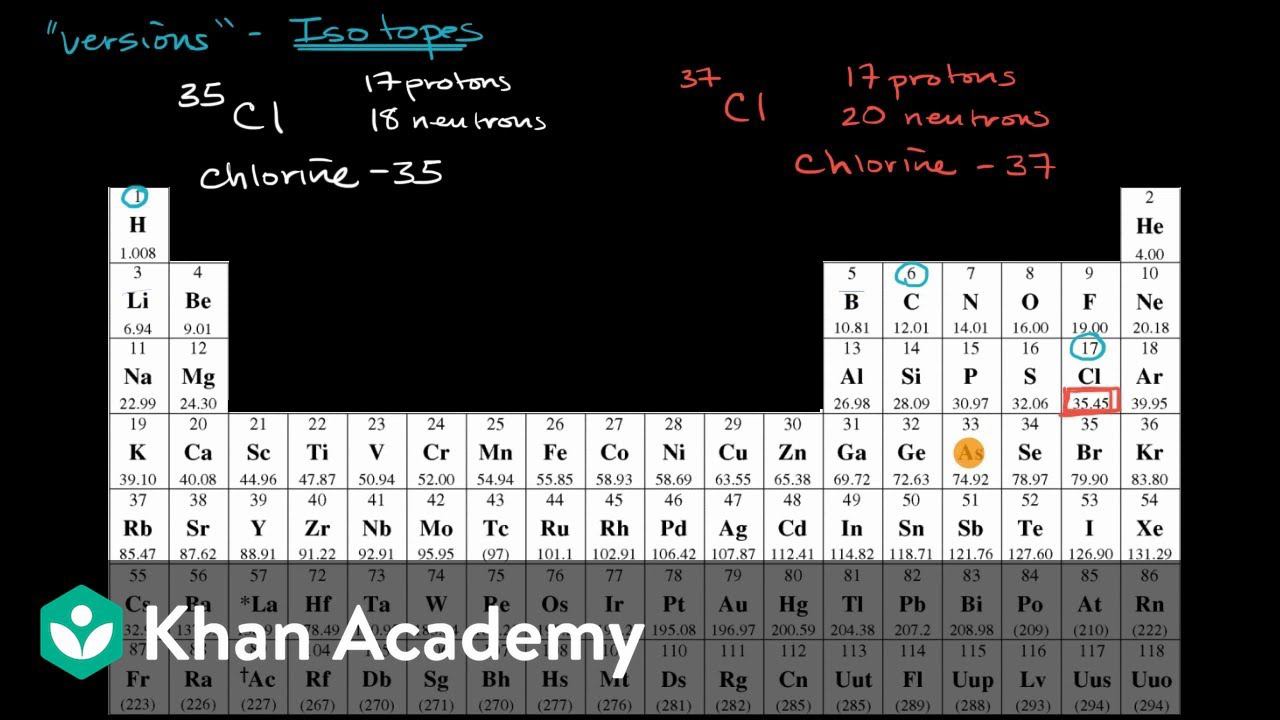
For example, consider chlorine:
and
Both atoms have atomic number , so both contain 17 protons. Therefore, both are chlorine. Their neutron counts differ:
They are two isotopes of chlorine: chlorine-35 and chlorine-37.
A compact full-mark definition is:
Isotopes are atoms of the same element with the same number of protons but different numbers of neutrons.
The wording “same element” and “different neutrons” are both essential.
See the difference in nuclear notation
Nuclear notation gives you everything needed to identify isotopes:
where:
- is the atomic number, equal to the proton count
- is the mass number, equal to protons plus neutrons
- is the element symbol
To compare two atoms, look at the lower-left number first. This is the fastest way to decide whether they are the same element.
| Comparison | What it tells you |
|---|---|
| Same atomic number | Same number of protons, so the same element |
| Different atomic numbers | Different proton numbers, so different elements |
| Same atomic number and different mass numbers | Isotopes |
| Same atomic number and same mass number | The same isotope, not two different isotopes |
Consider these two atoms:
Both have atomic number , so both contain 12 protons and are magnesium. Their mass numbers differ, so their neutron numbers differ:
Therefore, they are isotopes of magnesium.
Now compare:
The mass numbers are close, but that does not matter first. The atomic numbers are different: 11 and 12. These atoms have different proton counts, so they are different elements and not isotopes.
Watch this short explanation and its worked comparison questions from The Organic Chemistry Tutor. It reinforces the exam rule: atomic number must match, while mass number must differ.
In “What are Isotopes?” by The Organic Chemistry Tutor, carbon-12 and carbon-13 make the definition visual before the video applies it to exam-style comparisons.
Watch the core idea to connect proton count, neutron count, and mass number. Then watch comparison examples; pause just before each answer and decide whether the atomic numbers match before checking the reasoning.
A reliable decision method for particle-count tables
Some questions give a table rather than atomic notation. Do not be distracted by labels such as Atom A, Atom B, or Atom C. Compare the particle counts systematically.
Use this method:
- Compare the number of protons.
- If the proton numbers differ, the atoms are not isotopes.
- If the proton numbers match, compare the number of neutrons.
- Different neutron numbers mean they are isotopes of the same element.
- As a check, calculate mass numbers if needed by adding protons and neutrons.
Here is an exam-style table:
| Atom | Protons | Neutrons | Electrons |
|---|---|---|---|
| A | 8 | 8 | 8 |
| B | 8 | 10 | 8 |
| C | 9 | 10 | 9 |
| D | 8 | 8 | 8 |
Compare A and B:
- Both have 8 protons, so they are atoms of the same element: oxygen.
- A has 8 neutrons, while B has 10 neutrons.
- Therefore, A and B are isotopes.
Their mass numbers confirm this:
So they could be written as oxygen-16 and oxygen-18.
Compare A and D:
- Both have 8 protons.
- Both have 8 neutrons.
- They have the same mass number, 16.
A and D represent the same isotope, oxygen-16. They are not a pair of different isotopes because nothing in the nucleus differs.
Compare B and C:
- B has 8 protons.
- C has 9 protons.
Even though both have 10 neutrons, they are different elements. Therefore, they are not isotopes.
The number of electrons can help show that the examples are neutral atoms, but for this learning outcome, the decisive comparison is always protons first, neutrons second.
Read BBC Bitesize’s isotope section for a concise chlorine comparison and a particle-count table like the ones used in exams.
What is atomic structure? - BBC Bitesize
BBC Bitesize gives a clear definition of isotopes, then tests it with chlorine and a table of labelled atoms. Read it to practise spotting the proton-and-neutron pattern rather than relying on atom labels.
In the subsection “What are isotopes?”, read the definition and explanation. Then continue through the chlorine table and the question beginning “The table below gives information about four atoms”; before revealing the answer, identify the pair by locating matching proton counts and then checking for different neutron counts.
The most common isotope traps
Trap 1: “Different mass number means isotopes”
Not by itself. The atoms must first be the same element.
For example:
and
Both have mass number 14, but they have different atomic numbers and different element symbols. Carbon has 6 protons; nitrogen has 7. They are not isotopes.
Mass number tells you the total nuclear particles. It does not identify the element.
Trap 2: “Same number of neutrons means isotopes”
Again, no. Isotopes must have different neutron counts.
For example, an atom with 6 protons and 8 neutrons is carbon-14. An atom with 7 protons and 8 neutrons is nitrogen-15. They happen to have equal neutron numbers, but their proton numbers differ, so they are different elements.
Trap 3: Changing electrons creates an isotope
Changing the number of electrons creates an ion, not an isotope. The nucleus is unchanged.
For example, both a sodium atom and a sodium ion have 11 protons. A neutral sodium atom has 11 electrons, while a sodium ion has 10 electrons. Since the neutron number has not changed, this is not an isotope comparison.
Keep the distinction sharp:
| What changes? | Result |
|---|---|
| Number of protons | A different element |
| Number of neutrons | A different isotope of the same element |
| Number of electrons | An ion of the same element |
Trap 4: Using the decimal number on the periodic table
A periodic table often lists a decimal, such as approximately for chlorine. This is a relative atomic mass, an average based on naturally occurring isotopes. It is not the mass number of one individual atom.
An individual isotope has a whole-number mass number, such as chlorine-35 or chlorine-37.
How to write an exam-quality explanation
Multiple-choice questions often only require you to select the correct pair. Short-answer questions may ask you to explain why the pair are isotopes. State both the shared proton count and the differing neutron count.
For example:
Atom P has 17 protons and 18 neutrons. Atom Q has 17 protons and 20 neutrons. Explain why P and Q are isotopes.
A full answer is:
P and Q have the same number of protons, so they are the same element. They have different numbers of neutrons, so they are isotopes.
Notice what makes it strong:
- It uses the data from the question.
- It explains why the atoms are the same element.
- It names the nuclear difference that makes them isotopes.
Avoid a vague answer such as “They have different masses.” That is true, but it does not explain the cause of the mass difference or show that you know the definition.
A 30-second isotope checklist
When you meet two atoms in revision or in the exam, ask:
-
Do they have the same number of protons, or the same atomic number?
If no, stop: they are not isotopes. -
Do they have different neutron numbers, or different mass numbers?
If yes, they are isotopes. -
Can I state the reason in one complete sentence?
“They have the same number of protons but different numbers of neutrons.”
For a quick retrieval practice session, cover the definition and write it from memory. Then invent two nuclear symbols with the same lower number and different upper numbers, and explain aloud why they form an isotope pair. Finally, create a near-miss example with different lower numbers to make sure you can reject it.
Key takeaways
Isotopes are atoms of the same element with:
but
Equivalently, isotopes have the same atomic number but different mass numbers.
For any comparison question, use the same order every time: compare protons first, then neutrons. Do not decide from mass number alone, and do not confuse isotopes with ions.
You have now completed the atomic-structure calculation and isotope skills needed for this module. Next, the course moves into electron configurations: placing electrons into shells for the first 20 elements.
Can't find a good explanation? Sign up and we'll make it for you
Sign up