
Hello. This course will build the chemistry knowledge and exam habits needed for both multiple-choice and short-answer questions. We begin with a foundation that recurs throughout atomic structure: scientific models change when new experimental evidence no longer fits the old explanation.
By the end of this lesson, you should be able to place Dalton, Thomson, Rutherford, and Bohr in order and state the one defining feature that distinguishes each model. This is a frequent exam task, but it also prepares you to explain why Rutherford replaced Thomson’s model in the next lesson.
The essential timeline
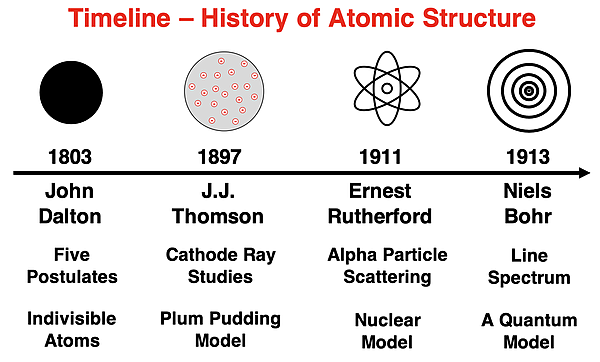
Learn this sequence as a story of increasing detail, not as four unrelated names:
| Date | Scientist | Model | Defining feature |
|---|---|---|---|
| 1803 | John Dalton | Solid-sphere model | Atoms are tiny, solid, indivisible spheres. |
| 1897 | J. J. Thomson | Plum pudding model | Negative electrons are embedded in a sphere of diffuse positive charge. |
| 1909–1911 | Ernest Rutherford | Nuclear model | A tiny, dense, positively charged nucleus contains most of the atom’s mass. |
| 1913 | Niels Bohr | Shell model | Electrons occupy fixed shells, or energy levels, around the nucleus. |
A useful memory frame is:
solid atom; electrons inside; nucleus at centre; fixed shells around nucleus.
The dates matter mainly for putting the models in order. In most exam questions, the defining feature earns the more valuable mark.
Watch the model develop
The following short video gives a clear visual account of the four-model sequence. Watch it once for the overall story; afterwards, use the table above to retrieve each model from memory.
Chemistry & Physics: History of the Atom (Dalton, Thomson, Rutherford, and Bohr Models)
Watch “Chemistry & Physics: History of the Atom (Dalton, Thomson, Rutherford, and Bohr Models)” from Socratica. It shows how each scientist’s model added a new structural idea to the atom.
Watch Dalton’s model and note the words “solid” and “indivisible.” Then watch Thomson’s model, focusing on how the electron forced scientists to abandon Dalton’s indivisible sphere. Continue with Rutherford’s evidence to see why a concentrated central nucleus was needed. Finish with Bohr’s shells; the exam-level distinction is that electrons could occupy only particular energy levels, rather than any distance from the nucleus.
What changed at each stage?
An atomic model is an explanation of what an atom is like. It is not simply a picture to memorise. Each new model had to account for evidence that the previous model could not explain.
1. Dalton: the atom as a solid sphere
Dalton proposed that all matter is made of atoms. In his model, an atom was a tiny, solid ball with no internal structure. He also proposed that atoms of different elements were different.
For this course, the phrase to associate with Dalton is:
Atoms are solid and indivisible.
“Indivisible” means that Dalton thought atoms could not be split into smaller particles. Later discoveries showed that this part of his model was incorrect, but it was an important starting point.
2. Thomson: electrons inside the atom
Thomson’s experiments discovered the electron, a negatively charged particle smaller than an atom. This immediately contradicted the idea that atoms were indivisible solid spheres.
To explain both the negative electrons and the fact that atoms are normally neutral overall, Thomson suggested that an atom was a sphere of spread-out positive charge with electrons embedded throughout it. This is called the plum pudding model: the positive charge is the “pudding,” and the electrons are like the plums or raisins.
The key phrase is:
Electrons embedded in diffuse positive charge.
A common mistake is to describe Thomson’s positive charge as a tiny nucleus. That is Rutherford’s model, not Thomson’s.
3. Rutherford: a small central nucleus
Rutherford’s gold-foil scattering experiment showed that most alpha particles passed through thin gold foil, but a very small number were strongly deflected or bounced back. His model explained this by placing the atom’s positive charge and most of its mass in a very small, dense central region: the nucleus.
This also implies that most of the atom is empty space. Electrons are outside the nucleus.
The key phrase is:
A small, dense, positively charged nucleus containing most of the mass.
Do not make Rutherford’s nucleus too large in a diagram. If it filled most of the atom, most alpha particles would have been blocked or deflected. The fact that most passed through supports the idea that the nucleus occupies very little space.
4. Bohr: electrons in fixed shells
Bohr kept Rutherford’s central nucleus but refined the description of the electrons. He proposed that electrons can exist only in particular fixed orbits, now usually called electron shells or energy levels.
The key phrase is:
Electrons occupy fixed shells at specific energy levels around the nucleus.
Bohr’s model is the one normally used in introductory chemistry when you draw electron configurations such as . You will use that idea throughout the next module.
A precise comparison for exam answers
The most reliable way to distinguish the four models is to ask: Where are the positive charge and electrons supposed to be?
| Model | Positive charge | Electrons | Feature that makes it distinct |
|---|---|---|---|
| Dalton | Not described as separate charge | Not included | Solid, indivisible sphere |
| Thomson | Spread throughout the atom | Embedded within the positive sphere | “Plum pudding” arrangement |
| Rutherford | Concentrated in a tiny nucleus | Outside the nucleus | Central nucleus; mostly empty space |
| Bohr | Concentrated in the nucleus | In fixed shells around the nucleus | Electrons have fixed energy levels |
Notice that both Rutherford and Bohr have a nucleus. The difference is the electron arrangement:
- Rutherford: electrons are outside the nucleus, but not yet organised into fixed shells in the model.
- Bohr: electrons are in fixed shells with particular energies.
This is a particularly common multiple-choice distractor.
Consolidate with a GCSE-level timeline
Use this concise reading to confirm the wording and dates expected at GCSE level.
Read BBC Bitesize’s “Atomic models – The evolution of the atom.” It provides a compact exam-ready timeline linking each model to the evidence that changed it.
First read the subsection “The first atomic model,” including the surrounding explanation of why models change when evidence does not fit them. Use Dalton’s summary to locate it. Then read the complete table in “A timeline to show how the atomic model has changed.” In particular, follow the model changes from Thomson through Bohr. For each row, say aloud: scientist, date, model feature, and the evidence that prompted the change.
Turning knowledge into marks
For a simple “identify” or “state” question, give the scientist and defining feature directly:
- Dalton: atoms were solid, indivisible spheres.
- Thomson: electrons were embedded in a positively charged sphere.
- Rutherford: positive charge and most mass were concentrated in a small nucleus.
- Bohr: electrons occupied fixed shells around the nucleus.
For a chronological-order question, write:
- Dalton
- Thomson
- Rutherford
- Bohr
If the question includes diagrams rather than names, scan for the distinguishing visual clue:
- one plain filled circle: Dalton
- dots inside a positive sphere: Thomson
- central nucleus with electrons around it: Rutherford
- several neat circular shells: Bohr
A short retrieval routine is more useful than rereading: cover the timeline, write the four names in order with one defining feature each, then compare against the table. Correct any missing word in a different colour. Repeat this tomorrow and again in several days; spacing the recall makes the sequence much more secure for the exam.
Key takeaways
The four models are ordered:
Their essential features are:
- Dalton: a solid, indivisible atom.
- Thomson: electrons embedded in diffuse positive charge.
- Rutherford: a small, dense, positive nucleus containing most mass.
- Bohr: electrons in fixed shells or energy levels around the nucleus.
In the next lesson, you will move beyond naming the models and explain how Rutherford’s gold-foil experiment provided evidence against Thomson’s plum pudding model.
Can't find a good explanation? Sign up and we'll make it for you
Sign up