
Hello again. Last time, you practised forming subject and object questions, especially the difference between Who called? and Who did you call? Earlier in this module, you also distinguished the present perfect from the past simple. This lesson brings those skills together through five very common time markers: for, since, already, yet, and ago.
They are small words, but they tell the listener whether an action is continuing, recently completed, expected, or clearly finished in the past. This matters in everyday messages such as “I’ve already sent the file” and “I sent it two hours ago.”
The central choice: connection to now or finished past?
Start with this useful contrast:
I moved here five years ago.
I’ve lived here for five years.
I’ve lived here since 2021.
All three sentences may describe the same situation, but they focus on different information.
| Time marker | What it tells us | Typical tense | Example |
|---|---|---|---|
| ago | How far before now a finished event happened | Past simple | I started this course two months ago. |
| for | The length of a period | Often present perfect for an unfinished situation | I’ve studied English for two months. |
| since | The starting point of an unfinished situation | Often present perfect | I’ve studied English since January. |
| already | Something is complete, often earlier than expected | Present perfect | I’ve already completed the form. |
| yet | Something is expected by now, but may not be complete | Present perfect, mainly questions and negatives | Have you completed the form yet? |
The key grammatical distinction is this:
- Use the present perfect when the past situation is still connected to the present.
- Use the past simple when the event belongs to a finished time in the past.
The present perfect form is:
have / has + past participle
I have worked here for two years.
She has already sent the message.
They haven’t arrived yet.
The past simple form is:
I worked there two years ago.
She sent the message yesterday.
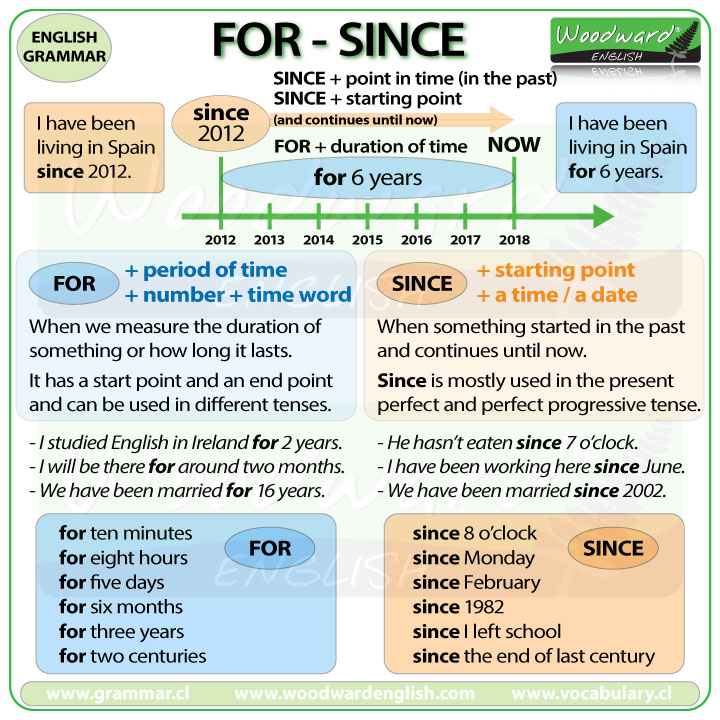
For: the length of time
Use for before a duration: a period that answers How long?
for ten minutes
for three weeks
for a long time
for many years
When a state or activity began in the past and continues now, for commonly goes with the present perfect:
I’ve known my neighbour for six years.
We’ve been waiting for thirty minutes.
He has worked online for a long time.
The listener understands that the situation began before now and remains true now.
However, for does not always require the present perfect. It simply expresses duration. Use the tense that matches the situation:
I worked in a restaurant for two years, but I left in 2022.
We talked for an hour yesterday.
I’ll be away for a week.
In these examples, the period is finished or belongs to a future plan, so a present-perfect form would not fit.
Since: the starting point
Use since before the specific point when a situation began:
since 8 o’clock
since Monday
since last year
since 2020
since I started my new job
since we were children
Compare the information after each word:
I’ve been in this city for three years.
I’ve been in this city since 2023.
For three years gives the length. Since 2023 gives the beginning.
When the situation continues until now, use since with the present perfect:
I’ve had this phone since January.
She has lived here since 2019.
We haven’t spoken since the meeting.
How long have you studied English?
I’ve studied English since school.
Notice a useful pattern with a full clause after since:
I’ve lived here since I moved here.
She hasn’t seen him since he left.
The main clause is usually present perfect because it continues to now. The clause after since usually uses past simple because it names the past starting event: I moved, he left.
Watch the following explanation from mmmEnglish to see the contrast among ago, for, and since on a timeline.
FOR, AGO & SINCE (Grammar Check!)
Watch “FOR, AGO & SINCE (Grammar Check!)” from mmmEnglish. It clearly separates a finished past event from an ongoing duration and starting point.
Watch ago to see why this marker goes at the end of a past-simple sentence. Then watch for for the difference between duration and a past date. Finally, watch since, focusing on the difference between a length of time and a precise starting point.
Ago: a completed event before now
Use ago to say how long before the present moment something happened.
I called her ten minutes ago.
They arrived two days ago.
We met a few years ago.
I started learning English online six months ago.
Put ago after the period of time, normally at the end of the clause:
Correct: I saw that email an hour ago.
Incorrect: I saw that email ago an hour.
Because ago points to a finished time in the past, it goes with the past simple, not the present perfect.
Correct: I sent the document three hours ago.
Incorrect: I have sent the document three hours ago.
Compare these two replies to a colleague:
When did you send the document?
I sent it three hours ago.
Have you sent the document?
Yes, I’ve already sent it.
The first question asks when a finished event happened, so use past simple and ago. The second question asks whether the task is complete by now, so use present perfect.
This distinction also applies to other finished-time expressions:
I spoke to her yesterday.
We finished the project last week.
He left that job in 2021.
Do not combine these finished time expressions with the present perfect in standard English.
Already: completed by now
Use already when something has happened before now, often earlier than expected.
I’ve already eaten, thanks.
She has already booked the appointment.
We’ve already discussed this issue.
They have already left.
The usual position of already is between have/has and the past participle:
subject + have/has + already + past participle
I have already checked the details.
He has already replied.
In a conversation, already often explains why you do not need to do something again:
“Can you send the link?”
“I’ve already sent it.”
It can also express surprise:
“Have you finished already?”
“Yes, it was quicker than I expected.”
The British Council’s Present perfect guide gives a concise explanation of the present perfect with unfinished situations and recent actions. Read the selected parts now.
Present perfect | LearnEnglish
Read “Present perfect” from the British Council’s LearnEnglish site. It connects present-perfect meaning to common markers such as “for,” “since,” “already,” and “yet.”
In “Grammar explanation,” read the subsection “Unfinished time and states.” Focus on the duration examples: identify why each situation continues to the present. Then, in “Past actions with a result in the present,” read the recent event examples. Notice the position of “already” and “yet,” and the absence of an exact finished time.
Yet: expected, but not complete—or asking if it is complete
Use yet when something is expected to happen by now.
It is most common:
- in questions, to ask whether something has happened;
- in negative sentences, to say it has not happened.
Put yet at the end of the sentence or question.
Have you finished the report yet?
Has the bus arrived yet?
I haven’t finished the report yet.
The bus hasn’t arrived yet.
Compare the meanings carefully:
I’ve already finished the report.
The report is complete.
I haven’t finished the report yet.
The report is not complete, but I expect to finish it.
Have you finished the report yet?
I am asking whether it is complete by now.
These short exchanges are useful for work and daily life:
“Have you had lunch yet?”
“No, not yet.”
“Have you replied to the customer yet?”
“Yes, I’ve already replied.”
“Has the meeting started yet?”
“No, it hasn’t started yet.”
In brief replies, Not yet is completely natural:
“Are you ready?”
“Not yet.”
The full meaning is: I am not ready yet.
A practical decision method
When you want to choose one of these markers, decide what kind of time information you are giving.
-
Is it a finished event at a known past time?
Use past simple. Use ago if you measure backward from now.
I joined the company two years ago. -
Did the situation start in the past and continue until now?
Use present perfect with for for a duration or since for a starting point.
I’ve worked here for two years.
I’ve worked here since 2024. -
Is the important message that a task is complete by now?
Use present perfect with already.
I’ve already paid the bill. -
Is the task expected, but not done—or are you checking its status?
Use present perfect with yet, usually at the end.
I haven’t paid the bill yet.
Have you paid the bill yet?
A useful real-life set of sentences is:
I started my current job a year ago.
I’ve worked there for a year.
I’ve worked there since last spring.
I’ve already learned a lot.
I haven’t met everyone yet.
Each sentence communicates a different relationship between past time and now.
For short speaking practice, choose one current situation—your English study, a job, a course, or a project. Say five true sentences aloud, using one of today’s markers in each sentence. Aim to explain a complete event with ago, an ongoing period with for and since, a completed task with already, and an unfinished expected task with yet.
Key takeaways
The markers in this lesson help you make time clear without adding long explanations:
- For introduces a duration: for two weeks, for a long time. With an ongoing situation, it commonly uses the present perfect: I’ve lived here for two years.
- Since introduces a starting point: since Monday, since 2022, since I moved here. It commonly uses present perfect when the situation continues now.
- Ago refers to a finished past event measured from now and uses past simple: I called you ten minutes ago.
- Already signals completion by now, often earlier than expected: I’ve already sent it.
- Yet is mainly used in questions and negatives for an expected action: Have you sent it yet? / I haven’t sent it yet.
This completes the first module on expressing time clearly. Next, you will begin building more accurate sentences by choosing between a/an, the, and no article in everyday English.
Can't find a good explanation? Sign up and we'll make it for you
Sign up