
Hello. Last lesson established who owns a decision through DACI: one Approver makes the call, a Driver runs the process, Contributors provide relevant input, and affected people are kept Informed. That removes a common source of confusion. This lesson addresses the next question: once ownership is clear, how involved should the manager be?
A technical manager should not use one default style. The appropriate involvement depends on the decision’s urgency and consequences, the engineer’s demonstrated capability for this specific decision, the value of wider input, and the clarity of constraints. By the end of this lesson, you will be able to select and communicate a managerial involvement level ranging from “I decide” to full delegation—and explain your reasoning in a manager interview.
Managerial involvement is a decision-rights choice
“Delegate more” is useful advice only when it is made precise. Delegation has at least two distinct dimensions:
- Decision authority: Who makes the choice?
- Execution responsibility: Who implements the result?
They often travel together, but they do not have to. For example, you might make a Level 3 decision to adopt a standard deployment platform after consulting the team, while leaving the implementation design and rollout sequencing to a senior engineer at Level 6 or 7.
The manager remains accountable for the team’s overall outcomes: delivery, reliability, people development, and risk management. What changes is the degree of authority retained for a particular decision. Effective delegation is therefore neither control nor abdication. It is a deliberate agreement about who decides, what constraints apply, and when communication is needed.
The seven-level model gives you a shared vocabulary for that agreement.
How to Delegate Better with the 7 Delegation Levels
Watch “How to Delegate Better with the 7 Delegation Levels” from Management 3.0 for a concise visual overview of the model and its practical use as a team agreement.
Watch the seven levels to establish who holds the final decision right at each level. Then watch the examples, which apply the levels to team composition, project selection, and tooling, followed by the delegation board for the idea of making decision boundaries visible across recurring team decisions.
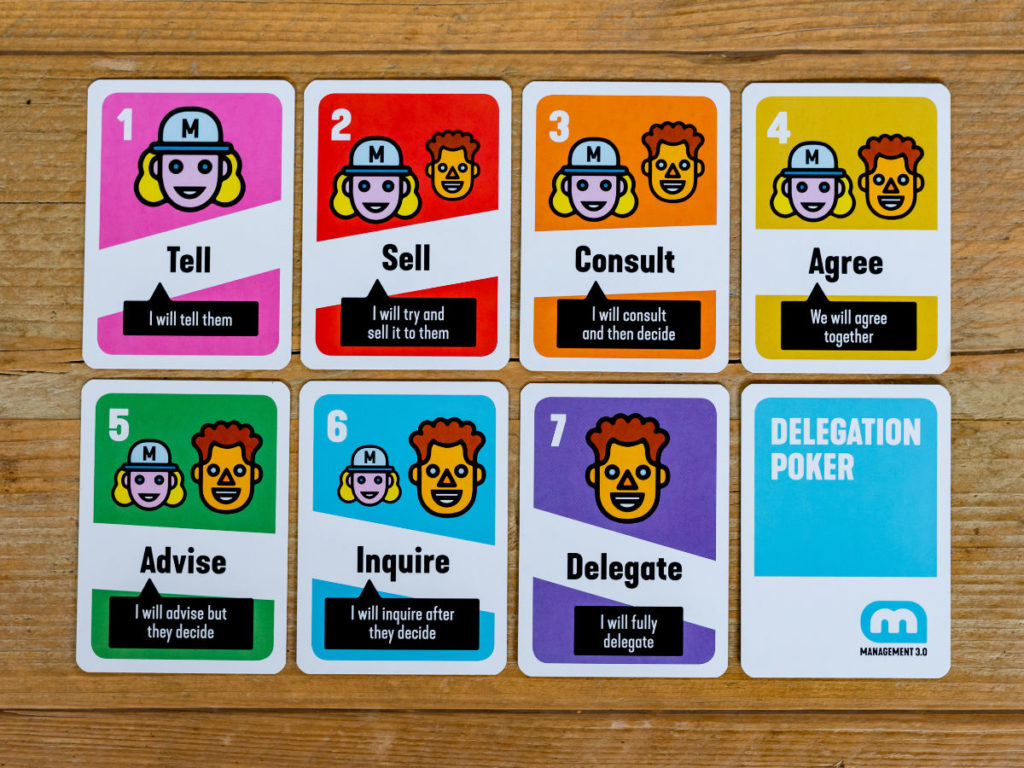
The seven levels: who decides, and when?
The levels are best understood in three bands.
| Level | Manager’s involvement | Who makes the final decision? | Best used when |
|---|---|---|---|
| 1. Tell | Decide, then communicate what will happen. | Manager | Extreme urgency, non-negotiable safety or legal constraint, or authority cannot be shared. |
| 2. Sell | Decide, then explain the rationale and answer questions. | Manager | A decision is already necessary, but alignment and understanding will materially improve execution. |
| 3. Consult | Seek input before deciding. | Manager | Expertise from engineers or stakeholders will improve the call, but one person must own the trade-off. |
| 4. Agree | Facilitate a shared decision process. | Group | The decision will only hold if the people affected genuinely commit to it, such as team working agreements. |
| 5. Advise | Set scope and constraints; offer advice; expect the person to seek needed expertise. | Delegatee | The person is ready to own the choice but benefits from structured input before deciding. |
| 6. Inquire | Let the person decide; discuss reasoning afterward for visibility and learning. | Delegatee | Strong expertise and clear constraints exist; you need understanding, not advance approval. |
| 7. Delegate | Define outcomes and boundaries, then focus on results. | Delegatee | The decision is routine, reversible, within proven expertise, and oversight adds little value. |
The essential dividing line is between Levels 3 and 4:
- At Levels 1–3, the manager retains final authority.
- At Level 4, authority is genuinely shared.
- At Levels 5–7, authority is genuinely delegated to another person or team.
That distinction matters because a manager who says “you decide” but quietly keeps an approval veto has not delegated. They have created uncertainty.
Levels 1–3: authority remains with the manager
At Level 1, Tell, the decision is closed; discussion is limited to implementation. This can be appropriate in a production incident. If a known-safe rollback is available and customer impact is increasing, the incident leader should not convene a consensus discussion:
“We are rolling back release 2025.07.14 now. Priya owns the rollback; I will update Support in ten minutes. Bring me implementation blockers immediately.”
Level 1 should be exceptional, not a manager’s everyday operating style. Used routinely, it suppresses expertise closest to the system and leaves engineers waiting to be told what to do.
At Level 2, Sell, the manager still decides, but makes the reasoning visible. Suppose organizational policy requires all customer-data services to use a newly mandated secrets-management control by a fixed deadline. Engineers do not control the policy, but they do need to understand the risk, alternatives rejected, migration support available, and the implementation plan. The decision itself is not up for debate; the explanation is part of enabling good execution.
At Level 3, Consult, the manager owns the final trade-off but seeks advice before making it. This is often the most useful level for consequential technical-management decisions. For example:
“I will decide by Friday whether we delay the reporting launch to complete load testing. Before then, I need your view on current capacity risk, the smallest credible test scope, and the customer impact of a one-week delay.”
This is not performative consultation. The team’s evidence must be capable of changing the manager’s view. But the manager should be clear that consultation is not a vote and that they will make the final call.
Levels 4–7: share or transfer decision authority honestly
At Level 4, Agree, the group makes the decision together. Use it sparingly. It is valuable when an agreement only works if everyone expected to follow it has participated in setting it.
A team’s on-call handoff norms are a good candidate. If engineers are expected to use a new escalation protocol every week, imposing it unilaterally may produce superficial compliance and recurring workarounds. Agreeing on the protocol, its exceptions, and how it will be reviewed produces stronger shared ownership.
Level 4 is not a default for architecture or delivery choices just because multiple people care. It is slow, can diffuse accountability, and can result in compromises that no one considers good. It requires a defined decision group, a facilitator, a decision method, a timeframe, and a fallback if the group cannot reach agreement.
At Level 5, Advise, you delegate the final decision but expect the decision-maker to seek relevant advice first. This is a strong level for developing technical leaders.
For example, a senior backend engineer is asked to choose an approach for introducing idempotency to a payment-processing API:
“You own the recommendation and final design choice. Keep the existing latency SLO and no-downtime deployment as constraints. Before deciding, get input from the payment-service owner, SRE on operational behavior, and Security on replay-risk controls. Record the trade-offs by next Wednesday.”
You can give a recommendation, but the engineer’s authority is real. In DACI terms, they may become the Approver for this bounded technical decision, while you set the business constraints and remain accountable for the broader team outcome.
At Level 6, Inquire, the engineer decides first and explains their reasoning afterward. This is appropriate when they have shown strong judgment in the domain and boundaries are already clear. The conversation afterward is for learning, alignment, and risk visibility—not a disguised approval meeting.
“Choose the alert-routing configuration for this service within our paging and cost guardrails. Add a short rationale to the operational runbook, and walk me through it in our next one-to-one.”
If you repeatedly overturn Level 6 decisions because you would have made a different choice, the level was not truly Level 6. Either establish clearer constraints or use Level 5 next time.
At Level 7, Delegate, the engineer or team owns decisions and action end to end within a defined area. The manager focuses on outcomes, not individual choices. A mature platform team might have this authority for routine infrastructure improvements within an agreed AWS budget, security baseline, and service-level objective.
Level 7 works when the cost of oversight is greater than the value it provides. It is not “I do not want to hear about problems.” It is “I have made the intended outcome and non-negotiable boundaries so clear that I trust your judgment within them.”
When and How to Use the Seven Levels of Delegation Well - Humanizing Work
Humanizing Work’s “When and How to Use the Seven Levels of Delegation Well” adds the important practical distinctions between shared authority, delegated authority, and merely symbolic delegation.
First, find the note immediately before the “4 – Agree” section and read the authority boundary. Focus on why taking back a delegated decision after disagreement damages trust. Then, in “4 – Agree,” read when shared authority fits; skim the historical example. In “6 – Inquire,” read the Level 6 guidance. Finally, in “7 – Delegate,” read the Level 7 conditions.
Choose the level from the situation, not from personality
A common mistake for first-time managers is to treat autonomy as a permanent property of an engineer: “Sam is senior, so I always delegate to Sam.” Capability and confidence are task-specific.
An engineer may be highly capable with Node.js services and AWS deployment automation while being new to financial controls, incident command, or cross-team architecture decisions. Conversely, a newer engineer may bring specialist expertise in an unfamiliar observability tool. Assess readiness for the actual decision, not tenure, title, or your personal comfort level.
Situational Leadership (How to Pick the Right Management Style for the Right Team and Situation)
Watch “Situational Leadership” from The Right Questions for a complementary way to assess how much direction, coaching, support, or delegation a person needs for a particular assignment.
Watch the four approaches for the distinction between directing, coaching, supporting, and delegating. Then watch task specific readiness. Focus on the point that capability must be assessed against the particular work, rather than inferred from seniority or general experience.
Use the following diagnostic sequence before selecting a level.
1. Establish the decision’s boundaries
Clarify what is actually being decided. A vague assignment such as “improve reliability” cannot be sensibly delegated at any level. A bounded decision can:
Choose a retry policy for the order-submission API by 30 August, while preserving the 300 ms p95 latency target and preventing duplicate charges.
Then identify non-negotiables:
- legal, security, safety, and regulatory requirements;
- budget or delivery boundaries;
- service-level objectives;
- architectural standards that apply;
- decisions that sit outside the team’s authority.
You cannot delegate authority you do not have. If a decision requires director approval, the team may still own analysis and recommendations, but that organizational constraint must be explicit.
2. Assess urgency, reversibility, and blast radius
Urgency can justify moving toward Levels 1 or 2, but it does not automatically require them. A fast asynchronous consultation can often preserve speed and improve the decision.
A useful rule of thumb:
- Immediate, high-impact, hard-to-reverse situation: retain authority unless prior delegation and guardrails already cover it.
- High-impact but time available: usually consult relevant expertise at Level 3 or delegate at Level 5 with required consultation.
- Low-impact, reversible, frequent decision: move toward Levels 6 or 7 when competence is proven.
A Sev-1 incident may require Level 1 for the immediate rollback. The later choice of permanent remediation should normally move back toward Level 3 or 5, because there is time to investigate and learn.
3. Evaluate capability and commitment for this decision
Ask four concrete questions:
- Has this person made comparable decisions successfully?
- Do they understand the relevant technical and business trade-offs?
- Do they know which stakeholders or specialists to involve?
- Are they showing sufficient ownership and engagement to carry the decision through?
A skill gap does not mean “do it yourself.” It may mean Level 3 or Level 5 with coaching, where the engineer owns a smaller decision and receives useful support. That builds the capability you will need the team to have later.
4. Decide whether collective commitment is essential
Use Level 4 only if the decision’s durability depends on shared commitment. Team norms, ownership boundaries, and operating agreements often qualify. A decision that merely affects several people usually does not; use consultation and clear ownership instead.
5. Name the level aloud
The practical value of the model comes from explicitness. Do not expect an engineer to infer whether you want a recommendation, a joint decision, or a post-decision update.
| If you choose… | State it this clearly |
|---|---|
| Level 3: Consult | “I will make the call on Friday. I need your input on the risks, options, and customer impact before then.” |
| Level 5: Advise | “You own this decision. Consult Security and the platform engineer first; stay within these constraints; tell me if the scope changes.” |
| Level 6: Inquire | “You decide within the agreed guardrails. Document the trade-offs, and we will review your reasoning afterward.” |
| Level 7: Delegate | “Your team owns this category of decision end to end. Report outcomes through the normal operational review; escalate only if a boundary is at risk.” |
This clarity prevents two failure modes: an engineer waiting for approval that was never required, or a manager expecting visibility that was never agreed.
Worked scenarios: calibrating involvement
Consider how the same manager should act differently across these situations.
| Scenario | Appropriate initial level | Why |
|---|---|---|
| A release has caused a sharp error-rate increase, and a tested rollback is available. | Level 1: Tell | Time pressure and customer impact outweigh consultation. Direct the rollback, make responsibilities clear, then create space for later analysis. |
| The team needs to decide whether a Q3 feature should be delayed for load testing. Product deadline, reliability risk, and customer impact conflict. | Level 3: Consult | The manager owns the delivery trade-off, but engineers, product, and SRE have evidence that should materially affect the decision. |
| The team needs a new working agreement for code-review expectations and review response times. | Level 4: Agree | The agreement works only if the team will follow it day to day. Use facilitation and a clear process; do not force false consensus. |
| A senior engineer will choose an idempotency approach for payments and needs operational, security, and domain input. | Level 5: Advise | The engineer can own the decision, while required consultation protects against blind spots and develops cross-functional judgment. |
| An experienced DevOps engineer selects a routine monitoring-dashboard layout within established service and cost standards. | Level 6: Inquire | Expertise and constraints are strong; a rationale afterward gives useful visibility without creating approval overhead. |
| A mature platform team continually improves CI configuration within its agreed security controls, budget, and reliability goals. | Level 7: Delegate | This is a recurring domain where the team has proven capability. The manager should inspect outcomes rather than approve individual choices. |
Notice that no row says “always delegate to senior people.” The level changes with the specific decision, its constraints, and the evidence of readiness.
Renegotiate rather than silently taking control
Delegation levels are not permanent. They should change when the situation materially changes.
Suppose you delegated an AWS cost-optimization choice at Level 6, but the engineer discovers that the proposed change affects production data retention and contractual commitments. That decision is now larger and riskier than originally scoped. The correct response is not to let the engineer proceed alone, nor to quietly overrule them after the fact.
Instead, explicitly renegotiate:
“This now affects our retention commitments, so the original Level 6 scope no longer applies. Let’s move this to Level 3. I will make the final call after we consult Legal, Security, and Finance.”
This protects trust because the reason for increased involvement is the changed scope—not a loss of confidence in the engineer.
Likewise, move down the involvement scale as competence and clarity grow. If a Level 5 decision is handled well several times, Level 6 may become appropriate. Development is not just sending someone to training; it is progressively expanding meaningful authority with appropriate guardrails.
A lightweight record makes the agreement visible:
Decision: [specific choice]
Delegation level: [1–7]
Decision owner: [person or group]
Outcome and constraints: [what success requires; non-negotiables]
Required input or consultation: [if applicable]
Decision date or reporting cadence: [when communication occurs]
Escalate if: [scope, risk, cost, timeline, or authority changes]
This is especially useful in a role where you lead through a mix of technical credibility, delivery coordination, and emerging formal management responsibility.
How to communicate this in an interview
When asked, “How do you delegate?” avoid answers such as “I empower my team” or “I stay hands-off.” They sound positive but reveal no judgment.
A stronger answer shows the diagnosis:
“I calibrate involvement to the decision rather than using one style. For a time-critical production rollback, I would be directive and make implementation ownership explicit. For a consequential delivery trade-off, I would consult the relevant engineers and product partner, then make the decision if I own the outcome. For a bounded technical decision within a senior engineer’s expertise, I would delegate authority with clear SLO, security, and cost constraints, then agree whether I need advice before the decision or simply a rationale afterward. The important part is naming the level clearly and renegotiating it if the scope changes.”
That response demonstrates decisiveness, respect for engineering expertise, awareness of risk, and an ability to develop ownership rather than merely distribute tasks.
Key takeaways
Choosing the right involvement level is a core technical-management judgment.
- Separate decision authority from implementation responsibility.
- Use Levels 1–3 when the manager retains the final call; use Levels 4–7 only when authority is genuinely shared or delegated.
- Assess the specific decision’s urgency, reversibility, risk, required expertise, and need for collective commitment.
- Assess an engineer’s readiness for the particular task, not simply by seniority or general reputation.
- Make the level, scope, constraints, communication expectations, and escalation conditions explicit.
- Do not override a delegated decision merely because you would have chosen differently. If risk or scope changes, renegotiate the level openly.
Next, you will learn to spot the team signals that often make this calibration necessary: unclear ownership, low trust, and weak execution.
Can't find a good explanation? Sign up and we'll make it for you
Sign up