
Hello. In the previous lesson, you shifted the unit of technical-manager success from personal output to the team’s sustained ability to deliver valuable, reliable work. That shift gives you a better way to read job descriptions: rather than scanning for technologies you recognize, look for evidence of the team system you would be expected to lead.
In this lesson, you will learn to separate a posting’s real core requirements from preferences, background context, and generic recruiting language. The goal is not to decide whether you match every bullet perfectly. It is to identify what the employer is truly hiring the technical manager to accomplish, which requirements may screen candidates out, and which strengths would differentiate an applicant.
A job description contains several different signals
A job description is not a clean specification. It is usually written by several people for several purposes: a hiring manager describes the work, HR adds standardized qualifications, recruiting adds legal or logistical conditions, and sometimes an older description gets adapted for a new team.
So do not use a simplistic rule such as “everything under Responsibilities is optional” or “everything under Preferred is unimportant.” Instead, distinguish four kinds of statements.
| Label | What it means | How to treat it |
|---|---|---|
| Eligibility gate | A condition the company may use to rule candidates in or out early | Verify it carefully and state it clearly if you meet it |
| Role-defining core | Work or capability essential for succeeding in the role | Prepare concrete evidence that you have done it, or closely related work |
| Preferred differentiator | Experience that increases competitiveness but is not required for consideration | Include honest evidence where available; do not self-reject without it |
| Context or constraint | Team domain, location, working arrangement, clearance, or company language | Check whether it affects eligibility or your interest in the role |
The first two are both “core,” but in different senses:
- An eligibility gate answers: Will the employer consider this candidate?
- A role-defining core answers: What must this manager be able to make happen after joining?
This distinction matters for a first formal management role. A posting may list “three years of engineering management” as a gate, while also requiring capabilities you may already have evidence for through project leadership: coordinating delivery, making technical trade-offs, working with product, mentoring peers, and improving operational execution. Strong evidence for the latter does not make the former disappear, but it tells you which roles are a credible stretch and which are likely a poor use of application time.
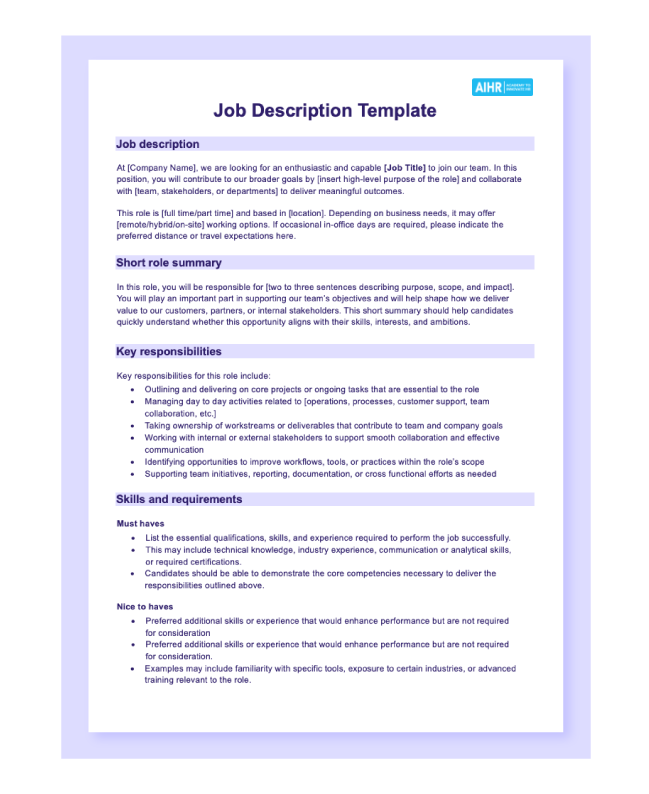
The template below captures the obvious distinction between must-haves and nice-to-haves. For technical-manager roles, add the distinction between formal screening requirements and the actual work of managing the team.
Read the role before you read the checklist
A frequent mistake is to start at “Qualifications,” count missing keywords, and decide whether to apply. That treats a job description as a compliance form. Start instead with the team’s mission and the role’s recurring responsibilities.
For a technical manager, look for verbs that indicate ongoing accountability:
- Lead a team, rather than merely contribute to a project.
- Set or shape direction through a roadmap, technical strategy, or priorities.
- Develop people through coaching, feedback, hiring, mentoring, or performance management.
- Own delivery conditions such as planning, execution, dependencies, and risk.
- Maintain operational health through quality, reliability, incident learning, or sustainable on-call.
- Partner across functions with product, program, security, support, or senior leadership.
These phrases tell you whether a role is truly management-oriented. A title such as Technical Lead, Engineering Manager, or Software Development Manager is less informative than the work described.
For example, a posting titled “Engineering Manager” that mainly asks someone to own architecture and deliver a project may be closer to a senior technical-lead role. Conversely, a posting titled “Software Development Manager” that emphasizes hiring, coaching, roadmap ownership, delivery, and operations is describing a genuine technical-management role.
A recruiter’s approach can help you identify the most consequential sections and avoid treating every line as equally weighted.
How to Read a Job Description (According to a Real Recruiter)
Watch “How to Read a Job Description (According to a Real Recruiter)” from Teal for a concise method of separating baseline qualifications from preferences, then using order and repetition as priority signals.
First watch minimum versus preferred for the distinction between explicitly mandatory criteria and desirable qualifications. The compliance discussion is specific to a US hiring context, but the practical lesson is broader: treat explicitly stated minimum criteria as serious screening signals. Then watch priority signals. Focus on the cautious heuristic that responsibilities near the beginning and concepts repeated across the posting often reveal what the hiring manager will probe for. Repetition and ordering are evidence of priority, not proof that a later item is irrelevant.
Extract “atoms,” not vague impressions
On your first active reading, rewrite each meaningful statement as a short, testable item. Keep the employer’s wording close to the original.
For instance, instead of noting:
“Seems to need a technical leader who is good with people.”
extract items such as:
- Lead a team of software engineers.
- Set a team vision and roadmap.
- Partner with product and program management.
- Coach and grow engineers.
- Maintain operational excellence.
- Understand the full development and production lifecycle.
This turns a dense posting into material you can classify. It also prevents an unhelpful response in an interview such as, “I think I’m a good culture fit.” You will instead be able to say, “The role requires team leadership, cross-functional delivery, and operational ownership; here is evidence of each.”
A practical classification method
Use the following five-pass method for any role you may seriously apply for. It should take about 15 minutes after some practice.
1. Identify the team’s purpose
Read the opening description and answer:
- What customer, platform, or business problem does this team own?
- Is the team building new capabilities, operating critical systems, modernizing a platform, or some combination?
- What scale, reliability, security, or domain constraints shape the work?
This is context, but it changes the kind of leadership evidence that matters. A manager leading a high-scale AWS control-plane team needs credible operational judgment in addition to people and delivery leadership. A manager leading an internal developer-tools team may be evaluated more heavily on platform adoption and engineering productivity.
2. Mark explicit language
Certain labels have high evidentiary value:
| Wording in the posting | Initial classification |
|---|---|
| “Basic qualifications,” “minimum qualifications,” “required,” “must have” | Eligibility gate |
| “Preferred,” “desired,” “ideal candidate,” “bonus” | Preferred differentiator |
| “You will,” “responsible for,” “in this role” | Role-defining work |
| “Based in,” “eligible to work,” “clearance,” “on-call rotation” | Constraint; may also be a gate |
Do not soften a stated minimum requirement merely because you have adjacent experience. Equally, do not treat a preferred qualification as a reason not to apply.
3. Look for recurrence and overlap
Next, circle ideas that appear in more than one section. A capability may be formally labelled “preferred” yet be strongly implied by the responsibilities.
For example, imagine a posting says:
- In responsibilities: “Attract, develop, and retain a high-performing team.”
- In preferred qualifications: “Experience recruiting, hiring, mentoring, and coaching engineers.”
The second item is technically preferred, but the first tells you that people development is central to succeeding in the role. The sensible interpretation is:
- Formal hiring experience may be a differentiator.
- Ability to develop engineers is a role-defining core capability.
This does not mean relabeling the preferred bullet as mandatory. It means preparing evidence for the underlying capability.
4. Separate specific evidence from generic language
Some phrases are real expectations but too vague to classify on their own:
- “Excellent communication skills”
- “Bias for action”
- “Team player”
- “Thrives in a fast-paced environment”
Give these more weight when they are connected to concrete work. “Communicate effectively with product and senior leadership to align priorities during incidents” is far more meaningful than “strong communication skills.”
For an application, the same principle applies: do not simply repeat a phrase such as “bias for action.” Show the behavior and result that make it credible.
5. Create a one-page role brief
Your final output should be short enough to use when tailoring your resume and preparing interview stories.
| Category | Requirement or signal | Why it matters | Evidence to prepare |
|---|---|---|---|
| Eligibility gate | Formal management experience, if explicitly required | May affect recruiter screening | State accurately; do not imply direct reports if you did not have them |
| Role-defining core | Lead delivery across a team | Central manager accountability | Project-lead example showing milestones, dependencies, risks, and outcome |
| Role-defining core | Operational excellence | The team runs production systems | AWS/DevOps example involving reliability, incident response, or safer deployment |
| Preferred differentiator | Domain-specific experience | Helps the team become effective faster | Relevant service, scale, data, or platform exposure |
| Constraint | Location, right-to-work status, on-call | Affects practical eligibility | Address only when relevant and truthful |
For now, this is an analysis tool, not a personal competency assessment. In the next lesson, you will use this role brief to evaluate your evidence and identify development gaps systematically.
Worked example: Amazon’s Software Development Manager posting
Now apply the method to the Amazon posting. Read it first without trying to decide whether you personally qualify. Your only task is to identify the job’s operating model.
Software Development Manager - Job ID: 3199129 | Amazon.jobs
Read this Amazon Software Development Manager posting as a case study in separating team accountabilities, explicit minimum qualifications, and preferred experience. It is particularly useful because its team mission, responsibilities, basic qualifications, and preferred qualifications are clearly separated.
Begin with the opening role overview, from the team mission and role scope. In the “Your Role and Potential Impact” portion, underline the verbs describing ongoing managerial accountability: leading the team, creating the vision and roadmap, growing engineers, coaching, operating reliably, and refining delivery process. Then read the “Basic Qualifications” section, beginning with the basic requirements. Treat these as likely screening criteria. Finally, read the “Preferred Qualifications” section, from the preferred experience. Notice which preferred items overlap with earlier responsibilities; that overlap raises their practical importance without changing their formal label.
Here is a defensible analysis of that posting.
| Posting signal | Classification | Reasoning |
|---|---|---|
| Lead a team building and running EC2 placement systems | Role-defining core | The manager is accountable for a team and production systems, not a single project |
| Create vision and drive the roadmap | Role-defining core | Direction-setting and prioritization are explicitly part of the job |
| Attract, grow, mentor, and coach engineers | Role-defining core | This is sustained people leadership, not occasional peer support |
| Maintain operational excellence | Role-defining core | The team owns critical infrastructure; operational judgment is central |
| Lead and refine agile development process | Role-defining core | The role owns conditions for predictable delivery |
| Lead definition and development of multi-tier web services | Eligibility gate | It appears under Basic Qualifications |
| Partner with product and program management | Eligibility gate and role-defining core | It is a stated minimum requirement and supports roadmap and delivery responsibilities |
| Three or more years of engineering team management | Eligibility gate | Explicitly listed as a basic qualification |
| Full lifecycle engineering practices, including live-site operations | Eligibility gate | The role needs broad engineering and operational literacy |
| Optimization, machine learning, and data-streaming interest | Contextual preference | It reflects the domain, but the wording signals interest rather than a stated minimum |
| Recruit, hire, mentor, coach, and manage engineers | Preferred differentiator with strong overlap | It is listed as preferred, but it reinforces the posting’s core people-leadership responsibility |
Two points deserve special attention.
First, the posting expects both people leadership and technical-operational judgment. This is a technical manager, not a purely administrative manager. Its core is not “be the best engineer on the team,” but rather “lead a capable team that can build and run complex systems.”
Second, “three or more years of engineering team management” is a genuine gap for someone moving from technical and project leadership into formal management. Treat it honestly. Do not rewrite project coordination as line management. Instead, look for roles where the management-experience requirement is less rigid, where leadership experience is accepted as equivalent, or where the organization is clearly open to a first-time manager.
Your experience coordinating backend and DevOps work can still offer relevant evidence for several core capabilities in this posting:
- working across product, program, and engineering stakeholders;
- improving release, infrastructure, or operational practices;
- making risks and dependencies visible;
- mentoring or unblocking engineers;
- guiding technical decisions without owning every implementation detail.
The application and interview task is to present that evidence accurately while showing a concrete understanding of the formal management responsibilities you are ready to take on.
Avoid two opposite application errors
Error 1: self-rejecting over preferred qualifications
Suppose a role prefers experience with a particular AWS service, a machine-learning domain, or formal hiring. If you meet the core role requirements and can demonstrate adjacent experience, a preference is not automatically disqualifying.
State the adjacent evidence precisely:
Led operational improvements for AWS-hosted backend services, including deployment and reliability work; ready to deepen domain knowledge in high-scale control-plane systems.
This is stronger than claiming expertise you do not have, and more useful than omitting the relevant overlap entirely.
Error 2: applying despite a clear mismatch on the role’s center of gravity
A technical manager job may contain attractive technology keywords but still be a poor match if its real center of gravity is far from your experience or intended transition.
Examples include roles that require:
- an established record of formal people management across several years;
- direct ownership of a specialized domain you have not worked in;
- a mandatory clearance, location, or work authorization you do not have;
- a manager to inherit a large team with immediate hiring and performance-management responsibility.
There is no universal percentage-match threshold. Instead, use judgment:
- Meet explicit eligibility gates wherever possible.
- Have credible evidence for most role-defining core capabilities.
- Be transparent about the one or two areas you are actively developing.
- Treat preferences as a way to prioritize preparation, not as a binary barrier.
Build a repeatable application habit
For each promising technical-manager role, make a copy of the posting before it changes or closes. Then produce a role brief with the four labels from this lesson.
A useful color-coding system is:
- Red: explicit eligibility gate
- Blue: role-defining core accountability
- Green: preferred differentiator
- Gray: team or logistical context
Then add a mark beside each red or blue item:
- E for evidence you can already describe truthfully;
- A for adjacent experience;
- G for a genuine gap.
Do not try to solve every gap at once. For a three-month application timeline, the highest-value work is usually:
- making existing leadership evidence visible on your resume;
- preparing stories for the core accountabilities that recur across target roles;
- closing one or two recurring gaps through focused practice;
- targeting postings whose explicit gates are realistic for your transition.
This approach keeps your applications selective without demanding a perfect match.
Key takeaways
A technical-manager job description should be read as an imperfect but useful map of the role.
- Separate eligibility gates from role-defining core accountabilities. Both matter, but they answer different questions.
- Start with the team’s mission and responsibilities, then examine qualifications.
- Give extra weight to explicit mandatory language, repeated themes, and overlap between responsibilities and qualifications.
- Treat “preferred” qualifications as differentiators, not automatic disqualifiers.
- Do not hide a formal-management gap by relabeling project or technical leadership as people management. Instead, connect your genuine leadership evidence to the role’s core capabilities.
- Produce a concise role brief that can guide your resume tailoring and interview preparation.
Next, you will turn this analysis inward: assess your own experience against a technical-manager competency matrix, identify usable evidence, and distinguish development gaps from gaps that only need clearer presentation.
Can't find a good explanation? Sign up and we'll make it for you
Sign up