
Hello. In the previous lesson, you built a role-specific competency matrix and evidence cards. You separated direct evidence from transferable experience and identified where project leadership overlaps with, but does not substitute for, formal people management.
This lesson turns one of those evidence cards into a résumé bullet. The goal is not to make a project-lead role sound like a people-manager role. It is to make your actual leadership visible: the initiative you owned, the people or systems you enabled, and the measurable result. By the end, you will have a defensible bullet that emphasizes leadership impact rather than a list of technical tasks.
From “what I did” to “what changed”
A task-based bullet tells a recruiter what occupied your time:
Implemented CI/CD pipelines for backend services.
That may establish technical competence, but it leaves several questions unanswered:
- What problem required the work?
- Did you make a leadership or coordination contribution?
- What was the scope?
- What improved for the team, customers, or business?
A stronger bullet makes a claim of impact. It identifies your contribution and gives the reader a reason to believe the work mattered.
The basic structure is:
Leadership action + initiative and scope + measurable result
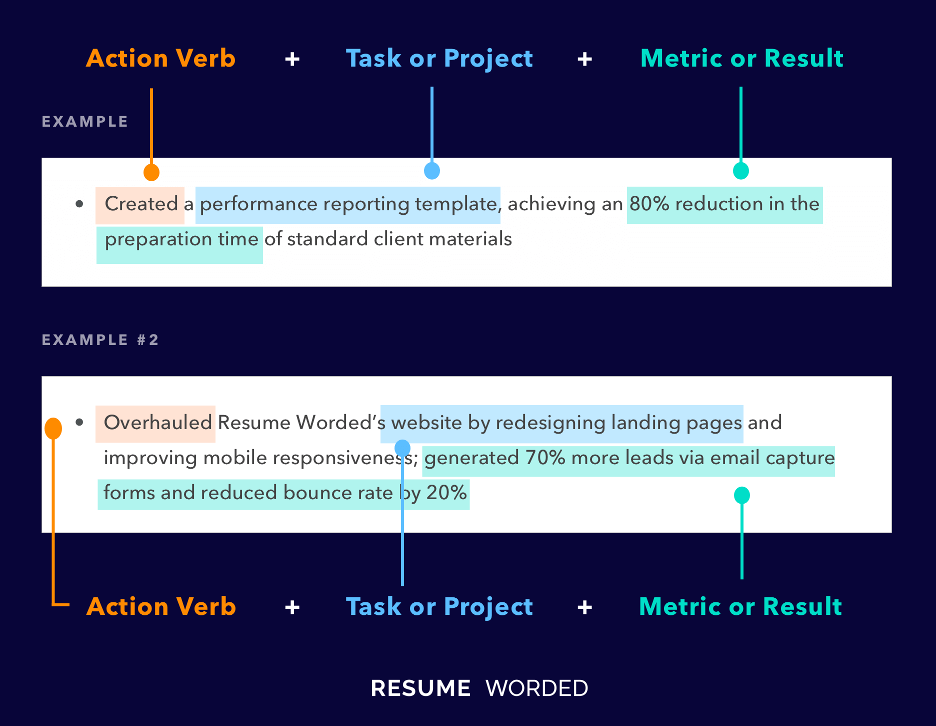
This does not mean every bullet must contain a percentage. A useful result can be:
- a measurable operational change, such as deployment frequency or recovery time;
- a business or customer outcome, such as onboarding time or reliability;
- a bounded delivery outcome, such as a migration completed across a stated number of services without customer-facing downtime;
- a people or team outcome, such as onboarding a new engineer to independent on-call readiness—if you can substantiate it.
The important shift is from activity to effect.
Writing Impactful Resume Bullets – Office of Career Strategy – Yale University
Read “Writing Impactful Resume Bullets” from Yale University’s Office of Career Strategy. It gives two compact structures for converting responsibilities into accomplishment statements and shows why a baseline makes a metric more meaningful.
Begin with the “Resume Accomplishment Statements” section. Read the opening rationale to distinguish an achievement from a duty. Then, in “Guidelines for Creating Impactful Resume Accomplishment Statements,” read the two writing formulas. Continue through the “Converting to Result Bullets: Before and After” examples and the following “Tips.” Focus on the way the revised bullets name the person’s contribution, establish scale, and provide a comparison point.
For technical-manager applications, we will slightly refine the generic structure. Your strongest bullets should make three things legible in a quick scan:
- Leadership behavior: You led, coordinated, facilitated, partnered, introduced, mentored, or made a decision.
- Scope and context: The services, engineers, teams, dependency, customer capability, or operational problem involved.
- Outcome: A metric, a before-and-after improvement, or a clearly bounded result.
A recruiter should not have to infer the leadership from a list of tools.
Choose language that matches your actual authority
Because you are moving from backend and DevOps work with project-lead experience toward a first formal technical-manager role, precision matters. Strong verbs are valuable only when they accurately describe what you did.
| If you actually did this | Accurate verbs and phrasing |
|---|---|
| Set direction, organized the work, and drove the initiative forward | Led, drove, coordinated |
| Brought multiple parties to a decision without owning them formally | Facilitated, aligned, partnered with |
| Improved a technical system through your own technical contribution | Designed, built, introduced, automated |
| Helped another engineer develop capability | Mentored, coached, onboarded |
| Had formal direct-report accountability | Managed, developed, set expectations for |
Do not use managed a team if you coordinated peers but were not their manager. “Led a four-engineer initiative” is both strong and truthful; it describes leadership without implying formal authority. Likewise, “partnered with Product and Security” is often more credible than “directed Product and Security.”
Avoid weak wording when you had real ownership:
Participated in an AWS migration project.
But also avoid inflated wording if you were one contributor:
Spearheaded company-wide cloud transformation.
A good résumé does not maximize senior-sounding verbs. It maximizes the clarity of your evidence.
Engineering Manager Resume: Examples and Tips 2026 | Wiz
Read the relevant work-experience guidance from Wiz Academy. Use it as a practical reference for leadership-oriented verbs, metric categories, and common ways management candidates accidentally bury their impact.
In the “Work experience” section, read the action-and-result guidance. Notice that leadership language must be paired with concrete context. Next, read the opening of “How to quantify engineering management impact,” including the metrics rationale, then the four metric categories: delivery velocity, team health, operational excellence, and business impact. Finish with “Common engineering manager resume mistakes,” particularly the points on vague team descriptions, missing metrics, and burying leadership experience.
For your background, operational excellence, delivery velocity, and cloud-cost or reliability impact are likely to yield the most credible initial metrics. People-impact evidence may also belong on the résumé, but only where you can describe a real mentoring, onboarding, feedback, or process-improvement outcome.
Find a metric without inventing one
The fastest route to a weak bullet is adding an impressive but unsupported number. Every metric must survive a follow-up question in an interview:
- What was the baseline?
- What dates or period does the measurement cover?
- What dashboard, report, ticket data, or business record supports it?
- What did you personally do?
- Who else contributed, and how should the result be attributed?
Use your evidence card from the previous lesson to retrieve these details. Start with the outcome, not the implementation detail.
Useful metric categories for backend, AWS, and DevOps leadership
| Category | Evidence you might retrieve | Example measure |
|---|---|---|
| Delivery | CI/CD dashboard, release calendar, pull-request or deployment data | Deployment cadence moved from weekly to daily |
| Reliability | Incident records, observability dashboard, post-incident review | Recovery time fell from 60 to 15 minutes |
| Quality and risk | Rollback record, defect trend, security backlog | Production incidents decreased; critical vulnerabilities remediated faster |
| Cost and efficiency | AWS billing data, capacity reports, manual-process timings | Cloud spend reduced by a documented amount or percentage |
| Customer or business | Product analytics, support volume, onboarding records | Customer onboarding time decreased |
| Scope | Project plan, service inventory, stakeholder list | Coordinated work across 6 services, 2 teams, or 3 critical dependencies |
Scope is not automatically impact. “Led eight engineers” describes the scale of your responsibility; it does not show what improved. Pair scope with an outcome whenever possible.
If you cannot retrieve a clean percentage, use a truthful, bounded result:
Coordinated the phased migration of three Node.js services to AWS, establishing dependency and rollback checkpoints that enabled completion without customer-facing downtime during the migration window.
That bullet has no percentage, but it still states scope, leadership behavior, and a verifiable outcome. It is much stronger than “Migrated services to AWS.”
Rewrite one bullet in three passes
Choose one evidence card that is both relevant to your target role and easy to substantiate. A delivery, AWS reliability, incident-response, or cross-functional initiative is a strong starting point.
Pass 1: Write the unedited task statement
Begin with what you would naturally put on your résumé:
Implemented CI/CD improvements for Node.js services.
This is not wrong; it is incomplete. It centers your technical task rather than the problem, leadership behavior, and result.
Pass 2: Recover leadership context
Use your evidence card to add only the context that proves management-relevant capability:
Coordinated a four-engineer effort to standardize CI/CD for six Node.js services, working with platform and application owners to define testing and rollback gates.
This establishes scope and coordination. It still needs evidence that the effort changed something.
Pass 3: Add the result and baseline
Here is an illustrative final version. Replace every bracketed value with facts you can verify; do not copy the numbers.
Led a four-engineer initiative to standardize CI/CD for six Node.js services, aligning platform and application owners on automated test and rollback gates; increased deployment cadence from [weekly] to [daily] and reduced rollback recovery time from [60] to [15] minutes.
Why this works:
- Led signals ownership, without claiming people-management authority.
- Four engineers and six services establish meaningful scope.
- Aligning owners on gates demonstrates leadership through coordination and risk management, not merely coding.
- Deployment cadence and recovery time show operational and delivery outcomes.
- The two before-and-after measures are more interpretable than a vague claim to have “improved DevOps.”
The technical detail is present, but it serves the leadership narrative. A hiring manager can now infer that you can help a team deliver software safely and predictably.
A second pattern: lead with the outcome
When the result is especially compelling, use Yale’s impact-first pattern:
Reduced AWS infrastructure spend by [18%] across [production workload] by leading a rightsizing review with application owners, prioritizing low-risk changes, and tracking realized savings against monthly billing data.
This version begins with business impact. It still reveals the leadership mechanism: you organized a review, worked across ownership boundaries, made prioritization decisions, and measured the result.
Use either structure. The better choice is the one that makes the most role-relevant evidence visible in the first line.
Run a credibility and relevance audit
Before placing the bullet on your résumé, edit it against five tests.
1. Ownership test
Can you point to the decisions, coordination, or work that you did?
If the team result depended on many contributors and you had a partial role, make that clear:
Partnered with the platform team to…
That is more credible than claiming sole ownership of a shared outcome.
2. Authority test
Does the bullet imply formal management that you did not have?
Replace “managed engineers” with “led an initiative involving engineers” when appropriate. Save formal people-management language for experience that genuinely involved direct reports, performance expectations, career development, or hiring decisions.
3. Measurement test
Can you explain the number and comparison point? Prefer:
Reduced mean recovery time from 60 to 15 minutes
over:
Improved incident response by 75%
The first tells the reader what changed and how much. The percentage may be correct, but the baseline makes it believable and operationally meaningful.
4. Relevance test
Does the bullet map to a requirement in the role brief you made in the previous lesson?
For a technical-manager role, prioritize evidence of delivery, reliability, technical judgment, stakeholder alignment, mentoring, and team-enabling process improvements. A technically impressive implementation may be lower priority if it does not show any of these.
5. Compression test
Can a rushed reader understand the point in one pass?
Remove internal project codenames, implementation trivia, and every detail that does not establish leadership, scope, or outcome. Aim for one or two lines in the final résumé format, even if your evidence card remains much longer.
Your résumé-bullet work product
Use one evidence card to produce a draft with this template:
[Calibrated leadership verb] [initiative, problem, and scope], [leadership mechanism or key decision]; [measurable outcome with baseline, or bounded verified result].
For example, a blank but usable draft might look like this:
Coordinated [number]-engineer delivery of [initiative] across [systems or teams], introducing [decision process, safety mechanism, or operating change]; improved [metric] from [baseline] to [new value] over [time period].
Keep the supporting facts in a private note beside the bullet:
- source of the metric;
- dates measured;
- your specific decisions and actions;
- other major contributors;
- a concise interview story you can tell if asked.
That private evidence prevents résumé polishing from drifting into overstatement—and gives you material for the interview story bank later in the course.
Key takeaways
A strong technical-manager-transition bullet is not a longer task description. It is concise evidence that you enabled a meaningful outcome.
- Lead with an accurate verb that reflects your real authority.
- Show scope, but do not confuse scope with impact.
- Use delivery, reliability, cost, customer, or team-capability evidence to quantify the change.
- Give a baseline when possible, and never invent a metric.
- Describe project or technical leadership honestly without presenting it as formal people management.
- Tailor the bullet to the accountabilities in the target role brief.
Next, you will shift from presenting leadership evidence to practicing leadership judgment: assigning clear decision ownership with a framework such as DACI.
Can't find a good explanation? Sign up and we'll make it for you
Sign up