
Introduction
In our last lesson, we saw the culmination of Plato's philosophical system in the Republic: the argument that the ideal state requires philosopher-kings. This radical claim rested squarely on the Theory of Forms, which posits a transcendent realm of perfect, eternal truths—most importantly, the Form of the Good—that only philosophers can access. This theory was the bedrock of Plato's metaphysics, epistemology, and political philosophy.
But what if this bedrock has a crack in it? Philosophy, at its best, is a process of relentless self-examination. In this lesson, we will see Plato the philosopher turn a critical eye on his own masterpiece. We will journey into his later, more complex dialogue, the Parmenides, where he, through the voice of the elder philosopher Parmenides, presents a series of powerful challenges to the Theory of Forms as defended by a young Socrates.
Our focus will be on the most famous of these challenges: the Third Man Argument. Your learning outcome for this lesson is to evaluate this argument and understand why it poses such a significant problem for Plato's theory. This exercise will not only deepen your understanding of Plato but also showcase the intellectual honesty that drives philosophical progress.
Setting the Stage: Plato the Self-Critic
Plato's Parmenides is a remarkable work. Instead of simply asserting his theory, Plato uses the dialogue to explore its potential weaknesses. This is not a sign of him abandoning his theory, but rather of his commitment to testing it with the full force of logical reasoning.
To get a sense of the dialogue's unique character, let's start with a brief video that introduces it as Plato's own critique of his most famous theory.
This clip from a lecture by Adam Rosenfeld introduces the Parmenides dialogue and highlights the remarkable fact that Plato is presenting a powerful critique of his own Theory of Forms.
Please watch from 06:22 to 07:44. Focus on the idea that this dialogue represents Plato turning his own critical method back on his own conclusions.
To understand the arguments in the Parmenides, we must first have a very precise understanding of the principles that underpin the Theory of Forms. The following reading from the Stanford Encyclopedia of Philosophy lays out the key assumptions that Socrates holds in the dialogue.
Plato's Parmenides - Stanford Encyclopedia of Philosophy
This reading from the Stanford Encyclopedia of Philosophy article "Plato's Parmenides" precisely defines the core principles of the Theory of Forms that will be challenged.
Please read Section 3, 'Socrates’ Speech: The Theory of Forms 128e–130a'. Pay close attention to the principles defined in bold, especially: One-over-Many: The idea that for any group of things sharing a quality, there is a single Form they partake of. Self-Predication: The idea that 'the F is F' (e.g., the Form of Beauty is itself beautiful). Separation: The idea that the Form is separate from the things that partake of it.
As you've just read, the Theory of Forms isn't a vague idea; it's a structured system built on specific principles. The Third Man Argument works by showing that these very principles, when applied rigorously, seem to lead to an absurd conclusion.
The Third Man Argument (TMA)
The name "Third Man Argument" comes from Aristotle's later discussion of the problem, where he used the example of the Form of Man. The argument demonstrates that the theory's own premises trigger an infinite regress, undermining the whole structure.
Let's begin with a short, clear video that illustrates the basic logic of the argument.
This video from the channel TeacherOfPhilosophy provides a concise and accessible explanation of the Third Man Argument and its consequences.
Please watch from 00:45 to 04:13. Notice how the need to explain a property leads to an endless chain of Forms.
To visualize this abstract problem, consider the following diagram:
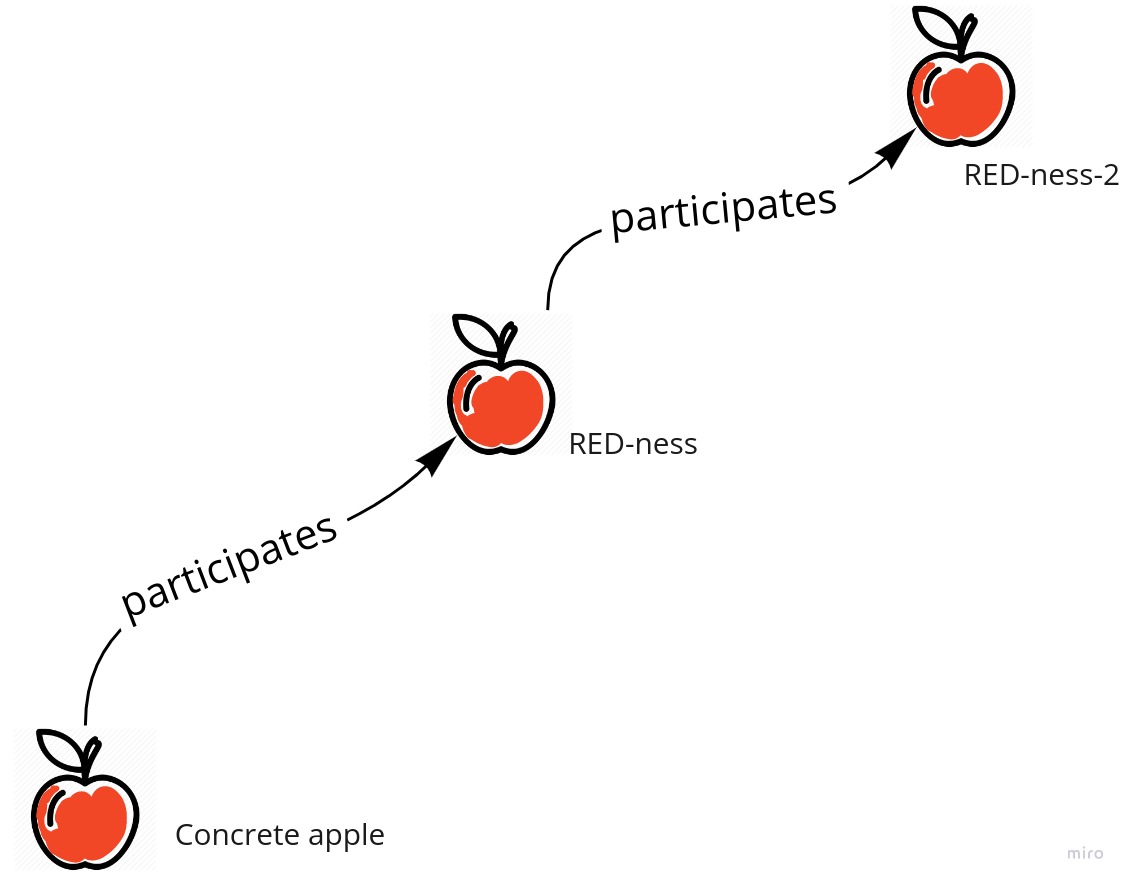
Now that you have the basic idea, let's dive into the rigorous, step-by-step breakdown of the argument as presented in the Parmenides. The following reading details the logical progression that creates the infinite regress.
Plato's Parmenides - Stanford Encyclopedia of Philosophy
This section of the Stanford Encyclopedia of Philosophy article provides a formal analysis of the Third Man Argument, breaking it down into its constituent premises and logical steps.
Please read Section 4.3, 'The Third Man Argument 132a–b'. Focus on how the principles of One-over-Many, Self-Predication, and Non-Identity work together to generate the infinite regress of forms.
Deconstructing the Regress
As the reading makes clear, the argument is a logical deduction that proceeds in steps. Let's reconstruct it using Plato's own example of "Largeness." The argument relies on three key premises we've already encountered:
- One-over-Many: If you have a group of large things, there must be a single Form of Largeness that they all partake of to be large.
- Self-Predication: The Form of Largeness is itself large.
- Non-Identity: A thing that partakes of a Form cannot be the Form itself. (This follows from Separation).
With these premises, the regress unfolds:
-
Step 1: Consider a set of large things: {Large Thing A, Large Thing B, Large Thing C}. By the One-over-Many principle, there must be a Form, Largeness-1, to account for their largeness.
-
Step 2: According to the Self-Predication principle, the Form Largeness-1 is itself large.
-
Step 3: We now have a new set of large things: {Large Thing A, Large Thing B, Large Thing C, Largeness-1}.
-
Step 4: By the One-over-Many principle again, this new set must partake of a Form of Largeness to be large. Let's call this new Form Largeness-2.
-
Step 5: According to the Non-Identity principle, because Largeness-1 partakes of Largeness-2, it cannot be identical to Largeness-2. Therefore, we have at least two distinct Forms of Largeness.
-
Step 6: The process now repeats forever. Largeness-2 must also be large (Self-Predication), creating a new set that requires Largeness-3, which requires Largeness-4, and so on ad infinitum.
Evaluating the Challenge
Why is this argument so devastating?
-
It Contradicts Uniqueness: The Theory of Forms holds that for any given property, there is exactly one Form. The TMA shows that the theory's own logic leads to an infinite number of Forms for any single property, a direct contradiction.
-
It Destroys Explanatory Power: The Forms are meant to be the ultimate explanation for why things are the way they are. A thing is large because it partakes in the Form of Largeness. But if the Form of Largeness itself needs another Form to explain its largeness, which needs another, and another, then nothing is ever truly explained. The explanation is infinitely deferred.
How Could Plato Respond?
The power of the TMA is that it uses Plato's own assumptions against him. To escape the regress, he would have to abandon one of the core premises. Which one is the most likely candidate?
-
Give up Self-Predication? This is the most common proposed solution. Plato could argue that the Form of Largeness is not itself a large thing. Instead, it is the abstract essence or definition of what it means to be large. A definition is not an instance of what it defines. The definition of "human" is not a human. If the Form of Largeness is not large, then Step 2 of the argument fails, and the regress never starts. This move, however, creates problems for the idea of the Forms as perfect exemplars or paradigms, a view Plato seems to hold in other dialogues.
-
Give up One-over-Many? Plato could restrict this principle, arguing that not every collection of things with a common name requires a Form. Perhaps the set that includes particulars and a Form does not generate a new Form. This weakens the theory's scope and seems somewhat arbitrary.
-
Give up Non-Identity? This seems impossible. The entire point of the theory is that Forms are separate from the particulars that instantiate them.
Plato never explicitly states how to solve the puzzle. The fact that he presents it so forcefully in the Parmenides shows his awareness of the deep conceptual challenges his theory faced. It suggests that he may have spent his later years refining or rethinking the nature of the Forms.
Conclusion
In this lesson, we have grappled with one of the most significant internal critiques in the history of philosophy. By examining the Third Man Argument, we've seen Plato the master dialectician at work, rigorously testing the foundations of his own thought.
Here are the key takeaways:
- The Third Man Argument (TMA) is Plato's own critique of his Theory of Forms, presented in the dialogue Parmenides.
- The argument shows that three core principles of the theory—One-over-Many, Self-Predication, and Non-Identity—combine to generate an infinite regress of Forms.
- This regress is problematic because it contradicts the Uniqueness of the Forms (one Form per property) and undermines their explanatory power.
- The argument's central flaw seems to be treating a Form (an abstract universal) as if it were just another particular instance of the property it represents. To escape the regress, Plato would likely need to reject the premise of Self-Predication.
The unresolved problems with the Theory of Forms, which Plato himself identified, created a crucial opening for his most brilliant student, Aristotle. While Plato had located true reality in a separate, transcendent world, Aristotle sought to find it within the concrete, particular things we experience. He developed a new metaphysical framework to avoid the problems raised by the TMA.
In our next lesson, we will begin our study of Aristotle by examining his foundational concept of the Four Causes, which represents his own powerful attempt to explain the nature of reality without resorting to a separate world of Forms.
Can't find a good explanation? Sign up and we'll make it for you
Sign up