
Introduction
Welcome back. In our last lesson, we journeyed out of Plato's Allegory of the Cave. We saw how philosophical education is not about passively receiving information, but about a painful and active reorientation of the "whole soul" towards the light of the Forms and, ultimately, the Form of the Good.
This raises a crucial question: what exactly is this "whole soul" that needs turning? What is its internal structure? In Book IV of the Republic, well before he tells the story of the cave, Plato provides the answer. Today, we will dissect that answer by analyzing his famous tripartite theory of the soul.
Our learning outcome is to analyze this theory from Republic Book IV. We will explore how Plato uses a powerful analogy and a core logical principle to argue that the soul is not a single, unified entity, but a complex system of three distinct parts: Reason, Spirit, and Appetite. Understanding this internal psychic landscape is essential, as it forms the basis for Plato's concepts of individual justice and political order.
The City-Soul Analogy
To understand the soul, which is small and difficult to inspect, Socrates proposes a brilliant methodological strategy: first, build a just city "in speech," and then use that large-scale model to see what justice looks like in the individual. This is the foundational city-soul analogy of the Republic.
The following video lecture provides an excellent overview of how Socrates constructs this ideal city (Kallipolis) and establishes the parallel between its social classes and the parts of the individual soul.
Great Minds - Part 1 - Plato's Republic II-V: Soul and City
In this segment from a lecture by the late Prof. Michael Sugrue, he explains the city-soul analogy and outlines the three classes of the ideal city and their corresponding virtues.
Please watch from 12:24 to 13:20, and then from 33:48 to 35:56. First, focus on Socrates's proposal to look for justice in the city to understand justice in the man. Then, pay close attention to the description of the three classes—bronze, silver, and gold—and their direct correspondence to the parts of the soul.
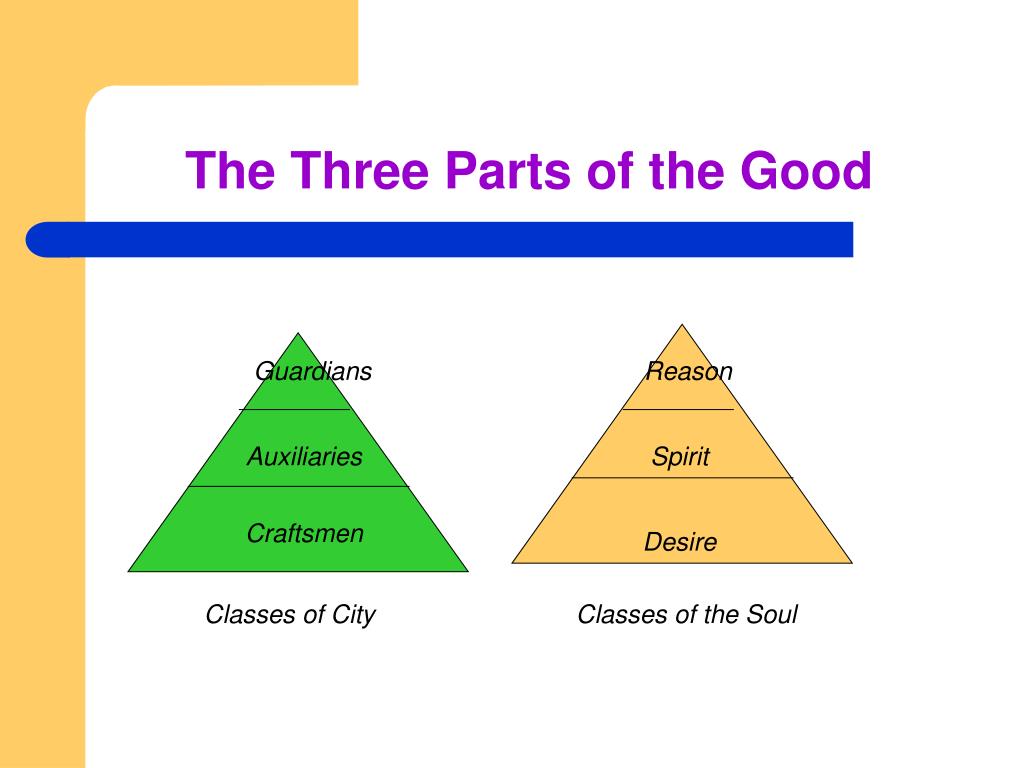
As you saw, the just city has a specialized, hierarchical structure:
- The Producers (Bronze): The artisans, farmers, and moneymakers who handle the economic life of the city. They are driven by their appetites and desires. Their specific virtue is moderation, meaning they agree to be ruled.
- The Auxiliaries (Silver): The warrior class, responsible for defending the city. They are driven by spirit (thumos)—honor, courage, and righteous anger. Their virtue is courage.
- The Guardians (Gold): The philosopher-rulers who possess true knowledge and govern the city. They are driven by reason. Their virtue is wisdom.
Justice in the city is defined as the state where each of these three classes performs its own function and does not meddle in the affairs of the others. With this blueprint in hand, Socrates turns to the soul, seeking to find these same three parts within each of us.
The Argument for Division: The Principle of Opposites
How can we prove that the soul actually has these distinct parts? Socrates employs a powerful logical tool, a version of the principle of non-contradiction, which we can call the Principle of Opposites.
The principle states:
The same thing will never do or suffer opposites in the same respect, in relation to the same thing, and at the same time.
In simpler terms, if we find a single entity (like the soul) being pulled in opposite directions at the very same moment, it can't be a single, simple thing. It must be a compound of different parts, with one part doing the pulling and another doing the pushing.
First Split: Reason vs. Appetite
Socrates first uses this principle to distinguish between the rational part of the soul and the appetitive part.
Plato's Republic book 4 | Distinguishing Parts of the Soul | Philosophy Core Concepts
Professor Gregory Sadler provides a very clear, step-by-step analysis of Plato's argument. In this first segment, he explains the Principle of Opposites and applies it to the classic example of thirst.
Watch from 3:37 to 12:24. Focus on how Socrates sets up the argument. Understand how the conflict experienced by a thirsty person who refuses to drink demonstrates the existence of two distinct parts of the soul: the appetitive and the rational.
Let's reconstruct the argument based on the video:
- Consider a person who is thirsty but chooses not to drink (perhaps the water is poisoned, or they are in the middle of a task).
- The state of thirst creates a desire, an impulse towards drinking. Socrates identifies this as the Appetitive part (τὸ ἐπιθυμητικόν, to epithymētikon), which drives us towards fulfilling bodily needs like hunger, thirst, and sexual desire. It drives us "like a beast to drink."
- Simultaneously, there is a force in the soul that forbids the drinking, an impulse that pulls away from the drink. This force arises from calculation and reasoning about what is best overall. Socrates calls this the Rational or Calculating part (τὸ λογιστικόν, to logistikon).
- Since the soul is simultaneously pushing towards and pulling away from the same object (the drink), it is "doing opposites at the same time."
- Therefore, according to the Principle of Opposites, the source of the desire (Appetite) must be a different part of the soul from the source of the refusal (Reason).
You can find the original text for this argument in Republic 436b-439d, which is excerpted in the "Selected Texts" resource (LINK).
Second Split: Introducing Spirit
So far, we have a two-part soul: one rational and one non-rational (the appetites). But Socrates's analogy requires a third part. This is Spirit (τὸ θυμοειδές, to thumoeides), the seat of emotions like anger, ambition, and the desire for honor. But how do we prove it's distinct from both reason and appetite?
Plato's Republic book 4 | Distinguishing Parts of the Soul | Philosophy Core Concepts
Continuing with Prof. Sadler's analysis, this segment tackles the arguments for the third part of the soul, Spirit.
Watch from 12:24 to 15:18. Pay close attention to the two key arguments here: The story of Leontius, which distinguishes Spirit from Appetite. The example of children and animals, which distinguishes Spirit from Reason.
Plato uses the Principle of Opposites again, this time in two stages:
1. Spirit is distinct from Appetite:
The key evidence is the story of Leontius.
- Leontius has an appetitive desire to look at a pile of corpses.
- At the same time, he feels revulsion and shame at this morbid curiosity. This feeling manifests as anger at himself for having such a base desire.
- This anger is the manifestation of Spirit. Since Spirit is fighting against Appetite, it must be a different part of the soul. Plato notes that Spirit naturally sides with Reason in such internal conflicts.
2. Spirit is distinct from Reason:
The evidence here is developmental.
- Small children and animals are "chock-full of rage and high spirit" from birth.
- However, many never develop rational calculation, or only do so much later in life.
- Since one can exist without the other, Spirit must be distinct from Reason.
With these arguments, the tripartite structure is complete. The soul consists of three distinct sources of motivation.
The Just Soul: A State of Harmony
Now we can fully understand the city-soul analogy and Plato's definition of justice.
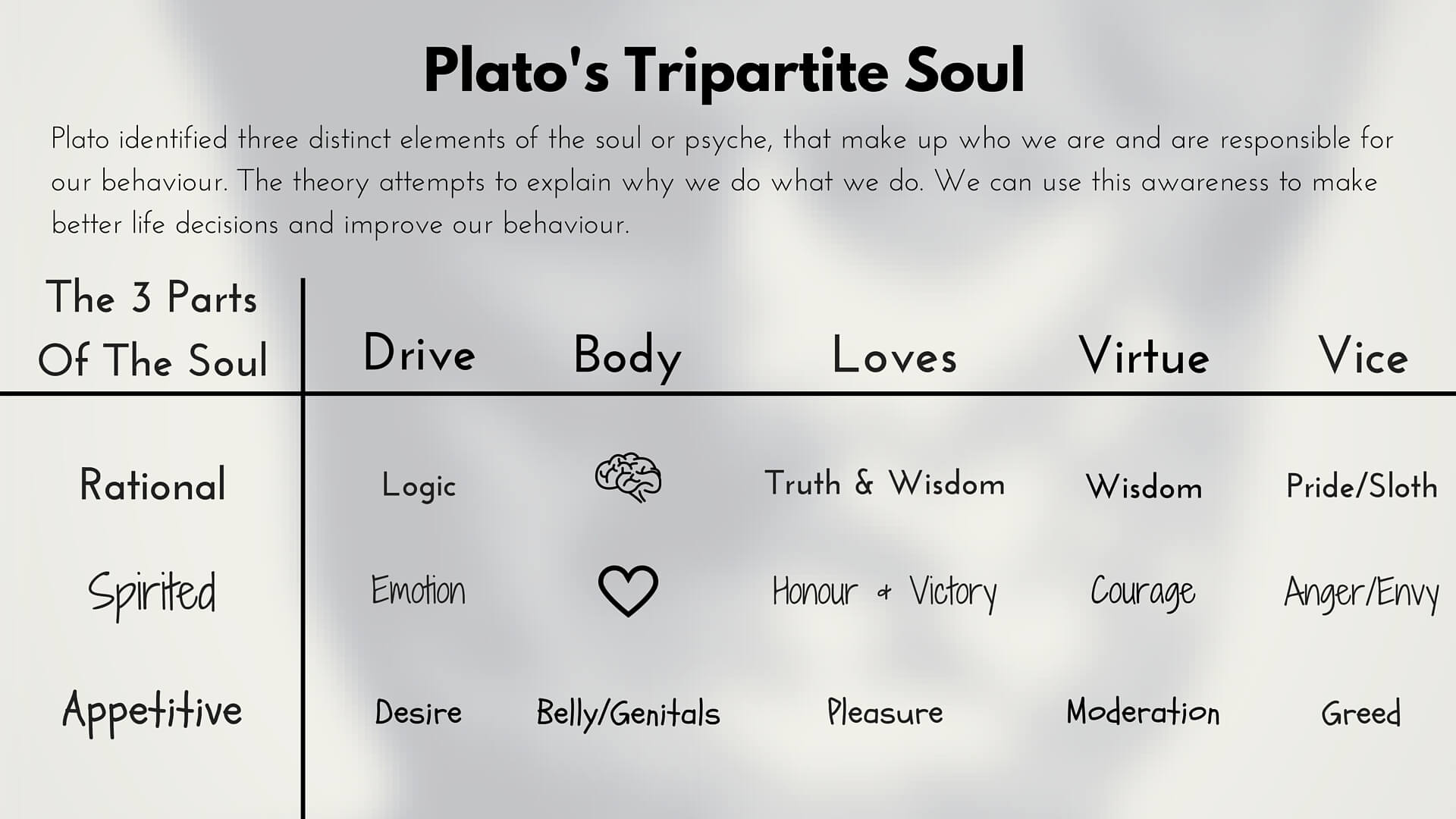
A well-ordered, or just, soul is one where these three parts function in harmony, maintaining their proper roles:
- Reason rules, using its wisdom to guide the entire soul towards what is truly good.
- Spirit acts as Reason's ally, using its courage and conviction to enforce Reason's decisions and protect the soul from internal and external threats.
- Appetite obeys, its desires moderated and managed by Reason and Spirit, ensuring it does not grow so powerful as to enslave the other parts.
Justice, for Plato, is not merely a matter of external actions; it is an internal state of psychic health and harmony. Injustice is the opposite: a state of civil war within the soul, where the appetites or the spirit usurp reason's right to rule.
Conclusion
In this lesson, we have moved from the external journey of the philosopher in the Allegory of the Cave to the internal map of the soul they must put in order.
Here are the key takeaways:
- Plato argues for a tripartite soul using the city-soul analogy as a framework and the Principle of Opposites as his primary argumentative tool.
- The three parts of the soul are Reason (which seeks truth), Spirit (which seeks honor), and Appetite (which seeks pleasure and satisfaction of bodily needs).
- Reason and Spirit are distinguished from Appetite through the example of the thirsty man. Spirit is distinguished from Appetite through the story of Leontius, and from Reason through the example of children and animals.
- Justice in the individual is the harmonious arrangement of the soul, where Reason rules, Spirit acts as its ally, and the Appetites are kept in check. It is a state of inner psychic order.
We now have the final piece of the puzzle. We have seen Plato's theory of reality (the Forms), his theory of knowledge (the Divided Line), his theory of education (the Cave), and his theory of psychology (the Tripartite Soul). In our next lesson, we will synthesize all of these elements to understand Plato's most radical and controversial political claim: that the only person fit to rule the state is the philosopher.
Can't find a good explanation? Sign up and we'll make it for you
Sign up