
Hello! Welcome to your first lesson in the technical scuba diving course.
This course is designed to give you a deep understanding of the physics, physiology, and procedures that underpin safe advanced diving. We'll be moving beyond the basics to explore the science that allows divers to explore deeper and for longer.
This first module, "Foundational Physics and Gas Laws," is the bedrock for everything that follows. Today, we'll focus on the first, and arguably one of the most important, principles for any diver using mixed gases.
Lesson 1: The Air We Breathe Under Pressure
Learning Outcome: By the end of this lesson, you will be able to apply Dalton's Law to calculate partial pressures of gases in breathing mixtures at various depths.
Understanding this is not just an academic exercise; it's fundamental to managing the primary risks of technical diving, such as oxygen toxicity and inert gas narcosis, which we will cover in later modules.
Let's begin.
1. Pressure and the Diver
Before we can talk about the gases we breathe, we need to understand the environment they're breathed in: a world of changing pressure. As a diver, your body is subject to the pressure of the water around you, in addition to the atmospheric pressure we experience at the surface.
- Atmospheric Pressure: At sea level, we are under approximately 1 bar (or 14.7 psi) of pressure from the Earth's atmosphere. We call this 1 atmosphere.
- Ambient Pressure: As you descend in water, the weight of the water column above you adds pressure. For every 10 meters (33 feet) you descend in saltwater, the pressure increases by another atmosphere.
- Atmospheres Absolute (ATA): To get the total pressure on a diver, we add the atmospheric pressure to the water pressure. This total is called Atmospheres Absolute, or ATA.
The formula to calculate this is simple:
ATA = (Depth in meters / 10) + 1
So, at 20 meters, the ambient pressure is (20 / 10) + 1 = 3 ATA.
To see a clear explanation of ATA, please watch the following segment from a video by Lake Hickory Scuba.
This video provides a straightforward explanation of Atmospheres Absolute (ATA), the measure of total pressure on a diver.
Watch the section from 01:37 to 04:01. The instructor explains what ATA is and how to calculate it for any given depth.
2. Dalton's Law of Partial Pressures
Now, let's consider the gas you're breathing. It's not a single entity, but a mixture of different gases. For example, air is roughly 21% oxygen () and 79% nitrogen ().
Dalton's Law states that the total pressure exerted by a mixture of gases is equal to the sum of the pressures of each individual gas in the mixture. The pressure of each individual gas is called its partial pressure.
Think of it like a team of people pushing a car. The total force on the car is the sum of the individual forces exerted by each person. In a gas mix, the total pressure is the sum of the partial pressures of the component gases.
To get a solid grasp of this concept, the next video offers an excellent introduction.
Daltons Law | Partial Pressures
This video from Dr Matt & Dr Mike explains the core concept of Dalton's Law and breaks down the composition of air at sea level.
Watch the first three minutes (00:00 - 02:59). Focus on how the total atmospheric pressure is the sum of the partial pressures of nitrogen, oxygen, and other gases.
3. Calculating Partial Pressures
The partial pressure of a specific gas () in your breathing mix is calculated by multiplying the fraction of that gas () by the total ambient pressure ( or ATA).
Let's calculate the partial pressures for air at the surface (1 ATA):
- Partial Pressure of Oxygen ():
- Partial Pressure of Nitrogen ():
Notice that , which is the total pressure, just as Dalton's Law predicts.
Partial Pressures at Depth
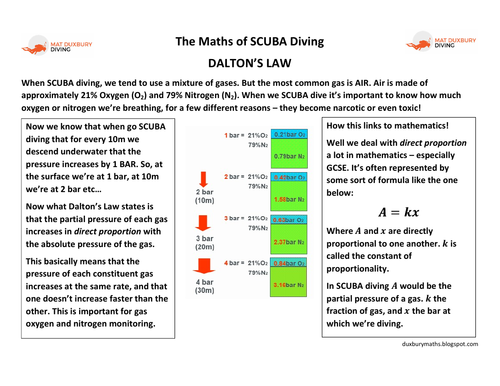
This is where Dalton's Law becomes critically important for divers. While the percentage of each gas in your tank remains constant, the partial pressure of each gas increases as you descend and the ambient pressure (ATA) rises.
Let's calculate the partial pressures for a diver breathing air at 30 meters (4 ATA):
- :
- :
The physiological effect of a gas is determined by its partial pressure, not its percentage. Breathing air at 30 meters means your body is exposed to an amount of oxygen equivalent to breathing 84% oxygen at the surface. This has major safety implications.
The following image provides a fantastic visual summary of this relationship.
To see this calculation in action and understand its importance, please return to the first video.
This segment connects the concepts of ATA and partial pressure, explaining why this calculation is vital for diver safety.
Watch from 04:01 to 08:18. Pay close attention to the formula used (PPO2 = %O2 x ATA) and the analogy of the beer to understand how a gas's 'potency' increases with depth. The video also introduces the safety limits for PPO2, which we will explore in detail in a future lesson.
4. Practice Calculations
Let's put this into practice. Try to solve the following problems.
Problem 1:
A diver is breathing standard air (21% , 79% ) at a depth of 25 meters in the ocean.
- What is the ambient pressure in ATA?
- What are the partial pressures of oxygen () and nitrogen ()?
Solution
- Calculate ATA:
Depth = 25 meters
ATA = (25 / 10) + 1 = 2.5 + 1 = 3.5 ATA - Calculate Partial Pressures:
$PPO_2 = 0.21 \times 3.5 \text{ ATA} = 0.735 \text{ ATA}$
$PPN_2 = 0.79 \times 3.5 \text{ ATA} = 2.765 \text{ ATA}$
Problem 2:
Technical divers often use Enriched Air Nitrox (EANx) to manage their nitrogen exposure. A diver is using EAN32 (32% , 68% ) for a dive to 35 meters.
- What is the at this depth?
Solution
- Calculate ATA:
Depth = 35 meters
ATA = (35 / 10) + 1 = 3.5 + 1 = 4.5 ATA - Calculate $PPO_2$:
$PPO_2 = 0.32 \times 4.5 \text{ ATA} = 1.44 \text{ ATA}$
Problem 3 (Challenge):
The recommended maximum for the main part of a dive is 1.4 ATA to avoid oxygen toxicity. If a diver is breathing air (21% ), what is the maximum depth they can safely dive to without exceeding this limit?
Solution
Here, we rearrange the formula to solve for ATA:
$$ \text{ATA} = \frac{PP_{gas}}{F_{gas}} $$
- Calculate maximum ATA:
Max ATA = 1.4 / 0.21 ≈ 6.67 ATA - Calculate depth from ATA:
Recall: ATA = (Depth / 10) + 1
Rearranging for Depth: Depth = (ATA - 1) × 10
Max Depth = (6.67 - 1) × 10 = 5.67 × 10 = 56.7 meters
This calculation is known as finding the Maximum Operating Depth (MOD) for a given gas, a crucial skill in technical dive planning.
Conclusion
Excellent work. You've just mastered the first and most fundamental gas law for diving.
Key Takeaways:
- Ambient Pressure (ATA) increases by 1 atmosphere for every 10 meters of descent in saltwater.
- Dalton's Law tells us that the total pressure of a gas mix is the sum of its partial pressures.
- The partial pressure of a gas increases proportionally with depth.
- The core formula you will use constantly is: .
- The physiological impact of any gas you breathe is a function of its partial pressure, not its percentage.
In our next lesson, we will build directly on this. Now that we understand how pressure affects the gases we breathe, we'll examine how that pressure changes the density of the gas. This will lead us to understand why breathing can become more difficult at depth and why that is a major consideration in deep, technical diving.
Can't find a good explanation? Sign up and we'll make it for you
Sign up