
Hello again. In the previous lesson, you classified the four major biological molecules by connecting structure to function. Cells are where those molecules interact: membranes set boundaries, DNA stores information, ribosomes build proteins, and many other structures help keep life running.
This lesson introduces the two fundamental cell plans: prokaryotic and eukaryotic. Your main goal is not to memorize every label in a diagram. It is to identify the defining differences—especially the location of DNA and the presence or absence of membrane-bound organelles—while also recognizing what all cells share.
Begin with this short visual overview from Amoeba Sisters.
Prokaryotic vs. Eukaryotic Cells (Updated)
Watch Prokaryotic vs. Eukaryotic Cells (Updated) by Amoeba Sisters for a visual overview of the two cell types, their shared features, and the crucial structural distinction between them.
Watch groups of life to connect prokaryotic cells with bacteria and archaea, and eukaryotic cells with plants, animals, fungi, and protists. Continue with shared features, identifying the four parts found in both types of cells. Finish with the defining contrast, focusing on what a nucleus is and what “membrane-bound organelle” means.
Every cell has a shared core
Despite their important differences, prokaryotic and eukaryotic cells are both cells. Each has four universal features:
| Shared feature | What it does |
|---|---|
| Plasma membrane | Forms the boundary between the cell and its surroundings; controls what enters and leaves. |
| Cytoplasm | Jelly-like material inside the membrane where many cell activities occur. |
| DNA | Stores genetic information, including instructions for making proteins. |
| Ribosomes | Build proteins using genetic instructions. |
This is important because a cell does not need a nucleus to be alive. Bacteria, for example, have DNA, ribosomes, a membrane, and cytoplasm. They can grow, respond to their environment, reproduce, and make proteins—without a nucleus.
The image below compares a generalized eukaryotic cell with a generalized prokaryotic cell.
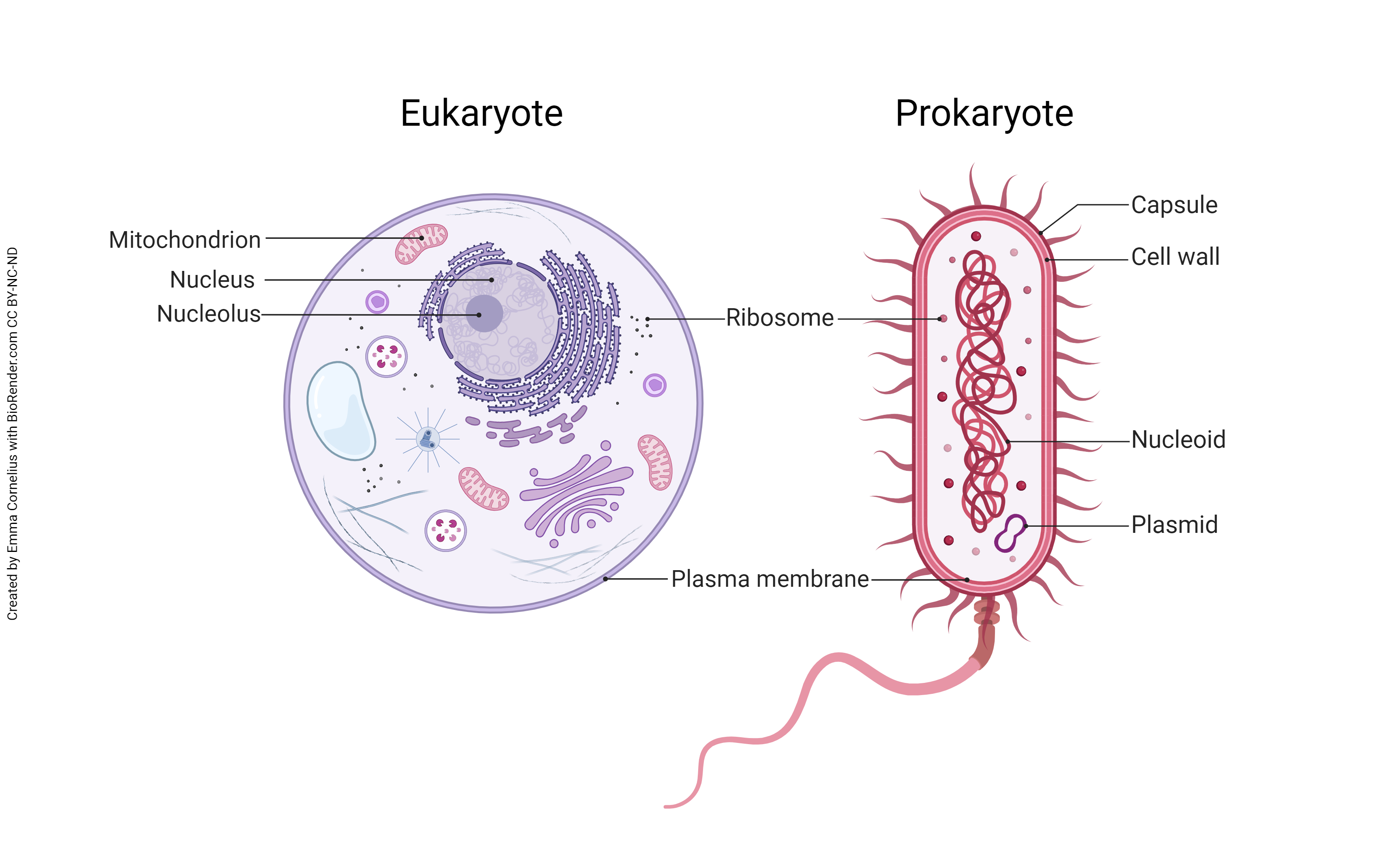
Notice the labels that appear on both sides: plasma membrane and ribosome. Those structures are not clues for distinguishing the two cell types, because both possess them.
Also notice that the drawing is a useful model, not a photograph of every possible cell. A prokaryotic cell may have a capsule, cell wall, or flagellum, but not all have every optional feature shown. Likewise, different eukaryotic cells contain different sets of organelles.
The defining division: nucleus and internal compartments
The most reliable way to distinguish the two groups is to ask:
Is the cell’s DNA enclosed inside a membrane-bound nucleus?
Prokaryotic cells
A prokaryotic cell has no nucleus. Its DNA is located in a concentrated region of the cytoplasm called the nucleoid.
A nucleoid is not an organelle. It is a DNA-containing region that lacks its own surrounding membrane. Prokaryotic cells also lack other membrane-bound organelles such as mitochondria, chloroplasts, the endoplasmic reticulum, and the Golgi apparatus.
Prokaryotes include:
- Bacteria
- Archaea
They are single-celled organisms, though many can live together in colonies.
Eukaryotic cells
A eukaryotic cell has a nucleus: a compartment surrounded by a membrane that contains most of the cell’s DNA. Eukaryotic cells also have other membrane-bound organelles, specialized structures with particular jobs.
Eukaryotes include:
- Animals
- Plants
- Fungi
- Protists
Eukaryotes may be single-celled, such as many protists and yeasts, or multicellular, such as humans, trees, and mushrooms.
The next lesson will examine the major eukaryotic organelles and their individual jobs. For now, the key idea is compartmentalization: eukaryotic cells use membranes to create separate internal spaces where different activities can occur.
Here is the essential comparison:
| Feature | Prokaryotic cells | Eukaryotic cells |
|---|---|---|
| Nucleus | Absent | Present |
| Location of main DNA | Nucleoid region in cytoplasm | Inside nucleus |
| Membrane-bound organelles | Absent | Present |
| Typical complexity | Less internally compartmentalized | More internally compartmentalized |
| Typical size | Smaller | Larger |
| Examples | Bacteria and archaea | Animals, plants, fungi, protists |
| Organism organization | Single-celled | Single-celled or multicellular |
A helpful memory cue is that eukaryotic contains the idea of a “true nucleus.” But rely primarily on the science, not just the word: eukaryotic cells have DNA enclosed in a nucleus; prokaryotic cells do not.
Size, walls, and other useful clues
Prokaryotic cells are generally much smaller than eukaryotic cells. Typical prokaryotic cells have diameters of about
while eukaryotic cells are commonly about
in diameter. A micrometer, written , is one millionth of a meter.
Small size helps prokaryotic cells move materials across the cell efficiently. In a small cell, nutrients entering through the membrane and wastes leaving it do not have far to travel. Larger eukaryotic cells face more of a transport challenge, which is one reason their internal compartments and membrane systems are useful.
Size is a typical pattern, not the definition. If you see a small cell, do not automatically call it prokaryotic. Look for the nucleus and membrane-bound organelles.
Cell walls are not the main distinction
Another common clue is the cell wall, a rigid layer outside the plasma membrane that supports and protects the cell.
- Many prokaryotes have cell walls.
- Plant cells and fungal cells are eukaryotic cells that also have cell walls.
- Animal cells are eukaryotic but do not have cell walls.
So this statement is correct: “A bacterial cell wall is evidence that the cell may be prokaryotic.”
But this statement is incorrect: “Any cell wall means the cell is prokaryotic.”
Cell walls help identify particular kinds of cells, but the nucleus remains the decisive feature.
The same caution applies to being single-celled. A bacterium is single-celled and prokaryotic, but a yeast cell is also single-celled and is eukaryotic. Single-celled does not automatically mean prokaryotic.
Read the comparison as a biologist
Read OpenStax’s 3.2 Comparing Prokaryotic and Eukaryotic Cells to consolidate the vocabulary and connect cell size to the problem of moving materials through a cell.
3.2 Comparing Prokaryotic and Eukaryotic Cells - Concepts of Biology | OpenStax
Read this OpenStax section to reinforce the shared parts of all cells, the distinction between a nucleoid and a nucleus, and the usual size difference between prokaryotic and eukaryotic cells.
In the subsection “Components of Prokaryotic Cells,” begin with the shared cell components. Then continue in that same subsection from the definition of a prokaryote through the description of its DNA-containing nucleoid. In “Eukaryotic Cells,” read the defining description and focus on why organelles are called specialized compartments. Finally, read the complete “Cell Size” subsection, including the first paragraph with the size ranges, then follow the size explanation to see why cell size affects transport.
A dependable classification method
When a diagram or description asks you to classify a cell, use evidence in this order:
-
Look for a nucleus.
A membrane-enclosed nucleus means the cell is eukaryotic. -
Look for membrane-bound organelles.
Structures such as mitochondria or chloroplasts indicate a eukaryotic cell. -
If no nucleus is present, locate the DNA.
DNA in an unenclosed nucleoid region indicates a prokaryotic cell. -
Use supporting clues carefully.
Small size, a bacterial-type cell wall, plasmids, a capsule, or flagella can support a prokaryotic classification, but none is as decisive as the absence of a nucleus.
For example, the prokaryotic cell in the image contains a plasmid, a small extra loop of DNA. Plasmids are common in bacteria and can carry useful genes, but the main classification clue remains that its DNA is not enclosed by a nucleus.
Similarly, the eukaryotic cell in the image includes a nucleus and mitochondria. Even if you did not yet know what mitochondria do, their presence as membrane-bound internal structures would be enough to classify the cell as eukaryotic.
Key takeaways
All cells have a plasma membrane, cytoplasm, DNA, and ribosomes.
The central distinction is:
- Prokaryotic cells lack a nucleus and membrane-bound organelles. Their DNA is in a nucleoid region. Bacteria and archaea are prokaryotes.
- Eukaryotic cells have a membrane-bound nucleus and other membrane-bound organelles. Animals, plants, fungi, and protists are eukaryotes.
Prokaryotic cells are usually smaller and are always single-celled. Eukaryotic cells are usually larger and can form either single-celled or multicellular organisms. Cell walls and single-celled organization can be useful clues, but they are not the defining distinction.
Next, you will build on this comparison by matching major eukaryotic organelles—such as the nucleus, mitochondria, and Golgi apparatus—to their primary functions.
Can't find a good explanation? Sign up and we'll make it for you
Sign up