
The last lesson selected action and review thresholds from labeled data, cost assumptions, and review capacity. That policy is only trustworthy if small, non-meaningful changes do not send equivalent cases down different routes. A system that escalates a ticket with one phrasing but passes the same ticket after an irrelevant field is added is brittle, even if its aggregate accuracy looks good.
In this lesson, you will build sensitivity tests for a Jev decision workflow. You will define which changes should preserve a decision, which changes should deliberately alter it, run paired requests against those variants, and turn unexpected changes into evidence for improving the question contract or state payload. The focus remains your confidence-aware support workflow, using a Noul proposition such as:
“Based only on the supplied state, this ticket requires urgent human intervention within one hour.”
1. Sensitivity testing asks a stronger question than accuracy
A labeled evaluation asks:
Did the system make the expected decision on this case?
A sensitivity test asks:
Does the system make a consistent decision when the meaningful facts have not changed?
Consider this support state:
const state = {
  message: "Checkout is failing for our customers. We have lost sales for 25 minutes.",
  affectedUsers: "many customers",
  checkoutStatus: "failing",
  knownIncidentCount: 1,
};
Suppose the urgent-risk assessment is , above your automatic-action threshold. Now compare it with a version that also contains an irrelevant UI preference:
const stateWithNoise = {
  ...state,
  customerThemePreference: "dark",
};
If the new decision becomes “pass,” that is not a normal disagreement with a gold label. The evidence supporting urgency did not change. It is a warning that the decision contract may be overly sensitive to irrelevant context, formatting, ordering, or an underspecified question.
The important distinction is between two kinds of variation:
| Variation | Meaning should change? | Expected testing relationship |
|---|---|---|
| Equivalent paraphrase of the Jev question | No | Same decision, with bounded score drift |
| Add irrelevant, non-sensitive state field | No | Same decision, with bounded score drift |
| Remove irrelevant state field | No | Same decision, with bounded score drift |
| Add verified evidence of wider impact | Yes | Urgency probability should not decrease materially |
| Add verified evidence that impact is resolved | Yes | Urgency probability should not increase materially |
| Remove key supporting evidence | Yes | Scenario-specific safe behavior, often review rather than automation |
| Replace “urgent” with “important” | Probably | Do not treat as an invariance test; you changed the proposition |
The final row is a common trap. Similar words are not necessarily equivalent in a business policy. “Urgent human intervention within one hour” is a defined operational proposition; “important” may be broader and less actionable. A sensitivity suite must preserve the decision semantics, not merely surface similarity.
2. Think in metamorphic relations, not isolated examples
A useful formal model comes from metamorphic testing. Instead of requiring a perfect expected output for every generated variant, you define a relationship that should hold between a source case and its transformed version.
[PDF] Metamorphic Testing of Large Language Models for Natural ...
This paper provides a precise vocabulary for the testing pattern used in this lesson: a source input, a transformation that creates a follow-up input, and an expected relationship between their outputs.
In Section II, “Metamorphic Testing for LLMs,” read from the definition of a metamorphic relation through the discussion of source and follow-up test inputs. Focus on the idea that a test can fail even when neither individual output has an obvious standalone “golden answer.”
For Jev, a source input consists of two separately versioned things:
- The question contract: question type, wording, options or proposition, and any instructions that define the judgment.
- The state payload: the evidence passed to Jev.
A transformation modifies one of them while holding the other fixed. This separation is essential for debugging:
| Test family | Change | Hold fixed | Typical diagnosis when it fails |
|---|---|---|---|
| Question sensitivity | Wording of the question contract | State evidence | The question is ambiguous or relies on accidental phrasing |
| State-noise sensitivity | Irrelevant state detail | Question contract | Payload contains distracting information, or model attention is brittle |
| Evidence ablation | A relevant evidence field is removed | Question contract | State lacks explicit missing-data semantics or policy handles uncertainty poorly |
| Evidence contrast | A verified fact changes | Question contract | The question is not using the most decision-relevant evidence |
For an invariant transformation, define the outcome relationship before sending a request. For a Noul urgency judgment, a reasonable relation might include:
and, for cases sufficiently far from a threshold:
Here, is the Noul probability, is Jev confidence, and the route is your deterministic action, review, or pass policy.
The tolerance values and are acceptance criteria, not universal constants. Start with values that are operationally meaningful for your product. A probability movement of may be harmless for a case far from thresholds but serious if it flips a ticket from automatic escalation to pass.
3. Build the test corpus from meaningful cases
Do not create a sensitivity suite by randomly mutating every word in production traffic. That generates many tests whose semantic relation is unclear, which leads to noisy failures and wasted review time.
Instead, begin with a small collection of human-reviewed source cases from the evaluation dataset you built earlier. Include cases from distinct operational regions:
| Source-case group | Why it belongs in the suite |
|---|---|
| Clearly urgent | Detects whether equivalent wording can suppress a needed action |
| Clearly non-urgent | Detects whether noise creates unnecessary escalation |
| Review-band case | Tests whether ambiguity is consistently routed to review |
| Near-threshold case | Reveals operational instability, but should be reported separately |
| Previously misclassified case | Confirms that a repair does not regress |
| Sparse-evidence case | Tests missing-data and fallback behavior |
| Edge-case language | Covers typos, rambling descriptions, mixed signals, or irrelevant details |
The Claude Platform guide gives practical examples of variations such as paraphrases, typos, rambling input, and irrelevant information. Although its examples concern generated answers, the principle transfers directly to typed Jev judgments: equivalent inputs should not produce arbitrary decision changes.
Define success criteria and build evaluations - Claude Platform
Read the Claude Platform guidance for concrete examples of meaningful input variation, then its recommendation to prefer deterministic grading when the expected condition is clear.
First, find the subsection “Consistency (FAQ bot) - cosine similarity evaluation.” Read the group of FAQ variants beginning with the long and irrelevant variants. Notice that typos, verbosity, and unrelated context are intentional test dimensions, not accidental data quality problems. Then go to “Grade your evaluations” and read the grading guidance. For Jev’s typed outputs, route equality, option equality, and score bounds are usually code-graded rather than judged by another model.
For the support workflow, define transformations deliberately.
Question-contract transformations
These are safe only when the proposition remains identical.
| Variant | Example | Expected relation |
|---|---|---|
| Paraphrase | “Estimate the probability…” instead of “What is the probability…” | Invariant |
| Explicit evidence scope | Add “Based only on the supplied state” | Usually invariant; may expose an underspecified original |
| Concise phrasing | Remove redundant explanation while retaining the same proposition | Invariant |
| Developer typo | A minor accidental misspelling | Regression probe; usually expected to remain stable |
| Different deadline | Change “within one hour” to “within one business day” | Semantic change, not invariant |
State-payload transformations
These should never introduce real customer data merely to make a test more realistic. Use de-identified, representative examples.
| Variant | Example | Expected relation |
|---|---|---|
| Add irrelevant metadata | UI theme, request trace label, harmless campaign tag | Invariant |
| Remove irrelevant metadata | Omit data not needed for urgency | Invariant |
| Reorder equivalent evidence | Present independent factual fields in another order | Invariant, if serialization preserves the same content |
| Add verified urgency evidence | “Affected customers increased from 3 to 500” | Urgency should not decrease materially |
| Add verified resolution evidence | “Checkout restored; no current errors” | Urgency should not increase materially |
| Remove key evidence | Omit affected-user scope | Scenario-specific: often no automatic action without supporting proof |
Do not assert that Jev confidence must always move monotonically when you add or remove evidence. Confidence summarizes Jev’s distributional certainty; it is not a generic measure of “amount of information.” Test the business decision and probability relation you care about, then record confidence as an additional diagnostic.
4. Write acceptance criteria before running variants
The workflow below is worth treating like ordinary test-driven development. The test relation should exist before you inspect the new output; otherwise, it is too easy to rationalize a surprising result after the fact.
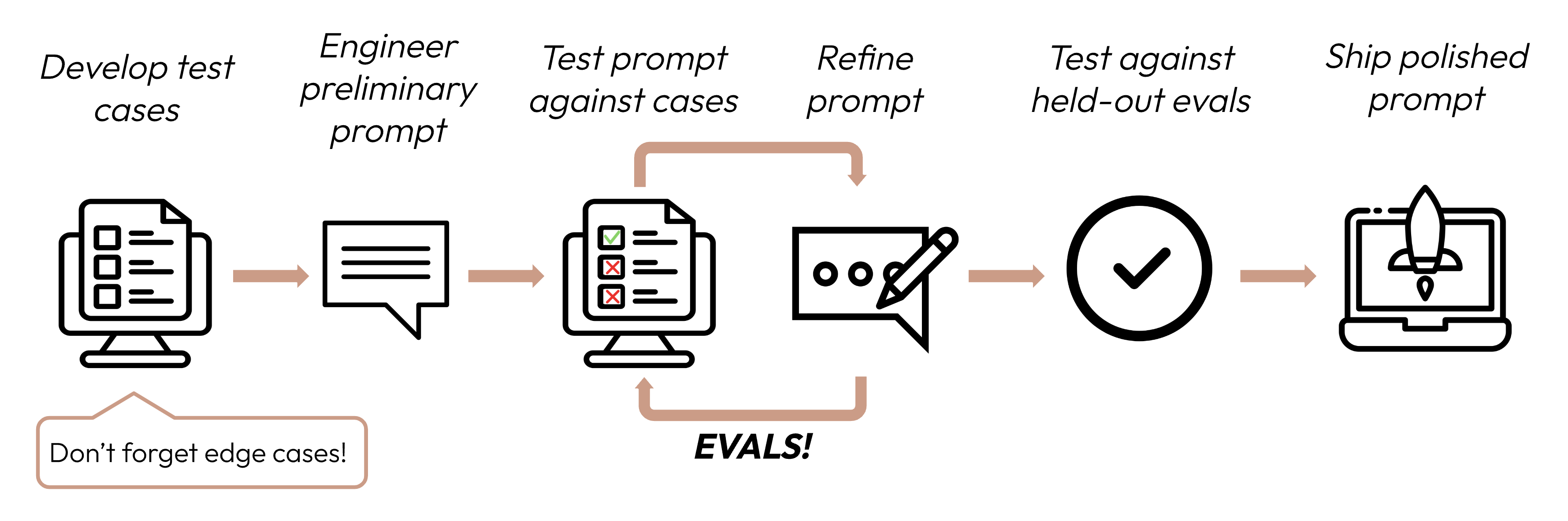
For each source case, record:
type SensitivityCaseMetadata = {
  id: string;
  contractVersion: string;
  sourceDatasetVersion: string;
  humanReviewedAt: string;
  goldUrgent: boolean;
  notes: string;
};
Then give each variant an explicit expectation. For example:
type InvariantExpectation = {
  kind: "invariant";
  maximumNoulDrift: number;
  maximumConfidenceDrift: number;
  requireSameRoute: boolean;
};

type DirectionalExpectation = {
  kind: "not-less-urgent" | "not-more-urgent";
  permittedProbabilityMovement: number;
};

type RouteExpectation = {
  kind: "allowed-routes";
  allowedRoutes: Array<"action" | "review" | "pass">;
};

type SensitivityExpectation =
  | InvariantExpectation
  | DirectionalExpectation
  | RouteExpectation;
A source case far from decision thresholds is the best candidate for a strict invariance test. Define a boundary margin for those cases:
where is the review threshold and is the automatic-action threshold from the previous lesson.
If is small, a minor probability shift can change the route. That may still be useful information, but it should not be mixed with failures from clearly urgent or clearly non-urgent cases. Report it as boundary sensitivity.
A practical initial policy is:
- Robustness suite: only cases with sufficient boundary margin; route stability is required.
- Boundary-observation suite: cases close to review or action thresholds; route movement is measured and manually inspected.
- Evidence-ablation suite: known cases where required evidence is absent; allowed routes are specified by product and safety policy.
5. Implement a paired Jev sensitivity runner in TypeScript
Keep this runner independent from your UI and application routing code. It should call a narrow adapter that performs the live Jev request using the Noul contract already established in your project, then store the typed response and test metadata.
The following code intentionally leaves assessUrgency as an injected adapter. Its job is to make the Jev request and return typed values; the sensitivity logic remains deterministic and fully testable.
type Route = "action" | "review" | "pass";

type State = Record<string, unknown>;

type NoulAssessment = {
  noul: number;
  confidence: number;
};

type UrgencyPolicy = {
  reviewThreshold: number;
  actionThreshold: number;
};

type InvariantVariant = {
  id: string;
  label: string;
  question: string;
  state: State;
  maximumNoulDrift: number;
  maximumConfidenceDrift: number;
};

type InvariantSensitivityCase = {
  id: string;
  question: string;
  state: State;
  minimumBoundaryMargin: number;
  variants: InvariantVariant[];
};

type VariantResult = {
  caseId: string;
  variantId: string;
  passed: boolean;
  reasons: string[];
  source: NoulAssessment;
  variant: NoulAssessment;
  sourceRoute: Route;
  variantRoute: Route;
};

type AssessUrgency = (
  question: string,
  state: State,
) => Promise<NoulAssessment>;

function assertUnitInterval(value: number, label: string): void {
  if (!Number.isFinite(value) || value < 0 || value > 1) {
    throw new Error(`${label} must be a finite number from 0 through 1.`);
  }
}

function routeUrgency(
  probability: number,
  policy: UrgencyPolicy,
): Route {
  if (probability >= policy.actionThreshold) {
    return "action";
  }

  if (probability >= policy.reviewThreshold) {
    return "review";
  }

  return "pass";
}

function boundaryMargin(
  probability: number,
  policy: UrgencyPolicy,
): number {
  return Math.min(
    Math.abs(probability - policy.reviewThreshold),
    Math.abs(probability - policy.actionThreshold),
  );
}

function validateAssessment(
  assessment: NoulAssessment,
  label: string,
): void {
  assertUnitInterval(assessment.noul, `${label}.noul`);
  assertUnitInterval(assessment.confidence, `${label}.confidence`);
}

export async function runInvariantSensitivityCase(
  testCase: InvariantSensitivityCase,
  policy: UrgencyPolicy,
  assessUrgency: AssessUrgency,
): Promise<VariantResult[]> {
  const source = await assessUrgency(testCase.question, testCase.state);
  validateAssessment(source, `${testCase.id}.source`);

  const sourceRoute = routeUrgency(source.noul, policy);
  const sourceMargin = boundaryMargin(source.noul, policy);

  const results: VariantResult[] = [];

  for (const variant of testCase.variants) {
    const assessment = await assessUrgency(
      variant.question,
      variant.state,
    );
    validateAssessment(assessment, `${testCase.id}.${variant.id}`);

    const variantRoute = routeUrgency(assessment.noul, policy);
    const reasons: string[] = [];

    if (sourceMargin < testCase.minimumBoundaryMargin) {
      reasons.push(
        `Source is too close to a decision boundary: margin ${sourceMargin.toFixed(3)}.`,
      );
    }

    const noulDrift = Math.abs(assessment.noul - source.noul);
    if (noulDrift > variant.maximumNoulDrift) {
      reasons.push(
        `Noul drift ${noulDrift.toFixed(3)} exceeds ${variant.maximumNoulDrift}.`,
      );
    }

    const confidenceDrift = Math.abs(
      assessment.confidence - source.confidence,
    );
    if (confidenceDrift > variant.maximumConfidenceDrift) {
      reasons.push(
        `Confidence drift ${confidenceDrift.toFixed(3)} exceeds ${variant.maximumConfidenceDrift}.`,
      );
    }

    if (variantRoute !== sourceRoute) {
      reasons.push(
        `Route changed from ${sourceRoute} to ${variantRoute}.`,
      );
    }

    results.push({
      caseId: testCase.id,
      variantId: variant.id,
      passed: reasons.length === 0,
      reasons,
      source,
      variant: assessment,
      sourceRoute,
      variantRoute,
    });
  }

  return results;
}
Here is one carefully scoped test case. The base state contains material urgency evidence. The variants preserve that evidence while changing only the question wording or an intentionally irrelevant field.
const urgentCheckoutCase: InvariantSensitivityCase = {
  id: "checkout-outage-001",
  question:
    "Based only on the supplied state, what is the probability that this ticket requires urgent human intervention within one hour?",
  state: {
    message:
      "Checkout has failed for 25 minutes and multiple customers cannot pay.",
    checkoutStatus: "failing",
    affectedUsers: "multiple customers",
    knownIncidentCount: 1,
  },
  minimumBoundaryMargin: 0.1,
  variants: [
    {
      id: "question-paraphrase",
      label: "Equivalent question wording",
      question:
        "Using only the provided state, estimate the probability that this ticket needs urgent human intervention within the next hour.",
      state: {
        message:
          "Checkout has failed for 25 minutes and multiple customers cannot pay.",
        checkoutStatus: "failing",
        affectedUsers: "multiple customers",
        knownIncidentCount: 1,
      },
      maximumNoulDrift: 0.1,
      maximumConfidenceDrift: 0.15,
    },
    {
      id: "irrelevant-ui-metadata",
      label: "Irrelevant metadata added",
      question:
        "Based only on the supplied state, what is the probability that this ticket requires urgent human intervention within one hour?",
      state: {
        message:
          "Checkout has failed for 25 minutes and multiple customers cannot pay.",
        checkoutStatus: "failing",
        affectedUsers: "multiple customers",
        knownIncidentCount: 1,
        diagnosticUiTheme: "dark",
      },
      maximumNoulDrift: 0.1,
      maximumConfidenceDrift: 0.15,
    },
  ],
};
The adapter can be connected to the actual Jev call you built earlier:
const policy: UrgencyPolicy = {
  reviewThreshold: 0.55,
  actionThreshold: 0.9,
};

const results = await runInvariantSensitivityCase(
  urgentCheckoutCase,
  policy,
  assessUrgency,
);

console.table(
  results.map(function (result) {
    return {
      caseId: result.caseId,
      variantId: result.variantId,
      passed: result.passed,
      sourceProbability: result.source.noul.toFixed(3),
      variantProbability: result.variant.noul.toFixed(3),
      sourceConfidence: result.source.confidence.toFixed(3),
      variantConfidence: result.variant.confidence.toFixed(3),
      sourceRoute: result.sourceRoute,
      variantRoute: result.variantRoute,
      reasons: result.reasons.join(" "),
    };
  }),
);
The runner should write a record for every request, including:
- case ID and variant ID;
- question-contract version;
- state-schema version;
- recorded typed Jev response;
- thresholds used to derive the route;
- test expectation and pass/fail reasons;
- timestamp, latency, and request outcome.
This makes a sensitivity failure reproducible rather than a screenshot of one surprising run.
6. Handle evidence changes differently from invariance tests
A common failure in AI evaluation is to expect every transformed input to produce exactly the same answer. That is wrong when the transformation changes real evidence.
Suppose the original state says:
{
  checkoutStatus: "failing",
  affectedUsers: "multiple customers",
  durationMinutes: 25
}
Now add verified information:
{
  checkoutStatus: "failing",
  affectedUsers: "all EU customers",
  durationMinutes: 25,
  revenueImpact: "orders cannot be completed"
}
This is not an invariant case. The correct relation is directional: urgency should not fall substantially.
Conversely, this updated state changes the substantive facts:
{
  checkoutStatus: "restored",
  affectedUsers: "no currently affected customers",
  durationMinutes: 25,
  mitigation: "rollback completed"
}
Here, the urgency assessment should not rise substantially.
For sparse evidence, do not create a generic rule such as “missing data must lower probability.” Absence of evidence is not evidence of absence. Instead, specify an application policy. For example:
| State condition | Expected application behavior |
|---|---|
| Scope is unknown but an outage is active | Human review may be acceptable |
| Strong evidence of active, widespread outage | Automatic urgent action may be acceptable |
| No impact, no active issue, and no corroborating evidence | Pass may be acceptable |
| Contradictory facts from trusted sources | Review or deterministic incident-system lookup |
That policy is part of the deterministic application layer. Jev provides a bounded judgment; your code decides whether available evidence is sufficient for automatic action.
7. Diagnose failures without hiding them in threshold changes
When a sensitivity test fails, do not first adjust the action threshold. A threshold change can conceal the route flip while leaving the underlying probability instability untouched.
Inspect failures in this order:
-
Verify the transformation.
Did the purported paraphrase actually preserve the one-hour urgency proposition? Did the supposedly irrelevant field imply a real business fact? -
Compare the source and variant payloads.
Use a structured diff. Check accidental omission, changed negation, altered units, or JSON serialization differences. -
Classify the failure.
Typical categories are:- ambiguous question contract;
- irrelevant state distractor;
- missing evidence semantics;
- conflicting evidence;
- threshold-boundary sensitivity;
- intermittent request or service failure.
-
Fix one layer deliberately.
You might refine the question wording, reduce the state to decision-relevant evidence, add an explicitunknownfield, or route a class of sparse-evidence cases to review. -
Re-run the complete evaluation suite.
Changing the question contract or state schema changes the decision system. Re-check accuracy, calibration, threshold cost, and review capacity rather than validating only the repaired case. -
Promote the failure to a regression test.
The next lesson focuses on exactly this step: recording typed responses and preserving decision-logic behavior without repeatedly calling the live service.
If a failure appears only intermittently, rerun the same, already-recorded source and variant pair several times. Preserve the exact inputs. This distinguishes a consistently brittle relation from variability that needs a broader statistical treatment. Do not regenerate the paraphrase on every retry, or you will be testing a different input each time.
8. Report brittleness as an engineering metric
For each test family, report more than a simple pass percentage.
| Metric | What it reveals |
|---|---|
| Invariant violation rate | Fraction of valid equivalent variants that break the expected relation |
| Route-flip rate | Operational instability in action, review, and pass behavior |
| Median and maximum probability drift | Typical versus worst sensitivity of the Noul result |
| Confidence drift | Whether equivalent changes alter Jev certainty |
| Boundary-case flip rate | How unstable behavior is near deployed thresholds |
| Failure rate by transformation type | Whether paraphrasing, irrelevant metadata, or evidence removal is the main problem |
| Service-error rate | Separates model-decision brittleness from timeouts or unavailable service |
A report might conclude:
Equivalent question paraphrases were stable for clearly urgent and clearly non-urgent cases. Adding irrelevant metadata caused three route changes, all near the review threshold. Evidence-ablation tests correctly moved two cases to review, but one sparse-evidence case still triggered automatic action. The next revision will make impact scope explicit and add a deterministic policy rule preventing automatic action when scope is unknown.
That is actionable. “Accuracy improved by two points” is not enough to explain whether the workflow is dependable under real input variation.
Key takeaways
- Sensitivity testing evaluates whether equivalent inputs receive consistent Jev judgments and deterministic application routes.
- Separate question-wording transformations from state-evidence transformations so failures are diagnosable.
- Only call a transformation invariant when it truly preserves the business proposition.
- Test irrelevant additions and removals for stability; test meaningful evidence changes with directional or scenario-specific expectations.
- Track probability drift, confidence drift, and route flips separately. A small score change can still be operationally serious at a threshold.
- Do not solve brittleness by immediately moving thresholds. First investigate the question contract, state payload, and fallback policy.
- Record live typed responses and test metadata so surprising behavior can become a reproducible regression case.
Next, you will convert important sensitivity cases and known failures into deterministic regression tests using recorded Jev responses.
Can't find a good explanation? Sign up and we'll make it for you
Sign up