
Good to see you again. In the previous lesson, we treated narratives as coordination devices: they give investors, candidates, customers, and follow-on funds a shared account of an uncertain future. The important next step is to see that this shared account does not merely describe a venture’s prospects. In private markets, it can alter the financing available to the company, the actions the company can take, and eventually the operating facts on which the original story was meant to rest.
This is Soros’s idea of reflexivity. It is especially useful in venture capital because a young company’s valuation, financing access, hiring capacity, customer credibility, and survival are tightly connected. By the end of this lesson, you should be able to trace a concrete loop from investor beliefs through financing conditions and company behavior to venture fundamentals, and back to investor beliefs.
From narrative to reflexivity
A conventional valuation picture has a one-way causal structure: fundamentals determine value. Revenue growth, margins, competitive position, and cash flows are assumed to exist independently; investors observe them imperfectly and assign a price.
Soros challenges the one-way assumption. In markets with thinking participants, investors’ views are fallible, but their views also shape their actions. Those actions can alter the very conditions that investors are trying to assess.
This requires two ideas:
- Fallibility: participants’ broad interpretations of the world are necessarily incomplete, biased, or both.
- Reflexivity: because participants act on those interpretations, their beliefs can influence the situation to which those beliefs refer.
A high valuation is therefore not simply an estimate of a company’s future. It can be an input into that future.
Fallibility, Reflexivity, and the Human Uncertainty Principle
Read George Soros’s essay on the conceptual foundations of reflexivity. It supplies the vocabulary needed to distinguish an ordinary forecast error from a feedback process in which beliefs help shape outcomes.
In the section “Fallibility and reflexivity,” read the two propositions. Then read the section “Reflexivity,” especially cognitive and manipulative functions. Treat “manipulative” here as intentional action to change one’s circumstances, not as deception. Finish with the section “Negative versus positive feedback loops.” Read feedback dynamics, focusing on Soros’s distinction between self-correcting and self-reinforcing processes.
Soros calls the route from observed reality to participants’ beliefs the cognitive function. The route from beliefs and intentions to actions that affect reality is the manipulative function.
In a VC setting, the distinction can be made concrete:
| Soros’s concept | Venture-capital interpretation |
|---|---|
| Subjective reality | Investors’ and founders’ beliefs about category importance, company quality, future financing, and likely winner status |
| Objective reality | Observable operating and market conditions: cash runway, hiring outcomes, product progress, customer adoption, competition, unit economics, and survival |
| Cognitive function | Investors update views from traction, technical progress, customer logos, financing rounds, marks, media, and peer behavior |
| Manipulative function | Investors fund, price, introduce, recruit, signal, and govern; founders hire, spend, price, build, and pursue customers in response |
| Prevailing bias | The category-level consensus: for example, “AI-native laboratories will become software-like platforms” or “this category cannot support venture-scale businesses” |
| Underlying trend | The genuine technological, regulatory, or demand change that exists even without investor enthusiasm |
The central analytical move is to stop treating the valuation as the final output of diligence. In a reflexive system, the valuation and the terms on which capital is available may become causal inputs into future company performance.
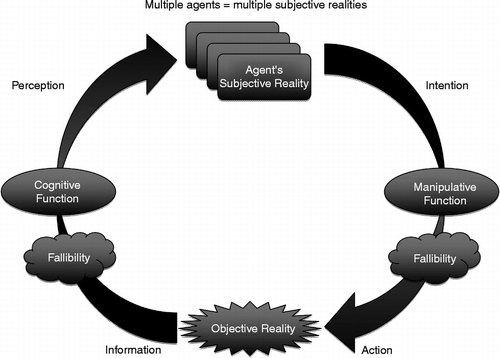
The diagram is deliberately general. For VC, we need to replace “objective reality” with the operating facts that capital can materially change.
The venture translation: valuation is not merely a score
A private-market financing differs from a continuously quoted public share price. It is a discrete agreement between specific parties, with governance rights, liquidation preferences, information rights, and an implicit post-money valuation. Yet it still affects a company’s opportunity set.
At pre-seed through Series A, a strong financing event can change at least five things:
-
Runway and experimentation. More capital gives the company time to iterate, build technical infrastructure, survive long sales cycles, and discover a viable product-market fit.
-
Talent access. A credible round, especially one led by an investor perceived as selective or useful, can increase the quality and quantity of candidates willing to accept startup risk.
-
Customer confidence. Enterprise buyers, partners, and regulators often care about vendor continuity. A well-capitalised startup can appear less likely to disappear during implementation or support.
-
Strategic freedom. Financing can permit more aggressive pricing, customer subsidies, product breadth, or a longer time horizon than a cash-constrained competitor can sustain.
-
Future-financing credibility. A priced round can establish a reference point for the next round. It need not guarantee one, but it can make a later financing easier to narrate, benchmark, and syndicate.
Each channel is potentially real. Therefore, the contrarian mistake is not to dismiss high valuations as “just sentiment.” The mistake is to assume that all of the operational improvement created by financing is permanent, proportional to the amount raised, and already worth the price being paid.
A useful causal map is:
The loop is positive only if each link actually works. A prestigious round that changes neither talent access nor customer behavior nor execution capacity is mostly a mark. A round that allows a company to solve a genuine bottleneck can change the fundamentals meaningfully.
This distinction gives a practical definition:
A venture is in a reflexive loop when investor beliefs improve financing conditions, the financing conditions change company behavior, and that behavior changes observable fundamentals in a way that reinforces or weakens the original beliefs.
Notice what this definition excludes. It is not enough that investors buy because other investors bought. That is social learning or herd behavior. It becomes reflexive when the buying itself changes the company’s capacity to perform.
A worked loop: an emerging “AI-native laboratory” category
Consider a hypothetical early-stage company building an AI-enabled laboratory platform. Its original pitch may be that advances in models, automation, and biological data make experimentation faster and cheaper. Assume that there is a genuine underlying trend: some laboratory workflows can indeed be accelerated, and buyers have real pressure to improve R&D productivity.
Now add a prevailing market belief:
Companies that combine AI and laboratory automation will become large, software-like platforms with proprietary data advantages and exceptional long-term margins.
This belief contains several separable claims. Some may be correct; others may not. Reflexivity begins when the belief changes access to resources.
The reinforcing path
A lead investor funds the company at a strong price, and the financing is visible within the relevant founder, talent, and buyer networks.
Financing conditions change. The company has more runway than its less well-funded peers. It can hire experienced computational scientists and commercial staff, invest in integrations, run pilots that would otherwise be too expensive, and tolerate a longer procurement cycle.
Company behavior changes. Management may pursue a broader data-collection strategy, subsidise early customers, build a more credible enterprise product, or undertake validation studies that reduce buyer uncertainty. A well-financed company can also survive long enough to learn which laboratory workflow is commercially repeatable.
Fundamentals may improve. The company may win reference customers, build a more useful dataset, reduce implementation time, improve product reliability, or establish a position in customer workflows that makes replacement harder.
The cognitive function resumes. Those developments are observed by other investors, candidates, customers, and potential partners. The initial belief gains apparent confirmation. Follow-on capital becomes more available, and a stronger round may further improve the company’s operating position.
The important nuance is that the original belief did not have to be wholly true for the loop to work. It only had to be sufficiently plausible to attract resources, and those resources had to improve enough of the company’s real prospects to reinforce the belief.
That is why some apparently overvalued companies can grow into valuations that initially looked difficult to justify. The early valuation may have been an overly optimistic forecast and an instrument that gave the company a better chance of making that forecast less wrong.
Firm-level reflexivity can coexist with category-level deterioration
This is where a VC application becomes more subtle than a simple “hot capital helps startups” story.
At the firm level, abundant funding can strengthen a specific company. It may hire better people, secure customers, and build product faster than competitors.
At the category level, the same abundance of capital can produce the opposite effect:
- more companies pursue similar customer budgets;
- founders and technical talent become expensive;
- startups subsidise customers and train them to expect uneconomic pricing;
- large incumbents take the category more seriously;
- suppliers, partners, and potential acquirers face a crowded field;
- apparent early traction becomes less diagnostic because it was purchased or shared among many well-funded firms.
The category’s reported activity can look impressive precisely while future category economics deteriorate.
This is close to Soros’s historical account of a venture-capital boom: attractive capital availability encouraged new company formation and industry demand, but the proliferation of companies intensified competition and weakened margins. The financing environment changed the “fundamentals” in both directions.
[PDF] Reflexivity in the Stock Market
Read Soros’s historical discussion of a venture-capital boom. Although the example is from an earlier technology cycle, it is unusually direct on the mechanism by which abundant venture finance can improve activity while also creating category-level competitive excess.
In the section beginning with the discussion of the 1975–1976 negative bias and the 1983 venture-capital boom, read the venture boom passage. Focus on the two simultaneous effects: financing enabled real activity, while the multiplication of companies intensified competition and changed the economics investors had expected.
This leads to a better question than “is the category real?” A category can be technologically real and commercially important while still being a poor place to deploy incremental venture capital at prevailing prices.
The question is:
Does additional capital create durable differentiation for this company, or does it mainly fund a category-wide race that erodes the economics everyone expects?
For a laboratory-automation company, the answer might depend on whether the extra capital produces a proprietary workflow, a hard-to-replicate dataset, regulatory validation, or trusted customer integration. If it merely funds more similar sales teams and more discounted pilots, the loop may strengthen activity while weakening future margins.
Positive feedback is not “good,” and negative feedback is not “bad”
In ordinary language, positive sounds desirable and negative sounds undesirable. In reflexivity, they mean something different.
- Positive feedback is self-reinforcing: an initial change produces effects that amplify the original change.
- Negative feedback is self-correcting: an initial change produces effects that restrain it or bring expectations and reality closer together.
A strong Series A at a high price can initiate positive feedback. The company appears more credible, gains access to talent and customers, shows improved progress, and attracts further capital. But the same loop can eventually become fragile because expectations rise faster than the company’s capacity to fulfil them.
A negative feedback process might begin when enterprise customers show that pilots do not convert, implementation remains labour-intensive, or follow-on investors demand evidence that a prior narrative treated as implicit. The valuation no longer buys as much credibility. Funding terms tighten. Hiring slows, product plans narrow, and customers become more cautious. These operational effects can validate the new scepticism even if the original technology remains useful.
George Soros - Reflexivity Explained
Watch Patrick Boyle’s “George Soros - Reflexivity Explained” for a concise visual explanation of positive and negative feedback, followed by a concrete example of how inexpensive capital can alter competitive outcomes. The public-market example is not a template for VC, but the financing-to-behavior mechanism transfers directly.
Watch the core model for the definition of reflexivity and the distinction between self-correcting and self-reinforcing loops. Then watch the Amazon example and the explanation of a boom–bust sequence. Focus on why access to capital changed what the company could do relative to competitors, rather than treating the example as evidence that every high valuation is justified.
Soros’s claim is not that every positive loop must end in collapse. A loop can be interrupted by corrective evidence, moderated by financing discipline, or converted into durable advantage by unusually strong execution. Amazon is interesting precisely because a reflexive financing advantage contributed to a stronger competitive position, rather than merely postponing failure.
Nor is reversal necessarily evidence that the initial trend was imaginary. A category can be underfunded after a reversal even though the underlying technology or customer problem remains important. This is often where contrarian opportunity begins—but only after separating a damaged financing narrative from the real operating constraints that remain.
How a venture reflexive loop breaks
A reflexive boom usually breaks at its weakest causal link. In early-stage VC, the trigger is often not a public-market price fall but a financing or recognition shock:
- a highly visible company fails to raise its next round;
- a mark-down resets comparable valuations;
- a strategic customer cancels or fails to renew;
- a technical bottleneck proves more persistent than expected;
- implementation costs reveal a services-heavy rather than software-like business;
- a change in liquidity conditions raises the threshold for follow-on financing.
The reversal can then become self-reinforcing.
| Element | During reinforcement | During reversal |
|---|---|---|
| Investor belief | “This is a category-defining opportunity.” | “The category was overfunded or structurally flawed.” |
| Financing conditions | Large rounds, generous runway, high prices, lower proof thresholds | Smaller rounds, insider dependence, down rounds, higher proof thresholds |
| Company behavior | Hiring, expansion, subsidised acquisition, broader experimentation | Hiring restraint, shorter horizons, reduced pilots, defensive pricing |
| Fundamentals | More visible activity, hiring, customer attention, apparent momentum | Slower product progress, churn risk, weaker customer confidence, survival pressure |
| New signals | Competitive rounds and growth stories | Failed processes, layoffs, weaker comparables, delayed milestones |
The key asymmetry is that financing constraints can harm a young company faster than financing abundance helps it. A company that raised at a high price may be forced to defend that price, delay a round, or pursue a difficult insider-led bridge. Employees and customers may infer weakness from the same visible events that had earlier been interpreted as validation.
Still, do not mechanically infer that every reduced valuation causes reduced fundamentals. Strong companies may become more disciplined, face less funded competition, and benefit from the exit of weaker peers. Reflexivity is an analytical framework, not a universal causal verdict.
A practical reflexivity memo for a VC thesis
For a pre-seed or Series A investment, write a compact loop description alongside the usual product and market analysis. The goal is not to predict a precise valuation path. It is to identify whether capital-market belief is likely to change the company’s operating reality, and whether that effect is durable.
Use six statements.
-
Underlying trend
State the real change that would matter even if the venture market ignored it. For example: a technical capability crosses a threshold, a regulation changes buyer incentives, or a cost curve alters an established workflow. -
Prevailing belief
State what the market currently believes about the company or category. Make it specific enough to be wrong: “This category will produce software-like margins because the data asset compounds,” not “AI is important.” -
Financing transmission mechanism
Identify precisely how capital or a visible investor changes the company’s option set: superior talent, longer technical iteration, customer continuity, inventory, regulatory work, distribution, or M&A capacity. -
Behavioral response
Specify what management will actually do differently with this advantage. “Hire excellent people” is insufficient. Which people, for what bottleneck, and why would that change the path to commercial proof? -
Fundamental consequence
Name the operating variable expected to improve: conversion rate, deployment time, repeatable gross margin, proprietary data quality, retention, regulatory clearance, or time to credible next financing. -
Break condition
Identify the evidence that would show the loop is not working. The break condition might be that additional capital fails to reduce implementation time, that customers do not convert after validation, or that the category’s economics worsen as funding increases.
A thesis becomes much stronger when it can make this claim:
The consensus is directionally right about a real trend, but wrong about which company will benefit from financing, how much financing is required, or which operational mechanism turns capital into durable advantage.
That formulation avoids two symmetrical errors. It avoids dismissing a hot company merely because capital is influencing its performance. And it avoids paying any price simply because the capital may make the narrative partly self-fulfilling.
Key takeaways
Reflexivity begins with fallibility: investors do not perfectly understand a venture’s future. It becomes economically important because investors act on their views, and those actions can alter the company’s financing conditions, behavior, and operating fundamentals.
For VC, the core loop is:
- beliefs about a company or category affect financing access and terms;
- financing changes what the company can do;
- those actions may improve or weaken observable fundamentals;
- new fundamentals alter the beliefs and financing decisions of the next set of participants.
The same capital inflow can strengthen an individual company while damaging category economics by attracting too many competitors, inflating talent costs, and subsidising uneconomic customer behavior. A contrarian investor therefore needs to identify both the genuine underlying trend and the specific causal pathway by which financing will—or will not—create durable advantage.
Next, we will examine Minsky’s financial-instability hypothesis and ask which elements of boom dynamics transfer cleanly to an equity-funded venture market, and which depend more specifically on debt, leverage, and forced liquidation.