
Welcome to Ancient Chinese Philosophy. This opening module develops the historical and textual habits needed to read these works carefully. Before asking what Confucius, Mozi, or Zhuangzi mean, we need to know when the figures, texts, political institutions, and later editorial communities entered the picture.
This lesson builds a working timeline from the late Zhou world through the Han dynasty. The goal is not to memorize a parade of “schools.” It is to place major texts and thinkers in a changing political landscape while keeping three dates distinct: the life of an attributed thinker, the likely formation of a text, and the date of its surviving received edition.
The large historical frame
A useful conventional chronology is:
| Period | Dates | Why it matters philosophically |
|---|---|---|
| Western Zhou | c. 1046–771 BCE | A royal house rules through kinship, ritual, and regional lords; classical ritual and divinatory traditions take shape. |
| Eastern Zhou: Spring and Autumn | 771–476 BCE | Zhou royal authority declines; regional rulers and mobile advisers become increasingly important. Confucius belongs here. |
| Eastern Zhou: Warring States | 475–221 BCE | Powerful states compete in sustained warfare and administrative reform. Most major pre-Qin philosophical texts take shape in this era. |
| Qin dynasty | 221–206 BCE | Qin conquers the rival states and creates the first unified empire. |
| Han dynasty | 206 BCE–220 CE | Classical texts are edited, classified, commented upon, taught, and adapted to imperial institutions. |
The dates are conventions, not perfectly sharp boundaries. For instance, the Zhou house continued in name until 256 BCE, while the Warring States political order ended decisively only with Qin’s conquest in 221 BCE. Still, these divisions give us an indispensable orientation: Confucius belongs to a world of declining Zhou aristocratic order; Mengzi, Zhuangzi, Xunzi, and Han Fei belong to the competitive Warring States; Han thinkers inherit a unified imperial state.
Ancient China Lecture by Dr. Andrew Field
Watch “Ancient China Lecture” by Dr. Andrew Field for a visual historical scaffold. It is especially useful for seeing how a long Zhou era gives way to the short Qin empire and for locating the major Warring States traditions within that transformation.
Begin with the dynastic frame, which places Zhou, Qin, and Han in a single broad chronology. Then watch the philosophical landscape, where the lecture surveys the “Hundred Schools,” Mengzi, Xunzi, the Daodejing, Zhuangzi, Shang Yang, and Han Fei. Use it as orientation rather than as a final authority on authorship: several “schools” and single-author attributions are later ways of organizing more complex textual histories.
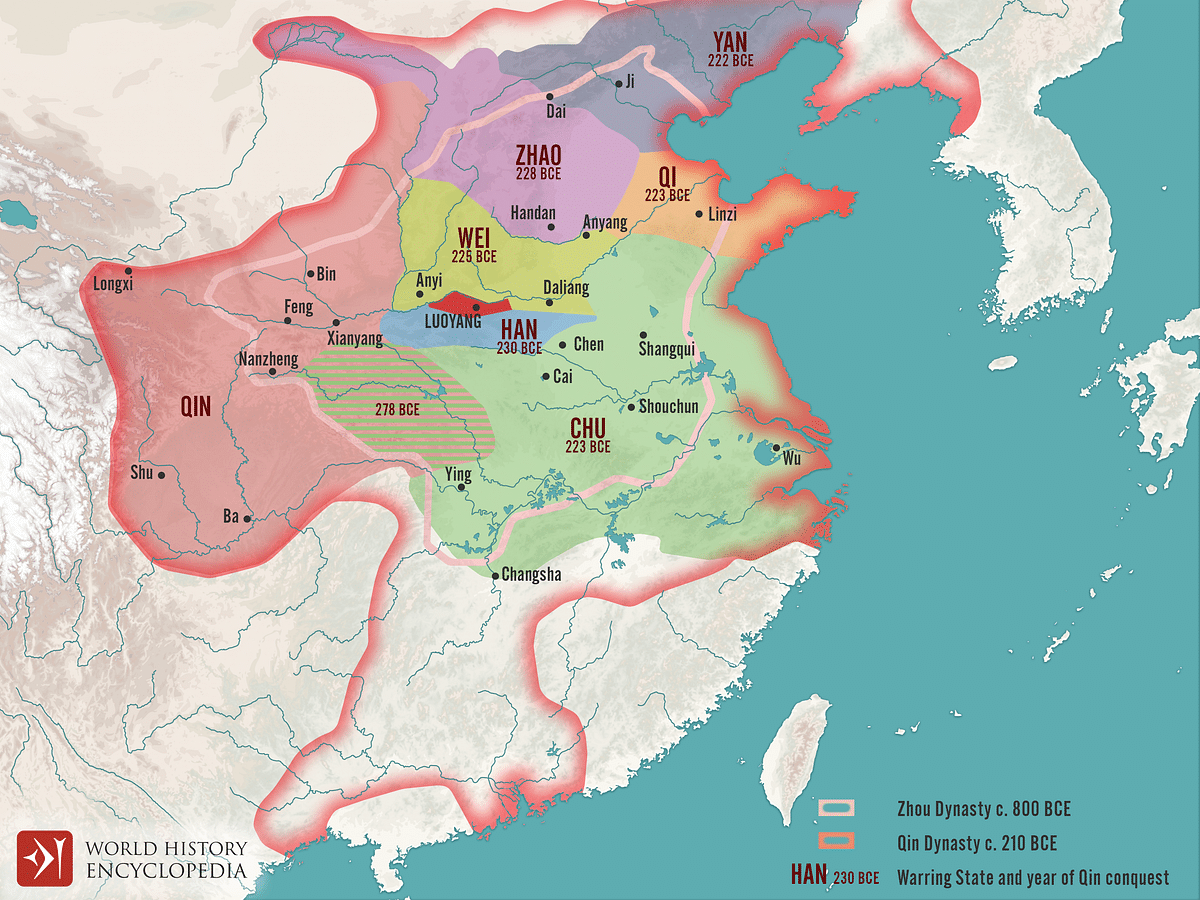
The map below captures the final decades of the Warring States. Do not treat it merely as a background image. Notice that “China” was not yet one political unit: Qin was one state among several, positioned in the west, and it conquered its rivals only at the end of this era.
A timeline of texts, thinkers, and textual formation
The following is a working map, with approximate dates. “Associated with” does not automatically mean “written solely by.” That distinction will become central in later lessons.
| Approximate date | Thinker or text | What to remember about placement |
|---|---|---|
| Western Zhou onward; philosophical commentary later | Zhouyi / Yijing (“Classic of Changes”) | The divination manual has early Zhou roots. The “Ten Wings,” including the “Great Commentary,” are later commentarial materials, substantially shaped in the Warring States and perhaps Han periods. |
| 551–479 BCE | Confucius (Kongzi) | A Spring and Autumn teacher associated with the Ru tradition of ritual learning. |
| Fifth to third centuries BCE | Analects (Lunyu) | A layered collection of sayings and dialogues associated with Confucius and later followers; it is not simply a transcript of one person’s speech. |
| c. 470–391 BCE, traditionally | Mozi (Mo Di) | A figure after Confucius, at the Spring and Autumn–Warring States transition. |
| Fifth to third centuries BCE | Mozi | An anthology preserving several Mohist lineages, including arguments on impartial concern, antiwar thought, standards, and later technical writings. |
| Mid-fourth century BCE onward | Guanzi | A large, composite corpus associated with the state of Qi; it includes political, economic, and cultivation materials from different periods. |
| Fourth to third centuries BCE | Later Mohist Canons; School of Names debates | The period of increasingly explicit work on distinctions, language, inference, and standards. Hui Shi and Gongsun Long are conventionally placed here, though much evidence is fragmentary. |
| c. 372–289 BCE | Mengzi (Mencius) | A Warring States Confucian thinker, roughly contemporary with Zhuangzi. |
| Fourth to third centuries BCE | Mengzi | Dialogues and arguments associated with Mengzi, likely transmitted and shaped by disciples. |
| c. 365–290 BCE, traditionally | Zhuang Zhou (Zhuangzi) | A Warring States thinker associated above all with the Zhuangzi’s “Inner Chapters.” |
| Fourth to third centuries BCE; received edition much later | Zhuangzi | The Inner Chapters are commonly treated as the earliest stratum; the received 33-chapter text incorporates later material and was edited by Guo Xiang in the early fourth century CE. |
| Fourth to third centuries BCE | Daodejing / Laozi | Best understood as a collection of sayings circulating among several lineages, rather than securely as the work of one historical Laozi. Excavated versions show that its early textual history was plural. |
| c. 390–338 BCE | Shang Yang | Qin reformer associated with institutional transformation, rewards, punishments, agriculture, and military organization. |
| Fourth to third centuries BCE | Book of Lord Shang (Shangjun shu) | A composite political text associated with Shang Yang but not safely reducible to his own authorship. |
| c. 400–337 BCE | Shen Buhai | Associated with administrative technique and matching officeholders’ claims with performance; his own writings largely survive only in quotations. |
| c. 325–235 BCE | Xunzi | A late Warring States Confucian thinker; his work responds to Confucian, Mohist, and other rivals. |
| Third century BCE | Xunzi | A collection of substantial essays on ritual, human nature, language, Heaven, learning, and government. |
| c. 280–233 BCE | Han Fei | A late Warring States political thinker, traditionally described as a student of Xunzi. He died before Qin unification. |
| Third century BCE | Han Feizi | Essays combining public standards, administrative technique, and the ruler’s positional power. |
| 239 BCE | Lüshi chunqiu | A deliberately synthetic Warring States encyclopedia compiled under the patronage of Lü Buwei, just before unification. |
| 221–206 BCE | Qin dynasty | The philosophical landscape changes because thinkers now confront a centralized empire, not a system of competing states. |
| Early Han, especially second century BCE | Huang-Lao materials | Texts and practices combining themes of non-coercive rulership, cosmology, and administrative order. Manuscripts from Mawangdui, buried in 168 BCE, are important evidence. |
| 139 BCE | Huainanzi | A Han synthesis produced around Liu An’s court, integrating cosmology, cultivation, and rulership. |
| c. 198–104 BCE | Dong Zhongshu | Han thinker associated with a cosmologically inflected account of Confucian classics and political order. |
| Han era; composite formation | Chunqiu fanlu | Traditionally associated with Dong Zhongshu, but likely containing contributions from more than one author or editorial layer. |
| c. 145–86 BCE | Sima Qian | Historian whose Shiji profoundly shaped later accounts of early thinkers and intellectual lineages. |
| 27–c. 100 CE | Wang Chong | A Han critic who challenged many claims about omens, spirits, and Heaven’s direct intervention. |
| Han dynasty broadly | Canon formation and commentary | Han scholars preserved, edited, categorized, and institutionally elevated many earlier texts, helping create the textual canon studied today. |
The central pattern is therefore not a simple succession of isolated masters. Early Chinese philosophy develops through overlapping debates, competing lineages, anthologies, and later editorial work. Mengzi and Zhuangzi are near contemporaries, for example; Xunzi and Han Fei are late Warring States figures whose concerns are inseparable from the rise of increasingly powerful states; the Han inherits all of them and reorganizes them into a classical past.
The Warring States is the central philosophical laboratory
The label “Hundred Schools of Thought” is memorable, but it can mislead. It suggests neat, bounded institutions that announced themselves as permanent schools. In reality, thinkers traveled among courts, served rulers, debated rivals, taught students, and contributed to traditions that were later gathered under names such as “Confucian,” “Mohist,” “Daoist,” and “Legalist.”
Still, the label points to something real: the Warring States period saw an extraordinary concentration of reflection on questions raised by political fragmentation and change.
Several clusters of texts emerge in this setting:
- Confucian or Ru traditions: Confucius, the Analects, Mengzi, and Xunzi ask how persons become ethically formed and how ritual, exemplary conduct, education, and government might produce order.
- Mohist traditions: the Mozi argues in a strikingly systematic fashion about social benefit, impartial concern, standards, Heaven, warfare, and frugality.
- Texts later called Daoist: the Daodejing and Zhuangzi challenge purposive striving, fixed distinctions, and intrusive forms of rule, but they do so in importantly different literary and philosophical ways.
- Disputation and language: the Later Mohists, Hui Shi, and Gongsun Long probe how names, distinctions, kinds, and arguments work.
- Political-administrative writings: texts associated with Shang Yang, Shen Buhai, Shen Dao, and Han Fei investigate standards, punishment and reward, offices, bureaucratic performance, and political power.
These are not merely abstract doctrines produced in calm libraries. The intensifying warfare, the growth of bureaucracies, the replacement of aristocratic chariot warfare with mass armies, and the need to tax, feed, and mobilize populations made government a pressing philosophical problem. Yet not every thinker reacted by proposing stronger institutions. The Zhuangzi, for example, often redirects attention away from the ruler’s project of ordering the world and toward the limits of the perspectives from which such projects are justified.
Read dates as claims about evidence
A date beside a text can mean at least four different things:
- The life of a named figure: Confucius lived from 551 to 479 BCE.
- The earliest material in a text: some Analects passages may preserve early traditions associated with Confucius.
- The period of compilation or expansion: the Analects, Mozi, Guanzi, Daodejing, and Zhuangzi contain material accumulated over time.
- The date of a received edition or commentary: Guo Xiang’s early fourth-century CE edition is crucial to the Zhuangzi we now read, even though much of its material is far older.
This is why “Laozi wrote the Daodejing around 500 BCE” is not a careful timeline entry. The traditional author name, the date of the historical person, the date of individual sayings, the formation of a collection, and the date of a transmitted version are separate issues. A more defensible entry is: the Daodejing is a late Warring States collection, traditionally attributed to Laozi, with multiple early textual versions.
Chinese Philosophy: Overview of History
Read the Internet Encyclopedia of Philosophy overview to consolidate the timeline while paying close attention to its distinctions between historical teachers, collective texts, and later received editions.
In Section 1, “Classical Chinese Philosophy in the Pre-Qin Period,” begin with subsection b, “Confucius (551-479 B.C.E.) of the Analects.” Read the discussion of the Analects, focusing on why a book associated with Confucius has several chronological strata. Then read subsection c, “Mozi (c. 470-391 B.C.E.) and Mohism,” from the opening account through the explanation of the Mozi as an anthology. In subsections e and f, “The Daodejing” and “The Zhuangzi,” read the Daodejing discussion and then the opening paragraphs of “The Zhuangzi,” especially the distinction between the Inner Chapters and later textual layers. Finally, in Section 2, “Philosophy from the Qin (221 B.C.E.) to the Tang,” read subsections a.i through a.iii: “Master Han Fei,” “The Masters of Huainan,” and “The Luxuriant Dew.” Begin at Han Fei’s placement, continue through the Huainanzi, and end with the authorship caution about Dong Zhongshu. These passages show how late Warring States texts lead into Han synthesis without becoming simple predecessors of one official ideology.
A second caution concerns the term “Legalism.” It is convenient, but it is a later classificatory label, not the name of a unified movement that all of its supposed members adopted. Shang Yang, Shen Buhai, Shen Dao, and Han Fei emphasize different mechanisms of rule. The Han Feizi itself is a late Warring States synthesis rather than a generic summary of a single “Legalist school.”
The same caution applies, though differently, to “Daoism” and “Confucianism.” These words are useful for orientation, provided we do not let them erase disagreement within a lineage or the complex editorial history of its texts.
From unification to Han reinterpretation
Qin unification in 221 BCE is a hinge in the timeline. Before it, a thinker might advise one of several rival rulers and imagine reforming or withdrawing from a particular state. After it, political thought increasingly addresses the problems of an empire: central administration, imperial authority, canonical learning, cosmological legitimacy, and the relation between ruler and bureaucracy.
The Qin dynasty was short, but the Han lasted more than four centuries and did three lasting kinds of philosophical work:
- It preserved and standardized many earlier writings through editing, commentary, and textual transmission.
- It classified earlier thinkers into “schools,” a framework that still shapes modern histories of Chinese philosophy.
- It synthesized ideas that are often treated as rivals: ritual and moral cultivation, administrative standards, cosmology, non-coercive rule, and classical learning could all be combined in different proportions.
The Huainanzi is a particularly important early Han example. Rather than defending one Warring States school against all others, it builds a large account of cosmos, body, cultivation, and rulership. Dong Zhongshu’s work shows another kind of Han transformation: Confucian classical language becomes connected with yin–yang, five-phase correlations, and arguments about the relation between Heaven and political order. Wang Chong, later in the Han, reminds us that this correlative and portent-based world was not universally accepted; he criticizes credulous claims and insists on more skeptical reasoning.
A compact way to retain the whole chronology is to keep six anchor points in view:
- Zhou inheritance: ritual, divination, and classical traditions.
- Confucius: late Spring and Autumn, 551–479 BCE.
- Warring States debate: roughly 475–221 BCE, where most foundational philosophical corpora developed.
- Late Warring States synthesis and administration: Xunzi, Han Fei, the Lüshi chunqiu.
- Qin unification: 221 BCE.
- Han reinterpretation: preservation, classification, cosmological synthesis, and institutionalized classical learning.
For quick self-study, draw a horizontal date line from 800 BCE to 200 CE and place each item as a person, text formation, or later editorial event. Marking those categories differently is more valuable than memorizing every year.
Key takeaways
Early Chinese philosophy is centered in the late Zhou, especially the Warring States era, but its texts often have histories extending into the Han and beyond. Confucius belongs to the Spring and Autumn period; Mozi bridges the transition into the Warring States; Mengzi, Zhuangzi, Xunzi, and Han Fei belong to the Warring States; and the Huainanzi, Dong Zhongshu, and Wang Chong belong to the Han imperial setting.
Most importantly, treat a work’s attributed author, earliest material, compilation, and received edition as distinct chronological claims. This prevents a misleading picture in which each text is simply the dated product of a single philosopher.
Next, we will move from the timeline to its driving conditions: how Zhou political institutions, the breakdown of royal authority, interstate warfare, and administrative transformation shaped the questions these thinkers chose to ask.
Can't find a good explanation? Sign up and we'll make it for you
Sign up