
Hello. Last lesson developed the logical fact that the negation of a universal statement is existential: if a claim says every object has a property, then its failure consists of at least one object that does not. We now turn that fact into a compact proof technique.
A counterexample is not merely an example related to a statement. It is a specific permitted case in which the statement fails. By the end of this lesson, you should be able to identify exactly what a counterexample must satisfy, find useful candidates systematically, and write a short complete disproof.
One failure defeats a universal claim
A universal statement makes an ambitious promise. In its simplest form, it says
It claims that every element of the domain satisfies . Its negation is
Therefore, to disprove the original universal claim, it is enough to exhibit one particular for which is false.
That value is a counterexample.
The asymmetry is fundamental:
- One successful example cannot prove that every case works.
- One failing example does prove that “every case works” is false.
For example, consider the statement:
Every prime number is odd.
The number supports the statement, but proves almost nothing: it checks only one prime. The number , however, settles the question:
and
Thus is a counterexample, so the universal statement is false.
4.1 Direct Proof and Counterexample
Read “Direct Proof and Counterexample” from the Runestone discrete mathematics text to consolidate the formal four-part structure of a counterexample.
In Section 4.1, locate the subsection “Counterexamples,” immediately after the discussion of existence proofs. Read the four-step method. Then read Example 4.1.12 directly below it, noting that the counterexample verifies both the relevant domain condition and the failure of the claimed property.
The image below shows the same logic in an everyday setting. The claim is not “mangoes are apples”; it is the broader claim that being a fruit guarantees being an apple. A mango meets the condition “is a fruit” while failing the conclusion “is an apple.”
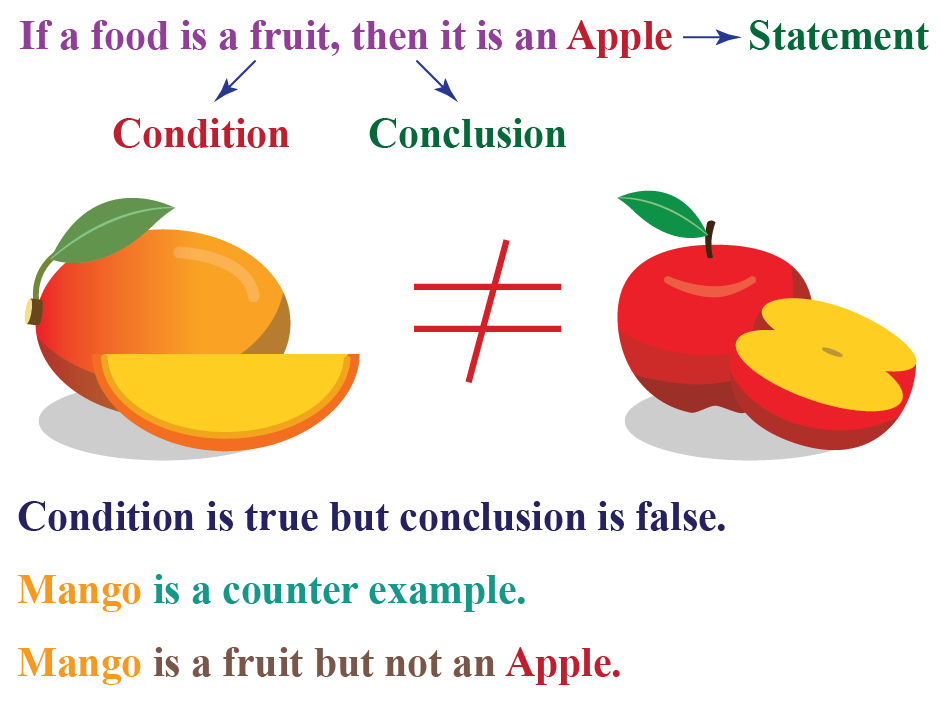
Counterexamples to implications: preserve the hypothesis, break the conclusion
Most mathematical counterexamples arise from statements of the form
Such a statement does not say that every satisfies . It says that whenever is true, must also be true.
As established in the previous lesson, its negation is
So a valid counterexample to an implication must do three things:
- belong to the stated domain;
- make the hypothesis true;
- make the conclusion false.
The second requirement is where most mistakes occur. A case where the hypothesis is false does not contradict an implication. The implication made no promise about such a case.
Consider the claim
A tempting but invalid choice is . Certainly , so the conclusion fails. But
so the hypothesis fails too. This does not refute the statement.
Instead choose . Then
and
so the hypothesis holds. Yet
Therefore is a genuine counterexample. The proposed universal implication is false.
Here is another example, involving two variables:
The “object” being quantified over is really an ordered pair . Choose
Both entries are real, and the hypothesis is true:
But the conclusion fails:
Hence is a counterexample. The missed feature in the false claim is the possible sign difference concealed by squaring.
Disproving implications with Counterexamples
Watch “Disproving implications with Counterexamples” by Dr. Trefor Bazett for a worked search for a two-variable counterexample, followed by the underlying quantified logic.
First watch the numerical search, where the hypothesis involving squares is kept true while the conclusion is made false. Then watch the logical explanation, which connects a counterexample to the negation of a universally quantified implication. In the first segment, treat the squared negative input as (-4)^2, and focus on why signs are the feature worth testing.
The video’s example illustrates a productive habit: do not test values randomly. Read the hypothesis and conclusion for structural clues. Squares erase signs, absolute values erase signs, and strict inequalities often fail at boundary values such as .
Finding a counterexample strategically
A counterexample is often small, but it is rarely found by unstructured guessing. Start from the logical requirements and look for a feature the statement has overlooked.
Useful places to look
| Feature in the claim | Productive test cases |
|---|---|
| A statement is claimed for all integers | , , , small primes, negative values |
| Squares or even powers occur | Opposite signs, such as and |
| A strict inequality occurs | Boundary values, especially or equality cases |
| A conclusion says “positive” | Try , then negative values if permitted |
| A conclusion says “nonzero” or “distinct” | Try or equal inputs |
| A divisibility statement is involved | Small multiples and small nonmultiples |
| A claim concerns all pairs or all functions | Look for a pair whose components behave differently |
These are not rules that guarantee a counterexample. A true statement will survive every test. But they direct attention to cases where an overgeneralized claim is most likely to break.
For instance, suppose someone claims that
The expressions agree when or , so those test cases conceal the issue. Expanding suggests that the omitted term is , which will be visible if both inputs are nonzero. Take and :
whereas
Since , the pair is a counterexample. Notice that saying “the expanded expressions look different” is not itself a disproof. An identity can have forms that look very different. The specific numerical mismatch is what refutes the universal claim.
A counterexample can also reveal a nearby correct theorem. “Every prime is odd” becomes true after adding the missing condition “greater than .” The original statement was not useless; its counterexample identified the exceptional case that a repaired statement must address.
Domain restrictions matter
A candidate must lie within the domain and within any restrictions built into the statement. This is especially important for algebraic identities and rational expressions.
Suppose the claim is
for every real for which both sides are defined. The legitimate domain excludes
and
Neither excluded value can be a counterexample, because the statement does not claim the equation is meaningful there. Instead take , which is allowed:
while
Thus is a valid counterexample.
Read the later examples in “Counterexamples” for two proof-writing safeguards: show a numerical inequality rather than merely saying expressions look different, and never use an excluded input as a counterexample.
In the section beginning with the definition of an algebraic identity, read the identity examples. Follow the example using (a+b)^2 and then the rational-expression example. Pay particular attention to the sentence explaining why undefined values are outside the assertion rather than counterexamples to it.
The same discipline applies to conditional statements. In the claim
the value is not a counterexample. Although is not odd, it fails the hypothesis . In fact, is precisely the exception excluded by the repaired statement.
How to write the disproof cleanly
Once you have found a candidate, the final write-up should be short and complete. Do not narrate unsuccessful trials. State only the candidate and the facts that certify it.
For a simple universal property, use this template:
The statement is false. Let . Then , but is false. Therefore is a counterexample.
For a universal implication, use this template:
The statement is false. Take . Then and is true. However, is false. Hence is a counterexample.
Applied to the squared-equality example:
The statement is false. Take and . Then and . However, . Hence is a counterexample.
That is a complete mathematical disproof. Nothing more is needed, because one verified failure logically contradicts the word “every.”
There is one final boundary to keep clear. A single example does not disprove an existential statement. If a claim says “there exists an with property ,” finding one value for which fails says nothing: another value may work. Counterexamples are the natural method for universal claims because their negations ask for one witness of failure.
Key takeaways
A counterexample is a concrete witness to the negation of a universal statement:
is disproved by finding
such that
For a universal implication,
the counterexample must make the hypothesis true and the conclusion false:
When searching, test structural edge cases: zero, signs, equality cases, small values, boundaries, and exceptions hidden by a broad claim. When writing, verify the domain, the hypothesis when relevant, and the failure of the conclusion.
Next, you will move from refuting false implications to proving true ones, beginning with direct proof from definitions and stated hypotheses.
Can't find a good explanation? Sign up and we'll make it for you
Sign up