
Hello! Welcome to our next lesson.
In our previous session, we explored Acharya Mahapragya's teaching on why meditation is considered spiritually superior to sleep. We learned that meditation cultivates "spiritual vigilance" and provides a more efficient form of mental and physical rest compared to the unconscious state of conventional sleep.
Today, we delve into the practical "how" behind that assertion. Our goal is to describe how meditation maintains awareness while providing physiological rest. We will explore the specific mechanisms—both from a scientific and a practical perspective—that allow a practice like Preksha Dhyaan to achieve this unique state of conscious tranquility.
1. The Physiology of Meditative Rest
A key to understanding how meditation provides rest lies in its effect on the autonomic nervous system (ANS). The ANS operates unconsciously and regulates bodily functions like heart rate, digestion, and breathing. It has two main branches that work in opposition:
- Sympathetic Nervous System: This is your "fight-or-flight" system. It prepares the body for intense physical activity. It increases heart rate, blood pressure, and breathing rate, mobilizing energy for a perceived threat or stressor.
- Parasympathetic Nervous System: This is your "rest-and-digest" system. It calms the body down after the danger has passed. It decreases heart rate and blood pressure, and stimulates digestion and other restorative processes.
While sleep naturally shifts the body into a parasympathetic-dominant state, meditation appears to do so with greater control and intentionality. A scientific study on Kayotsarga—a core practice of Preksha Dhyaan—provides direct evidence for this.
Influence of Kayotsarga (Relaxation with self-awareness) ...
This study, 'Influence of Kayotsarga (Relaxation with self-awareness) practice on Cardio-Pulmonary Functions,' scientifically measures the physiological effects of this specific meditative practice.
Please read the following parts of the paper: The Abstract and the first paragraph of the Introduction to understand the study's purpose and key findings. The paragraph in the Introduction that begins 'Kayotsarga means abandonment of the body...' The Discussion and Interpretation section, focusing on the paragraphs about Blood pressure, Heart rate, and Breathing rate. The Conclusion. As you read, focus on what physiological markers changed and the proposed mechanism for those changes (i.e., which part of the nervous system was involved).
This study confirms that practicing Kayotsarga leads to significant physiological changes indicative of deep rest:
- A decrease in systolic and diastolic blood pressure.
- A decrease in heart rate.
- A decrease in breathing rate.
Crucially, the paper attributes these changes to a stimulation of the parasympathetic nervous system and a suppression of the sympathetic system. As the authors state, "short term practice of Kayotsarga facilitates the reduction in autonomic functions by bringing in Para-sympathetic dominance."
This is the physiological secret: meditation is an active technique for engaging the body's innate relaxation system, consciously guiding yourself into a state of deep physical calm that rivals, and may even exceed, the restfulness of sleep.
2. Maintaining Awareness: The Practice of Perception
While the body enters this state of deep rest, how does the mind avoid simply shutting off and falling asleep? The answer lies in the very definition of Preksha Dhyaan: the meditation of perception. Awareness is not a byproduct; it is the central tool.
Let's look at the core components of Preksha Dhyaan to see how they actively maintain and focus consciousness.
This document on Preksha Dhyana provides a clear description of its foundational techniques, emphasizing the role of perception.
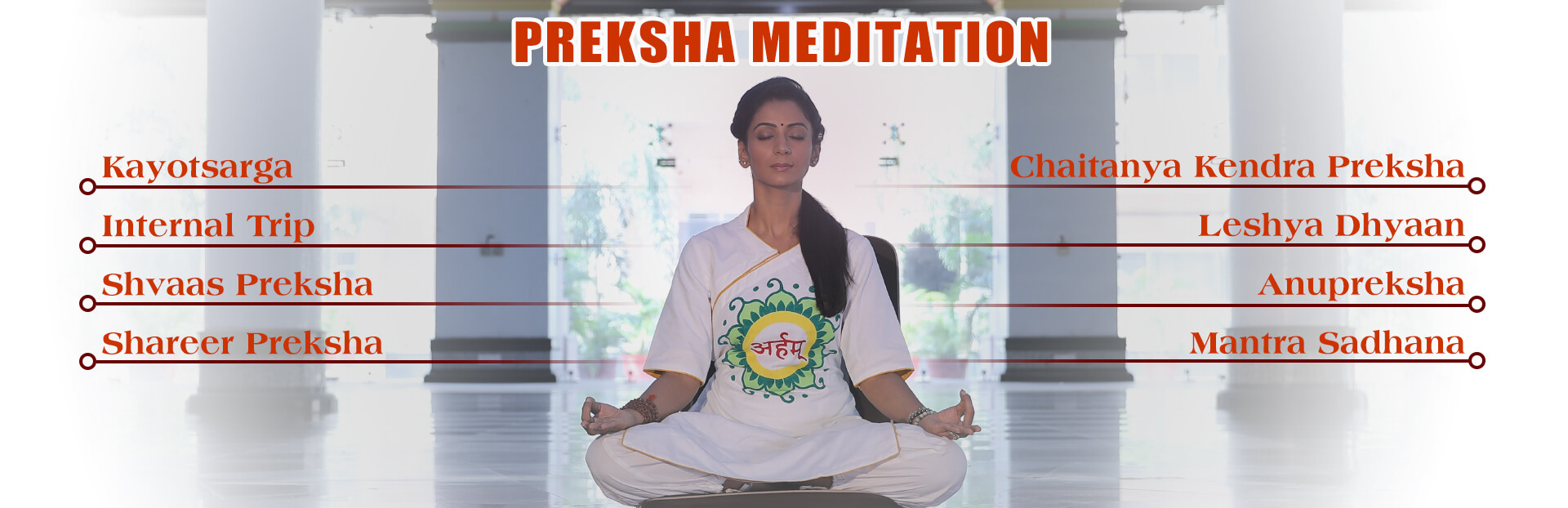
Please read the following three sections: 'Relaxation with Self Awareness': Focus on the definition of Kayotsarga and how it differs from sleep. 'Perception of Breathing': Note how awareness of breath is used to control mental activity. 'Perception of Body': Understand how Sarira Preksa is a process of directing consciousness inward.
This text clarifies that meditative awareness is maintained by giving the mind a specific, subtle object of focus. Instead of letting the mind wander or shut down, you direct it with intention.
-
In Kayotsarga (Relaxation with Self Awareness): You maintain a "high degree of conscious awareness" while systematically relaxing the body. The mind's job is to move through the body, part by part, and perceive the sensation of relaxation. The text makes a remarkable claim: "Physically it is more restful than sleep." This is because awareness is used to consciously suspend muscle tension and nervous activity, which may persist unconsciously during sleep.
-
In Shwas Preksha (Perception of Breath): The mind is anchored to the "reality of the present moment"—the breath. The instructions are clear: "Complete awareness of breathing and nothing else but breathing." This focus prevents the mind from being carried away by thoughts, memories, or future plans, which are the primary sources of mental agitation. By regulating the breath, you simultaneously regulate the mind.
-
In Sharira Preksha (Perception of Body): This is a deliberate, centripetal (from outside to inside) flow of consciousness. You train the mind to perceive subtle internal sensations impartially. This is the opposite of unconsciousness; it is a state of heightened, internally directed sensitivity.
Test your understanding!
Imagine two scenarios:
- After a long day, you lie down and immediately fall asleep.
- After a long day, you lie down and practice Kayotsarga for 20 minutes, consciously relaxing your body from toe to head.
From the perspective of maintaining awareness, what is the fundamental difference between these two ways of "abandoning the body"?
Show answer
In the first scenario (falling asleep), the "abandonment" is passive and unconscious. Your awareness shuts off, and you lose control over your mental state.
In the second scenario (Kayotsarga), the "abandonment" is an active, conscious process. Your awareness is the very tool you use to release physical tension. You are not losing consciousness; you are directing consciousness to perceive and create a state of relaxation. The mind remains the master of the process.
3. The Synergy of Awareness and Rest
We have seen the two sides of the coin: meditation induces physiological rest, and it uses focused perception to maintain awareness. The final insight is that these two are not separate processes happening at the same time. In meditation, focused awareness is the cause of deep rest.
The constant, discursive thinking of a stressed mind is what keeps the sympathetic ("fight-or-flight") nervous system active. By anchoring the mind to a neutral, present-moment object like the breath or bodily sensations, you interrupt this cycle. The mind becomes stable and quiet. This mental stillness sends a powerful signal to the body that it is safe to enter a state of deep restoration.
Therefore, awareness and rest are not in opposition. Rather, meditation demonstrates that a calm, stable, and focused awareness is the most direct path to profound physiological rest. You are not just resting; you are consciously managing your own state of being.
Conclusion
In this lesson, we have unpacked the mechanism behind conscious rest. We have moved from the "why" to the "how."
Key Takeaways:
- Physiological Rest: Meditation, particularly practices like Kayotsarga, actively stimulates the parasympathetic nervous system, leading to measurable signs of deep rest such as decreased heart rate, blood pressure, and breathing rate.
- Maintained Awareness: Consciousness is maintained by anchoring the mind to a specific object of perception, such as the body (Kayotsarga, Sharira Preksha) or the breath (Shwas Preksha). This prevents the mind from wandering or shutting down.
- Awareness as the Cause of Rest: The practice of focused awareness is what quiets the stress-inducing mental chatter, which in turn signals the body to enter a state of deep, restorative calm. Awareness is the tool that facilitates rest.
Preview of the Next Lesson:
We have now established that meditation can provide a state of deep rest while maintaining awareness. This naturally leads to a compelling question: Can this conscious rest substitute for the unconscious rest of sleep? In our next lesson, we will examine this directly by describing scientific studies on the potential for meditation to reduce sleep need, exploring both the exciting possibilities and the crucial biological limitations.