
Hello. In the previous lesson, you separated owner’s capital from a creditor: capital is the owner’s equity interest, while a creditor is an outside party the business owes. Now we turn to four terms that describe everyday business activity: earning money, allowing a customer to pay later, incurring costs, and an owner taking value out of the business.
For a word-bank test, the central task is to recognize both the definition and the effect on the business. By the end, you should be able to distinguish revenue, sale on account, expense, and withdrawals quickly—even when a question uses a short business scenario rather than a direct definition.
The four-term map
A business does not treat every inflow or outflow of cash as revenue or expense. Accounting asks why the money or value changed.
| Term | Test-ready definition | Main effect |
|---|---|---|
| Revenue | Amount earned from selling goods or providing services to customers | Increases owner’s equity |
| Sale on account | A sale in which the customer receives goods or services now and agrees to pay later | Increases revenue and Accounts Receivable |
| Expense | A cost incurred to earn revenue or operate the business | Decreases owner’s equity |
| Withdrawals | Cash or other assets the owner takes from the business for personal use | Decreases owner’s equity, but is not an expense |
A memory line worth learning exactly is:
Revenue is earned. Expense is incurred. A sale on account is paid later. Withdrawals are taken personally by the owner.
The key distinction is that revenue and expense measure business performance, while withdrawals are personal owner transactions. A sale on account is a particular type of revenue transaction: the business has earned the revenue, but has not yet received cash.
Revenue: value earned from customers
Revenue is the value a business earns by performing its main activity: selling merchandise, providing services, renting property, and so on.
For example:
- A landscaping company completes a lawn-care job for .
- A bakery sells cakes for .
- A tutoring business provides lessons worth .
Each business has earned revenue. Revenue increases the owner’s equity because profitable activity adds value to the business.
Read the short, foundational explanations in OpenStax’s How Does a Company Recognize a Sale and an Expense? They establish the important point that revenue is earned from goods or services provided, whether the customer pays now or later.
4.3 How Does a Company Recognize a Sale and an ...
Read this OpenStax explanation to connect the vocabulary to simple sales situations. Its most useful contribution for this lesson is the distinction between earning revenue and receiving cash.
Under “Revenue Recognition,” read from the definition of revenue. Notice that services already performed count as revenue. Then, under “Short-Term Revenue Recognition Examples,” read the credit-sale explanation. Focus on the fact that the sale occurs before the later collection of cash. Finally, under “Expense Recognition,” read the opening definition. Keep the contrast with revenue in mind: revenue adds value, while expenses use resources to help the business earn it.
Revenue is not the same as cash received
A common test trap is assuming that every cash receipt is revenue. It is not.
Suppose a customer owes the business from an earlier sale and pays today. The business receives cash today, but it does not earn new revenue today. It is simply collecting an amount already owed.
Use this distinction:
| Event | Cash changes? | Revenue earned now? |
|---|---|---|
| Customer pays immediately for a completed service | Yes, cash increases | Yes |
| Customer pays later for a prior sale | Yes, cash increases | No |
| Owner invests personal money in the business | Yes, cash increases | No |
| Bank lends money to the business | Yes, cash increases | No |
For a word-bank definition, choose revenue when you see phrases such as:
- “amount earned”
- “goods sold”
- “services provided”
- “income from the business’s operations”
- “value received from customers”
Sale on account: earned now, collected later
A sale on account occurs when a business sells goods or provides services now, and the customer promises to pay later. It is also called a credit sale.
Imagine a graphic-design business finishes a logo for a client for . The client receives an invoice and has 30 days to pay.
At the date the design work is completed:
| What changes | Why |
|---|---|
| Accounts Receivable increases by | The customer owes the business money. This is an asset. |
| Revenue increases by | The business has earned revenue by completing the work. |
The business has not received cash yet, but it does have a valuable right to collect cash. That right is called Accounts Receivable.
Later, when the customer pays:
| What changes | Why |
|---|---|
| Cash increases by | The business receives payment. |
| Accounts Receivable decreases by | The customer no longer owes the business. |
| Revenue does not change | It was recorded when the work was completed. |
Do not confuse “on account” with a credit card sale
In basic accounting vocabulary, a sale on account means the business itself lets the customer pay later. A credit card transaction is generally treated as a cash sale for this purpose because the business receives payment through the card system rather than waiting for the customer to settle a personal account with the business.
The fastest identification clue is:
If the customer owes the business afterward, it is a sale on account.
Also keep this pair separate:
| Business situation | Correct term |
|---|---|
| The business sells to a customer who will pay later | Sale on account; customer owes the business |
| The business buys from a supplier and will pay later | Purchase on account; business owes a creditor |
A sale on account creates Accounts Receivable, an asset. Buying on account commonly creates Accounts Payable, a liability.
Expense: the cost of operating and earning revenue
An expense is a cost the business incurs in providing goods or services and earning revenue. Common examples include:
- rent expense;
- wages expense;
- advertising expense;
- utilities expense;
- insurance expense;
- supplies used in operations.
If a business pays for advertising, the cash decreases, and Advertising Expense increases. The expense reduces the business’s owner’s equity because the business used resources in its operations.
An expense is often a cash payment, but the two ideas are not identical. The word expense tells you the purpose of the cost, not merely that cash left the business.
For example:
| Event | Is it an expense? | Why? |
|---|---|---|
| Paying employee wages | Yes | Wages are a cost of operating the business. |
| Paying rent for business space | Yes | Rent helps the business operate. |
| Paying a supplier for an earlier debt | Not a new expense | The expense or asset purchase was recorded earlier; this payment settles a liability. |
| Buying equipment for long-term use | Usually not immediately an expense | The business receives an asset, such as equipment. |
| Owner takes cash for personal use | No | This is a withdrawal, not a business operating cost. |
For a word-bank question, choose expense when the wording describes:
- a cost of running the business;
- a cost of producing goods or providing services;
- a cost incurred to earn revenue;
- a reduction in owner’s equity caused by business operations.
Revenue and expense meet on the income statement
An income statement reports revenues and expenses for a stated period. Its main calculation is:
The Cheesy Chuck’s Classic Corn income statement shows of revenues and of expenses for June. The difference is of net income.
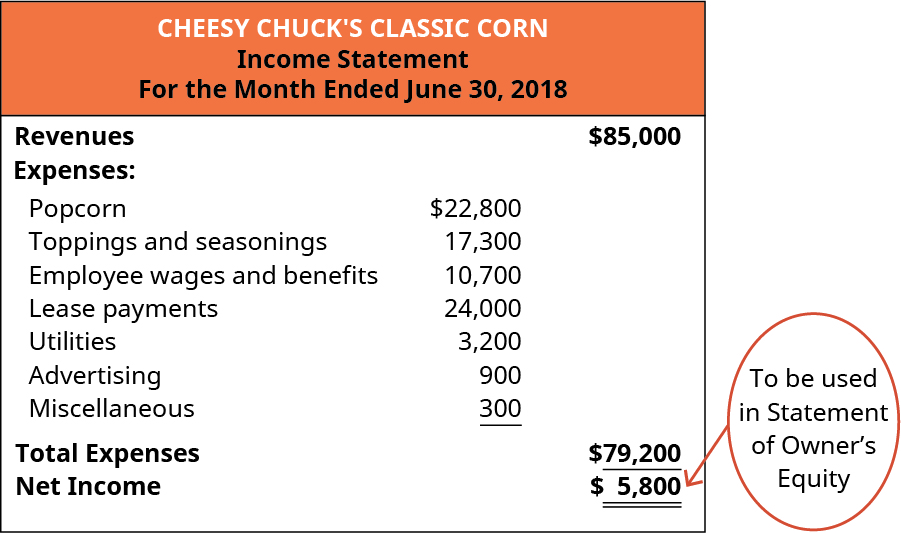
This calculation explains why revenue and expense have opposite effects:
- Revenue increases net income and ultimately increases owner’s equity.
- Expenses reduce net income and ultimately decrease owner’s equity.
The statement does not list owner withdrawals as an expense. That omission is essential.
Withdrawals: the owner takes value out
Withdrawals occur when the owner takes cash or other assets from the business for personal use. They are often recorded in an account called Owner, Withdrawals or Owner, Drawing.
Suppose the owner of a sole proprietorship takes from the business bank account to pay a personal phone bill.
| What changes | Why |
|---|---|
| Cash decreases by | Business assets leave the company. |
| Owner’s equity decreases by | The owner’s claim on the business is reduced. |
| Expense does not change | The payment was personal, not a cost of operating the business. |
This is the defining contrast:
| If money is used for... | Classify it as... |
|---|---|
| Rent, utilities, wages, supplies used by the business | Expense |
| The owner’s groceries, personal bills, or personal spending | Withdrawal |
A withdrawal reduces the owner’s equity, but it does not reduce net income. Therefore, withdrawals are not shown as an expense on the income statement.
A useful way to organize the effects on owner’s equity is:
Owner investments can also increase equity, but in this lesson the essential comparison is that expenses come from business operations, whereas withdrawals come from the owner’s personal use of business assets.
One story, four terms
Consider a sole proprietor who runs a small pet-grooming business during one week.
-
The business completes of grooming services, and customers pay immediately.
This is revenue. Cash and owner’s equity increase. -
The business completes of grooming for a regular client, who will pay next month.
This is a sale on account. Accounts Receivable and revenue increase. -
The business pays for shop rent.
This is an expense. Cash and owner’s equity decrease. -
The owner takes of business cash to pay a personal expense.
This is a withdrawal. Cash and owner’s equity decrease, but it is not an expense.
Notice that events 3 and 4 both reduce cash. The test asks you to identify the reason for the reduction:
- Business operating cost: expense
- Owner’s personal use: withdrawal
A word-bank decision method
When a definition or scenario appears on a test, look for the relationship first.
| If the wording says... | Select... |
|---|---|
| “Earned from goods sold or services provided” | Revenue |
| “Customer will pay later” or “customer owes the business” | Sale on account |
| “Cost of operating the business” or “cost incurred to earn revenue” | Expense |
| “Owner takes cash or assets for personal use” | Withdrawals |
Then check the effect:
| Term | Assets | Liabilities | Owner’s equity |
|---|---|---|---|
| Revenue from a cash sale | Cash increases | No direct effect | Increases |
| Sale on account | Accounts Receivable increases | No direct effect | Increases through revenue |
| Expense paid in cash | Cash decreases | No direct effect | Decreases |
| Withdrawals | Cash or another asset decreases | No direct effect | Decreases |
For efficient memorization, make four flashcards. Put the term on one side; on the other, write its definition, one identifying clue, and its effect on owner’s equity. Review them by saying the contrast aloud, not just rereading the words.
Key takeaways
- Revenue is value earned from selling goods or providing services. It increases owner’s equity.
- A sale on account is a revenue transaction in which the customer pays later. It increases Accounts Receivable and revenue.
- An expense is a business cost incurred to earn revenue or operate the business. It decreases owner’s equity.
- Withdrawals are assets the owner takes for personal use. They decrease owner’s equity but are not expenses and do not appear on the income statement.
- The most common test trap is confusing an expense with an owner withdrawal. Ask whether the outflow served the business or the owner personally.
This completes the vocabulary set for the module. For test review, focus especially on the paired contrasts: revenue versus cash received, sale on account versus buying on account, and expense versus withdrawals.
Can't find a good explanation? Sign up and we'll make it for you
Sign up