
Hello. In the previous lesson, you learned to separate accounting (the process), an accounting system (the organized setup), and financial statements (the reports). This lesson narrows the focus from a business to an individual’s finances.
You will learn four closely connected terms for a word-bank test: net worth statement, asset, liability, and personal net worth. The main challenge is distinguishing the document—the net worth statement—from the number reported by that document—personal net worth.
The central idea: what you own, what you owe, and the difference
Personal financial position can be summarized with one relationship:
An asset is something valuable that you own or that is owed to you. A liability is an amount that you owe someone else. Personal net worth is the difference after liabilities are subtracted from assets.
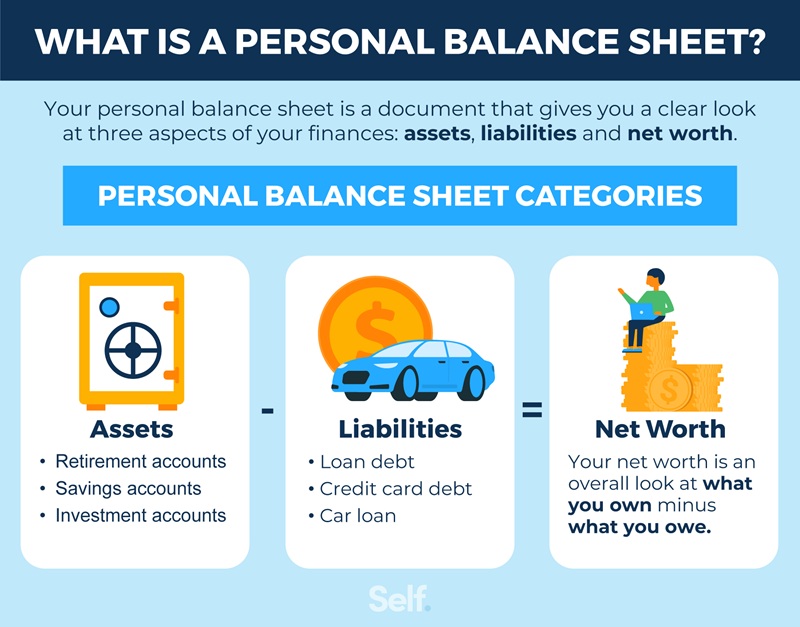
The image calls the document a personal balance sheet. In this course’s vocabulary, a net worth statement serves the same basic purpose: it lists a person’s assets and liabilities and reports the resulting personal net worth on a particular date.
How to Calculate Your Net Worth
Watch How to Calculate Your Net Worth by Preet Banerjee for a short practical introduction to assets, liabilities, and net worth.
Watch the definitions first. Then watch the example, noticing that the calculation begins by listing assets and liabilities separately before finding the difference.
The order matters:
- Identify and total the assets.
- Identify and total the liabilities.
- Subtract total liabilities from total assets.
- The result is personal net worth.
A positive result means assets are greater than liabilities. A negative result means liabilities are greater than assets. Either result is still called personal net worth; it is simply a snapshot of financial position at that date.
Asset: something of value you own
An asset is anything of value that a person owns or controls, or something owed to that person.
The quickest test clue is:
Asset = what you own or are owed that has value.
Common personal assets include:
- cash;
- money in checking or savings accounts;
- investments;
- retirement-account balances;
- a car;
- a home or other real estate; and
- money another person owes you.
An asset does not have to be cash. A car is an asset because it has resale value, even though it usually declines in value. A retirement account is an asset because it belongs to you and has financial value. If someone owes you , that amount is an asset to you, because you have a right to receive it.
What Is an Asset? Definition, Types, and Examples
Read the relevant sections of Investopedia’s What Is an Asset? Definition, Types, and Examples to lock in the ownership-and-value clue for an asset and contrast it with a liability.
In the section “What Is an Asset?”, read from the basic definition. Then, in “Assets vs. Liabilities,” read the direct comparison. Focus on the words owned, economic value, and owed to another.
For a word-bank exercise, definitions containing these clues usually point to asset:
| Definition clue | Likely answer |
|---|---|
| “Property or items of value owned” | Asset |
| “Cash, savings, investments, or property” | Asset |
| “Something owed to a person” | Asset |
| “Resources with financial value” | Asset |
Do not confuse valuable with merely useful. In accounting vocabulary, an asset needs identifiable financial value. Your favorite old notebook may be useful, but it is generally not recorded as a meaningful personal asset.
Liability: an amount you owe
A liability is a debt or obligation that a person owes to another party.
The shortest reliable memory cue is:
Liability = what you owe.
A liability often requires payment in the future, whether in money, goods, or services. Personal examples include:
- credit-card balances;
- student loans;
- car loans;
- mortgages;
- unpaid bills;
- taxes due; and
- money borrowed from another person.
If a bank lends you money for a car, the car itself may be an asset because you own it and it has value. But the remaining car loan is a liability because you owe that amount to the bank. One situation can therefore produce both an asset and a liability.
Liability: Definition, Types, Example, and Assets vs. Liabilities
Read the opening explanation in Investopedia’s Liability: Definition, Types, Example, and Assets vs. Liabilities for the precise meaning of liability and the clean asset-versus-liability contrast.
Under “What Is a Liability?”, read from the core definition and contrast. For a final plain-language memory check, read the “Explain It Like I’m Five” passage beginning the simple summary. Notice that an obligation can be a liability even before you have actually paid it.
Definitions containing the following language are strong signals for liability:
| Definition clue | Likely answer |
|---|---|
| “Debt or obligation owed” | Liability |
| “Amount due to another person or business” | Liability |
| “Loan, mortgage, unpaid bill, or credit-card balance” | Liability |
| “Future payment required” | Liability |
The most important contrast is not whether an item involves money. Both assets and liabilities involve money. The deciding question is whose side are you on?
- If money is yours, is owed to you, or is represented by property you own, it is an asset.
- If you must pay someone else, it is a liability.
Personal net worth: the resulting amount
Personal net worth is the amount of a person’s total assets minus total liabilities.
It is not a list and not a report. It is the final financial amount calculated from the two lists.
Suppose a person has these assets:
| Assets | Amount |
|---|---|
| Checking and savings | |
| Car’s current value | |
| Retirement account | |
| Total assets |
Their liabilities are:
| Liabilities | Amount |
|---|---|
| Credit-card balance | |
| Student loan | |
| Total liabilities |
Their personal net worth is:
So is the person’s personal net worth. Notice the categories carefully:
- Checking, car, and retirement account are assets.
- Credit-card debt and student debt are liabilities.
- The final is personal net worth.
A test definition may say “the difference between what a person owns and what the person owes” or “assets minus liabilities.” Both point to personal net worth.
Net worth statement: the document containing the calculation
A net worth statement is a financial statement that lists a person’s assets and liabilities and shows that person’s net worth on a specific date.
The key distinction is:
Net worth statement = the document.
Personal net worth = the amount on the document.
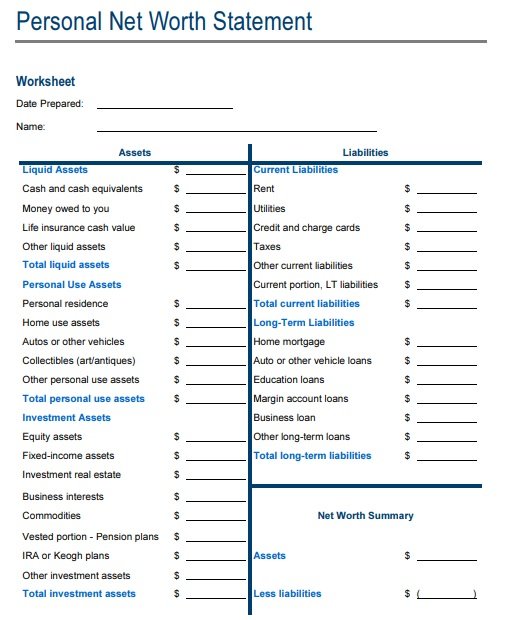
The date is important. A net worth statement is a snapshot, not a record of what happened over many months. If it is prepared on June 30, it reports the values and debts that exist as of June 30. A person’s net worth can change later as savings increase, investments change in value, or debts are paid down.
The worksheet groups assets into categories such as:
- liquid assets, including cash and savings;
- personal-use assets, such as a residence or vehicle; and
- investment assets, such as retirement accounts or investments.
It also groups liabilities into current obligations and longer-term debts. You do not need to memorize every category for this outcome. What matters is recognizing the net worth statement as the organized listing and summary.
Use these definition clues:
| If the definition emphasizes... | Best word-bank match |
|---|---|
| A report or statement listing an individual’s assets, liabilities, and net worth at a specific date | Net worth statement |
| Something valuable that is owned or owed to a person | Asset |
| A debt, obligation, or amount owed to another party | Liability |
| The difference between total assets and total liabilities | Personal net worth |
A frequent test trap is a definition that contains the words “net worth” but describes a statement or report. Choose net worth statement when the definition describes the document. Choose personal net worth when it describes the calculated value.
A compact method for word-bank questions
When you see a definition, find its central clue before looking at examples.
| Central clue | Choose |
|---|---|
| Report, statement, document, specific date | Net worth statement |
| Own, value, resources, owed to you | Asset |
| Owe, debt, obligation, due | Liability |
| Difference, assets less liabilities, financial position | Personal net worth |
Use this four-part memory line:
Statement lists; asset is owned; liability is owed; net worth is the difference.
For memorization, make four flashcards. Put the vocabulary word on one side and its shortest definition on the other:
- Net worth statement: a report listing assets, liabilities, and personal net worth on a specific date.
- Asset: something of value that a person owns or is owed.
- Liability: a debt or obligation owed to another party.
- Personal net worth: total assets minus total liabilities.
Review them by covering the definitions and reconstructing each one from its identity word: report, owned, owed, and difference.
Key takeaways
- An asset is something of financial value that you own or that is owed to you.
- A liability is a debt or obligation that you owe.
- Personal net worth is the numerical difference between total assets and total liabilities.
- A net worth statement is the dated document that lists assets and liabilities and reports personal net worth.
- For the word-bank test, remember: statement lists; asset is owned; liability is owed; net worth is the difference.
Next, you will distinguish three related equity terms: equity, equities, and owner’s equity.
Can't find a good explanation? Sign up and we'll make it for you
Sign up