
Introduction
Welcome to your second lesson in the module on African Philosophical Traditions. In our previous session, you analyzed the concept of Ma'at as the foundational principle of ancient Egyptian thought, encompassing cosmic order, social justice, and personal truth. We saw that the ultimate aim of a virtuous life was to "do Ma'at" and maintain harmony in the face of chaos (isfet).
Today, we transition from the abstract principle to its practical application. Your learning outcome is to examine the ethical teachings in the Maxims of Ptahhotep as an early work of moral philosophy. This text, one of the oldest surviving books in the world, serves as a practical handbook for a young man aspiring to live a life aligned with Ma'at. It gives us a remarkable window into the ethical values of the Old Kingdom.
This lesson will be text-focused, allowing you to engage directly with the primary source, just as you prefer. We will explore the historical context of the work and then analyze its core moral teachings.
1. The Sebayt: Ancient Egypt's Wisdom Literature
The Maxims of Ptahhotep belongs to a genre of Egyptian writing known as sebayt, which translates to "instructions" or "teachings." These texts were typically framed as an aging, experienced father passing down wisdom to his son.
To understand this genre and its philosophical importance, let's start with a short video.
The Philosophers of Ancient Egypt | Human Voiced, No Ads
The video 'The Philosophers of Ancient Egypt' offers a clear introduction to the concept of sebayt and situates the Maxims of Ptahhotep within this tradition.
Please watch from 05:28 to 06:36. Focus on how the narrator describes sebayt as a form of moral philosophy, even if it's presented as practical, fatherly advice.
As the video notes, while these texts might seem like simple collections of proverbs, they contain a coherent worldview about virtue and the good life. This has led many scholars to view figures like Ptahhotep as some of the world's earliest philosophers, predating the Pre-Socratics by nearly two millennia.
To get a feel for the historical significance and textual nature of this work, let's turn to the primary source itself. The Maxims of Ptahhotep survive today primarily through a document known as the Papyrus Prisse.
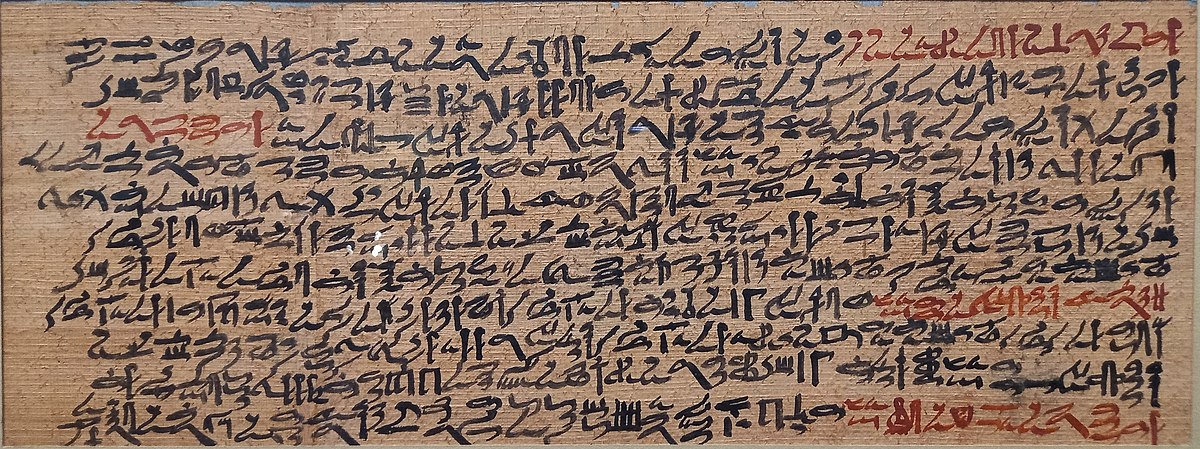
Now, let's get some background on this incredible document. The following reading is the introduction to a public domain translation of the Maxims. It will provide you with the historical context necessary for a university-level engagement with the text.
The Project Gutenberg E-text of The Instruction of Ptah ...
The introduction to Battiscombe G. Gunn's translation of 'The Instruction of Ptah-Hotep' provides a wealth of historical information about the text and its significance.
Please read the 'INTRODUCTION' section. I know this is a substantial text, so focus your attention specifically on these points: The Age of the Text: Look for the discussion of how the Maxims of Ptah-hotep compares in age to other ancient texts like the Vedas or the works of Moses and Solomon. (Find the paragraph beginning 'To draw comparisons between them...'). The Prisse Papyrus: Read the description of the papyrus itself—its discovery, its condition, and its approximate date. (Find 'The Prisse Papyrus, which is well known...'). The Author: Read about what is known (or not known) about the historical Ptah-hotep. (Find 'Thus we may take about 3550 as the period of Ptah-hotep.'). The Core Teaching: Skim the editor's analysis of the moral teaching, particularly the classification of duties and the connection between good conduct and material happiness.
This introduction establishes the Maxims not just as a piece of ancient advice but as a foundational document in the history of literature and ethics, centered on the idea that a life of virtue—a life of Ma'at—leads to happiness and success.
2. The Core Ethical Teachings
Now, let's dive into the maxims themselves. We will analyze them not as a random list, but by grouping them into key ethical themes that demonstrate a coherent moral philosophy. For each theme, we will read the relevant maxims directly from the text and then consider their philosophical implications.
Theme 1: Humility and the Pursuit of Wisdom
One of the most profound philosophical attitudes in the text is the emphasis on intellectual humility.
The Project Gutenberg E-text of The Instruction of Ptah ...
Let's read three maxims from the text that establish this theme.
Please read maxims 1, 2, and 4 in the section titled 'THE INSTRUCTION OF PTAH-HOTEP'. Note the advice given for dealing with the learned, your equals, and those of lower status.
Analysis:
- Maxim 1: "Be not proud because thou art learned; but discourse with the ignorant man, as with the sage." This is a remarkable statement. It asserts that wisdom is not a possession but a pursuit, and that insight ("fair speech") can be found in unexpected places ("by slave-maidens on the pebbles").
- Maxims 2 & 4: The advice here is strategic but also deeply ethical. You are advised to be humble before a wiser person to learn from them, but also to be gentle with a "poor man" in argument because it is "shameful to confuse a mean mind."
This theme echoes the Socratic paradox ("I know that I know nothing"), but nearly 2,000 years earlier. For Ptahhotep, humility is the gateway to learning and a cornerstone of virtuous character.
Theme 2: Justice and Right Leadership
As you learned in the last lesson, upholding Ma'at was the primary duty of the powerful. Ptahhotep gives very specific advice to leaders on how to embody justice.
The Project Gutenberg E-text of The Instruction of Ptah ...
Now read two maxims that address leaders and judges directly.
Please read maxims 5 and 17.
Analysis:
- Maxim 5: This maxim directly connects leadership to "Truth" (Ma'at). It states that Ma'at is a "straight path" and has been constant since the time of the gods. It contrasts this with the "covetous man" who tries to grab things for himself, violating the established order.
- Maxim 17: This is practical advice for any leader: listen patiently to a petitioner. The reason given is deeply philosophical: a patient hearing is itself a form of justice that removes injury and allows the proper order (Ma'at) to be restored. Power must be exercised with compassion and attentiveness.
Theme 3: Social Harmony and Self-Control
Many of the maxims are dedicated to maintaining social harmony through self-control, politeness, and moderation. These are not just rules of etiquette; they are methods for preventing isfet (chaos) from disrupting the community.
Egyptian Ethics & Philosophy: Hardjedef & Ptahhotep
The following video provides a good summary of several of these social and personal maxims.
Please watch from 04:31 to 08:56. You don't need to memorize every maxim. Instead, get a general sense of the wide range of advice given on topics like: Dealing with arguments and enemies. Guarding against greed. Treating one's wife. The value of silence vs. speech.
Now, let's focus on a particularly famous maxim about domestic life.
The Project Gutenberg E-text of The Instruction of Ptah ...
Let's read Ptahhotep's advice on how a man should treat his wife.
Please read maxim 21.
Analysis:
Ptahhotep's advice to "love thy wife," "fill her stomach, clothe her back," and "gladden her heart" is notable for its time. He describes her as "an estate profitable unto its lord," which might sound transactional to us, but the emphasis is on care, kindness, and gentleness ("gentleness mastereth her more than strength") as the way to maintain harmony within the household, the fundamental unit of a society based on Ma'at.
3. Conclusion: A Philosophy of Right Living
The Maxims of Ptahhotep provide a detailed ethical framework for a life lived in accordance with Ma'at. More than a simple list of dos and don'ts, it presents a coherent moral philosophy rooted in the idea that right action creates order and leads to a flourishing life.
Key Takeaways:
- A Practical Guide to Ma'at: The Maxims translate the abstract principle of Ma'at into concrete rules for conduct in leadership, social interactions, and personal life.
- Core Virtues: The ethical system prizes virtues like intellectual humility, justice, compassion in leadership, self-control, moderation, and kindness.
- An Early Form of Moral Philosophy: The text grapples with fundamental questions of how to live well, the nature of wisdom, and the duties of individuals within a community, making it a crucial document in the history of world philosophy.
- Consequentialist Ethics: The underlying reasoning is often consequentialist: you should act virtuously because it leads to good outcomes—social respect, a peaceful home, success in your career, and favor from your superiors and the God.
In our next lesson, we will leap forward in time and across the African continent to 17th-century Ethiopia. There, we will meet the philosopher Zera Yacob, whose autobiographical and rationalist approach in his work, the Hatata, will provide a fascinating and stark contrast to the traditional, wisdom-based style of Ptahhotep.
Can't find a good explanation? Sign up and we'll make it for you
Sign up