
Hello. In the previous lesson, you built an evidence-based argument for why institutions may need on-chain rate markets and why Exponent’s Solana-focused fixed-maturity yield exchange could matter. This lesson turns that market thesis into a personal hiring case.
Your objective is to prepare three distinct, truthful, evidence-backed stories from your institutional CEX business-development work. Each should demonstrate a capability Exponent needs now: acquiring the right capital, moving it through diligence and deployment, resolving institutional blockers, and building a repeatable capital-markets function. You will not claim that CEX experience is identical to selling a non-custodial DeFi protocol. Instead, you will show that you have already managed the institutional decision processes, risk conversations, cross-functional dependencies, and commercial discipline that Exponent must operationalize.
Start with Exponent’s actual scorecard
Before selecting stories, identify what the interviewer must be able to conclude about you. The role is not conventional top-of-funnel sales. Exponent needs someone who can source suitable allocators and liquidity providers, understand their mandates, coordinate diligence and onboarding, support deployment, and expand relationships over time.
Institutional Sales Lead @ Exponent | Solana Network Opportunities Job Board
Read Exponent’s “Institutional Sales Lead” posting to turn broad interview preparation into a precise hiring scorecard. Its wording clarifies that the job is accountable for funded, retained capital and for the operating process that produces it.
In “The Role” and “Responsibilities,” begin with the sentence “Your objective is not simply to generate introductions” and read the relationship-lifecycle mandate. Then read the remaining responsibility bullets, particularly the references to client mandates, risk limits, operational requirements, and coordination with product, risk, and operations. In “What we are looking for” and “Success in the role,” read the qualifications and success measures. As you read, mark each requirement that a specific experience from your CEX role can substantiate.
The posting can be condensed into six interview tests:
| Exponent hiring test | What an interviewer needs to hear | Useful CEX evidence |
|---|---|---|
| Institutional origination | You can identify, access, and develop the right professional counterparties. | Qualified accounts sourced, senior stakeholders engaged, referral channels developed |
| Full-lifecycle ownership | You do not stop when a prospect agrees to a meeting. | Diligence, legal, compliance, custody, technical integration, activation, and post-launch follow-up |
| Commercial judgment | You prioritize deployable, durable relationships over vanity pipeline. | Qualification, deal disqualification, risk-based sizing, retained revenue or activity |
| Crypto-product fluency | You can explain a complex product and its risks without overselling it. | Product education, risk disclosures, execution discussions, portfolio-use-case framing |
| Cross-functional execution | You can turn institutional feedback into coordinated internal action. | Work with risk, compliance, operations, product, or trading teams |
| Early-stage operating discipline | You can build a process, measure it, and improve it autonomously. | CRM stages, reporting cadence, account plans, conversion improvements, repeatable materials |
A strong story is not a career chronology. It is a compact proof that one of these tests has already been passed under real constraints.
For Exponent, the most persuasive result metrics are usually not raw meeting count. They are closer to the role’s own measures:
- qualified-to-funded conversion;
- activated capital, trading activity, or revenue;
- time from first engagement to deployment;
- retention, repeat deployment, or account expansion;
- quality and diversity of the client base;
- reduction in recurring onboarding friction;
- a repeatable process adopted by colleagues or adjacent teams.
Where you cannot disclose exact commercial information, use a truthful rounded amount, percentage range, relative improvement, or anonymized client description. For example: “a mid-eight-figure crypto fund relationship,” “reduced the process from several weeks to roughly half that,” or “increased activation from a minority of approved accounts to a clear majority.” Never use a number you cannot substantiate if challenged.
Use STAR, but make the evidence do the work
The STAR structure prevents a story from becoming a product monologue or a vague claim of relationship-management skill. Its real value is that it forces the interviewer to see your decision-making.
Using the STAR method for your next behavioral interview ...
MIT Career Advising and Professional Development’s guide gives a concise structure for behavioral answers and emphasizes the two habits that matter most here: show your individual actions and prepare a small, adaptable portfolio of stories.
In “The STAR method,” read the STAR framework, including the recommended relative emphasis on each component. Then read the guidance in “Interview Tips,” beginning “The purpose of behavioral interviewing is to objectively measure” through specific behavior and ownership. Focus especially on the instruction to use “I” statements accurately. Finally, in “Preparing your responses,” read the story-portfolio guidance. Prepare outlines rather than a word-for-word script, so that you can adapt each story to the question asked.
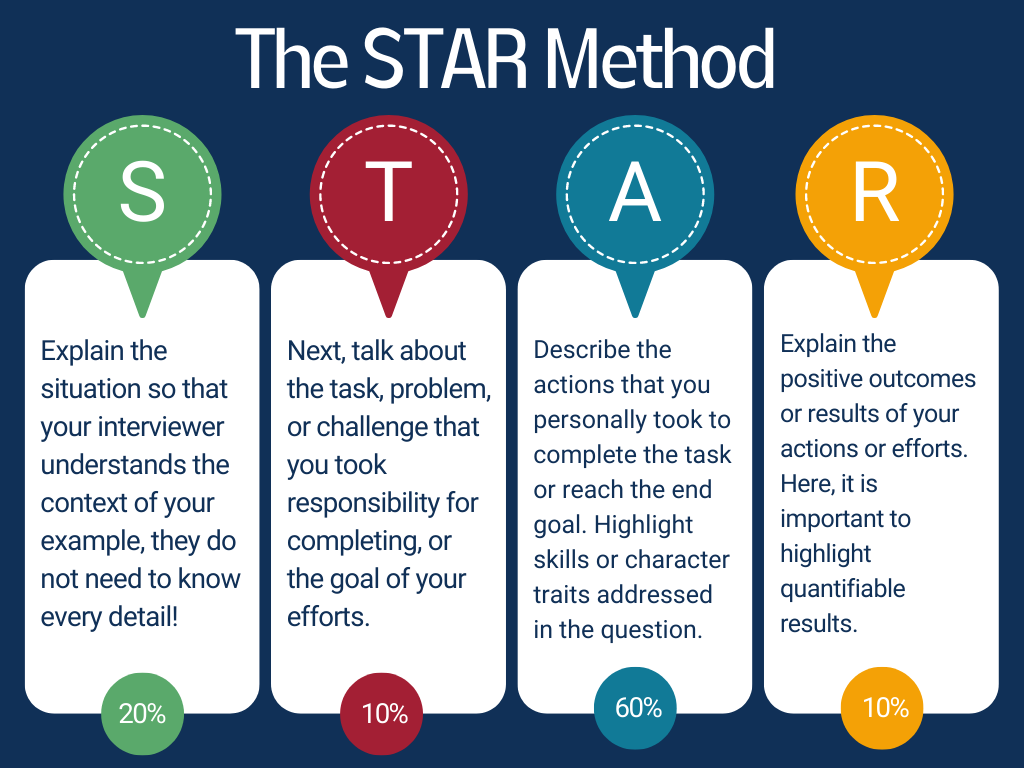
For a 90-second to two-minute answer, use this approximate allocation:
| Component | Purpose | Typical content |
|---|---|---|
| Situation | Establish stakes and context. | Client type, product or market context, business problem, constraint |
| Task | State what you personally owned. | The outcome you were accountable for, not merely the team’s objective |
| Action | Demonstrate judgment and execution. | How you qualified, influenced, coordinated, decided, escalated, or changed the process |
| Result | Prove value and learning. | Quantified business outcome, durability of result, and what you would apply at Exponent |
Two rules protect credibility.
First, distinguish “I” from “we.” Institutional business development is necessarily collaborative. Say “we” when describing the organization’s product or final outcome, but state precisely what you did: “I mapped the decision makers,” “I surfaced the custody blocker,” “I convened the risk and operations workstream,” or “I changed the qualification criteria.”
Second, include a trade-off. Institutional sales leads are judged not only on their ability to close. They are judged on when to slow down, involve control functions, limit a promise, or decline an unsuitable opportunity. An answer that includes a real constraint is more credible than one in which every stakeholder agrees immediately and every prospect converts.
A useful sentence to bridge your experience to Exponent is:
“The product and settlement model are different: a CEX relationship does not create the same smart-contract, wallet, or protocol-dependency considerations as Exponent. But the institutional workflow is directly relevant: identifying the mandate, translating risk into decision-ready terms, coordinating the control functions, and remaining accountable through deployment and retention.”
That sentence demonstrates transferability without pretending the differences do not exist.
Story 1: From targeted origination to retained institutional activity
Your first story should prove that you can develop a professional relationship through the whole commercial lifecycle. Select a real CEX account, campaign, or segment in which you did more than generate an introduction.
A suitable headline is:
“I converted a carefully qualified institutional prospect into an active, durable client relationship by aligning the commercial opportunity with its mandate and operational reality.”
This story maps most directly to Exponent’s need to attract and retain institutional and crypto-native liquidity, own the relationship lifecycle, and improve qualified-pipeline-to-funded-account conversion.
Evidence to collect before drafting
Create a one-page evidence card from your actual records, CRM history, account plan, internal notes, or recollection:
| Evidence category | Capture this detail |
|---|---|
| Starting point | Client segment, mandate, initial relationship state, and why it mattered strategically |
| Qualification | Return objective, liquidity horizon, product fit, risk constraints, decision-makers, and operational prerequisites |
| Your intervention | The specific outreach, discovery process, commercial framing, stakeholder management, and follow-through you owned |
| Friction | The obstacle that could have prevented activation: internal alignment, operational readiness, risk concern, timing, pricing, or competing venue |
| Outcome | Activation, capital, revenue, volume, product adoption, retention, expansion, or a meaningful next-stage commitment |
| Attribution | What was truly your contribution versus the contribution of sales, trading, compliance, or leadership colleagues |
Draft it in STAR form
Use the following outline, replacing every bracket with facts that you can defend:
Situation: “In my institutional business-development role at [CEX], I was responsible for developing [segment] relationships. One opportunity involved [anonymized client type], which had [specific mandate or requirement]. Although they had interest in [product or service], they had not moved forward because [specific obstacle].”
Task: “I owned the commercial path from [initial stage] through [activation or deployment], while making sure the opportunity met our [risk, operational, or commercial] criteria.”
Action: “I first [segmented or qualified the account] by clarifying [mandate, liquidity needs, product use case, decision process]. I then [mapped stakeholders and built engagement plan]. Rather than presenting the broad platform, I framed [product or capability] around [their concrete portfolio or execution problem], including the limitations and trade-offs. When [blocker] surfaced, I [specific action], coordinated with [functions], and maintained a [cadence or shared process] so the client always knew the next decision and owner. After activation, I [post-launch action] to monitor adoption and identify [retention or expansion opportunity].”
Result: “The result was [outcome] over [time period], compared with [baseline, target, or previous state]. More importantly, [evidence of durability]. I learned that institutional conversion improves when qualification happens before solutioning; that is the same discipline I would apply to Exponent’s allocator and liquidity-provider pipeline.”
The actions must sound like decisions, not a list of meetings. The interviewer should understand why you chose a particular client segment, what you learned in discovery, and how that information changed your commercial approach.
Translate the story to Exponent
At Exponent, this same discipline might mean separating:
- a treasury seeking predictable income from a fund seeking variable-yield exposure;
- an allocator able to hold a PT to maturity from one that requires reliable early-exit liquidity;
- a market maker that has genuine rate-market capability from one attracted only by temporary incentives;
- a large prospective account from a genuinely qualified, operationally ready one.
The transferable principle is mandate-first capital acquisition. High-quality retained capital is more valuable than a large but unsuitable deposit that exits at the first volatility, liquidity, or operational challenge.
Story 2: Turn a difficult diligence or operational issue into an informed decision
Your second story should establish trust and cross-functional operating ability. Choose a situation where a sophisticated client encountered a material concern, such as custody, settlement, product risk, compliance, legal documentation, reporting, credit, market access, or technical integration.
This need not end in a signed account. A well-managed decision to pause, restructure, or disqualify an unsuitable relationship can be excellent evidence of commercial judgment. Exponent’s first-quarter objective is retained, high-quality capital, not indiscriminate capital.
A suitable headline is:
“I protected a strategic relationship by making a complex risk or operational issue explicit, coordinating the right experts, and giving the client a decision-ready path rather than an oversimplified sales answer.”
This directly supports Exponent’s requirements for sophisticated communication, institutional diligence, trust, and coordination with risk, product, and operations.
The structure to use
Situation: “A [client type] was evaluating [CEX service or product] for [use case]. The relationship had strategic potential because [reason], but during diligence they raised [specific concern]. Their concern was legitimate because [commercial, operational, regulatory, risk, or portfolio consequence].”
Task: “My responsibility was not simply to overcome the objection. I needed to determine whether the requirement could be met responsibly and, if so, create a credible route to resolution without making commitments outside my authority.”
Action: “I clarified the underlying requirement by asking [two or three real discovery dimensions]. I separated what was a non-negotiable control requirement from what was a preference. I assembled [risk, legal, compliance, operations, product, trading] stakeholders and gave them a concise client-specific problem statement rather than asking for generic support. I communicated transparently to the client about [what was known, what required confirmation, and expected timing]. When we identified [trade-off], I recommended [solution, phased approach, revised scope, or decision to pause]. I kept ownership of the client narrative and internal next steps.”
Result: “The outcome was [approved onboarding, modified solution, improved process, retained trust despite a delay, or disciplined disqualification]. We measured success through [time to resolution, account activation, avoided risk, client retention, process change, or subsequent opportunity]. The lesson was that sophisticated counterparties respond well to specificity and transparent limits; confidence comes from a well-run diligence process, not from pretending risk is absent.”
For this story, select evidence that reveals the quality of your judgment:
- What exactly did the client need to decide?
- What was the potential downside of rushing?
- Which internal dependency was genuinely difficult?
- What did you do personally to reduce ambiguity?
- What did the eventual decision make possible or prevent?
Make the DeFi bridge explicitly and carefully
At Exponent, institutional diligence may cover more than the conventional CEX questions. It can include wallet custody and signing authority, smart-contract and upgrade risks, the underlying yield source, price and liquidity risk, maturity and redemption mechanics, Solana operational requirements, reporting, and legal or accounting treatment.
Do not say that you have already resolved every one of these DeFi-specific issues if you have not. Instead, explain the operating method you would bring:
- Establish the allocator’s non-negotiable requirements before proposing a product.
- Translate each requirement into a factual diligence question and accountable internal owner.
- Provide documentation and evidence rather than reassurance alone.
- Escalate gaps early and avoid promising liquidity, yield, or risk outcomes that the protocol cannot guarantee.
- Maintain the relationship even if the appropriate immediate answer is “not yet.”
This is the story most likely to answer prompts such as: “Tell me about a difficult client,” “How do you build trust?” “Describe a time you worked across teams,” or “Tell me about a time you had to manage risk in a commercial opportunity.”
Story 3: Build a repeatable capital-markets process, not just a book of contacts
Your third story should show that you can operate autonomously and create infrastructure around a growing institutional function. Select an example in which you improved the system: pipeline definitions, account segmentation, CRM hygiene, senior coverage cadence, reporting, product-feedback loops, onboarding workflow, or a repeatable communications program.
A suitable headline is:
“I turned an inconsistent institutional coverage process into a measurable operating rhythm that improved prioritization, accountability, and conversion.”
This speaks directly to Exponent’s need for someone who can establish the capital-markets function, report with discipline, and ultimately help scale the team.
The core contrast
Do not frame the situation as “we needed more leads.” That is too shallow. Frame it as a business-control problem:
| Weak process | Strong institutional process |
|---|---|
| Large undifferentiated prospect list | Segmented accounts with a defined ideal-client profile |
| Pipeline stages based on activity | Stages based on verified client commitments and prerequisites |
| Sales update based on anecdotes | Reporting based on conversion, time in stage, blockers, and next owner |
| Onboarding treated as another team’s problem | Shared workflow with clear accountability and client communication |
| One-off outreach | Deliberate account cadence, opportunity updates, and retention plan |
Draft it in STAR form
Situation: “In [period] at [CEX], I saw that our institutional pipeline had [specific inconsistency]. We had [observable consequence], such as poor forecasting, stalled accounts, duplicated outreach, unclear ownership, or a gap between approvals and activation.”
Task: “I took responsibility for creating a more reliable process for [scope], while preserving flexibility for high-value accounts and coordinating with [relevant teams].”
Action: “I analyzed [CRM data, account notes, funnel history, client feedback, or operational timelines] to identify where prospects were stalling. I introduced [specific segmentation, entry criteria, stage definitions, dashboard, account-plan format, meeting cadence, or escalation mechanism]. I defined [what evidence moved an account forward], including [risk, operations, legal, or funding criteria]. I also created a feedback loop with [team] so recurring client requirements informed [materials, workflow, product priorities, or controls]. To ensure adoption, I [trained colleagues, produced a simple template, piloted with selected accounts, or reported metrics regularly].”
Result: “Over [time period], [metric] changed from [baseline] to [outcome], and we improved [conversion, forecasting, activation speed, revenue, data quality, or retention]. The process also revealed [a useful non-obvious insight], which changed our targeting or resource allocation. That experience is relevant to Exponent because early institutional growth needs a repeatable conversion system, not a collection of relationships held only in one person’s inbox.”
This story should contain at least one hard measure. If a direct revenue or capital number is unavailable, use an operational measure that mattered to the business: aging of open accounts, percentage of accounts with complete diligence information, onboarding turnaround time, forecast accuracy, stakeholder response time, or a conversion rate between meaningful stages.
Apply the story to Exponent’s first-quarter measures
A credible Exponent capital-markets process might track:
- accounts meeting a defined qualified-prospect standard;
- qualified accounts in diligence;
- diligence accounts with custody, risk, legal, and operational requirements resolved;
- accounts that have actually funded or executed;
- early retention and expansion indicators;
- concentration by client type, strategy, maturity, and liquidity-provider profile;
- recurring blockers that should be addressed by product, documentation, or operations.
The point is not to impose CEX CRM terminology on an on-chain protocol. The point is to build a shared operating language between commercial, risk, product, and operations teams, so that the firm can distinguish interest from deployable capital.
Assemble the three-story portfolio
Your portfolio should be deliberately varied. Avoid recycling one successful account story three times with slightly different labels.
| Story | Primary Exponent proof | Best questions it can answer |
|---|---|---|
| 1. Origination through retention | Relationship development, qualification, lifecycle ownership, commercial execution | “How have you won institutional clients?” “How do you manage a strategic account?” |
| 2. Diligence or blocker resolution | Trust, risk judgment, product communication, cross-functional execution | “How do you handle objections?” “Tell me about a difficult client or complex problem.” |
| 3. Process building | Autonomy, pipeline discipline, scalable operating system, reporting | “How would you build our capital-markets function?” “Tell me about improving a process.” |
For each story, prepare three layers of notes:
- A one-line headline that triggers recall.
- Six to eight evidence bullets: context, task, three or four actions, result, and learning.
- A tailored closing bridge to Exponent.
Do not memorize a full script. A script can sound rehearsed and can prevent you from answering the exact question asked. Memorize the chronology, key evidence, and the decision points. Then vary the emphasis:
- For a question about sales, emphasize account strategy and conversion.
- For a question about trust, emphasize transparency and the risk trade-off.
- For a question about leadership, emphasize ownership and cross-functional coordination.
- For a question about building from zero, emphasize the process and measurable improvement.
Before the interview, pressure-test every story with four checks:
- Specificity: Could a listener tell exactly what happened?
- Ownership: Is it clear what you did?
- Evidence: Does the result have a number, time frame, behavioral outcome, or independently observable change?
- Relevance: Does the final sentence connect naturally to one of Exponent’s stated needs?
Key takeaways
- Exponent is hiring for more than introductions: the role owns institutional relationships from origination through diligence, deployment, retention, and expansion.
- Your CEX background is highly relevant when presented as evidence of institutional workflow discipline, commercial judgment, cross-functional execution, and accountable relationship ownership.
- Build three distinct stories: one about originating and retaining a qualified client, one about resolving a real diligence or operational issue, and one about building a repeatable institutional-coverage process.
- Use STAR with most of the time on your individual actions. Include an authentic constraint or trade-off, quantify the result where possible, and avoid claiming DeFi-specific experience you do not possess.
- Each story should end by naming the specific Exponent capability it proves: quality capital acquisition, trustworthy diligence, or scalable capital-markets execution.
Next, you will combine these stories, the market thesis, and your 30–60–90-day plan into a ten-minute interview presentation proposing an institutional acquisition strategy for Exponent.
Can't find a good explanation? Sign up and we'll make it for you
Sign up