
Hello again. In the previous lesson, you converted laboratory measurements into compatible metric units. That skill matters here because ratios are only meaningful when the quantities being compared use the same unit.
This lesson introduces two closely related ways to describe a small forensic dataset:
- a ratio, which compares two quantities;
- a percentage, which states how large one part is out of a chosen whole.
You will use fictional evidence counts and masses, keeping the calculation separate from any claim about what the evidence proves. Plan for roughly 40 minutes.
Ratios: comparisons with an order
A ratio compares two quantities. It may be written with a colon, as a fraction, or in words:
“18 to 12”
The order is essential. A ratio of is not the same statement as . Before calculating, write the comparison in words: “the ratio of red fibers to blue fibers” means red is first and blue is second.
Consider this small fictional dataset from a tape lift collected at a scene:
| Fiber color | Number observed |
|---|---|
| Red | |
| Blue | |
| Total |
The ratio of red fibers to blue fibers is:
Both numbers divide by , so the simplified ratio is:
This means that for every red fibers observed, there were blue fibers observed. It does not mean there were only red and blue fibers. A simplified ratio preserves the relationship while removing a common multiplier.
A ratio can compare:
- part to part, such as red fibers to blue fibers: ;
- part to whole, such as red fibers to all observed fibers: .
These answer different questions. Confusing them is one of the most common ratio errors.
Part to whole ratio word problem using tables
Watch “Part to whole ratio word problem using tables” from Khan Academy for a compact visual demonstration of separating parts from a total and organizing the information in a table.
Watch the full example. Notice that the presenter first identifies the separate categories and their total, then uses the total number of ratio parts to determine actual counts. Apply that same organization to evidence-count tables: label each category, state the total, and keep part-to-part comparisons distinct from part-to-whole comparisons.
A percentage is always “part out of a whole”
The word percent means “per hundred.” A percentage therefore requires a reference whole.
The central relationship is:
For the fiber dataset, red fibers are the part and all fibers are the whole:
So of the observed fibers are red. Similarly, blue fibers make up:
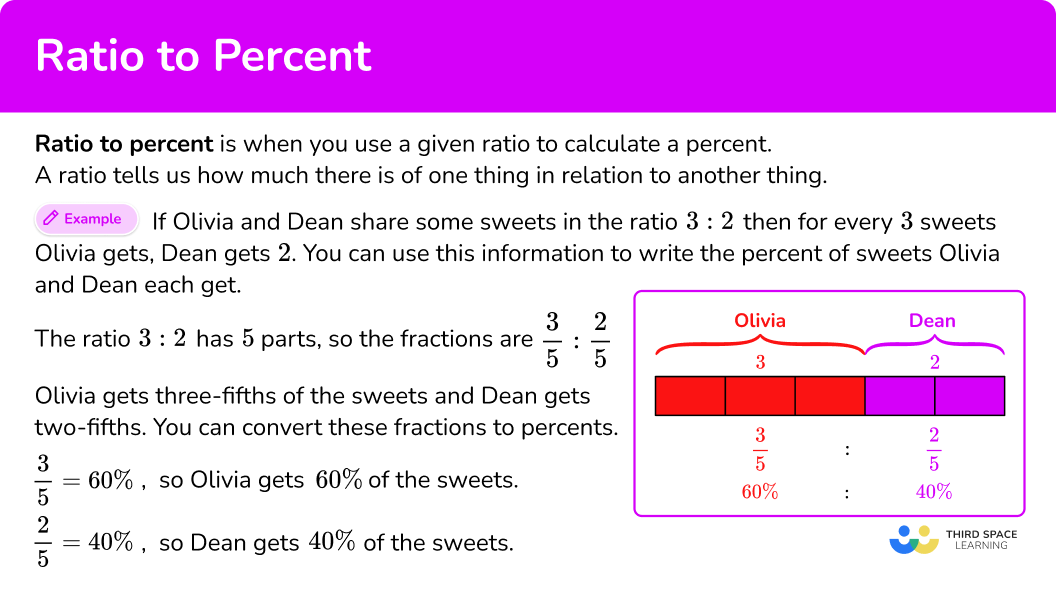
The image below shows this same idea using a ratio of . There are equal total parts, so the two shares are and , which become and .
There is a useful connection between the two forms:
The ratio has total ratio parts. Therefore:
This shortcut works when the ratio accounts for all categories in the chosen whole. If a dataset contains other categories, you cannot calculate a category’s percentage using only two selected parts.
For example, if the tape lift also contained green fibers, the red-to-blue ratio would still be . But the percentage of red fibers in the full sample would change:
The whole must match the question being asked.
Part, Whole, & Percent Proportion Word Problems
Watch “Part, Whole, & Percent Proportion Word Problems” from The Organic Chemistry Tutor to reinforce how to identify the numerator and denominator in a percent calculation.
Watch finding percentages. Focus on the repeated setup: part divided by whole, then multiplied by 100. The example in which the percentage exceeds 100\% is also useful: it shows that a percentage describes a comparison to a reference amount, not necessarily a share of a complete set.
Working through a forensic-style dataset
Imagine a preliminary screening record for separate stain samples. In this fictional example, “positive” means the sample gave a positive screening result; it does not yet establish the substance conclusively.
| Screening result | Number of samples |
|---|---|
| Positive | |
| Negative | |
| Total tested |
Part-to-part ratio
The ratio of positive to negative screening results is:
There is no common whole-number factor other than , so this is already simplified.
This comparison tells us how the two groups relate to one another. It is not itself a percentage.
Part-to-whole percentage
To find the percentage of samples with a positive result, use the total number tested as the whole:
Thus, of the tested samples had a positive screening result. The negative-result percentage is:
Because positive and negative are the only categories in this table, the percentages should add to :
That is a valuable check. If category percentages are meant to partition one total but add up to or , check the denominator, arithmetic, or rounding.
Ratios involving measurements: convert first
Ratios of measured quantities need compatible units. This directly builds on the previous lesson.
Suppose two powder samples recovered from separate locations have masses:
| Sample | Recorded mass |
|---|---|
| A | |
| B |
It would be incorrect to write the ratio as , because the first number is in grams and the second is in milligrams.
Convert sample A to milligrams:
Now the comparison is valid:
The common unit cancels conceptually, leaving:
Both values divide by :
So the mass ratio of sample A to sample B is .
You can also calculate each sample’s share of the combined recovered mass. The total mass is:
Sample A’s percentage of the combined mass is:
Sample B’s percentage is:
These add to , apart from any small rounding difference.
The calculation describes only the distribution of recovered mass. It does not establish that the materials have the same composition, came from the same source, or have the same forensic significance. Those are separate scientific questions requiring suitable examinations.
A reliable calculation routine
For every ratio or percentage question, use this sequence:
-
State the comparison in words.
For example: “positive results to negative results” or “positive results as a percentage of all tested samples.” -
Choose the correct whole.
A percentage always has a denominator. Ask, “Out of what total?” -
Make units compatible.
Counts can usually be compared directly. Measurements such as grams and milligrams must first be converted into the same unit. -
Calculate and simplify appropriately.
Simplify ratios by dividing both sides by a common factor. Calculate percentages using part divided by whole, multiplied by . -
Check whether the result makes sense.
A part that is less than its whole should produce a percentage below . Mutually exclusive categories that include every case should total approximately .
A calculator is useful when the division produces a long decimal. For example:
Depending on the reporting context, this could be reported as or . Do not imply unnecessary precision: a small dataset rarely justifies many decimal places.
Key takeaways
A ratio compares two quantities in a stated order, while a percentage expresses one part relative to a chosen whole.
Remember these distinctions:
- compares positive results to negative results.
- gives positive results out of all tested samples.
- Convert measurement units before forming a ratio.
- Category percentages should total only when the categories are mutually exclusive and cover the entire selected dataset.
- A numerical proportion describes the data; it does not, by itself, prove a forensic conclusion.
Next, you will build on these calculations by summarizing a small set of measurements with the mean, median, and range.
Can't find a good explanation? Sign up and we'll make it for you
Sign up