
Hello, and welcome to the first lesson in Wave Foundations and Core Calculations. This module begins with the central idea that makes every later topic in waves meaningful: a wave is a travelling disturbance that carries energy. We will then build toward classifying waves, reading wave graphs, and calculating wave quantities.
In this lesson, focus on one precise claim: a travelling mechanical wave transfers energy from place to place without a net transfer of matter. This is the idea behind the cork-on-water question and is a useful test for distinguishing the motion of the wave pattern from the motion of the material through which it travels. Allow about 35–40 minutes.
A wave is a travelling disturbance, not a travelling object
A useful definition is:
A wave is a travelling disturbance that transfers energy from one place to another.
For a mechanical wave—such as a wave on a rope, a sound wave in air, or a water wave—the disturbance travels through a material called a medium. The medium is made of particles or parts that can interact: rope segments, water molecules, air molecules, or slinky coils.
The key distinction is this:
- The disturbance travels through the medium.
- The particles of the medium move temporarily about their usual positions.
- Energy is passed along as neighbouring particles exert forces on one another.
- After the wave has passed, the particles have no overall change in position.
This is why it is better to say that a wave transports energy, rather than saying it transports the medium itself.
Wave Motion | Waves | Physics | FuseSchool
Watch “Wave Motion | Waves | Physics” from FuseSchool - Global Education. Its stadium-wave example gives a clear visual model of a travelling pattern without people moving around the stadium.
Watch the stadium example. Notice the two different motions: the pattern moves around the stadium, while each person only stands up and sits back down in their own location. The stadium wave is an analogy for how a disturbance can travel through a material without carrying that material with it.
The stadium example is not a physical wave in the strictest sense, but it illustrates the essential separation between local motion and propagating motion.
How energy moves through a medium
Imagine a long slinky stretched along the floor. You move the first coil sideways once and let go. That first coil has been given energy because your hand did work on it. As the coil moves, it pushes or pulls on its neighbour. The neighbouring coil starts to move, then affects the next coil, and so on.
Each coil moves only for a short time, but the disturbance continues along the length of the slinky. Energy is carried from the hand at one end to the far end, even though no individual coil travels all the way there.
At any location in the slinky, energy appears in two connected forms:
- Kinetic energy, while a coil is moving.
- Potential energy, when the slinky is stretched or compressed away from its equilibrium arrangement.
The important process is not that one object “hands over a packet” of energy like a physical parcel. Rather, forces between neighbouring parts of the medium cause each part to move, temporarily store energy, and transfer energy onward.
Physics Tutorial - Vibrations and Waves - Nature of a Wave - What is a Wave?
Read this explanation from The Physics Classroom to establish the definition of a wave, then trace the particle-by-particle mechanism that carries energy through a medium.
Begin with the opening definition, the definition, and continue to the discussion of a repeating disturbance. Then read the section titled “Particle-to-Particle Interaction.” Focus on the interacting-particle model, followed by the explanation beginning with the slinky. In particular, follow the account of how each particle affects its neighbour. Finally, read the section titled “A Wave Transports Energy and Not Matter,” beginning with the temporary displacement of particles. Focus on the distinction between a wave and an object such as a bat: both can transfer energy, but only the bat must itself travel from one place to another.
This particle-by-particle mechanism explains why a mechanical wave needs a medium. If there are no particles to interact, there is no way for a rope wave or sound wave in air to pass its disturbance onwards. Later, this will help distinguish mechanical waves from electromagnetic waves such as light.
Separate the two kinds of motion
Many wave misunderstandings come from mentally combining two very different motions.
1. Motion of a particle in the medium
A particle moves locally, around an equilibrium position—its undisturbed resting location. It may move up and down, side to side, or back and forth, depending on the type of wave. Its displacement changes as the wave passes, but it remains part of roughly the same local region of the medium.
2. Motion of the wave pattern
The disturbance itself travels across the medium. A crest on the surface of water, a compressed region in air, or a pulse on a rope appears successively at different positions. This travelling pattern is what carries energy away from the source.
A useful phrasing is:
The medium oscillates locally; the disturbance propagates through it.
Do not say that “the crest is a lump of water moving forward.” A crest is a shape or pattern created by the motion of many water particles, not a permanent group of the same particles.
The cork or dragonfly on water
The standard water-wave example makes this visible. A cork floating on water may bob upward as a crest reaches it, then move downward as the trough passes. After the wave passes, the cork is approximately where it began, even though the visible crest has moved far away.
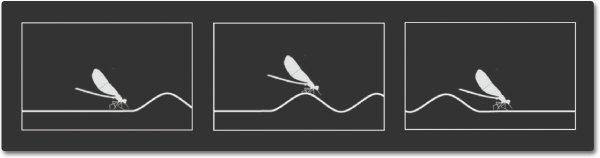
The image demonstrates that the wave moves energy across the water, while the floating object experiences mainly vertical local motion. If the wave reaches a shore and splashes against it, it can do work: moving sand, rocking a boat, or exerting a force on a structure. That visible effect is evidence that energy arrived at the shore.
Yet the water initially beneath the dragonfly does not become the water at the shore simply because a wave crossed the surface.
For idealised small water waves, water particles often move in approximately circular or elliptical paths, returning close to their starting positions after a cycle. In real conditions, wind, currents, breaking waves, and effects such as wave drift can carry water or floating objects over longer distances. Those effects do not change the core wave principle: the wave motion itself does not require a net bulk transport of the medium.
The word net matters. A particle can certainly move during a wave. The claim is that, over a complete disturbance or several complete cycles, there is no overall transport of the medium from the source to the destination.
What “energy transfer” means physically
Energy transfer is not merely an abstract statement. It means a wave can produce an effect at a location distant from its source.
For example:
- A shake of a rope sends energy to the far end, where the rope may lift or move an object.
- A loudspeaker transfers energy through vibrating air to an eardrum, causing it to vibrate.
- Ocean waves can transfer energy to a shoreline, eroding material or moving a floating boat.
- Earthquake waves transfer energy through rock and can shake buildings far from the earthquake’s origin.
In each case, the source supplies energy by doing work. The wave is the mechanism that makes that energy available elsewhere.
Compare this with throwing a ball. A ball transfers energy when it collides with something, but it also transfers matter because the ball itself travels from one place to another. A wave differs because its energy moves on through successive local motions of the medium.
An exam-ready explanation
For a question such as “Does a mechanical wave transfer matter from one location to another?” a complete response should contain three linked ideas:
A mechanical wave transfers energy through vibrations of particles in a medium. Each particle is temporarily displaced from its equilibrium position and passes energy to neighbouring particles through forces between them. The particles then return approximately to their original positions, so there is no net transfer of matter from the source to the destination.
For the cork question, you could state:
The cork moves up and down as the wave passes but ends near its original position. This shows that the wave pattern and its energy travel across the water, whereas the water and cork mainly undergo local oscillations rather than being carried forward with the wave.
Avoid these common errors:
| Inaccurate idea | Better statement |
|---|---|
| “The water travels with the wave.” | Water particles move locally while the wave pattern travels. |
| “Nothing moves in a wave.” | Particles do move, but there is no net movement of the medium from source to destination. |
| “Energy is the same as matter.” | Energy is a quantity that can be transferred; it is not material substance. |
| “A wave cannot move an object.” | A wave can transfer energy and exert forces on objects, without transporting its entire medium along the path. |
Key takeaways
A travelling wave is a disturbance that transfers energy from one place to another. In a mechanical wave, particles of the medium are displaced from equilibrium, interact with nearby particles, and return approximately to their initial positions. Thus, energy propagates through the medium without a net transfer of matter.
The dragonfly or cork example is the essential visual evidence: the wave travels onward, while the floating object bobs locally rather than travelling with each crest.
Next, you will classify waves by how the particles move relative to the direction of wave travel, and distinguish mechanical waves from electromagnetic waves.
Can't find a good explanation? Sign up and we'll make it for you
Sign up