
Hello. In the last lesson, you learned to read a wave diagram correctly: amplitude is a vertical displacement, wavelength is a horizontal distance on a displacement–distance graph, and period is a horizontal time interval on a displacement–time graph.
This lesson turns those measurements into calculations. The central aim is to recognise which quantity a question gives you, convert all values into SI units where needed, and choose the appropriate relationship:
For echoes, the key adjustment is that the recorded time is for the sound’s outward and return journey.
The calculation toolkit
Before calculating, make sure the symbols are secure:
| Quantity | Symbol | Meaning | SI unit |
|---|---|---|---|
| Period | Time for one complete oscillation | second, | |
| Frequency | Number of complete oscillations each second | hertz, | |
| Wave speed | Speed at which the disturbance travels | metres per second, | |
| Wavelength | Length of one complete wave cycle | metre, |
Frequency and period describe the same repeating motion from opposite viewpoints:
- Frequency asks: “How many cycles occur each second?”
- Period asks: “How long does one cycle take?”
Therefore, they are reciprocals:
A high frequency means many cycles occur in each second, so each individual cycle must have a short period.
The wave equation combines the temporal and spatial descriptions of a wave:
During one period, a wave crest travels one wavelength. That also gives an equivalent form:
The formula you use depends on the information supplied, not on the type of wave. It works for water waves, sound waves, waves on strings, seismic waves, and electromagnetic waves.
Period, Frequency, Amplitude, & Wavelength - Waves
Watch “Period, Frequency, Amplitude, & Wavelength - Waves” by The Organic Chemistry Tutor for a compact visual review of the two equations and several calculation examples.
First watch the core relationships. Focus on why frequency is the reciprocal of period and why wave speed can be written as either v=f\lambda or v=\lambda/T. Then watch a wavelength example, noting the conversion from kilohertz to hertz before substitution. Finish with a mixed example, which combines centimetres, milliseconds, period, frequency, and speed.
Period and frequency: reciprocal calculations
From frequency to period
Suppose a wave has frequency . This means it completes cycles every second. The time for just one cycle is:
Notice that the answer is small. That is reasonable: if the wave completes cycles in a second, a single cycle cannot take a large fraction of a second.
From period to frequency
If a wave has a period of , one cycle lasts a quarter of a second. Its frequency is:
So four complete cycles occur every second.
When the number of oscillations is given
Sometimes a question does not state frequency directly. Instead, it gives a number of cycles and a time. Use:
For example, suppose oscillations occur in :
Then find the period:
A useful check is that multiplying frequency and period should give :
In this case,
Ignore irrelevant information
Test questions often include measurements that you do not need. If the question asks for period and gives frequency, use . Do not get distracted by amplitude, wavelength, or the kind of medium unless the question specifically requires them.
For example, a string wave may have an amplitude of , a frequency of , and some information about crest-to-trough distance. To calculate the period, only frequency matters:
SI prefixes: convert before substituting
Physics equations work most reliably when you use SI units:
- metres for wavelength or distance;
- seconds for period or elapsed time;
- hertz for frequency;
- metres per second for wave speed.
The prefixes below are especially important in wave questions.
| Prefix | Symbol | Meaning | Example |
|---|---|---|---|
| kilometre | metres | ||
| centimetre | metres | ||
| millisecond | seconds | ||
| microsecond | seconds | ||
| nanometre | metres |
A prefix with a negative power means the unit is smaller than the base unit. So converting milliseconds to seconds makes the numerical value smaller:
Similarly, for length:
For a basic amplitude conversion:
Exam habit: write the conversion on its own line before placing values into a formula. It makes unit errors easy to spot.
Applying the wave equation
The equation
says that wave speed equals the number of wavelengths passing a point each second multiplied by the length of each wavelength.
Finding speed
A wave has frequency and wavelength .
The unit check is useful:
Finding wavelength
A sound wave travels at and has frequency . Rearrange first:
Then substitute:
A higher frequency at the same speed would produce a shorter wavelength. This is why, in one medium, frequency and wavelength vary inversely.
Finding frequency
A water wave travels at and has wavelength :
A mixed question using period
A wave travels at and has a period of .
First calculate frequency:
Now calculate wavelength:
You could also use:
Rearranging gives:
Both methods agree.
A four-step test-style routine
For most wave calculations:
- Identify the target quantity. Is the question asking for , , , or ?
- List only relevant known values, with units.
- Convert to SI units before substituting.
- Choose, rearrange, substitute, and check units.
If a result seems unreasonable, inspect the units first. A wavelength of hundreds of metres for an ordinary audible sound wave, for example, may indicate that kilohertz was entered as hertz.
Echoes: distance from a round-trip time
An echo is sound reflected from a surface and heard or detected after the original sound. A clap near a wall, a shout near a cliff, and a sonar pulse in water all use the same principle.
The timed sound pulse travels from the source to the reflecting surface, then returns to the receiver. The elapsed time therefore describes a distance that is twice the one-way distance to the object.
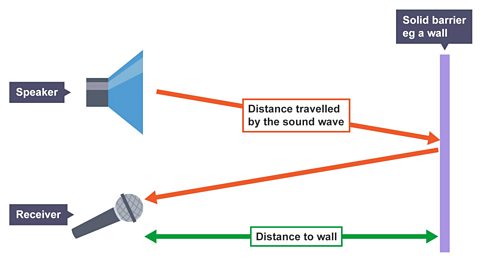
If is the one-way distance to the reflector, then the total distance travelled by the sound is :
Using speed as distance divided by time:
Rearranging for distance gives the echo equation:
Here:
- is the one-way distance to the wall, cliff, seabed, or object;
- is the speed of sound in the relevant medium;
- is the measured time between emission and return.
Measuring Speed of Sound Using Echoes | GCSE Physics
Watch “Measuring Speed of Sound Using Echoes | GCSE Physics” by vt.physics to see why echo timing measures a round-trip path and how repeated echoes improve an experiment.
Watch the single echo method. Notice that a wall 100\ \text{m} away corresponds to a sound path of 200\ \text{m}, not 100\ \text{m}. Then watch the repeated method. Focus on why timing many echoes reduces the relative effect of human reaction time in a practical investigation.
Example: distance to a wall
An echo returns after . Take the speed of sound in air as .
The sound has travelled a total distance of , but the wall is only away.
Example: sonar in water
A sonar pulse returns after in water, where sound speed is .
The object is away.
Example: finding echo time
A cliff is away. The sound must travel:
Then:
The common echo error
If a student uses
with the full echo time, their answer is the total round-trip path, not the distance to the reflector. Divide by only after being clear that the measured time includes both journeys.
Quick test-recognition guide
| If the question says... | Use... |
|---|---|
| “How long does one oscillation take?” | |
| “How many oscillations occur each second?” | or |
| “Find wave speed” | |
| “Find wavelength” | |
| “Find frequency from speed and wavelength” | |
| “An echo returns after...” | |
| “Convert milliseconds, nanometres, or kilometres” | Convert to seconds or metres before calculating |
For focused practice after this lesson, work through Q37–Q65 and Q291–Q295 from your question bank. Show the formula, substitution, unit conversion, and final unit on every answer; this is especially important when a question mixes prefixes with wave equations.
Key takeaways
Frequency and period are reciprocal quantities:
A wave’s speed, frequency, and wavelength are connected by:
Use SI units before substitution: seconds, metres, hertz, and metres per second. For echoes, the measured time describes the sound’s outward and return journey, so the distance to the reflector is:
You have now completed the core measurement and calculation tools for wave foundations. The next module moves from calculating wave properties to recognising wave behaviours in real situations, beginning with reflection, diffraction, and polarisation.
Can't find a good explanation? Sign up and we'll make it for you
Sign up