Hello! Welcome to the next lesson in our module on Investment Instruments and Term Sheets.
In the last few lessons, we've dissected the key components of a term sheet: the economic terms that determine financial outcomes, the control terms that define power, and the strategic rights like pro-rata that enable you to double down on your winners. Now, it's time to put it all together.
Today’s lesson addresses a fundamental question you'll face with every single investment: Which investment instrument should I use? We will focus on choosing the most appropriate instrument—a SAFE, a convertible note, or a priced equity round—for a given pre-seed startup scenario.
As the founder of an incubator and fund, your ability to make these decisions quickly, efficiently, and appropriately will be a cornerstone of your operations. The instrument you choose impacts speed, cost, founder relations, and your own legal protections.
1. The Three Main Contenders: An Overview
At the early stages of a startup's life, there are three primary ways to structure an investment. Let's start with a high-level comparison.
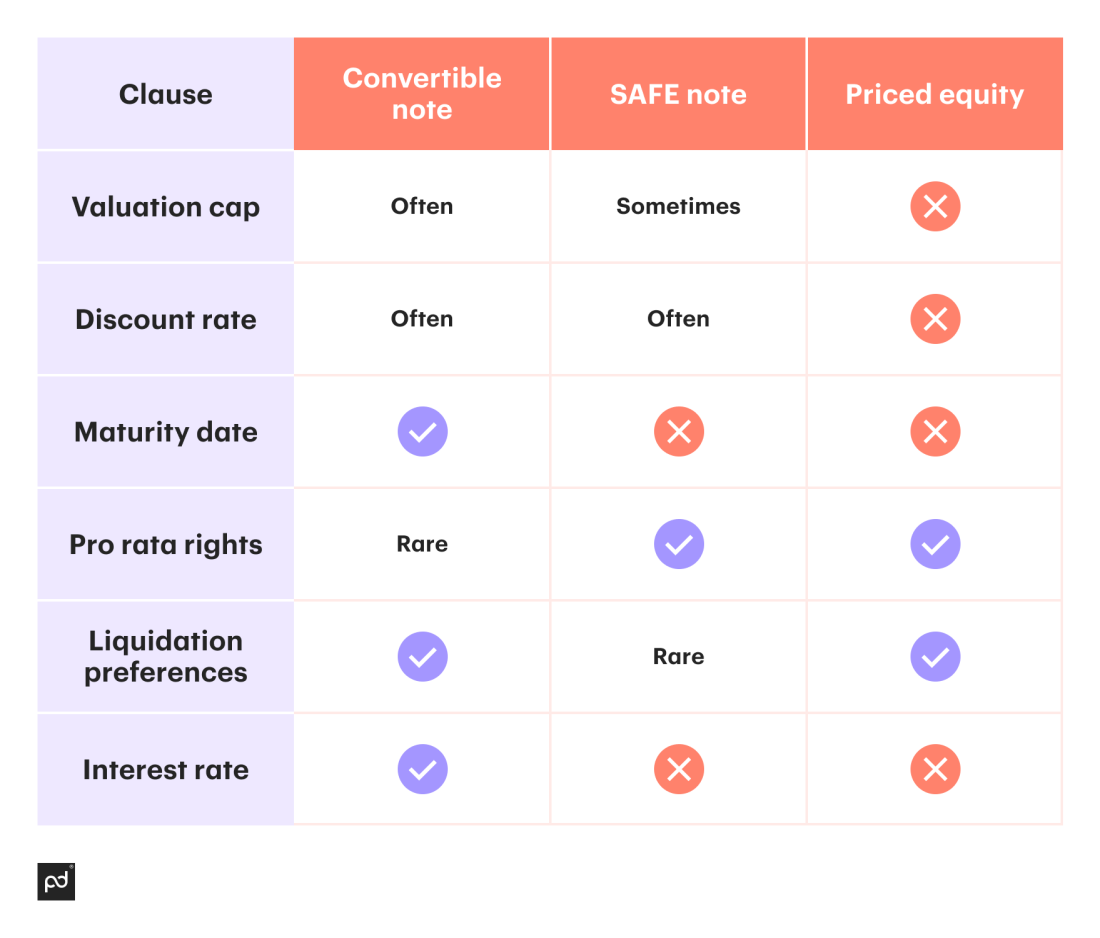
This table gives you a great snapshot, but let's briefly define each:
- Priced Equity Round: This is the most traditional form of investment. You and the startup agree on a valuation, and you buy a specific number of shares (usually "preferred stock") at a fixed price. This is common for Series A rounds and beyond.
- Convertible Note: This is a loan that is intended to convert into equity at a later date, typically during a future priced round. Because it's a loan, it has an interest rate and a maturity date (a repayment deadline).
- SAFE (Simple Agreement for Future Equity): This is a legal agreement that gives an investor the right to purchase stock in a future equity round. It is not debt; it has no interest rate and no maturity date. Created by Y Combinator, it has become the standard for very early-stage (pre-seed) funding in the U.S.
The primary reason convertible instruments (Notes and SAFEs) exist is to defer the difficult and often contentious conversation about valuation until the startup has more traction and a lead investor for a priced round can more formally set the terms.
2. Deep Dive: The SAFE Note
Given your focus on pre-seed startups, the SAFE will be your most frequently used tool. It's designed for speed, simplicity, and low legal cost—all critical factors in early-stage investing.
A SAFE is essentially a warrant—a promise of future equity. To understand its mechanics and nuances, let's go straight to the source.
Understanding SAFEs and Priced Equity Rounds by Kirsty Nathoo
This video from Y Combinator, featuring partner and CFO Kirsty Nathoo, is the definitive guide to SAFEs. She explains what a SAFE is, how it differs from debt, and the different forms it can take.
Please watch from the beginning of the 'The SAFE' section (02:46) to the end of the 'Flavors of SAFE' discussion (14:40). Focus on understanding: Why SAFEs are 'Simple Agreements for Future Equity' and not debt. The purpose of the Valuation Cap. The other types of SAFEs, such as those with a Discount or a Most Favored Nation (MFN) clause.
The key takeaway is that post-money SAFEs, which are now the standard, make dilution calculations much more straightforward for founders. You, as the investor, agree on a valuation cap, and your ownership is calculated as (Your Investment) / (Valuation Cap). This clarity is a major advantage.
3. Deep Dive: The Convertible Note
Before the SAFE became popular, the convertible note was the primary tool for early-stage investment. It is still widely used, especially outside the main U.S. tech hubs and for specific situations like "bridge rounds."
The crucial difference is that a convertible note is debt. This introduces two key terms that a SAFE does not have:
- Interest Rate: The loan accrues interest over time, which is typically added to the principal and converts into equity along with the original investment. This results in slightly more dilution for the founders compared to a SAFE.
- Maturity Date: The loan must be repaid or converted by a specific date (e.g., 18-24 months). This creates a deadline, which can be both a benefit (creating urgency to raise the next round) and a risk (if the startup fails to raise, they could technically default on the loan).
The following video provides a clear, animated comparison of how convertible notes and SAFEs function.
SAFE vs Convertible Notes vs KISS
This video from Slidebean effectively contrasts Convertible Notes and SAFEs, highlighting the core differences like interest and maturity dates.
Please watch the sections explaining convertible notes (04:26 - 08:38) and the introduction to SAFEs (08:38 - 10:12). Pay close attention to how the convertible note's interest and maturity date create different dynamics than a SAFE.
4. The Decision Framework: When to Use Which Instrument
Now for the central task: choosing the right instrument for the right situation. Your decision will balance the startup's stage, your relationship with the founders, and the overall fundraising environment.
The following reading provides a sharp, actionable guide for making this choice.
SAFE vs Convertible Notes: Startup Funding Explained
The article 'SAFE vs Convertible Notes' from EquityList provides a clear, scenario-based framework for deciding between the two most common early-stage instruments.
Please read the section titled 'When to use a SAFE vs convertible note'. This directly addresses our learning outcome and provides a checklist for your decision-making process.
Let’s synthesize this into a practical framework for your accelerator and fund.
Choose a SAFE if:
- Stage: It's a pre-seed or very early seed round. The company may be pre-product or pre-revenue.
- Goal: You need to invest quickly with minimal legal overhead. This is perfect for the standardized investments you'll make into your accelerator cohort.
- Valuation: There's no clear way to value the company, and you want to defer that decision.
- Investor Type: You are one of several angel investors or small funds making small investments.
Choose a Convertible Note if:
- Stage: It's a "bridge round" to get a company to its next priced round (e.g., providing 3-6 months of runway).
- Investor Preference: Your investors (or you) are more traditional or risk-averse and prefer the legal structure and protections of debt (e.g., a claim on assets in liquidation and a maturity date that forces action).
- Geography: You are investing in a market where convertible notes are more common and understood than SAFEs.
Choose a Priced Equity Round if:
- Stage: It's a formal Seed, Series A, or later round. The company has significant traction (e.g., revenue, strong user growth) that makes valuation defensible.
- Lead Investor: There is a dedicated "lead investor" who is negotiating the terms for all investors in the round.
- Goal: You need the certainty of a fixed valuation and a clear, updated capitalization table. The complexity and cost are justified by the size of the fundraise.
Test your understanding!
You are presented with three different investment opportunities. For each, choose the most appropriate instrument (SAFE, Convertible Note, or Priced Equity) and briefly explain your reasoning.
- A two-person team has a compelling prototype for an AI-driven compliance tool but no revenue. They need $100k for their first year of operations and are applying to your accelerator. This will be their first outside capital.
- A company in your portfolio successfully raised a $2M seed round 18 months ago. They have strong product-market fit but are about to run out of money. They have a verbal commitment for a $10M Series A, but the lead VC's legal process will take 3 months. The founders need $500k to bridge the gap.
- A startup with $2M in Annual Recurring Revenue (ARR) is raising a $7M Series A. A well-known venture fund is leading the round and has set the valuation at $30M pre-money. They have offered your fund a $250k allocation in the round.
Show answer
-
Instrument: SAFE.
- Reasoning: This is a classic pre-seed scenario. The company is too early for a formal valuation. The investment amount is small, and the need is for speed and simplicity. A SAFE is the standard, most efficient tool for this situation, making it ideal for an accelerator's initial investment.
-
Instrument: Convertible Note.
- Reasoning: This is a textbook "bridge round." The financing has a specific, short-term purpose: to bridge the company to a known, upcoming priced round (the Series A). The investors in this bridge will want the structure of a note, including a maturity date that likely aligns with the expected close of the Series A, to ensure their capital is either repaid or converted on a clear timeline.
-
Instrument: Priced Equity Round.
- Reasoning: The round is already being structured as a priced round by a lead investor. The company is mature enough ($2M ARR) to command a formal valuation. Your role is not to set terms but to participate in the round established by the lead VC. You will be buying preferred stock at the agreed-upon price per share.
Conclusion
You have now built a clear mental model for selecting the right investment vehicle. This choice is not just a legal formality; it's a strategic decision that reflects the startup's maturity, the fundraising context, and your goals as an investor.
Key Takeaways:
- SAFEs are for speed and simplicity at the earliest stages. They are your default tool for pre-seed and accelerator investments.
- Convertible Notes are structured debt instruments for specific situations, like bridge rounds or when investors demand more formal protections.
- Priced Equity Rounds are for mature fundraises where a lead investor sets a formal valuation, providing certainty at the cost of speed and expense.
- Your choice of instrument sets the tone for the investment and your relationship with the founder. Matching the instrument to the stage is a mark of a sophisticated investor.
Preview of the next lesson:
Now that you understand the vehicles used to invest, we'll tackle a critical question for your accelerator's business model: How do you determine the appropriate equity stake to take for program participation versus a direct cash investment? We'll explore market standards and how to value the "non-cash" contributions of your program.