Hello! Welcome back to our module on Market Entry and Positioning.
In our last lesson, we examined the pros and cons of being a "first mover." We concluded that whether you decide to be a pioneer or a fast follower, the most critical factor is not just when you enter the market, but where you place yourself within it. A technological lead, like using a CNC machine, can be short-lived if you don't use that head start to build a durable strategic position.
Today, we'll focus on exactly that. Our learning outcome is to determine an optimal market position (e.g., a premium niche) based on competitor analysis. We'll explore why simply copying what successful competitors do can be a trap and how you can carve out a profitable space for your new woodworking business.
The Pull of the Center: Why Competitors Look Alike
Have you ever noticed how fast-food chains, gas stations, or big-box stores often cluster together? Or how major smartphone brands all end up looking remarkably similar? It might seem counterintuitive. Why would you want to set up right next to your biggest rival?
This phenomenon is explained by a core concept in game theory called Hotelling's Law, or the principle of minimum differentiation. It describes the tendency of competitors to gravitate toward the center of the market to capture the most customers.
To understand this powerful idea, let's start with a simple, classic analogy: two ice cream vendors on a beach.
Why do competitors open their stores next to one another? - Jac de Haan
This animated video from TED-Ed, 'Why do competitors open their stores next to one another?', explains Hotelling's model brilliantly. It shows how two competitors, each acting in their own self-interest, end up in the same spot.
Please watch the entire video. Pay close attention to how the vendors' positions evolve from a 'socially optimal' spread-out solution to a clustered one, and why that clustered outcome is a 'Nash Equilibrium.'
As the video shows, the logical endpoint is for both vendors to be back-to-back in the middle of the beach. This is a Nash Equilibrium: at this point, neither vendor can improve their situation by unilaterally moving. If one moves away from the center, they instantly give up more than half the market to their rival.
This isn't just about physical location. It applies to product features, styles, and prices. In your market, this means there's a natural pull for cabinet makers to offer similar "safe" designs (like standard Shaker-style cabinets), use common materials, and compete in a narrow price range that targets the bulk of homeowners.
The article 'The Ice Cream Vendor Paradox' further explores this idea with more business examples and discusses the major drawback of this clustering effect.
Please read the sections 'Hotelling’s Law: The Principle of Minimum Differentiation,' 'Real-World Applications of Hotelling’s Law,' and 'The Drawback of Minimum Differentiation.' These sections will connect the ice cream story to real industries like smartphones and fast food and explain the danger of price wars.
The critical takeaway for your business is that competing in the crowded "center" of the market leads to commoditization. When everyone offers a similar product, customers have no reason to choose one over the other except for price. This inevitably leads to price wars, which erode profits and are particularly dangerous for a new business without deep pockets. Your high-end CNC machinery and craftsmanship become irrelevant if you're forced to compete on price with a low-cost, mass-producer.
Finding Your Own Space: The Power of Differentiation
If the middle of the market is a battlefield, the strategic move is to find a different space to compete in. The same article you just read calls this finding the "(n+1)th Dimension." Instead of competing on the single dimension of product category (e.g., "kitchen cabinets"), you can introduce new dimensions.
For your woodworking business, these new dimensions could be:
- Precision & Quality: The flawless finish and tight tolerances only possible with CNC.
- Design Aesthetic: A focus on minimalist, European-style designs that no local competitor offers.
- Materials: Using unique or sustainably sourced woods.
- Service: A highly consultative design process for discerning clients.
The process of defining this unique space is formally known as Segmentation, Targeting, and Positioning (STP).
MARKETING 101: Marketing Segmentation, Targeting, and Positioning
This video from marketing expert Adam Erhart provides a fantastic, no-nonsense breakdown of the STP model. It explains how to go from serving 'everyone' to serving a specific group of customers who truly value what you offer.
Please watch from 03:15 to 09:47. This covers 'Targeting' and, most importantly, 'Positioning.' Focus on how positioning is about the space you occupy in the customer's mind relative to your competitors.
Let's break this down for your business:
- Segmentation: The total market for cabinets is huge. You can segment it by income (mid-range vs. high-end), style preference (traditional vs. modern), or customer type (homeowners vs. contractors).
- Targeting: You choose the segment you are best equipped to serve. Given your equipment and goal of making premium products, you might target high-income homeowners who value modern design and precision craftsmanship.
- Positioning: This is where you create your identity. You want your target customer to see your business not just as "another cabinet maker," but as "the only local source for architect-grade, minimalist cabinetry." As the video notes, positioning is what your customers think and feel about you.
A Framework for Your Strategic Position
A classic business framework that visualizes this choice is Porter's Generic Strategies. It maps out the fundamental ways a business can achieve a competitive advantage.

Based on your business plan, you can immediately rule out two of these quadrants:
- Cost Leadership: You are not trying to be the cheapest.
- Differentiation (Broad): You are not trying to appeal to the entire market with a unique product (like Apple does).
Your strategy fits squarely in Differentiation Focus. You are targeting a narrow market segment (a niche) with a unique, premium offering. This is the definition of a premium niche strategy.
How to Map the Market and Find Your Niche
So, how do you find this niche in practice? By analyzing your competitors. A simple but effective tool is a competitive matrix. You create a 2x2 grid with the most important dimensions of competition for your market and then plot where your competitors fall. This can visually reveal an empty space—an unmet need.
Here is an example of a competitive matrix:
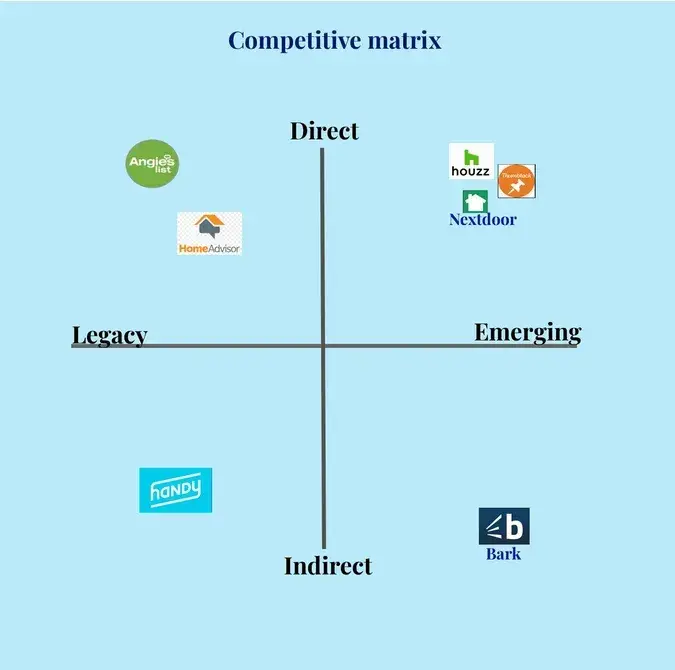
For your local woodworking market, the axes could be:
- Axis 1 (Vertical): Price/Quality (Value -> Mid-Range -> Premium)
- Axis 2 (Horizontal): Style (Traditional -> Transitional -> Modern)
By plotting your local competitors on this map, you might discover that the "Premium/Modern" quadrant is empty or only occupied by distant, non-local companies. That empty space is your target market position.
Test your understanding!
Take a moment to sketch out a 2x2 competitive matrix for the furniture/cabinet market in your area.
- Define your axes. Use
Price Tier (Value vs. Premium)for the vertical axis andDesign Style (Traditional vs. Modern)for the horizontal axis. - Plot your competitors. Think of 2-3 other furniture or cabinet makers in your region. Where would you place them on your map? (e.g., Home Depot cabinets might be Value/Traditional, a local custom woodworker might be Premium/Traditional).
- Find your spot. Where does your planned business fit? Mark its position on the map. Is that quadrant crowded or open?
Show answer
Your map might look something like this:
- Bottom-Left (Value/Traditional): Big box stores like Home Depot or Lowe's.
- Top-Left (Premium/Traditional): Established, high-end custom woodworkers who specialize in classic, ornate styles.
- Bottom-Right (Value/Modern): Perhaps a company like IKEA (even if not local, they define this category).
You would likely place your business in the Top-Right (Premium/Modern) quadrant. The key question this exercise reveals is: how crowded is that space? If it's empty, you have a clear opportunity to become the market leader in that niche. If there's already a competitor there, your positioning needs to be even more specific (e.g., "the most sustainable premium/modern option" or "the fastest lead times for premium/modern cabinets").
Conclusion
Today, we've built a clear, actionable process for finding your place in the market. We saw how the natural tendency of competitors to cluster creates both a threat (commoditization, price wars) and an opportunity for a new business willing to be different.
Key Takeaways:
- Avoid the Crowded Middle: The principle of minimum differentiation explains why competitors often become similar, leading to intense head-to-head competition. As a new business, this is a dangerous place to be.
- Differentiate or Perish: The key to success is to find a unique market position by competing on different dimensions (e.g., design, quality, service), not just on the base product.
- Use the STP Framework: Segment the market, Target a profitable niche you can serve well, and Position your brand to hold a unique place in that customer's mind.
- Your Strategy is Differentiation Focus: For a premium, niche business like yours, this is the most viable path to achieving a competitive advantage.
- Map Your Market: A simple competitive matrix is a powerful tool to visualize the competitive landscape, identify gaps, and solidify your optimal market position.
Preview of the Next Lesson:
We've focused today on the strategy of differentiation—finding an open space. But what if a competitor is already in your desired niche? Or what if a large incumbent decides to fight you for it? In our next lesson, we will assess when to compete head-on with an incumbent versus differentiate your offerings, giving you a framework to decide whether to fight or find a different battle.